
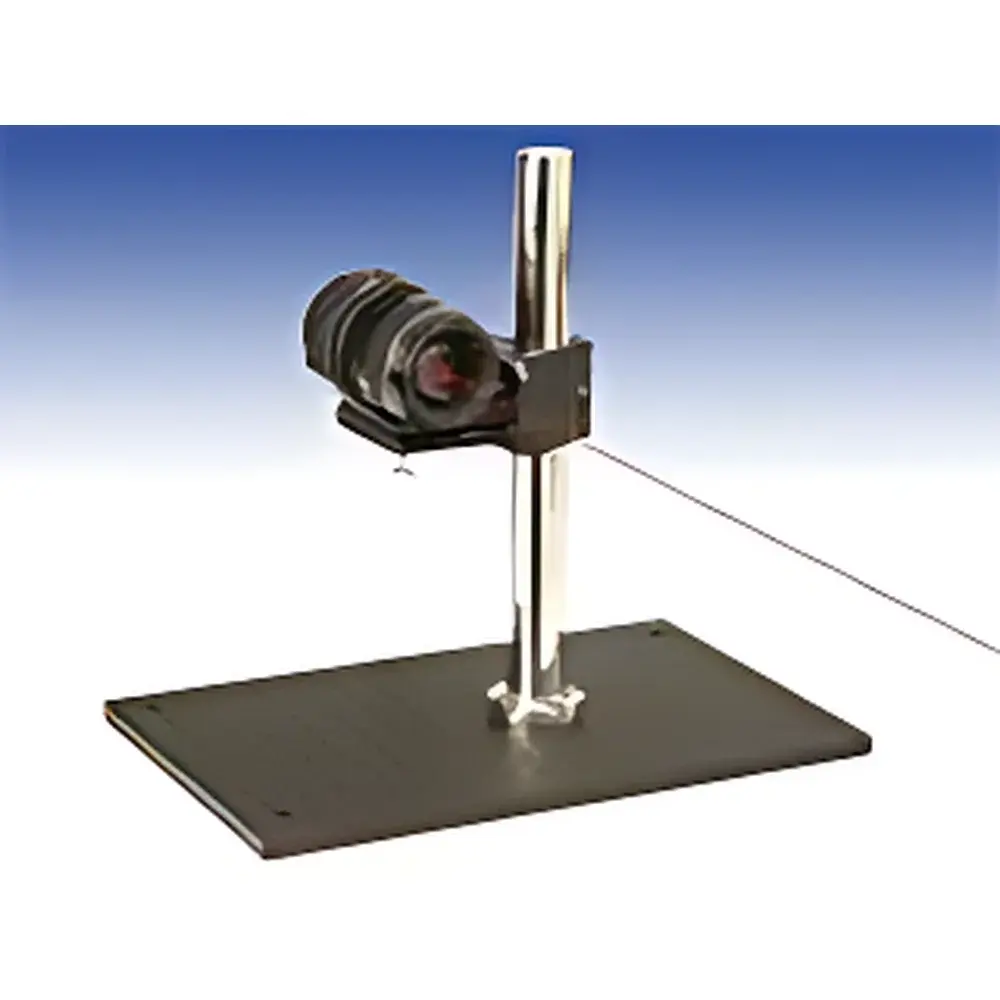
Duma AngleMeter Laser Beam Angle Meter
| Origin | Israel |
|---|---|
| Manufacturer Type | Distributor |
| Origin Category | Imported |
| Model | Duma AngleMeter |
| Price Range | USD 1,400–7,200 (based on configuration) |
| Core Component | Semiconductor Laser-Based Measurement System |
| Spectral Range | 350–1100 nm |
| Angular Deviation Accuracy | ±0.5% of reading |
| Power Measurement Accuracy | ±5% |
| Sensor Options | PSD4 (4×4 mm), PSD9 (9×9 mm), CMOS USB2, with HR (High-Resolution) and Analog/USB interfaces |
| Lens Options | 50 mm f/1.8, 85 mm f/1.8, 100 mm f/4, 200 mm f/5.6 |
Overview
The Duma AngleMeter Laser Beam Angle Meter is a precision optical metrology instrument engineered for real-time, non-contact measurement of angular deviation and relative power fluctuations in collimated laser beams. Operating on the principle of position-sensitive detector (PSD) or CMOS-based centroid tracking, the system quantifies beam displacement across a calibrated focal plane to derive angular deflection with traceable linearity. Designed for integration into laser alignment workflows, optical platform stabilization systems, and industrial beam monitoring applications, the AngleMeter delivers high reproducibility in dynamic environments—particularly where thermal drift, mechanical vibration, or long-term drift must be continuously assessed. Its spectral response (350–1100 nm) covers common continuous-wave and pulsed laser sources including HeNe, diode, Nd:YAG (fundamental and frequency-doubled), and Ti:sapphire oscillators, making it suitable for both R&D laboratories and production-floor quality assurance.
Key Features
- Multi-sensor architecture supporting interchangeable detector heads: PSD4 (4×4 mm active area), PSD9 (9×9 mm), and CMOS USB2 imaging sensor—each optimized for distinct trade-offs between dynamic range, resolution, and response speed.
- High-resolution (HR) variants feature a predefined 1×1 mm central working zone on the PSD surface, enabling sub-microradian sensitivity for fine-alignment tasks requiring enhanced signal-to-noise ratio.
- Flexible interface options: USB 2.0 digital output for direct PC integration with real-time visualization and logging; analog voltage outputs (±5 V or 0–10 V) for PLC or DAQ system interfacing in embedded control loops.
- Modular lens selection (50 mm f/1.8, 85 mm f/1.8, 100 mm f/4, 200 mm f/5.6) allows optimization of field-of-view, depth of focus, and spot size resolution depending on working distance and beam divergence requirements.
- Robust mechanical housing with kinematic mounting features (M4/M6 tapped holes, Ø6 mm alignment pins) ensures repeatable positioning on optical tables and compatibility with standard optomechanics.
- Factory-calibrated angular scale traceable to NIST-traceable reference standards; calibration certificates available upon request for ISO/IEC 17025-compliant environments.
Sample Compatibility & Compliance
The AngleMeter is compatible with free-space, collimated or weakly divergent laser beams (diameter < 8 mm at detector plane). It is not intended for focused spots or multimode fiber-coupled outputs without external collimation. The instrument meets CE marking requirements for electromagnetic compatibility (EN 61326-1) and safety (EN 61010-1). While not classified as a medical device, its measurement methodology aligns with principles referenced in ISO 11146-1 (laser beam widths, divergence angles, and beam propagation ratios) and supports data integrity practices consistent with FDA 21 CFR Part 11 when used with validated software configurations. Audit trails, user access controls, and electronic signature capability are implemented in the optional DumaLab software suite for GLP/GMP-regulated facilities.
Software & Data Management
The included DumaLab software (Windows 10/11, 64-bit) provides real-time angular deviation plots (X/Y tilt in mrad), RMS stability statistics, power trend logging, and threshold-triggered alarms. Data export is supported in CSV, MATLAB (.mat), and HDF5 formats. For enterprise integration, a documented DLL API enables custom scripting in Python, LabVIEW, or C#. All measurement sessions are timestamped with system clock synchronization (NTP-capable), and raw sensor frames (for CMOS variants) can be archived for post-hoc centroid analysis. Software updates are distributed via secure HTTPS portal with version-controlled release notes and validation reports.
Applications
- Laser beam collimation verification during optical assembly and maintenance procedures.
- Real-time monitoring of mirror or stage angular drift in interferometric setups, gravitational wave detection prototypes, and synchrotron beamlines.
- Dynamic angular stability assessment of scanning galvanometers and MEMS mirrors in LIDAR and laser marking systems.
- Remote alignment feedback for large-aperture telescopes and satellite communication terminals.
- Quantitative evaluation of thermal lensing effects in high-power laser amplifiers by tracking slow angular drift over time.
- Calibration reference for electronic autocollimators and angle encoders in metrology labs.
FAQ
What is the minimum measurable angular step size for the PSD4 USB-HR-Lens configuration?
Typical resolution is ≤1 µrad under optimal signal conditions (beam diameter ≥1 mm, SNR > 50 dB); actual performance depends on laser stability, ambient lighting, and lens focal length.
Can the AngleMeter measure absolute angle, or only relative deviation?
It measures relative angular change from a user-defined zero reference position; absolute angle requires external calibration against a theodolite or precision rotary stage.
Is the system compatible with pulsed lasers?
Yes—for pulse repetition rates ≥1 kHz and pulse widths >10 ns, provided average power remains within detector damage thresholds (≤100 mW for PSD sensors, ≤500 mW for CMOS variants with neutral density filters).
Does the AngleMeter support multi-beam analysis?
No—it is designed for single-beam centroid tracking; simultaneous multi-spot analysis requires the SpotOn series or BeamOn M² systems.
How often does the system require recalibration?
Annual recalibration is recommended for metrology-critical applications; factory recalibration includes full linearity verification across the operational angular range (±10 mrad standard, ±50 mrad optional).



