
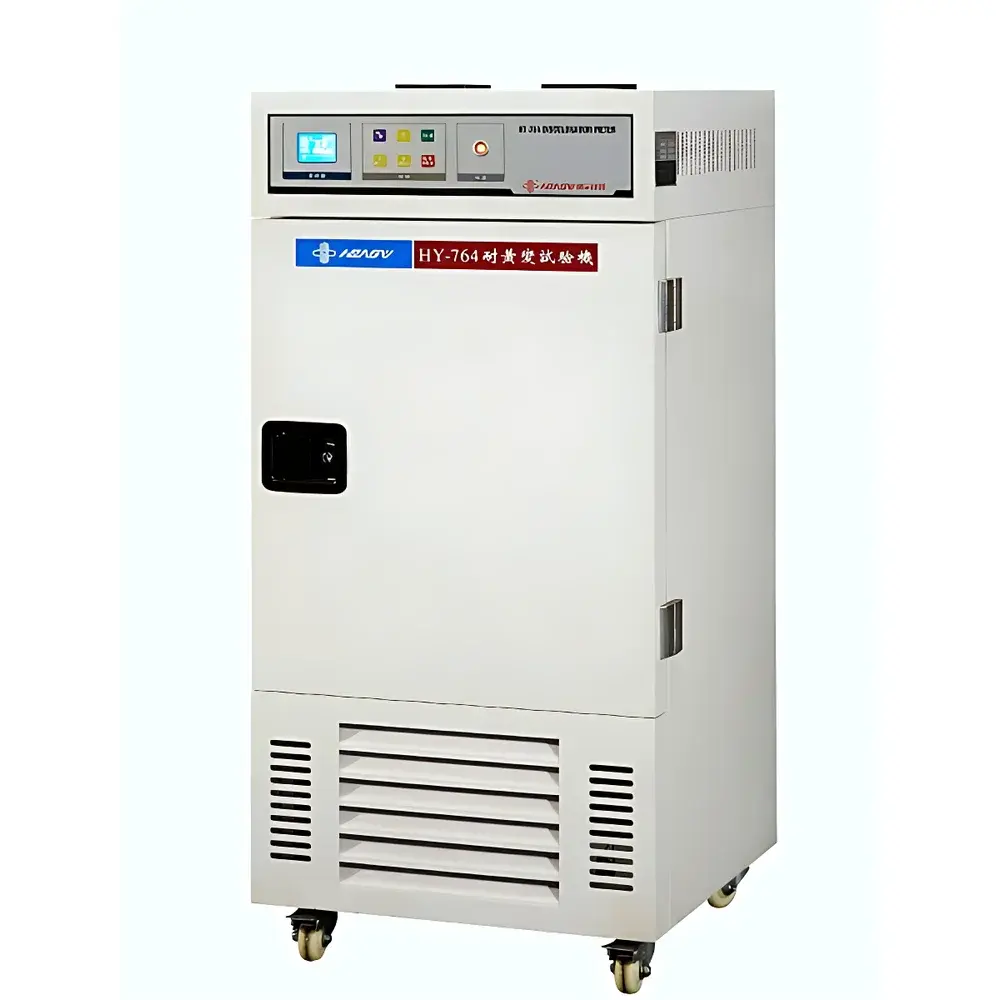
HY-764A Bulb-Type Yellowing Resistance Test Chamber
| Origin | Tianjin, China |
|---|---|
| Manufacturer Type | Authorized Distributor |
| Origin Category | Domestic (China) |
| Model | HY-764A |
| Price | Upon Request |
| Sample Turntable Diameter | Φ450 mm |
| Turntable Speed | 1–5 rpm (adjustable) |
| Test Chamber Dimensions | 500 × 500 × 600 mm (W × D × H) |
| UV Wavelength Range | 280–400 nm |
| UV Irradiance | (25 ± 0.4) W/m² |
| Operating Temperature Range | Ambient to 200 °C |
| Insulation Material | Glass Fiber |
| Heating Method | Forced-Air Circulation |
| Control System | Independent lamp and chamber heating control |
| UV Intensity Adjustment | Via front-panel digital interface |
| Timer | LCD digital timer, 0–24 h |
| Drive Motor | AC 220 V, 200 W |
| Test Lamp | German-made 300 W infrared bulb |
| Calibration Certificate | CNAS-accredited calibration report included |
Overview
The HY-764A Bulb-Type Yellowing Resistance Test Chamber is a purpose-built environmental test instrument engineered for quantitative assessment of yellowing resistance in light-colored or white polymeric materials—particularly footwear components including uppers, soles, and synthetic leathers—under simulated solar radiation exposure. Unlike fluorescent UV-based aging chambers, the HY-764A employs a high-intensity, broad-spectrum infrared bulb as its primary irradiation source, delivering a spectral output closely approximating terrestrial sunlight in the critical 280–400 nm ultraviolet region. This design enables reproducible acceleration of photooxidative degradation pathways responsible for chromophore formation and surface discoloration. The system integrates controlled thermal loading via forced-air circulation and independent lamp/chamber heating, allowing users to decouple photolytic and thermally driven yellowing mechanisms—essential for root-cause analysis in QC and R&D workflows.
Key Features
- German-sourced 300 W infrared lamp with stable spectral output across 280–400 nm, calibrated to deliver (25 ± 0.4) W/m² irradiance at sample plane
- Motor-driven rotating turntable (Φ450 mm, 1–5 rpm adjustable) ensuring uniform irradiation exposure across all specimens
- Forced-air convection heating system with ambient-to-200 °C operating range and glass-fiber thermal insulation for precise thermal management
- Digital LCD timer (0–24 h) with auto-shutdown function; front-panel UV intensity adjustment for method-specific irradiance tuning
- Independent dual-zone control: separate regulation of lamp power and chamber air temperature to isolate photothermal interaction effects
- Compliance-ready architecture: includes traceable CNAS-accredited calibration certificate for irradiance and temperature sensors per ISO/IEC 17025 requirements
Sample Compatibility & Compliance
The HY-764A accommodates flat or low-relief specimens up to 100 mm × 100 mm per position on the rotating turntable, supporting standardized multi-sample evaluation per ASTM D1148 “Standard Test Method for Rubber Deterioration—Yellowing.” It is also validated for HG/T 3689–2014 Method A (Sunlamp Method), a widely adopted Chinese industry standard for footwear material aging. The chamber’s irradiance profile and thermal uniformity meet the spatial homogeneity requirements specified in ASTM G154 Annex A1 for non-fluorescent lamp systems. All electrical and thermal safety features conform to IEC 61000-6-3 (EMC) and IEC 61010-1 (safety for laboratory equipment). For regulated environments, the instrument supports GLP-compliant operation through documented calibration history, operator access logs (via external audit trail integration), and adherence to FDA 21 CFR Part 11 principles when paired with compliant LIMS or ELN platforms.
Software & Data Management
The HY-764A operates as a standalone hardware platform with no embedded software stack; all controls and monitoring are implemented via dedicated analog/digital circuitry and an industrial-grade LCD interface. This architecture ensures deterministic response times, zero firmware vulnerabilities, and long-term operational stability—critical for unattended 24-hour testing cycles. Irradiance and chamber temperature readings are displayed in real time with 0.1 °C and 0.1 W/m² resolution. For data capture and traceability, users integrate the unit with external data loggers or SCADA systems via analog 4–20 mA outputs (optional add-on). Calibration records—including CNAS report number, uncertainty budgets, and date-stamped verification—are maintained offline per ISO/IEC 17025 clause 7.7, enabling full audit readiness without dependency on proprietary software.
Applications
- Quality assurance of PU, PVC, EVA, and TPR compounds used in shoe uppers and midsoles
- Comparative yellowing screening of antioxidant packages in polymer formulations
- Validation of UV stabilizer efficacy under combined UV/thermal stress (e.g., automotive interior trim, medical device housings)
- Material qualification per brand-specific internal specifications requiring sunlamp-based yellowing metrics
- Failure analysis of premature discoloration in export-bound consumer goods subject to tropical shipping conditions
FAQ
What standards does the HY-764A directly support?
ASTM D1148 (Rubber Yellowing), HG/T 3689–2014 Method A (Sunlamp Method), and ISO 4892-2 Annex C (non-fluorescent lamp exposure protocols).
Is the UV irradiance value traceable to national standards?
Yes—the included CNAS-accredited calibration report provides traceability to NIM (National Institute of Metrology, China) via ISO/IEC 17025 accredited laboratories.
Can the chamber operate continuously for extended durations?
Yes—rated for uninterrupted 24-hour operation with thermal cut-off protection and overcurrent safeguards on both lamp and heater circuits.
Does the system require periodic lamp replacement, and is recalibration needed after replacement?
The German 300 W infrared bulb has a nominal service life of 1,000 hours; post-replacement irradiance recalibration is mandatory and must be performed by an accredited lab to maintain measurement integrity.
How is sample rotation synchronized with irradiation timing?
The turntable motor is mechanically coupled to the lamp power circuit—rotation initiates only when the lamp is energized, ensuring exposure duration aligns precisely with rotational dwell time per specimen position.



