
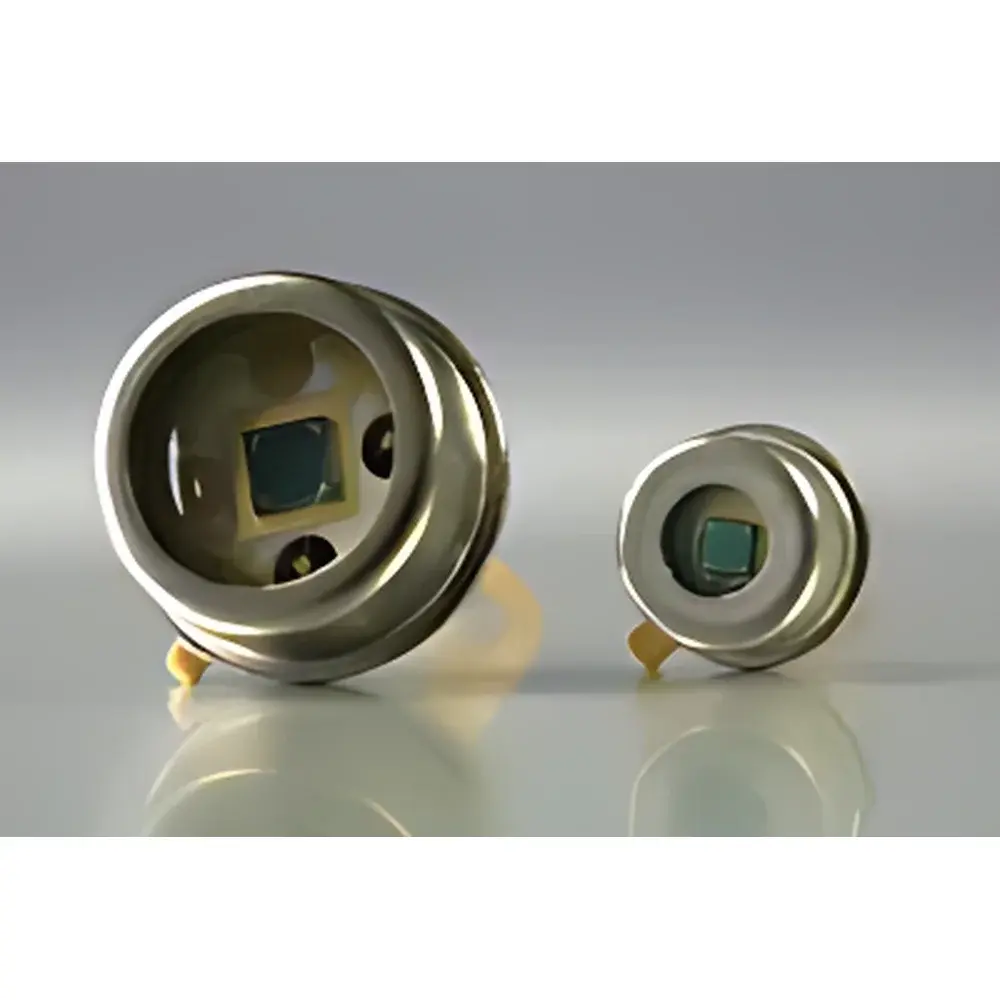
NewOpto PIN Photodiode Series
| Origin | Germany |
|---|---|
| Manufacturer Type | Authorized Distributor |
| Origin Category | Imported |
| Model | NewOpto PIN Series |
| Pricing | Upon Request |
Overview
The NewOpto PIN Photodiode Series comprises a family of high-performance, silicon-based photodetectors engineered for precise optical-to-electrical signal conversion across ultraviolet (UV), visible (VIS), near-infrared (NIR), and short-wave infrared (SWIR) spectral ranges. Operating on the principle of the internal photoelectric effect, these devices feature a wide intrinsic (i) region between p- and n-doped layers—enabling low junction capacitance, high quantum efficiency, and excellent linearity over broad irradiance levels. Designed for demanding laboratory, industrial, and defense applications, each variant is optimized for specific spectral responsivity, speed, dark current, and packaging requirements—ensuring compatibility with pulsed laser detection, radiometric calibration, scintillation readout, and high-bandwidth optical communication systems.
Key Features
- Multiple spectral response variants: UV/blue-enhanced (Series-2, 200–500 nm), blue/green-optimized (Series-6b, 400–650 nm), high-speed epitaxial (Series-5, -5t, -5b, 360–950 nm), low-dark-current general-purpose (Series-6, 700–950 nm), fully depletable low-capacitance (Series-7, 700–1100 nm), YAG-laser–optimized NIR (Series-Q, 900–1100 nm), InGaAs-based SWIR (Series-i, 600–1700 nm), and ionizing radiation–compatible configurations (Series-X).
- Active area range from 0.25 mm² to 100 mm², supporting scalable sensitivity and spatial resolution requirements.
- Rise times as low as 0.4 ns (e.g., PS0.25-5 series under 20 V bias), enabling time-resolved photon counting and sub-nanosecond pulse detection.
- Dark current values down to 0.01 nA at specified reverse bias (e.g., PS1-2, PS1-6), critical for low-light spectroscopy and radiometric stability.
- Standardized hermetic packages including TO-5, TO-8, TO-52, LCC6.1, LCC10, CERpin, BNC-mount, and custom TO-5i/TO-8i variants with integrated bandpass filters (e.g., 254 nm, 488 nm, 633 nm, 1064 nm).
- Compliance-ready mechanical and electrical interfaces suitable for integration into ISO/IEC 17025-accredited optical test benches and GLP/GMP-compliant analytical instrument platforms.
Sample Compatibility & Compliance
The NewOpto PIN Photodiode Series supports direct coupling with optical fibers (SMA, FC/PC), collimated free-space beams, scintillator crystals (e.g., NaI(Tl), CsI(Tl), LYSO), and laser diodes (including pulsed Nd:YAG at 1064 nm). Devices are rated for operation under controlled ambient conditions (20–25 °C, <50% RH) and meet RoHS Directive 2011/65/EU and REACH Regulation (EC) No. 1907/2006. Selected models—including those with TO-5i filter modules and LCC-packaged variants—are routinely deployed in ASTM E308-compliant colorimetric systems and ISO 13406-2–aligned display metrology setups. For regulated environments, traceable calibration certificates (NIST-traceable irradiance responsivity at 254 nm, 488 nm, 633 nm, and 1064 nm) are available upon request.
Software & Data Management
While inherently analog transducers, NewOpto photodiodes integrate seamlessly with industry-standard data acquisition systems (e.g., National Instruments PXI, Keysight DAQ970A, Thorlabs PM100D) and OEM instrumentation firmware. When paired with compatible transimpedance amplifiers (e.g., NewOpto PA-Series), they support real-time digitization at sampling rates up to 1 GS/s. Firmware-level timestamping and hardware-triggered acquisition modes ensure synchronization with pulsed light sources. All calibrated responsivity curves and spectral correction factors are provided in ASCII-compatible .csv format for import into MATLAB, Python (NumPy/SciPy), or LabVIEW-based analysis pipelines. Full audit trails—including device serial number, calibration date, and spectral irradiance reference conditions—are maintained per FDA 21 CFR Part 11–compliant documentation protocols when requested.
Applications
- Laser rangefinding and LIDAR systems requiring fast rise time and high peak power tolerance (e.g., PS100-5, QP154-Q).
- UV/VIS spectrophotometry and fluorescence lifetime measurement where low dark current and stable quantum efficiency are essential (e.g., PS1-2, PC5-6b).
- Medical imaging detectors—including PET/MRI-compatible scintillation readout using Series-2 and Series-X configurations.
- Aerospace-grade optical telemetry receivers operating under thermal cycling and radiation exposure (e.g., PS100-6, QP45-Q).
- Industrial process monitoring in semiconductor fabrication, where UV-curable resin dosimetry relies on 254 nm–filtered PC10-2 TO5i modules.
- High-energy physics experiments utilizing fully depletable Series-7 and Series-Q photodiodes for α/β/γ/X-ray coincidence detection with scintillators.
FAQ
What reverse bias voltage is recommended for optimal linearity and speed?
For most Series-2, -5, and -6 devices, 5 V is sufficient; Series-5t variants operate optimally at 3.5 V. High-speed Series-5 and Series-Q require 20 V or 150 V respectively—always consult the datasheet for maximum rated voltage per package.
Are these photodiodes compatible with standard transimpedance amplifier circuits?
Yes—each model includes defined shunt resistance and junction capacitance values referenced at specified bias points, enabling accurate gain and bandwidth design per IEEE Std 1245–2021 guidelines.
Do you provide NIST-traceable calibration for individual units?
Calibration services are available for all active-area variants above 1 mm², covering absolute responsivity (A/W) at up to four discrete wavelengths within the device’s spectral range.
Can I integrate a NewOpto photodiode directly into an existing optical bench without custom mounting?
All TO-can, LCC, and CERpin packages conform to JEDEC MO-041B and MIL-STD-883H mechanical standards, ensuring drop-in compatibility with standard kinematic mounts and lens tubes.
Is there documentation supporting use in FDA-regulated diagnostic instruments?
Device-level compliance documentation—including material declarations, RoHS/REACH reports, and biocompatibility summaries (ISO 10993-5)—is supplied for Series-X and Series-i configurations used in clinical analyzers.





