
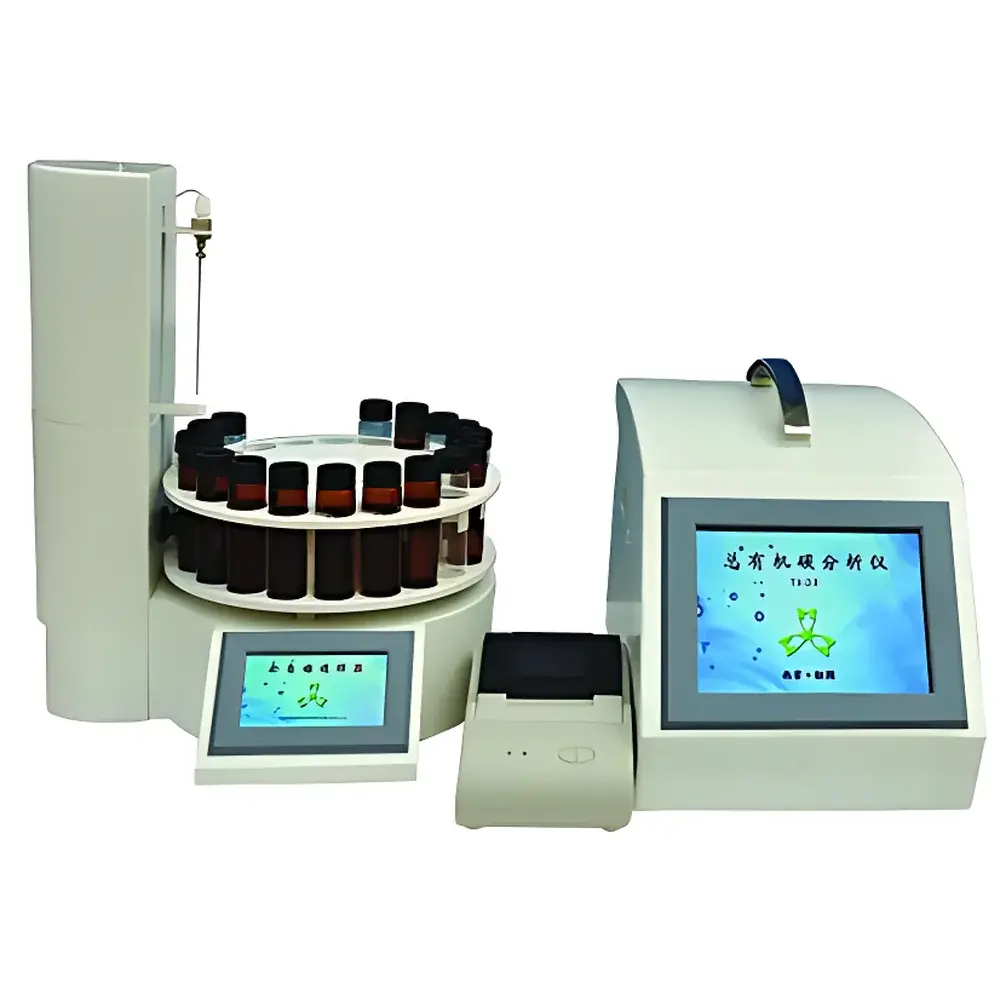
NeuronBC 20-Position Multifunctional Autosampler for TOC and GC Analysis
| Brand | NeuronBC |
|---|---|
| Origin | Beijing, China |
| Manufacturer Type | Authorized Distributor |
| Product Category | Domestic |
| Model | 20-Position |
| Instrument Type | Gas Chromatography & TOC Analyzer Autosampler |
| Maximum Sample Capacity | 20 vials |
| Minimum Injection Volume | 0.1 µL |
| Quantitative Loop Volume | 100 µL |
| Positioning Accuracy | < 0.3 mm |
| Motion Control | Motorized XYZ Stage |
| Needle Wash Cycles | Unlimited |
| Replicate Injection Capability | Unlimited |
Overview
The NeuronBC 20-Position Multifunctional Autosampler is an engineered sample introduction system designed for high-reliability integration with total organic carbon (TOC) analyzers and gas chromatographs (GC). It operates on a precision motorized XYZ robotic stage, enabling repeatable, low-volume liquid handling with sub-millimeter positional fidelity. Unlike generic syringe-based autosamplers, this unit incorporates intelligent liquid-level sensing technology—capable of detecting meniscus position in real time—to prevent air aspiration during aspiration, thereby eliminating carryover risk and ensuring volumetric accuracy across diverse sample matrices (e.g., ultrapure water, pharmaceutical rinse solutions, and environmental aqueous extracts). Its dual-mode architecture supports automated batch analysis, manual intervention via touchscreen, and passive trigger-based sampling synchronized with external instrument start signals—making it suitable for regulated environments where method flexibility and audit readiness are essential.
Key Features
- 20-position vial carousel compatible with standard 4–10 mL glass or polypropylene screw-cap vials (including ASTM D5907-compliant TOC vial formats)
- High-precision syringe pump with PTFE-coated stainless steel needle and ceramic plunger, delivering consistent 0.1 µL minimum injection volume with ≤±0.5% RSD over 100 injections
- Onboard quantitative loop of fixed 100 µL volume, calibrated per ISO/IEC 17025 traceable procedures for GC applications requiring loop-based injection
- Integrated needle washing station with programmable solvent selection (water, methanol, acetone), multi-cycle rinse protocol, and waste volume monitoring
- Industrial-grade capacitive touchscreen interface (7-inch, 800×480 resolution) supporting multilingual UI (English default), method storage (≥50 protocols), and real-time status feedback including vial position, remaining wash solvent, and error logs
- Modular mechanical design with replaceable consumable modules (needle assembly, wash port, vial tray), all critical drive components sourced from Tier-1 European suppliers
Sample Compatibility & Compliance
The autosampler accommodates aqueous samples ranging from deionized water (conductivity < 0.1 µS/cm) to mildly acidic or alkaline matrices (pH 2–12), provided viscosity remains below 5 cP. It complies with key regulatory expectations for analytical instrumentation used in GMP environments: full support for electronic signature workflows, user-accessible audit trails (including method edits, injection history, and maintenance events), and compatibility with FDA 21 CFR Part 11–compliant LIMS interfaces via RS-232 and Ethernet (TCP/IP Modbus RTU). All firmware revisions are version-controlled and documented per ISO 9001 quality management requirements. The device meets CE marking criteria for electromagnetic compatibility (EN 61326-1) and low-voltage safety (EN 61010-1).
Software & Data Management
Firmware is upgradable via secure USB or network connection, with checksum-verified binary validation prior to installation. Raw event logs—including timestamped injection sequences, needle wash cycles, positional errors, and sensor diagnostics—are stored locally on embedded industrial-grade eMMC (8 GB) and exportable as CSV or XML for long-term archiving. Optional PC software (NeuronControl Suite v3.2) provides method development wizards, calibration curve generation, QC flagging (e.g., outlier detection based on retention time drift or peak area variance), and direct export to Empower, Chromeleon, or LabSolutions platforms. Audit trail records include operator ID, action type, timestamp (UTC), and pre-/post-value states—fully compliant with ALCOA+ data integrity principles.
Applications
- Pharmaceutical water systems: Automated TOC analysis of Purified Water (PW) and Water for Injection (WFI) per USP , EP 2.2.44, and JP 17 standards; supports system suitability testing (SST) with replicate injections and blank subtraction routines
- Clean-in-place (CIP) and cleaning validation: Sequential sampling of rinse waters across multiple equipment trains with programmable delay intervals and cross-vial contamination avoidance logic
- Environmental monitoring: Batch analysis of surface water, wastewater effluent, and drinking water per EPA Method 415.3 and ISO 8245
- Electronics-grade ultrapure water (UPW): Low-particulate sampling with inert fluid path (no silicone lubricants) and HEPA-filtered wash solvent delivery
- Method transfer labs: Seamless interoperability with third-party TOC analyzers (e.g., GE Sievers, Shimadzu TOC-L) and GC systems (Agilent 8890, Thermo ISQ LT) via standardized TTL and analog trigger protocols
FAQ
Does the autosampler support variable loop injection volumes?
No—this model features a fixed 100 µL quantitative loop optimized for GC applications requiring high reproducibility; however, syringe-based direct injection mode allows adjustable volumes from 0.1 µL to 100 µL.
Can it be integrated into a 21 CFR Part 11–compliant workflow?
Yes—when paired with NeuronControl Suite and a validated network authentication server, it supports role-based access control, electronic signatures, and immutable audit trails meeting Part 11 Annex 11 requirements.
What maintenance is required for long-term reliability?
Quarterly calibration verification using NIST-traceable volumetric standards; annual replacement of syringe seals and needle; biannual inspection of stepper motor encoder alignment per manufacturer’s PM checklist.
Is the vial tray compatible with non-standard container formats?
The base tray accepts ANSI/SLAS microplate footprints (96-well compatible with optional adapter); custom trays for 20 mL scintillation vials or crimp-top TOC vials are available under OEM engineering service agreement.
How is carryover minimized during high-sensitivity TOC analysis?
Triple-rinse protocol with alternating solvents (water → methanol → water), post-rinse dry purge (N₂-assisted), and dynamic needle immersion depth adjustment reduce carryover to < 0.1 ppb carbon equivalent in purified water matrices.





