
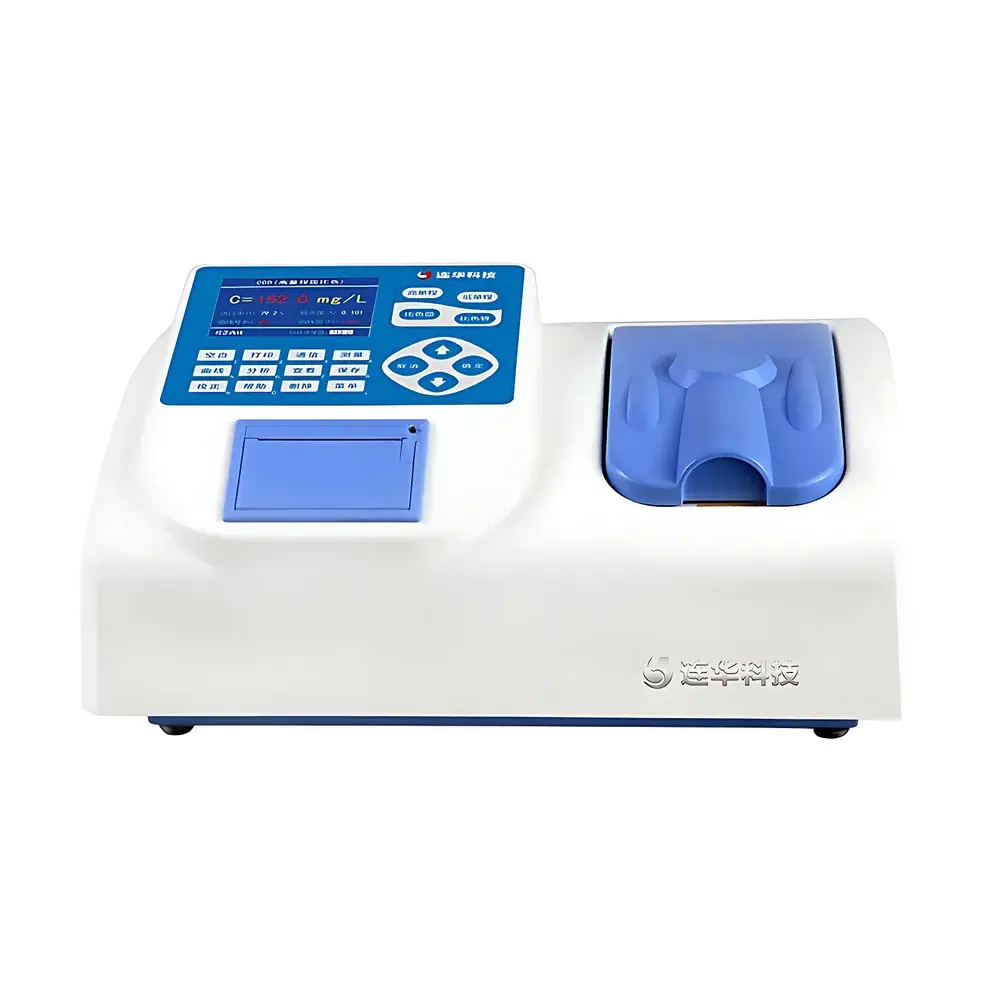
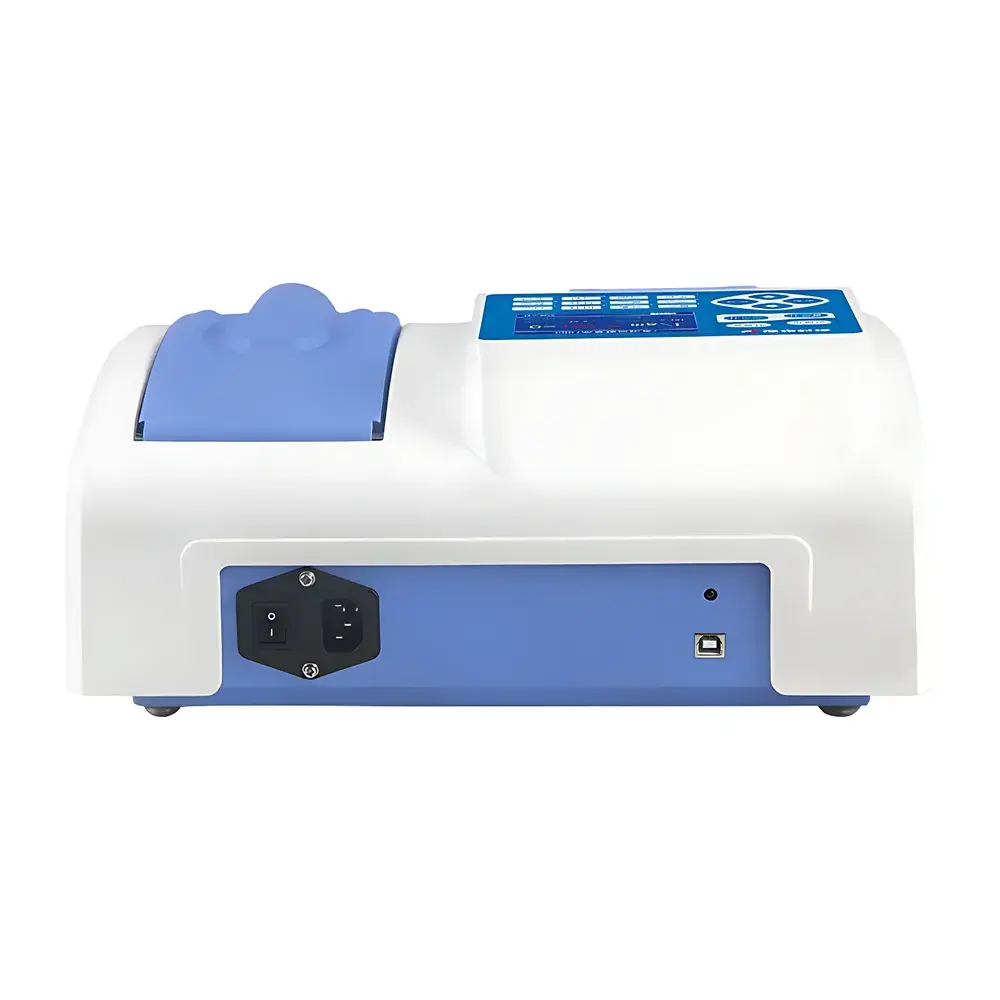
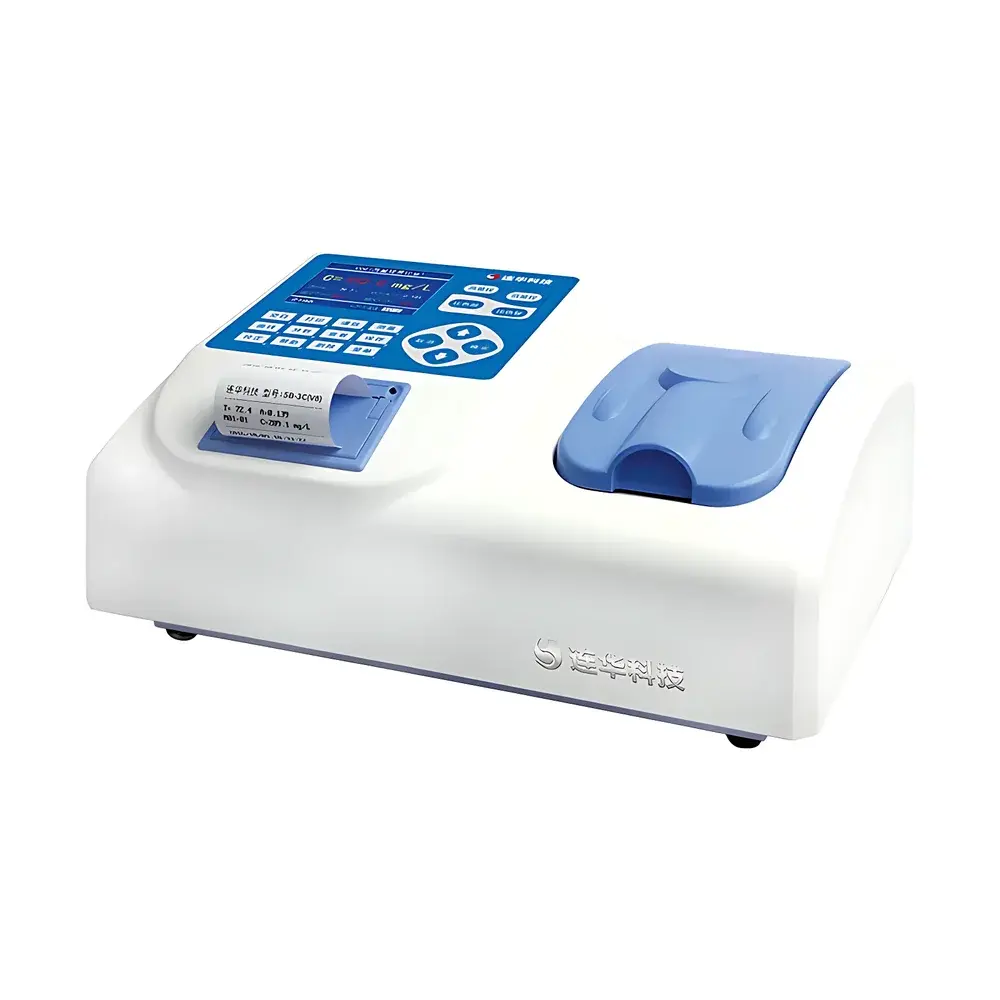
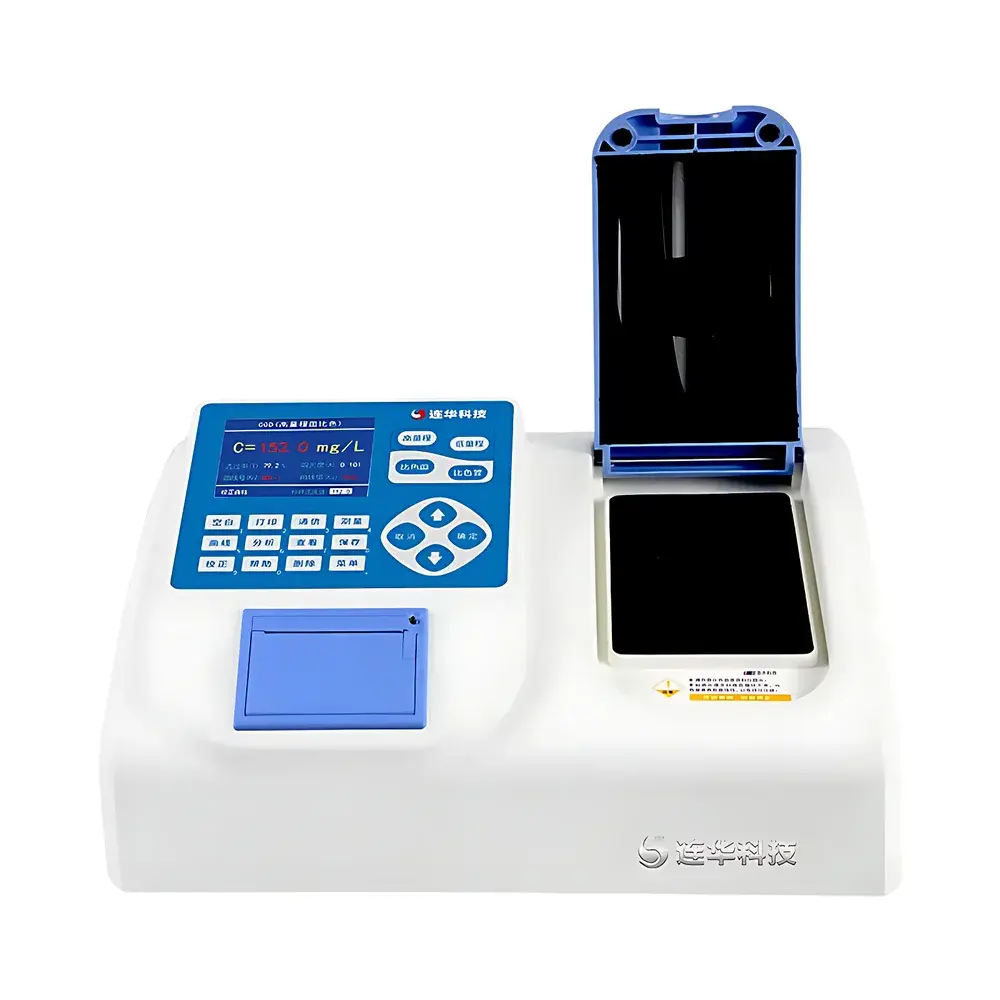
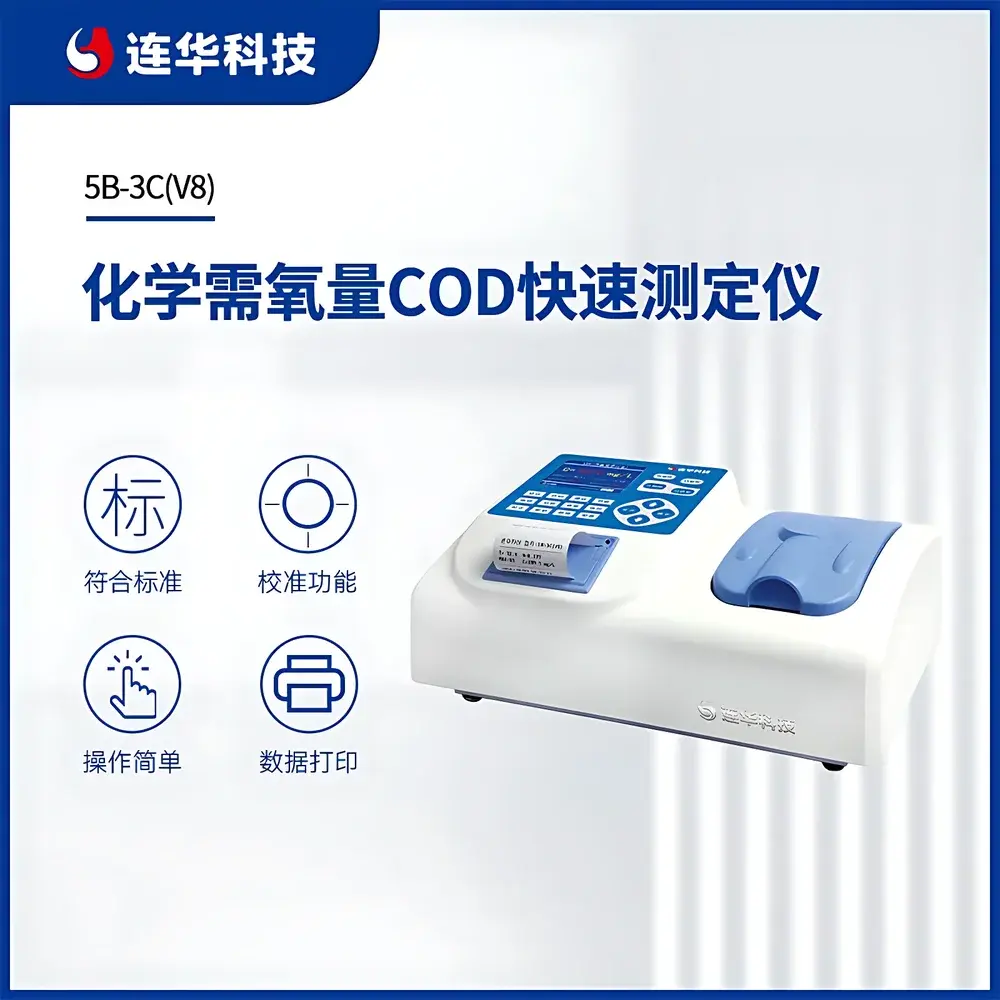
Lianhua Tech 5B-3C(V8) COD Rapid Analyzer
| Brand | Lianhua Tech |
|---|---|
| Origin | Beijing, China |
| Manufacturer Type | Direct Manufacturer |
| Product Origin | Domestic (China) |
| Model | 5B-3C(V8) |
| Instrument Type | Benchtop Laboratory Analyzer |
| Measurement Principle | Rapid Digestion–Spectrophotometric Method (HJ/T 399–2007 compliant) |
| Wavelength | 610 ± 20 nm |
| COD Range | High-range: 20–10,000 mg/L (segmented) |
| Accuracy | ≤ ±8% for COD ≤ 50 mg/L |
| Repeatability | ≤ ±3% |
| Detection Limit | 0.1 mg/L |
| Analysis Time | 20 minutes per batch |
| Sample Throughput | 16 samples per run |
Overview
The Lianhua Tech 5B-3C(V8) COD Rapid Analyzer is a benchtop spectrophotometric instrument engineered for precise, high-throughput chemical oxygen demand (COD) determination in environmental and wastewater laboratories. It implements the rapid digestion–spectrophotometric method standardized in China’s HJ/T 399–2007 (“Water Quality – Determination of Chemical Oxygen Demand – Rapid Digestion Spectrophotometric Method”), ensuring full regulatory alignment with national monitoring protocols. The analyzer operates on dual-beam optical architecture—featuring two independent, non-interfering optical paths—to eliminate baseline drift and enhance photometric stability across repeated measurements. This design enables direct concentration readout without manual calibration interpolation, supporting both high-range (20–10,000 mg/L) and low-range COD quantification within a single platform. Its integrated digestion module (included as standard) performs controlled thermal oxidation of organic matter under acidic potassium dichromate conditions, followed by absorbance measurement at 610 ± 20 nm—a wavelength optimized for detecting the Cr(III) reduction product. The system is validated for use with surface water, municipal wastewater, reclaimed water (tertiary effluent), and industrial effluents containing moderate chloride interference.
Key Features
- Dual independent optical path system ensures long-term photometric stability and eliminates cross-channel interference during simultaneous multi-parameter analysis.
- Integrated rapid digestion unit (16-position) with programmable temperature control (165 °C ± 1 °C) and timed heating cycles, fully compliant with HJ/T 399–2007 digestion requirements.
- 3.5-inch color LCD touchscreen with intuitive Chinese-language menu navigation, adjustable font size (large/small mode), and real-time operational prompts for reduced operator training burden.
- Automated calibration curve generation: instrument calculates and stores up to 20 user-defined calibration curves using certified reference standards; no manual curve plotting or spreadsheet dependency required.
- Flexible cuvette compatibility: supports both 10-mm rectangular quartz/glass cuvettes and 16-mm round digestion vials for seamless transition between pre-digested and in-situ measurement workflows.
- Built-in thermal printer enables immediate hardcopy output of current results and full historical datasets—including date/time stamps, sample IDs, and operator codes.
- High-capacity data storage: retains up to 12,000 measurement records with embedded metadata (timestamp, range selection, digestion batch ID, and calibration version).
- Multi-interface data export: USB 2.0 port for direct file transfer to PC; optional infrared wireless module (IRDA-compliant) for contactless data synchronization with laboratory information management systems (LIMS).
Sample Compatibility & Compliance
The 5B-3C(V8) is validated for aqueous matrices including freshwater, secondary/tertiary treated effluents, and industrial discharges with chloride concentrations ≤ 2,000 mg/L (within specification limits defined by HJ/T 399–2007). It supports co-determination of ammonia nitrogen (NH₃-N) alongside COD, enabling dual-parameter assessment without instrument reconfiguration. All hardware and firmware comply with GB/T 18204.2–2014 (Chinese national standard for spectrophotometric water quality analyzers) and meet electromagnetic compatibility (EMC) Class B requirements per GB 9254–2008. While not FDA 21 CFR Part 11–certified out-of-box, its audit trail functionality—including immutable timestamped logs of calibration events, measurement history, and user login sessions—supports GLP/GMP-aligned documentation practices in regulated environmental testing labs.
Software & Data Management
The embedded firmware provides role-based access control (administrator/operator modes), automatic data tagging (sample ID, analyst ID, digestion lot number), and CSV-formatted export compatible with Excel, LabArchives, and mainstream LIMS platforms. Calibration history is retained with versioned curve parameters (slope, intercept, R²), and all modifications require administrator-level authentication. Data integrity safeguards include write-protected archival storage and cyclic redundancy check (CRC) verification on every saved record. Optional PC software (Lianhua DataLink v3.2) enables remote instrument configuration, spectral review, and batch report generation meeting ISO/IEC 17025 documentation requirements.
Applications
- Regulatory compliance monitoring for municipal wastewater treatment plants (WWTPs) submitting data to local ecological environment bureaus.
- Process control in industrial pretreatment units (e.g., electroplating, pharmaceutical, food processing) where rapid COD feedback informs dosing of oxidants or biological nutrient removal stages.
- Research and teaching laboratories requiring reproducible, low-maintenance COD analysis for student experiments and method validation studies.
- Environmental consulting firms conducting field-deployable lab analysis for site characterization and remediation verification under China’s “Blue Sky & Clear Water” initiative.
- Third-party testing laboratories accredited to CNAS CL01 (equivalent to ISO/IEC 17025) seeking cost-effective, standards-aligned instrumentation for routine water quality profiling.
FAQ
Does the 5B-3C(V8) support ASTM D1252 or ISO 6060 methods?
No—it is specifically designed and verified for HJ/T 399–2007. While measurement principles align broadly with dichromate-based COD methods, formal equivalence to ASTM or ISO protocols requires independent method validation per your laboratory’s SOP.
Can the instrument be used for chloride-rich samples above 2,000 mg/L Cl⁻?
Not without pretreatment. High chloride interferes with dichromate oxidation; users must apply mercury sulfate masking or dilution per HJ/T 399–2007 Annex B prior to analysis.
Is the built-in printer capable of generating GLP-compliant reports?
Yes—the printed output includes instrument ID, calibration status, sample ID, date/time, analyst ID, and digest batch number, satisfying core GLP traceability requirements for raw data records.
What is the expected lifetime of the optical source and detector?
The LED light source and silicon photodiode detector are rated for ≥ 100,000 measurement cycles under normal operating conditions (25 °C ambient, ≤ 60% RH), with factory recalibration recommended every 24 months.
Does the system support external barcode scanning for sample ID entry?
Not natively—but the USB interface accepts HID-compliant USB barcode scanners, enabling automated sample ID input when paired with custom data capture scripts or LIMS middleware.
Related Products







