
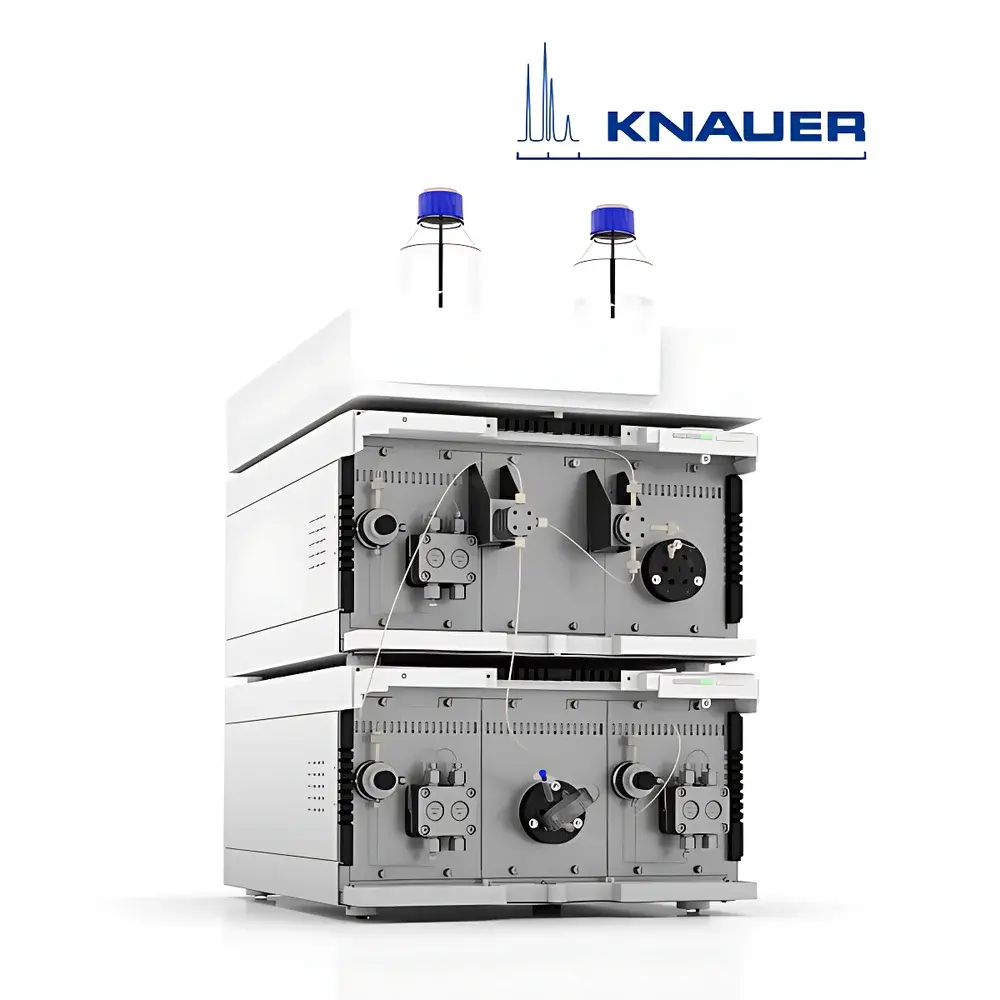
KNAUER IJM NanoScaler Benchtop Impingement Jet Mixer for Lipid Nanoparticle Formulation
| Brand | KNAUER |
|---|---|
| Origin | Germany |
| Model | IJM NanoScaler |
| Instrument Type | Microfluidic Impingement Jet Mixer |
| Dimensions (W×D×H) | 361 × 501 × 603 mm |
| Max. Flow Rate | 0.1 L/min |
| Max. Operating Pressure | 140 bar |
| Temperature Range | 4–60 °C |
| Inlet | 1/8″ OD, 2.1 mm ID FEP tubing (UNF 1/4-28, flat-bottom) |
| Outlet | 1/16″ OD, 0.5 mm ID PEEK tubing (UNF 10-32, conical thread) |
| Pump Count | 3 |
| Flowmeter Count | As required |
| Valve Count | 2 |
| Jet Mixer Modules | 1–5 interchangeable units |
| Software | CDS with optional 21 CFR Part 11 & GAMP5 compliance |
Overview
The KNAUER IJM NanoScaler is a precision-engineered benchtop impingement jet mixing system designed explicitly for the formulation development of lipid nanoparticles (LNPs) at laboratory scale. It operates on the principle of controlled hydrodynamic cavitation and turbulent micro-mixing, where two or more high-velocity fluid streams collide at precisely defined angles within a microstructured mixing chamber. This impingement geometry generates intense shear gradients, rapid diffusion-limited mixing (< 100 µs), and highly reproducible nanoprecipitation kinetics—critical for achieving narrow polydispersity index (PDI < 0.1) and consistent encapsulation efficiency of nucleic acid therapeutics. Unlike conventional sonication or extrusion methods, the NanoScaler enables deterministic control over mixing time, energy input, and interfacial contact dynamics—parameters directly governing LNP size, lamellarity, surface charge, and payload integrity. Its modular architecture supports early-stage screening of formulation variables—including lipid composition, molar ratios, aqueous phase pH, and solvent-to-aqueous flow rate ratios—without requiring process transfer to larger-scale systems.
Key Features
- Modular impingement jet mixer platform supporting 1–5 interchangeable mixing cartridges, each engineered with distinct internal geometries (e.g., T-junction, Y-junction, multi-inlet vortex chambers) to systematically evaluate mixing intensity and residence time distribution.
- Triple high-precision syringe pumps with integrated pressure monitoring, delivering flow stability ±0.5% CV across the full operational range (0.01–10 mL/min per channel).
- Real-time pressure feedback loop maintaining constant backpressure up to 140 bar, ensuring consistent cavitation threshold and eliminating batch-to-batch variability in particle nucleation.
- Temperature-controlled fluid path (4–60 °C) with Peltier-based regulation and inline thermistor monitoring, enabling studies on thermal sensitivity of mRNA integrity and lipid phase behavior.
- FEP and PEEK wetted materials compliant with USP Class VI and ISO 10993-5 standards; chemically inert toward ethanol, isopropanol, chloroform, and acidic/basic aqueous buffers commonly used in LNP synthesis.
- Compact footprint (361 × 501 × 603 mm) optimized for biosafety cabinet integration and Class A/B cleanroom deployment without dedicated utility infrastructure.
Sample Compatibility & Compliance
The NanoScaler is validated for processing fragile biologics including unmodified and chemically stabilized mRNA, siRNA, self-amplifying RNA (saRNA), plasmid DNA, and CRISPR ribonucleoprotein (RNP) complexes. Its low dead-volume fluidic path (< 15 µL per channel) minimizes API loss—particularly critical when working with nanogram-to-microgram quantities of clinical-grade nucleic acids. All contact surfaces meet ISO 13485 design controls and are compatible with standard cleaning-in-place (CIP) protocols using 0.5 M NaOH or 70% ethanol. The system supports audit-ready operation under GLP and GMP environments through optional configuration with electronic signatures, role-based access control, and immutable audit trails aligned with FDA 21 CFR Part 11 and ISPE GAMP5 Category 3/4 software validation requirements.
Software & Data Management
Control and data acquisition are managed via KNAUER’s CDS (Chromatography Data System)-derived interface, adapted for continuous-flow nanoparticle synthesis. The software provides synchronized logging of pressure transients, flow profiles, temperature setpoints, and mixer selection status at 10 Hz resolution. Experimental metadata—including batch ID, operator credentials, timestamped parameter sets, and raw sensor outputs—is exported in ASTM E2500-compliant .csv and .xml formats. Version-controlled method templates can be locked, duplicated, and shared across instrument networks. Remote operation is supported over Ethernet or Wi-Fi using Windows 10/11, macOS Monterey+, or iPadOS 16+ devices—enabling seamless integration into centralized lab informatics platforms such as LabVantage or Thermo Fisher SampleManager.
Applications
- Formulation optimization of ionizable cationic lipids (e.g., DLin-MC3-DMA, SM-102, ALC-0315) with helper lipids (DSPC, cholesterol, PEG-lipids) for mRNA vaccine candidates.
- Screening of alternative solvent systems (e.g., tert-butanol, cyclohexane) to reduce ethanol content while preserving encapsulation efficiency.
- Process analytical technology (PAT) development: correlation of real-time pressure spikes with dynamic light scattering (DLS) size trends during mixing.
- Scale-down modeling for tech transfer to production-scale KNAUER IJM-1000 or IJM-5000 systems, leveraging identical fluid mechanics and dimensionless numbers (Weber, Reynolds, Capillary).
- Stability assessment of LNPs under accelerated stress conditions (e.g., thermal cycling, freeze-thaw) using serial sampling from the outlet stream.
FAQ
What is the minimum sample volume required for one complete mixing cycle?
Typical total process volume ranges from 200 µL to 5 mL, depending on mixer geometry and target LNP concentration. Dead volume remains below 15 µL per fluidic channel.
Can the NanoScaler be used with non-lipid-based nanocarriers such as polymeric micelles or inorganic nanoparticles?
Yes—the impingement jet principle applies broadly to any rapid precipitation or anti-solvent crystallization process; users have successfully adapted it for PLGA, chitosan, and iron oxide nanoparticle synthesis.
Is third-party calibration certification available for regulatory submissions?
KNAUER provides factory calibration certificates traceable to NIST standards; IQ/OQ/PQ documentation packages and vendor-supported 21 CFR Part 11 validation services are available upon request.
How is cleaning validation performed between different API batches?
Residue testing follows ICH Q5C guidelines using HPLC-UV or qPCR quantification; swab recovery studies demonstrate >95% removal of nucleic acid residues after a single 0.5 M NaOH flush followed by DI water rinse.
Does the system support automated gradient mixing for multi-component formulations?
Yes—via programmable pump ramping profiles and synchronized valve sequencing, enabling controlled introduction of tertiary lipids or targeting ligands during the mixing event.



