
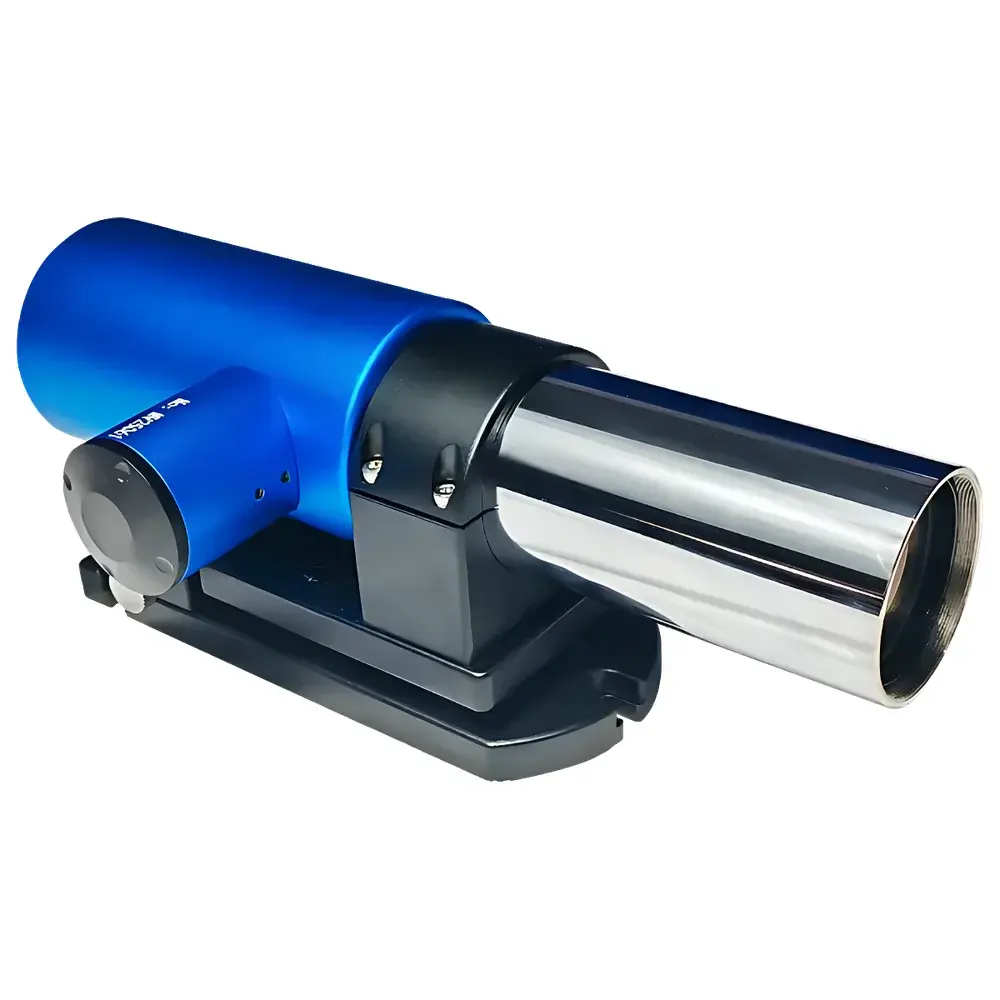
YANRUN MC030-WF200-5700 Dual-Axis Electronic Autocollimator
| Brand | YANRUN |
|---|---|
| Origin | Shanghai, China |
| Manufacturer Type | Direct Manufacturer |
| Country of Origin | China |
| Model | MC030-WF200-5700 |
| Price Range | USD 11,200 – 16,800 |
Overview
The YANRUN MC030-WF200-5700 is a dual-axis electronic autocollimator engineered for high-precision angular metrology in controlled industrial and laboratory environments. It operates on the principle of optical autocollimation—where a collimated beam is reflected from a target mirror back into the instrument’s objective lens—and integrates a high-resolution CMOS image sensor with real-time digital image processing algorithms to quantify angular deviations in both X and Y axes simultaneously. Unlike traditional visual autocollimators requiring manual reticle alignment, this system delivers quantitative angular displacement data with sub-arcsecond resolution, making it suitable for dynamic alignment verification, static tilt measurement, and long-term stability monitoring of optical and mechanical reference surfaces. Its optical architecture is optimized for minimal thermal drift and mechanical hysteresis, supporting traceable calibration against NIST-traceable angle standards.
Key Features
- Dual-axis simultaneous measurement capability for pitch and yaw angles, eliminating sequential axis scanning and reducing cumulative setup error.
- Modular optical design with interchangeable objective lenses (standard 200 mm focal length; optional 570 mm for extended working distance), enabling flexibility across applications ranging from compact optical benches to large-scale machine tool beds.
- High-stability mechanical housing constructed from low-expansion aluminum alloy, CNC-machined and anodized for dimensional consistency under ambient temperature fluctuations (±0.5 °C).
- Real-time digital processing engine delivering measurement output at up to 50 Hz frame rate with onboard averaging, outlier rejection, and noise suppression filters.
- Integrated USB 3.0 and Ethernet interfaces for deterministic data streaming and remote operation; compatible with Windows-based host systems without proprietary drivers.
- Factory-calibrated sensitivity options include 0.1 arcsecond, 0.01 arcsecond, 0.001 arcsecond, and 0.0001 arcsecond per pixel—configured via firmware selection to match application-specific uncertainty budgets.
Sample Compatibility & Compliance
The MC030-WF200-5700 is designed to interface with standard optical flats, precision mirrors, and retroreflective targets meeting ISO 10110-7 surface quality specifications (scratch-dig ≤ 20–10). It supports measurement on surfaces with reflectivity ≥75% (at 633 nm) and minimum target size ≥Φ15 mm. The instrument complies with IEC 61326-1:2013 for electromagnetic compatibility in industrial environments and meets CE marking requirements for safety (EN 61010-1:2010). While not certified to ISO/IEC 17025, its calibration methodology aligns with ISO 10110-19 and ASTM E2493-18 for angular measurement instrumentation validation. Traceable calibration certificates are provided with each unit, referencing national metrology institute (NMI)-certified angle artifacts.
Software & Data Management
The instrument ships with YANRUN Autocollimator Control Suite (v4.2+), a native Windows application supporting multi-session data logging, statistical process control (SPC) charting, and export to CSV, XML, and HDF5 formats. Software features include real-time vector magnitude calculation (θ = √(θₓ² + θᵧ²)), zero-point offset memory per fixture, and user-defined pass/fail thresholds with audible and visual alerts. Audit trail functionality records operator ID, timestamp, configuration changes, and raw image metadata—supporting GLP/GMP-aligned documentation workflows. Optional API (C/C++, Python bindings) enables integration into automated alignment stations or MES platforms compliant with ISA-95 and OPC UA frameworks.
Applications
- Precision alignment of optical components in laser cavity assembly, interferometer setup, and telescope collimation procedures.
- In-process angular verification of linear motion stages, hydrostatic guideways, and air-bearing tables during CNC machine tool qualification (per ISO 230-1 Annex C).
- Long-term drift monitoring of granite surface plates, optical tables, and vibration isolation systems in metrology labs.
- Verification of angular repeatability in robotic end-effector positioning systems and semiconductor wafer handling modules.
- Calibration support for coordinate measuring machines (CMMs), laser trackers, and theodolites where angular artifact references are required.
FAQ
What is the minimum measurable angle for the MC030-WF200-5700 in its highest resolution mode?
The instrument achieves a theoretical resolution of 0.0001 arcsecond when configured with the optional high-gain processing mode and used with a stable, high-reflectivity target under low-vibration conditions. Actual measurement uncertainty depends on environmental stability, target quality, and integration time.
Does the system support external triggering or synchronization with other metrology equipment?
Yes—TTL-compatible trigger input/output ports enable hardware-synchronized acquisition with laser interferometers, piezo actuators, or motion controllers operating on common timing protocols (e.g., IEEE 1588 PTP).
Can the software generate ISO/IEC 17025-compliant calibration reports?
The software exports raw and processed data in audit-ready formats; however, formal ISO/IEC 17025 accreditation requires third-party laboratory assessment of the user’s entire measurement process—including environmental controls, personnel competency, and uncertainty budgeting—not just instrument output.
Is the 570 mm focal length option field-upgradable?
Yes—the WF-570 objective module is mechanically and optically compatible with the base MC030 platform and can be installed by authorized service personnel following optical centering and firmware recalibration procedures.
What environmental conditions are recommended for optimal performance?
Operation is rated for 15–25 °C ambient temperature, <50% RH non-condensing, and vibration levels below 25 µm peak-to-peak at 10–100 Hz. Active air turbulence mitigation (e.g., laminar flow enclosures) is advised for sub-0.01″ measurements.





