
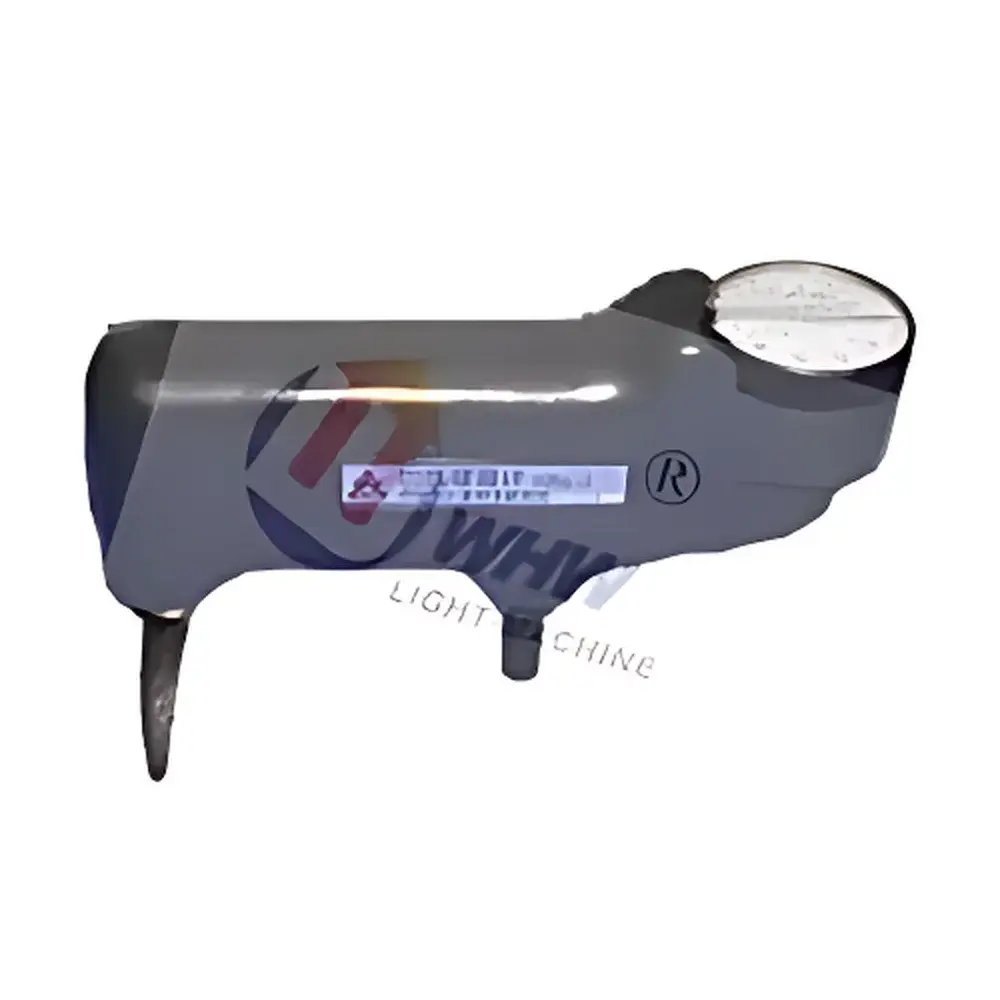
MC010-HBa-1 Barcol Hardness Tester
| Origin | Shanghai, China |
|---|---|
| Manufacturer Type | Authorized Distributor |
| Origin Category | Domestic (China) |
| Model | MC010-HBa-1 |
| Pricing | Upon Request |
| Measurement Range | 0–100 HBa (equivalent to 25–150 HBW) |
| Indenter | 26° truncated conical tip, flat end diameter 0.176 mm |
| Resolution | 0.5 HBa |
| Accuracy | ±2 HBa (42–52 HBa), ±1 HBa (84–88 HBa) |
| Repeatability | ±2 HBa (42–52 HBa), ±1 HBa (84–88 HBa) |
| Weight | 0.5 kg |
| Compliance | GB/T 3854–2005, ASTM B648–2000 |
Overview
The MC010-HBa-1 Barcol Hardness Tester is a portable, spring-loaded indentation hardness instrument engineered for rapid, non-destructive assessment of soft-to-medium-hard non-ferrous metals and rigid polymers. Based on the Barcol hardness principle—originally developed by Barber-Colman Company in the United States—the device applies a defined load via a calibrated helical spring onto a precision-ground 26° truncated conical indenter. The depth of penetration into the material surface is mechanically translated into a linear scale reading (0–100 HBa), where higher values correspond to greater resistance to localized plastic deformation. Unlike rebound or dynamic methods, Barcol hardness relies on static indentation under constant spring force, offering high reproducibility for field and production-floor applications where portability, one-handed operation, and minimal sample preparation are critical. Its measurement range (0–100 HBa) correlates empirically to Brinell hardness values from 25 to 150 HBW, making it particularly suitable for quality control of aluminum extrusions, copper alloys, fiber-reinforced composites (e.g., GFRP), and thermosetting plastics.
Key Features
- Compact, handheld design weighing only 0.5 kg—enabling on-site testing without external power or mounting fixtures.
- Single-hand operation with intuitive analog dial readout; no operator training or calibration expertise required for routine use.
- Direct-contact measurement: requires access to only one side of the test piece—ideal for large structural components, assembled parts, pipes, and thick castings where backside support is impractical.
- High-resolution scale (0.5 HBa increments) and dual-point verification capability (±1 HBa at high end, ±2 HBa at mid-range) ensure metrological reliability across diverse material classes.
- Interchangeable standard hardness reference blocks (high- and low-value sets) facilitate traceable field calibration per ISO/IEC 17025-aligned procedures.
- Robust mechanical architecture with hardened steel indenter and corrosion-resistant housing ensures long-term stability under industrial environmental conditions.
Sample Compatibility & Compliance
The MC010-HBa-1 is validated for use on homogeneous, smooth-surfaced materials with minimum thickness ≥6 mm and surface roughness Ra ≤3.2 µm. Certified applications include wrought and cast aluminum alloys (e.g., 6061-T6, 7075-T6), copper and brass sheets, glass-fiber reinforced polyester and epoxy laminates, rigid PVC, phenolic resins, and vulcanized rubber compounds. It is not intended for ferrous alloys, thin foils (<1 mm), porous sintered metals, or highly anisotropic composites. The instrument conforms to GB/T 3854–2005 “Determination of Barcol Hardness of Reinforced Plastics” and ASTM B648–2000 “Standard Test Method for Indentation Hardness of Aluminum Alloys by Means of a Barcol Impressor”, supporting audit-ready documentation in manufacturing environments governed by ISO 9001, AS9100, or IATF 16949 quality management systems.
Software & Data Management
As a fully mechanical analog instrument, the MC010-HBa-1 does not incorporate digital electronics, firmware, or data logging capabilities. All measurements are recorded manually in laboratory notebooks or QC check sheets. However, its compliance with ASTM B648–2000 and GB/T 3854–2005 ensures compatibility with paper-based or LIMS-integrated reporting workflows. For organizations requiring electronic records, manual entry into validated systems (e.g., LabWare LIMS or TrackWise QMS) satisfies FDA 21 CFR Part 11 requirements when paired with documented operator training, controlled forms, and audit-trail-enabled review protocols.
Applications
- In-process verification of heat treatment efficacy in aluminum extrusion lines.
- Final inspection of composite aircraft interior panels per Boeing D6-17487 or Airbus AITM 1-0003.
- Supplier qualification testing of copper busbar hardness prior to electrical assembly.
- Field assessment of aging effects in marine-grade fiberglass hulls and deck laminates.
- QA screening of injection-molded engineering thermoplastics (e.g., PEEK, PEI) during mold validation.
- Non-destructive hardness mapping of large-diameter welded aluminum piping in petrochemical facilities.
FAQ
What materials are appropriate for Barcol hardness testing?
Aluminum and copper alloys, fiber-reinforced plastics (FRP), rigid thermosets, and certain elastomers—provided surfaces are smooth, flat, and ≥6 mm thick.
How often should the instrument be calibrated?
Before each shift or daily usage cycle, using certified high- and low-value reference blocks traceable to NIM (China) or NIST (USA). Annual third-party verification is recommended.
Can the MC010-HBa-1 replace a Brinell hardness tester?
No—it provides comparative, not absolute, hardness values. HBa readings correlate empirically to HBW but are not interchangeable in specification-critical contexts requiring ISO 6506-compliant testing.
Is the indenter replaceable?
Yes—the 26° truncated conical indenter is a field-serviceable component; replacement kits are supplied with certificate of conformity and geometry verification report.
Does this instrument meet GLP or GMP requirements?
When used within a documented QA system—including controlled calibration records, operator competency assessments, and raw data retention—it supports GLP adherence for non-clinical material testing; however, it is not classified as GxP-critical instrumentation per FDA guidance.



