
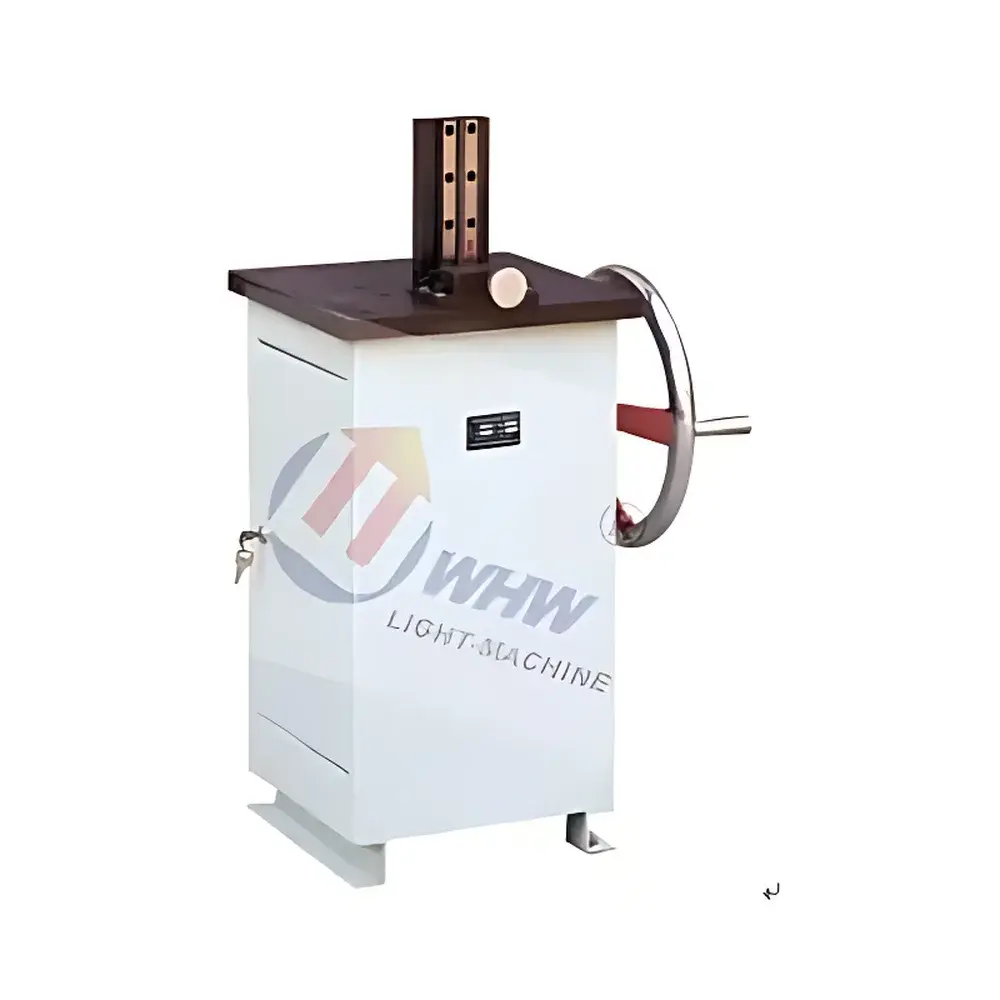
MC009-CSL-A Manual Single-Blade Notching Machine for Charpy/Izod Impact Test Specimens
| Origin | Shanghai, China |
|---|---|
| Manufacturer Type | Authorized Distributor |
| Origin Category | Domestic (China) |
| Model | MC009-CSL-A |
| Price | Upon Request |
| Sample Dimensions | 10 × 10 × 55 mm |
| Notch Types | V-notch (GB/T 229–2020, ISO 148-1:2016) or U-notch (2 mm radius per GB/T 229–2020 |
| Stroke Length | 350 mm |
| Feed Rate | 2.5 mm/min |
| Overall Dimensions (L×W×H) | 350 × 350 × 700 mm |
| Net Weight | 95 kg |
Overview
The MC009-CSL-A Manual Single-Blade Notching Machine is a precision mechanical tool engineered exclusively for the preparation of standardized notches in metallic specimens prior to Charpy or Izod impact testing. It operates on the principle of controlled linear broaching—where a hardened, ground carbide-tipped notching cutter is drawn through a clamped specimen at a fixed feed rate and depth, producing geometrically consistent V- or U-shaped notches with high repeatability. Unlike milling or grinding methods, broaching eliminates thermal distortion and microstructural alteration at the notch root, preserving the material’s intrinsic fracture behavior. This machine fulfills critical pre-test requirements defined in international standards including GB/T 229–2020 (replacing GB 229–94), ISO 148-1:2016, ASTM E23, and DIN 50115. Its manual operation ensures full operator control over feed initiation, dwell, and retraction—essential for laboratories requiring traceable, non-automated notch fabrication under GLP-compliant workflows.
Key Features
- Single-blade broaching architecture optimized for high geometric fidelity and minimal notch root plastic deformation
- Interchangeable V-notch and U-notch cutters (2 mm or 3 mm radius) compatible with standard 10 × 10 × 55 mm Charpy specimens
- Precision-machined cast-iron base and rigid vertical column ensuring dimensional stability during repeated loading cycles
- Manually actuated hydraulic-assisted ram with calibrated stroke limit (350 mm) and fixed feed velocity (2.5 mm/min)
- Adjustable specimen clamp with micrometer-scale positioning capability for repeatable notch centering relative to specimen mid-length
- No electrical or pneumatic power required—suitable for clean-room environments, mobile labs, or facilities with constrained utility infrastructure
- Tool alignment verification system using dual dial indicators for post-replacement cutter calibration (per OEM procedure)
Sample Compatibility & Compliance
The MC009-CSL-A accepts only standardized rectangular metallic bars measuring 10 mm × 10 mm × 55 mm, conforming to the dimensional tolerances specified in ISO 148-1:2016 Annex A and ASTM E23 Table 1. It produces notches meeting the following metrological criteria: V-notch angle = 45° ± 2°, depth = 2 mm ± 0.075 mm, root radius = 0.25 mm ± 0.025 mm; U-notch radii available at 2 mm (for GB/T 229–2020) or 3 mm (for DIN 50115 DVM specimens). All manufactured notches are verified using optical profile projectors or coordinate measuring machines (CMM) per ISO 17025-accredited procedures. The device itself carries no CE marking or UL certification, as it is classified as a mechanical workshop tool—not an electrically powered test instrument—yet its output directly supports compliance with ISO/IEC 17025 clause 6.4.3 (equipment suitability for intended use).
Software & Data Management
This is a fully manual, non-digitalized notching system with no embedded firmware, touchscreen interface, or data logging capability. All operational parameters—including cutter type, specimen batch ID, date/time of notching, operator initials, and visual inspection pass/fail status—are recorded manually in laboratory notebooks or LIMS-integrated paper-based worksheets. To satisfy FDA 21 CFR Part 11 or ISO/IEC 17025 audit requirements, users must maintain a controlled logbook with page numbering, ink-only entries, and dated witness signatures. Optional accessories include a certified reference notch gauge set (traceable to NIM, China) for daily cutter wear verification and a digital caliper with SPC-capable output for automated entry into Excel-based statistical process control templates.
Applications
The MC009-CSL-A serves as a foundational specimen preparation tool across metallurgical QA/QC, pressure vessel certification, aerospace component validation, and academic fracture mechanics research. It is routinely deployed in third-party testing laboratories accredited to CNAS (China National Accreditation Service) and A2LA (American Association for Laboratory Accreditation) for Charpy impact qualification of structural steels per ASME BPVC Section IX, EN 10045-1, and API RP 579. In R&D settings, it enables systematic study of notch sensitivity across alloy families—including low-alloy steels, aluminum 7xxx series, and nickel-based superalloys—by ensuring identical notch geometry across comparative test series. Its robust construction also supports field deployment in shipyard QC labs and mobile NDT units where portability and utility independence are essential.
FAQ
What standards does the MC009-CSL-A support for V-notch and U-notch production?
It complies with GB/T 229–2020 (V-notch and 2 mm U-notch), ISO 148-1:2016 (V-notch), ASTM E23 (V-notch), and DIN 50115 (3 mm U-notch for DVM specimens).
Is the machine suitable for non-metallic specimens such as polymers or composites?
No. It is designed exclusively for metallic materials with hardness ≤ 350 HB. Polymer or composite specimens require specialized low-force notching systems.
How often must the broaching cutter be replaced or resharpened?
Under normal usage (≤ 500 specimens per cutter), replacement is recommended after visible flank wear exceeds 0.1 mm, verified via optical microscope at 50× magnification per ISO 3685.
Can this unit be integrated into an automated test cell?
Not natively. As a manual device, it lacks I/O ports or communication protocols. Integration requires external robotic handling and vision-guided alignment—beyond OEM scope.
Does the manufacturer provide calibration services or traceable certificates?
The distributor provides a factory-issued Certificate of Conformance (CoC) with each unit. NIST-traceable calibration of notch geometry must be performed externally using certified reference specimens.
Related Products



