
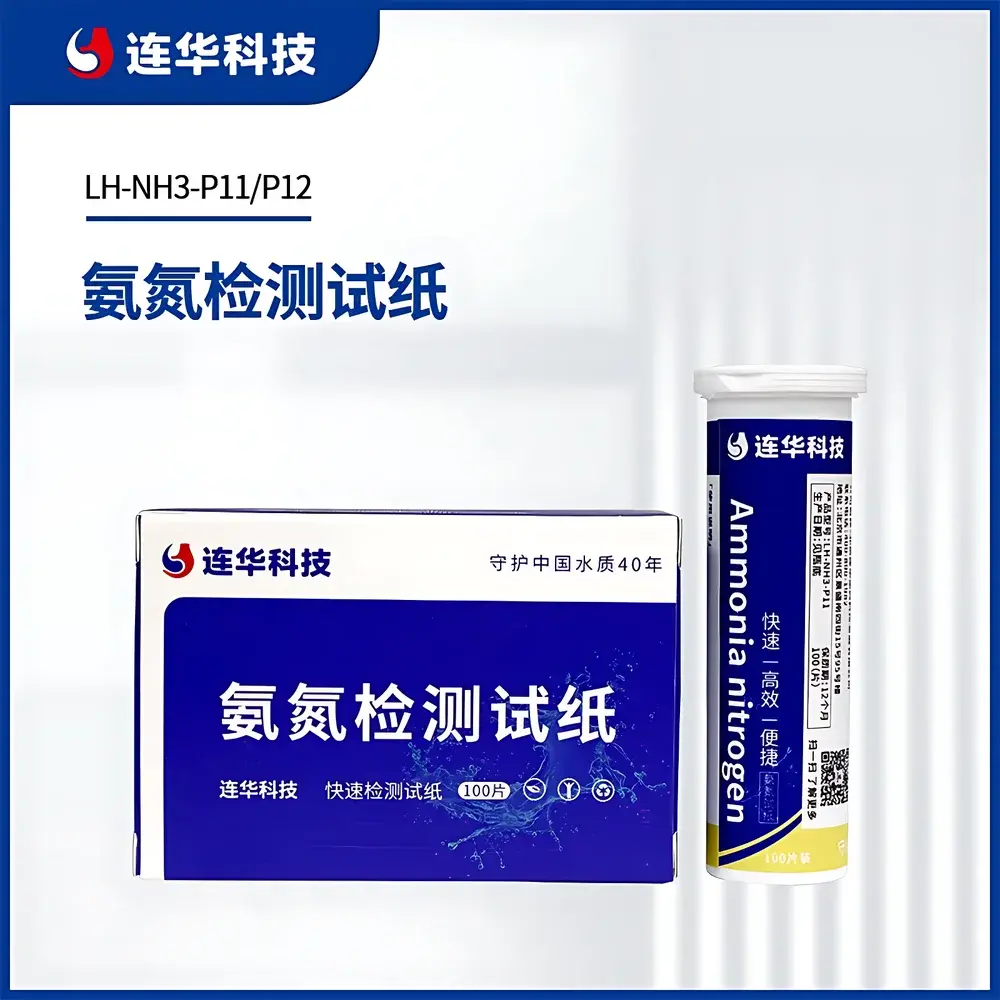
Lianhua Technology Ammonia-Nitrogen Dual-Range Test Strips LH-NH3-P11 / LH-NH3-P12
| Brand | Lianhua Technology |
|---|---|
| Origin | Beijing, China |
| Manufacturer Type | Direct Manufacturer |
| Product Origin | Domestic (China) |
| Model | LH-NH3-P11 / LH-NH3-P12 |
| Pricing | Available Upon Request |
Overview
Lianhua Technology Ammonia-Nitrogen Dual-Range Test Strips (Models LH-NH3-P11 and LH-NH3-P12) are calibrated, single-use colorimetric reagent strips engineered for rapid, on-site quantification of aqueous ammonia-nitrogen (NH₃-N) concentrations in environmental water samples. These test strips operate on the principle of indophenol blue colorimetry — a well-established, standardized method referenced in ISO 7150-1 and EPA Method 350.1 — where free ammonia reacts with hypochlorite and phenol under alkaline conditions to form a stable blue chromophore proportional to NH₃-N concentration. The dual-range design enables precise visual assessment across two complementary concentration intervals: LH-NH3-P11 covers 0.1–5.0 mg/L NH₃-N (low range), while LH-NH3-P12 extends detection from 5–50 mg/L NH₃-N (high range), minimizing dilution requirements and improving measurement fidelity in heterogeneous field conditions.
Key Features
- Dual-range calibration: Two distinct strip formulations eliminate interpolation errors by matching analytical range to expected sample concentration — critical for wastewater effluent, surface water screening, or aquaculture monitoring where NH₃-N levels vary widely.
- Optimized color development: Proprietary impregnation and drying protocols ensure uniform reagent distribution and consistent chromogenic response; color bands exhibit high contrast and minimal diffusion, supporting reliable visual interpretation under ambient daylight or standard LED lighting.
- Field-deployable architecture: Each strip is individually sealed in aluminum-laminated foil pouches with desiccant, maintaining reagent stability for ≥24 months at 4–30 °C without refrigeration — validated per ICH Q1A(R2) long-term storage guidelines.
- Minimal operational dependency: Requires no instrumentation, power source, or trained analyst; analysis completed in ≤2 minutes post-dip, including 60-second reaction time and 10-second color stabilization period — compliant with ISO 5667-3 for preliminary field screening.
- Robust environmental tolerance: Tested for performance integrity across humidity (30–85% RH) and temperature (5–40 °C), ensuring reproducibility in rainwater runoff surveys, emergency spill response, or remote watershed assessments.
Sample Compatibility & Compliance
The strips are validated for use with clarified freshwater, wastewater, treated effluent, and aquaculture pond water. Turbidity up to 50 NTU does not interfere with color development when samples are pre-filtered using 0.45 µm membrane filters (optional but recommended for highly suspended matrices). Interference testing confirms negligible cross-reactivity with common ions including chloride (<1000 mg/L), nitrate (<50 mg/L), and phosphate (<5 mg/L). The methodology aligns with regulatory frameworks supporting Tier 1 field screening under US EPA Region 10 Field Screening Protocols and China’s HJ 535-2009 standard for ammonia-nitrogen determination in water quality monitoring.
Software & Data Management
As a non-instrumental, analog colorimetric method, the LH-NH3-P11/P12 system does not integrate with digital data acquisition platforms. However, it supports GLP-compliant documentation: each foil pouch includes batch-specific calibration reference cards printed with NIST-traceable color standards (CIELAB ΔE < 2.0 vs. certified reference patches), enabling auditable visual comparison. Users may log results manually into LIMS-compatible templates (e.g., CSV or PDF forms) that capture batch number, date/time, observer ID, sample ID, and interpreted concentration — satisfying basic 21 CFR Part 11 recordkeeping prerequisites for field-based environmental compliance reporting.
Applications
- Rapid assessment of ammonia spikes during wastewater treatment plant upsets or sewer overflow events
- Pre-screening prior to lab-based spectrophotometric confirmation (e.g., Hach DR3900 or similar)
- Onboard monitoring for mobile environmental response units and municipal inspection vehicles
- Education and community science programs requiring low-barrier, safe chemical exposure protocols
- Baseline surveys in agricultural drainage ditches, stormwater retention basins, and wetland restoration sites
FAQ
What is the shelf life of unopened test strips?
Unopened foil pouches retain full performance for 24 months from manufacturing date when stored at 4–30 °C and protected from direct sunlight.
Can these strips be used for seawater analysis?
No — high chloride and ionic strength cause significant positive bias; validation is limited to freshwater and low-salinity wastewater matrices (<500 mg/L TDS).
Is there a documented limit of detection (LOD) for visual interpretation?
The practical LOD is 0.1 mg/L for LH-NH3-P11 and 5 mg/L for LH-NH3-P12, based on inter-operator repeatability studies (n=12 analysts, CV ≤12%).
Do the strips require buffer adjustment or pH conditioning before testing?
Yes — samples must be adjusted to pH ≥11.0 using sodium hydroxide solution (provided in kit) to ensure complete conversion of ammonium ion (NH₄⁺) to free ammonia (NH₃), the reactive species in indophenol chemistry.
Are certificates of analysis (CoA) available for each production batch?
Yes — CoAs include batch-specific calibration verification against NIST SRM 2171a (Ammonia Nitrogen Standard) and are supplied digitally upon order fulfillment.







