DHS Large-Scale Cell Culture System
| Brand | DHS |
|---|---|
| Origin | Tianjin, China |
| Manufacturer Type | Authorized Distributor |
| Product Origin | Domestic (China) |
| Model | Large-Scale Cell Culture System |
| Temperature Range | −60 °C to 60 °C |
| Culture Volume per Layer | 636 mL (scalable to 636 × n mL) |
| Stackable Layers | 1–40 |
| Material | Polyethylene (PE) |
| Sterilization Method | Gamma Irradiation |
Overview
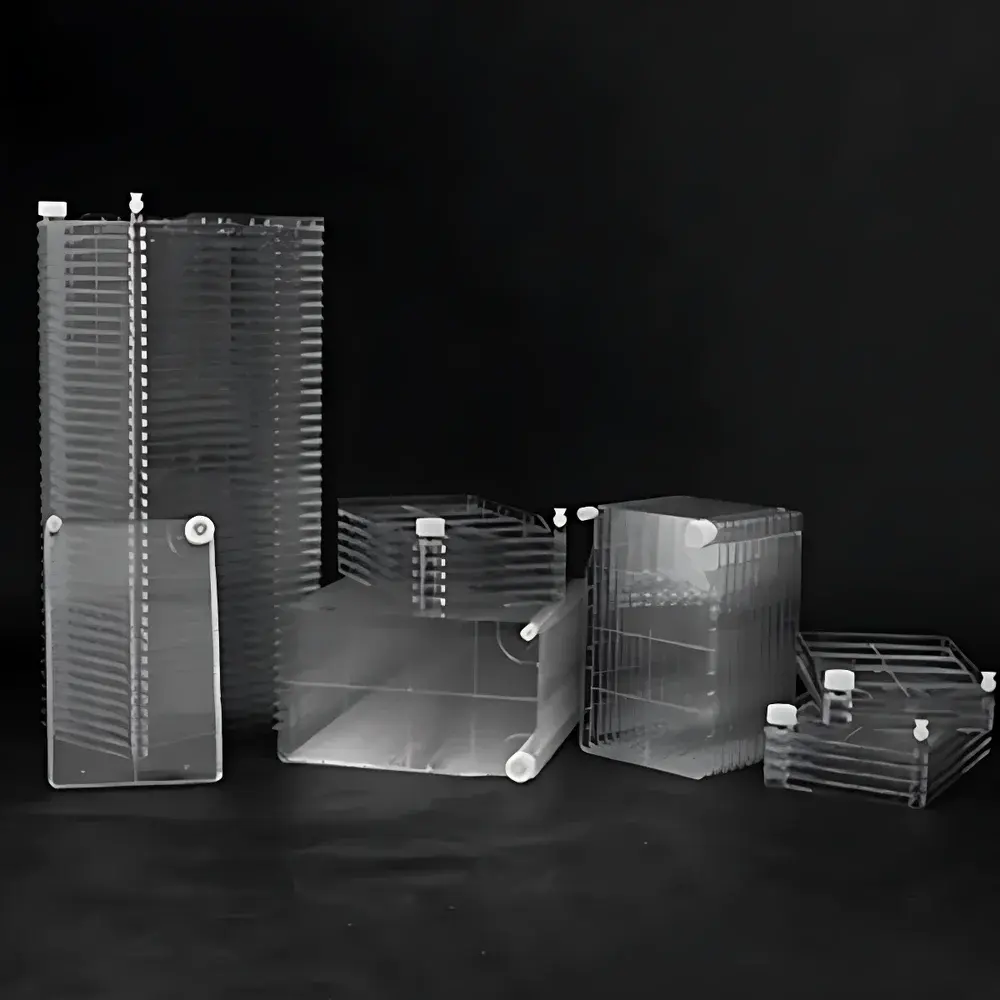
The DHS Large-Scale Cell Culture System is a modular, stackable bioreactor platform engineered for high-density adherent cell expansion under controlled environmental conditions. Unlike traditional roller bottles or static flasks, this system employs a fixed-bed, multi-layer architecture based on gas-permeable, surface-modified polyethylene (PE) culture plates. Each layer provides 636 mL working volume with optimized surface area-to-volume ratio, enabling scalable suspension-adapted or strictly adherent cultures—including CHO, Vero, HEK293, and human mesenchymal stem cells—without enzymatic passaging or microcarrier dependency. The system operates within a temperature-controlled incubator environment (−60 °C to +60 °C), supporting both cryopreservation workflows and active proliferation phases. Its design conforms to fundamental bioprocess engineering principles: uniform gas exchange (O₂/CO₂), low shear stress distribution, and minimal medium dead volume—critical parameters for maintaining genomic stability and reducing DNA damage associated with mechanical agitation in rotary systems.
Key Features
- Third-generation plasma-based surface modification: Low-temperature, ultra-high-vacuum plasma treatment enhances PE substrate hydrophilicity and integrin-binding motif density—improving initial cell attachment efficiency by >40% compared to untreated PE and eliminating the need for extracellular matrix coating.
- Modular scalability: Configurable from 1 to 40 stacked layers; each layer is independently sealable and interchangeable—enabling parallel process development, scale-down modeling, and seamless transition from lab-scale qualification to clinical batch production.
- Pre-sterilized, ready-to-use format: All components undergo validated gamma irradiation (25–35 kGy), certified free of endotoxin (<0.03 EU/mL), viable microorganisms, and leachable cytotoxins—compliant with ISO 10993-5 and USP biological reactivity testing.
- Space-efficient footprint: A 40-layer configuration occupies 70% versus conventional flask-based workflows.
- Multi-port fluidic interface: Standardized inlet/outlet ports support automated perfusion, sampling, pH/DO monitoring integration, and closed-system media exchange—compatible with common peristaltic pump manifolds and single-use tubing sets.
Sample Compatibility & Compliance
The system supports primary adherent cells, immortalized lines, and differentiated progenitor cells without surface coating or microcarriers. It has been validated for use in serum-free and chemically defined media formulations. All materials comply with USP Class VI plastic standards and meet FDA-recommended extractables/leachables profiles for mammalian cell culture. The gamma-irradiated assembly satisfies ISO 13408-1 (aseptic processing) and is suitable for GLP-compliant preclinical manufacturing and Phase I/II clinical material production under cGMP Annex 1-aligned facility controls.
Software & Data Management
While the base hardware operates as a passive, non-instrumented culture platform, it integrates seamlessly with third-party environmental monitoring systems (e.g., Vaisala, Sartorius) and process data management platforms (e.g., DeltaV, PI System). Users may configure electronic batch records (EBRs) with audit trails compliant with 21 CFR Part 11 via LIMS or MES interfaces. Documentation packages include full sterilization validation reports, material traceability dossiers, and biocompatibility summaries aligned with ICH Q5A(R2) and Q5D guidelines.
Applications
- Adherent cell expansion for viral vector production (AAV, lentivirus)
- Clinical-grade vaccine manufacturing (e.g., inactivated whole-virus or subunit antigens using Vero or MRC-5 cells)
- Monoclonal antibody upstream processing—particularly for early-phase candidates requiring rapid, low-risk process definition
- Stem cell expansion under xeno-free conditions for regenerative medicine applications
- Biosafety Level 2 (BSL-2) compliant process intensification in contract development and manufacturing organizations (CDMOs)
FAQ
Is the system compatible with automated liquid handling platforms?
Yes—standardized port geometry and consistent layer dimensions allow integration with robotic arms and tube-guided pipetting systems for inoculation, feeding, and harvest.
Can individual layers be removed or replaced during culture?
No—layers are sealed as a unit post-sterilization; however, the modular design permits parallel culturing across multiple independent stacks to mitigate batch failure risk.
What is the maximum recommended passage number for primary cells cultured in this system?
Based on published comparative studies, human MSCs retain >95% trilineage differentiation capacity up to Passage 8 when maintained under optimized perfusion conditions.
Does DHS provide regulatory support documentation for IND submissions?
Yes—comprehensive CMC dossiers including material specifications, sterilization validation protocols, and biocompatibility test reports are available under NDA/CTA confidentiality agreements.
How is temperature uniformity maintained across all 40 layers?
Uniformity relies on external incubator control; users must validate thermal homogeneity (±0.5 °C) across the full stack using calibrated thermocouple mapping prior to GMP implementation.