
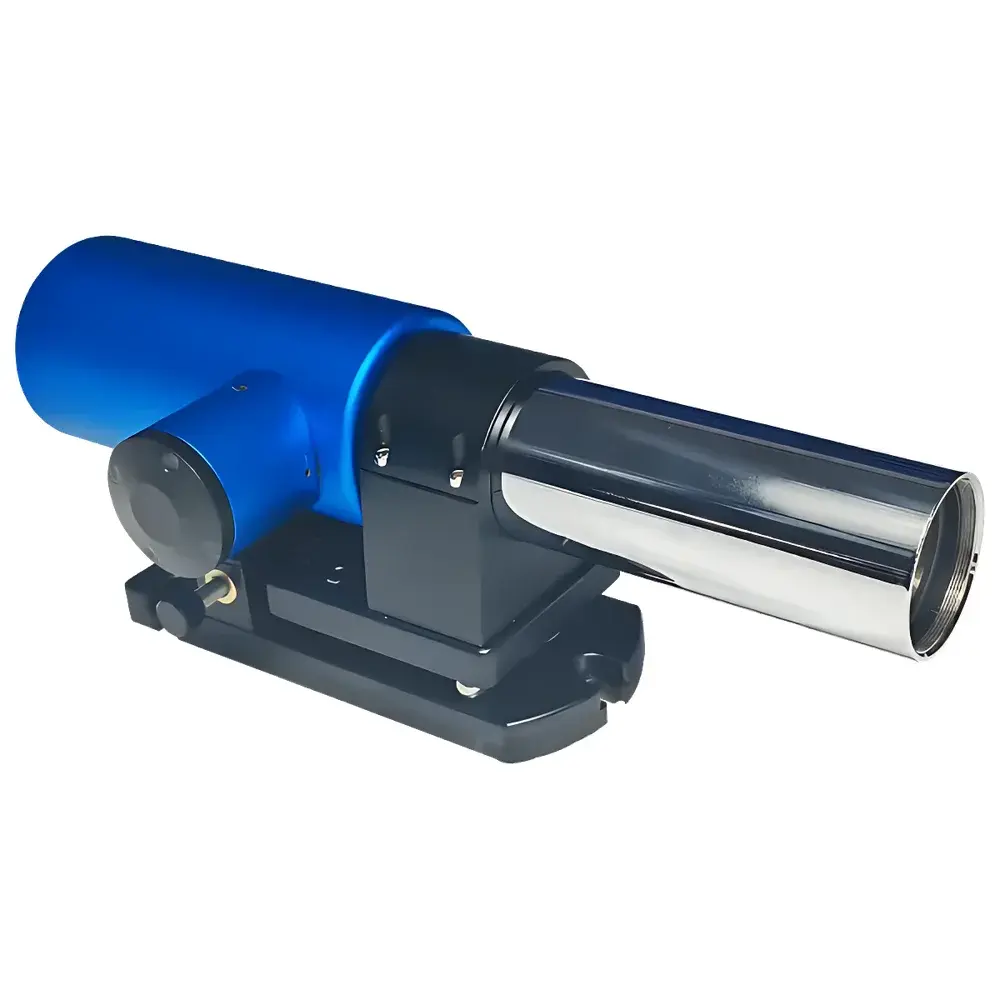
YANRUN MC030-ZJHS200-200HZ High-Precision Dual-Axis Photoelectric Autocollimator
| Brand | YANRUN |
|---|---|
| Origin | Shanghai, China |
| Manufacturer Type | Direct Manufacturer |
| Country of Origin | China |
| Model | MC030-ZJHS200-200HZ |
| Price Range | USD 5,600 – 12,700 |
Overview
The YANRUN MC030-ZJHS200-200HZ is a high-precision dual-axis photoelectric autocollimator engineered for quantitative angular metrology in industrial metrology, precision alignment, and optical calibration environments. It operates on the fundamental principle of optical autocollimation: a collimated beam—generated by projecting a reticle located at the focal plane of a high-stability objective lens—is directed toward a reflective surface (e.g., a precision mirror or optical flat). Upon reflection, the beam retraces its path and reimages the reticle onto a calibrated photodetector array situated at the same focal plane. A mirror tilt α induces a linear displacement ΔS = 4f·α (where f is the effective focal length), enabling sub-arcsecond angular resolution via high-fidelity centroid detection. Unlike manual visual autocollimators, this instrument replaces the eyepiece with a low-noise, high-dynamic-range photodiode array and real-time centroiding firmware, eliminating parallax and observer-dependent bias while supporting traceable, repeatable measurements compliant with ISO 10110-5 and ISO 21098 (optical component testing) and ASTM E284 (standard terminology for optics).
Key Features
- Dual-axis simultaneous measurement (X and Y) with independent signal processing channels, enabling real-time orthogonal angular deviation tracking without mechanical reorientation.
- Real-time electronic eyepiece interface with on-screen crosshair overlay and live centroid visualization—reducing human aiming error to <0.5 arcsec under standard lab conditions.
- High-resolution linear photodetector array (≥1280 × 1024 active pixels) with 16-bit ADC digitization and hardware-based centroid calculation engine (update rate ≥200 Hz).
- Stable, temperature-compensated LED light source (635 nm ±5 nm) with >50,000-hour rated lifetime and intensity stabilization circuitry ensuring consistent illumination across extended operation cycles.
- Modular optical interface supporting interchangeable measurement modules—including long-focus objectives (f = 300 mm / 600 mm), retroreflector adapters, and motorized mirror mounts—for scalable working distance (0.5–30 m) and field-of-view adaptation.
- Embedded firmware with built-in curve fitting (polynomial, spline, least-squares), error band analysis, and ISO 1101-compliant GD&T evaluation routines (straightness, flatness, perpendicularity, parallelism).
Sample Compatibility & Compliance
The MC030-ZJHS200-200HZ is compatible with all optically flat, specularly reflective surfaces meeting minimum reflectivity ≥85% at 635 nm (e.g., polished stainless steel, fused silica flats, aluminum-coated mirrors). It supports both static and dynamic angular monitoring applications—such as rotary stage wobble verification (per ISO 230-2 Annex C) and CNC machine tool squareness validation (per VDI/VDE 2617 Part 6). The system complies with CE marking requirements (EMC Directive 2014/30/EU and Low Voltage Directive 2014/35/EU), meets RoHS 2011/65/EU material restrictions, and provides audit-ready calibration logs aligned with ISO/IEC 17025:2017 documentation practices. Optional NIST-traceable calibration certificates are available upon request.
Software & Data Management
The included YANRUN Autocollimator Control Suite (v4.2+) runs on Windows 10/11 (64-bit) and supports full GLP/GMP data integrity protocols: user-level access control, electronic signatures, immutable audit trails, and 21 CFR Part 11–compliant data archiving. Measurement data—including raw pixel displacement, calculated angles (arcsec), statistical summaries (mean, std dev, Cp/Cpk), and GD&T reports—are exportable in native .CSV, standardized .XLSX (with formula-locked cells), and XML formats compatible with MES and LIMS platforms. Batch report generation, custom template design, and API integration (via RESTful endpoints and .NET SDK) enable seamless deployment in automated QA workflows.
Applications
- Precision installation and in-situ alignment of large-scale machinery (e.g., turbine shafts, laser interferometer bases, synchrotron beamline components).
- Geometric error mapping of multi-axis motion systems—linear axis straightness (ISO 230-1), vertical/horizontal plane flatness, and orthogonal axis squareness.
- Verification of angular stability in high-accuracy rotation stages used in semiconductor lithography and space-borne optical benches.
- Assembly and adjustment of complex optical systems—including laser cavities, interferometric sensors, and adaptive optics testbeds.
- Research-grade angular metrology in university and national metrology labs, including gravitational wave detector alignment support and inertial sensor characterization.
FAQ
What is the angular measurement range and resolution of the MC030-ZJHS200-200HZ?
The standard configuration offers ±1000 arcsec full scale per axis with digital resolution of 0.01 arcsec and repeatability ≤±0.1 arcsec (2σ, after thermal stabilization). Extended-range optics can extend coverage to ±5000 arcsec.
Does the system support external triggering or synchronization with other instruments?
Yes—it features TTL-compatible trigger input/output ports and IEEE-1588 PTP time stamping for synchronized multi-sensor acquisition in distributed metrology networks.
Is calibration traceable to national standards?
All factory calibrations are performed using primary-angle artifacts certified by CNAS-accredited laboratories; optional NIST-traceable calibration packages include uncertainty budgets per GUM (JCGM 100:2008).
Can the software generate ISO 1101–compliant GD&T reports directly?
Yes—the software includes embedded GD&T evaluators for straightness, flatness, perpendicularity, parallelism, and angularity per ISO 1101:2017 and ASME Y14.5–2018, with customizable tolerance zones and graphical deviation overlays.
What environmental conditions are recommended for optimal performance?
Operating temperature: 15–25 °C (±0.5 °C/hour drift limit); relative humidity: 30–60% non-condensing; vibration isolation recommended for measurements below 0.2 arcsec.
Related Products





