
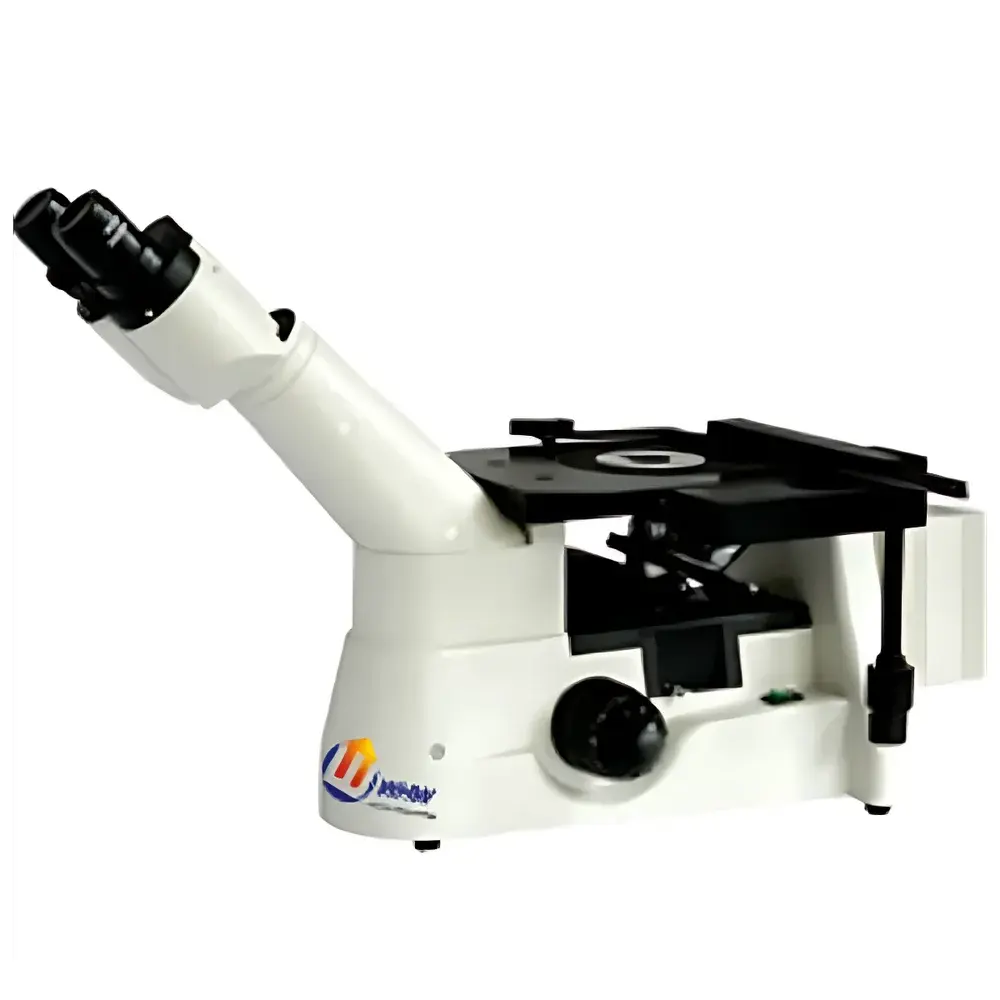
YANRUN 5XB Inverted Polarizing Metallurgical Microscope
| Brand | YANRUN |
|---|---|
| Origin | Shanghai, China |
| Manufacturer Type | Direct Manufacturer |
| Product Type | Inverted |
| Total Magnification | 100×–1000× (optional up to 1600×) |
| Eyepieces | WF10×/22 mm, WF10×/20 mm with crosshair reticle and 0.1 mm scale |
| Objective Lenses | 50×, 80×, 100× (optional) |
| Optical Design | Köhler illumination, polarizing optics with rotatable analyzer (0–360°), removable polarizer/analyzer, adjustable aperture & field diaphragms |
| Stage | Dual-layer mechanical stage (242 × 172 mm), 75 × 50 mm travel range, central circular stage Ø110 mm |
| Focus Mechanism | Coaxial coarse/fine focus with gear-box drive |
| fine focus graduation | 2 µm |
| Illumination | 12 V / 30 W halogen lamp, AC 85–230 V input |
| Filters | Yellow, green, blue interference filters |
| Calibration Tool | 0.01 mm stage micrometer |
| Standard Accessories | Host unit, observation tube, pair of WF10× eyepieces, 0.01 mm micrometer slide, plan apochromatic objectives (4×, 10×, 20×, 40×), full polarizing kit, filter set, spare halogen bulb, certificate of conformity, warranty card, operation manual |
Overview
The YANRUN 5XB Inverted Polarizing Metallurgical Microscope is engineered for high-precision microstructural analysis of opaque, reflective specimens—particularly metallic alloys, ceramics, composites, and semiconductor wafers. Its inverted optical configuration positions the objective lenses beneath the specimen stage, enabling direct observation of large, heavy, or thermally unstable samples without reorientation or mounting constraints. The system integrates a full polarizing optical train compliant with ISO 9001 manufacturing standards and optimized for birefringence evaluation, extinction angle measurement, and anisotropic phase identification in metallurgical and materials science laboratories. Core optical components—including plan apochromatic objectives (4×, 10×, 20×, 40× standard; 50×, 80×, 100× optional), wide-field eyepieces with calibrated reticles, and Köhler illumination—ensure uniform brightness, minimal chromatic aberration, and consistent contrast across the entire field of view. The microscope supports quantitative metallography workflows when paired with third-party image analysis software via C-mount adapter (sold separately).
Key Features
- Inverted optical architecture with bottom-mounted objectives for unrestricted access to large or vertically constrained specimens (e.g., castings, heat-treated plates, mounted cross-sections).
- Full polarizing system featuring a 360° rotatable analyzer and independently removable polarizer, facilitating precise extinction angle determination and stress-induced birefringence mapping.
- Coaxial coarse/fine focusing mechanism with gear-driven fine adjustment (2 µm graduation), ensuring repeatable Z-axis positioning critical for depth-of-field assessment and serial sectioning alignment.
- Dual-layer mechanical stage (242 × 172 mm footprint) with 75 × 50 mm travel range and centered Ø110 mm specimen platform—designed for stable positioning of standard 1″–4″ metallurgical mounts.
- Köhler illumination system with independently adjustable aperture and field diaphragms, delivering optimal resolution and contrast control per magnification level.
- Standard plan apochromatic objective set (4×/0.10, 10×/0.25, 20×/0.40, 40×/0.60) with long working distances (up to 25 mm at 4×), compatible with immersion media and thick cover slips.
- Halogen-based illumination (12 V / 30 W) with universal AC input (85–230 V), integrated voltage regulation, and thermal shielding to maintain color temperature stability during extended operation.
Sample Compatibility & Compliance
The 5XB accommodates standard metallurgical specimens mounted in epoxy, phenolic, or acrylic resins—up to 40 mm in height and 110 mm in diameter. Its inverted design eliminates interference from mounting fixtures or stage clamps during high-magnification imaging. The microscope conforms to ISO 10772:2018 (Metallographic examination — Terminology and definitions) and supports methodologies referenced in ASTM E3, ASTM E407, and ISO 643 for grain size analysis and inclusion rating. Polarization functionality aligns with ASTM E1122 for birefringent phase characterization in duplex steels and titanium alloys. All optical components are manufactured under controlled cleanroom conditions and undergo wavefront testing to meet ISO 10110-5 tolerances for transmitted wavefront error.
Software & Data Management
While the base configuration does not include proprietary image analysis software, the microscope is fully compatible with industry-standard platforms including Image-Pro Premier, Olympus cellSens, and open-source solutions such as FIJI/ImageJ via USB-C or HDMI output (requires optional C-mount video adapter). Digital documentation workflows comply with GLP/GMP data integrity requirements when used with validated acquisition software supporting audit trails, electronic signatures, and metadata embedding (e.g., TIFF + EXIF + XMP). The calibrated reticle eyepieces and included 0.01 mm stage micrometer enable traceable linear measurements per ISO/IEC 17025 calibration guidelines.
Applications
- Quantitative metallography: grain size evaluation (ASTM E112), phase fraction analysis, inclusion rating (ASTM E45), and carbide morphology assessment in tool steels and stainless alloys.
- Polarized light microscopy: identification of anisotropic phases (e.g., graphite flakes in cast iron, martensite variants, beta-phase in Ti-6Al-4V), stress corrosion cracking analysis, and thin-film interference characterization on coated substrates.
- Failure analysis: crack propagation path mapping, intergranular vs. transgranular fracture mode differentiation, and weld HAZ microstructure evaluation.
- Quality control in foundries, heat treatment facilities, and aerospace component manufacturers requiring repeatable, standardized microstructural verification.
- Academic research in physical metallurgy, materials engineering, and solid-state physics laboratories requiring stable polarization geometry and high numerical aperture imaging.
FAQ
Is the 5XB compatible with digital camera systems?
Yes—via optional C-mount adapters (1× or 0.5× reduction), it supports industrial CMOS/CCD cameras with sensor sizes up to 1″. Integration requires external power and software for live capture and measurement.
What is the maximum specimen height supported?
The inverted design permits specimens up to 40 mm tall when placed directly on the stage, with no upper clearance limitation imposed by objective lens position.
Can the polarizing system be disabled for routine brightfield observation?
Yes—the polarizer and analyzer are mechanically removable from the light path, allowing rapid transition between polarized and conventional reflected-light imaging modes.
Does the microscope support oil immersion objectives?
No—standard objectives are dry-type only. Oil immersion capability is not provided in the base configuration or optional 50×/80×/100× lens set.
Is calibration documentation included?
A factory-issued certificate of conformance is supplied, listing optical alignment verification and mechanical stage repeatability test results. NIST-traceable calibration of the 0.01 mm micrometer slide is available upon request.



