
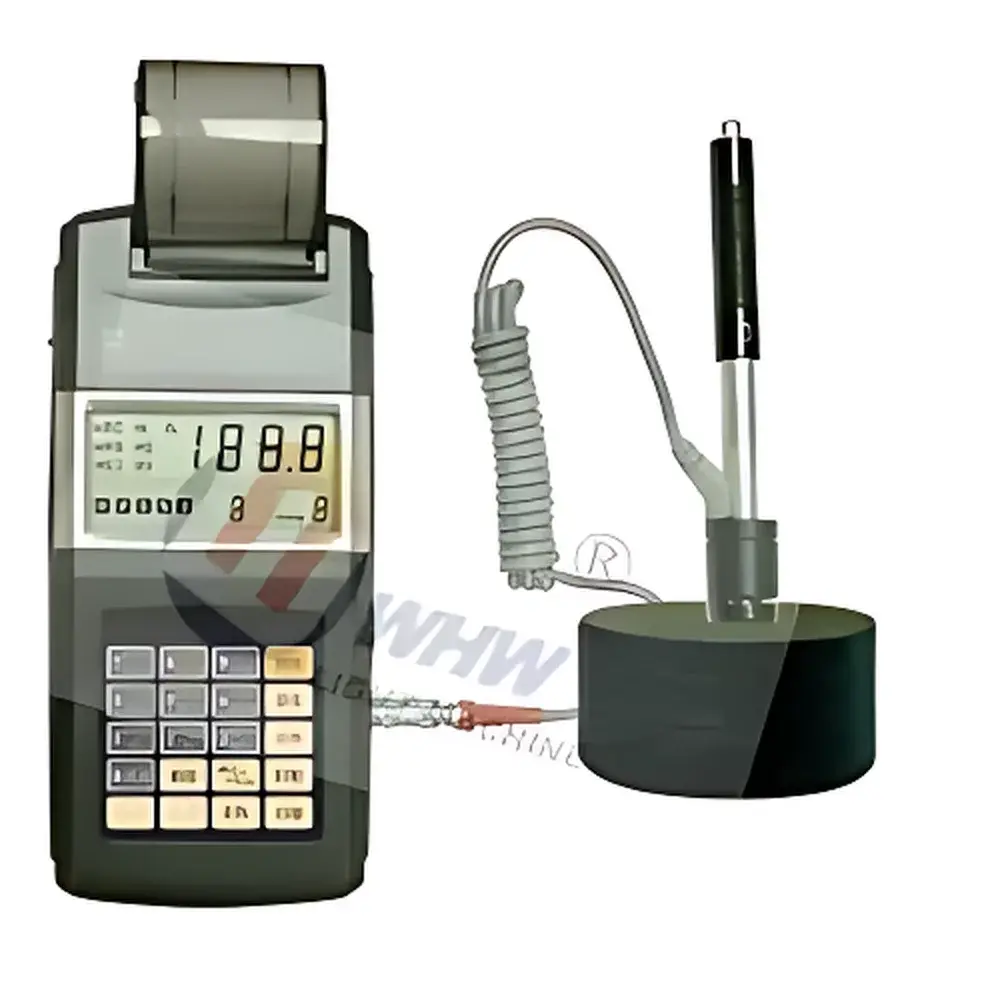
MC010-TH110 Portable Leeb Hardness Tester
| Origin | Shanghai, China |
|---|---|
| Manufacturer Type | Authorized Distributor |
| Origin Category | Domestic (PRC) |
| Model | MC010-TH110 |
| Price | Upon Request |
| Measurement Range | 170–960 HLD |
| Indication Error | ±6 HLD (at HLD = 760 ± 30) |
| Repeatability Error | <6 HLD (at HLD = 760 ± 30) |
| Operating Temperature | 0–40 °C |
| Power Supply | 4.7–6.0 V DC |
| Battery | Ni-MH rechargeable pack (approx. 4 h charging time) |
| Weight | 0.615 kg |
| Hardness Scales Supported | HL, HRB, HRC, HB, HV, HS |
| Tensile Strength Conversion | Yes |
| Impact Device Compatibility | 7 types (auto-recognized, no recalibration required) |
| Data Display | Measured value, average, date/time, impact direction, impact count, material code, hardness value |
| Calibration | Software-based soft calibration function |
| Low-voltage alarm & charging status indicator | Yes |
Overview
The MC010-TH110 Portable Leeb Hardness Tester is an engineered solution for non-destructive, on-site hardness assessment of metallic components under real-world industrial conditions. Based on the Leeb rebound principle—where a tungsten carbide impact body is propelled against the test surface and the ratio of rebound velocity to impact velocity is measured—the instrument delivers rapid, repeatable hardness values in HLD (Leeb Hardness Scale). Unlike static indentation methods (e.g., Brinell or Vickers), the Leeb method requires minimal surface preparation, no optical alignment, and leaves only a microscopic imprint, making it ideal for in-situ evaluation of large, immovable, or geometrically complex parts. Its compact form factor and integrated Ni-MH power system enable operation across manufacturing floors, field service sites, power generation facilities, and warehouse inspection zones without reliance on mains power or external calibration benches.
Key Features
- Multi-scale hardness conversion: Direct calculation and display of equivalent values in HL, HRB, HRC, HB, HV, and HS, plus estimated tensile strength (Rm) based on ASTM A956 and ISO 16859 material-specific algorithms.
- Universal impact device support: Compatible with seven standardized Leeb impact devices (D, DC, D+15, G, C, E, DL)—each automatically detected upon connection; no manual reconfiguration or factory recalibration required.
- Intelligent measurement interface: Real-time display of individual readings, arithmetic mean of up to 32 impacts, impact direction (vertical/horizontal/inverted), material group selection (steel, cast steel, stainless, aluminum, copper, etc.), timestamp, and battery status.
- Field-ready metrology: Built-in soft calibration function allows user-adjusted offset correction against reference blocks per ISO 16859 Annex B, supporting traceable verification without sending the unit to a metrology lab.
- Robust operational envelope: Certified for continuous use between 0 °C and 40 °C; low-voltage warning and LED charging indicator ensure uninterrupted workflow during extended shift-based inspections.
Sample Compatibility & Compliance
The MC010-TH110 is validated for testing wrought and cast ferrous and non-ferrous metals—including structural steels, tool steels, austenitic stainless grades, aluminum alloys, and copper-brass composites—provided minimum thickness exceeds 10 mm and surface roughness remains below Ra 3.2 µm. It conforms to the fundamental requirements of ISO 16859:2013 (Metallic materials — Ultrasonic contact impedance and Leeb hardness testing) and supports compliance workflows aligned with ASME BPVC Section V, ASTM E103, and EN 10045-1. While not certified to FDA 21 CFR Part 11 out-of-the-box, audit-ready data export (via optional USB/RS232 interface) enables integration into GLP/GMP documentation systems when paired with controlled file handling protocols.
Software & Data Management
Data logging is supported via internal memory (up to 500 groups × 32 readings each), with timestamped records exportable in CSV format for post-processing in Excel or LIMS platforms. Optional PC software provides statistical analysis (mean, SD, min/max, histogram), report generation with customizable headers (company logo, inspector ID, job number), and firmware update capability. All stored results retain full metadata: material code, impact direction flag, device type, ambient temperature, and operator-defined batch identifiers—facilitating root-cause analysis during failure investigations or supplier quality audits.
Applications
- In-service inspection of turbine casings, boiler tubes, and pressure vessel welds in power generation plants.
- Rapid sorting of incoming raw materials (billets, forgings, castings) in metal service centers and foundries.
- Hardness mapping of large-diameter shafts, rolls, and extrusion dies where bench-top testers are physically inaccessible.
- Quality gate checks for heat-treated components prior to final machining or assembly.
- Field validation of case depth consistency in carburized or nitrided gears and bearings.
- Forensic metallurgical assessment following mechanical failure events (e.g., fatigue fracture, stress corrosion cracking).
FAQ
What standards does the MC010-TH110 comply with?
It adheres to ISO 16859:2013 and incorporates algorithms consistent with ASTM A956 for hardness scale conversions.
Can the instrument measure curved or irregular surfaces?
Yes—when used with appropriate curvature compensation (via material-specific calibration blocks) and supported by minimum radius guidelines (≥10 mm for convex, ≥30 mm for concave per ISO 16859).
Is third-party calibration certification available?
Yes—accredited calibration certificates (ISO/IEC 17025) can be provided upon request, covering HLD measurement at three points across the range (300, 600, and 850 HLD).
How is measurement repeatability verified in practice?
Users perform five consecutive impacts on a certified reference block; standard deviation must remain ≤3 HLD at 760±30 HLD to confirm system stability.
Does the device support custom material curves?
No—conversion tables are fixed per ISO 16859 Annex A; however, soft calibration offsets allow empirical adjustment for specific alloy lots within certified tolerance limits.



