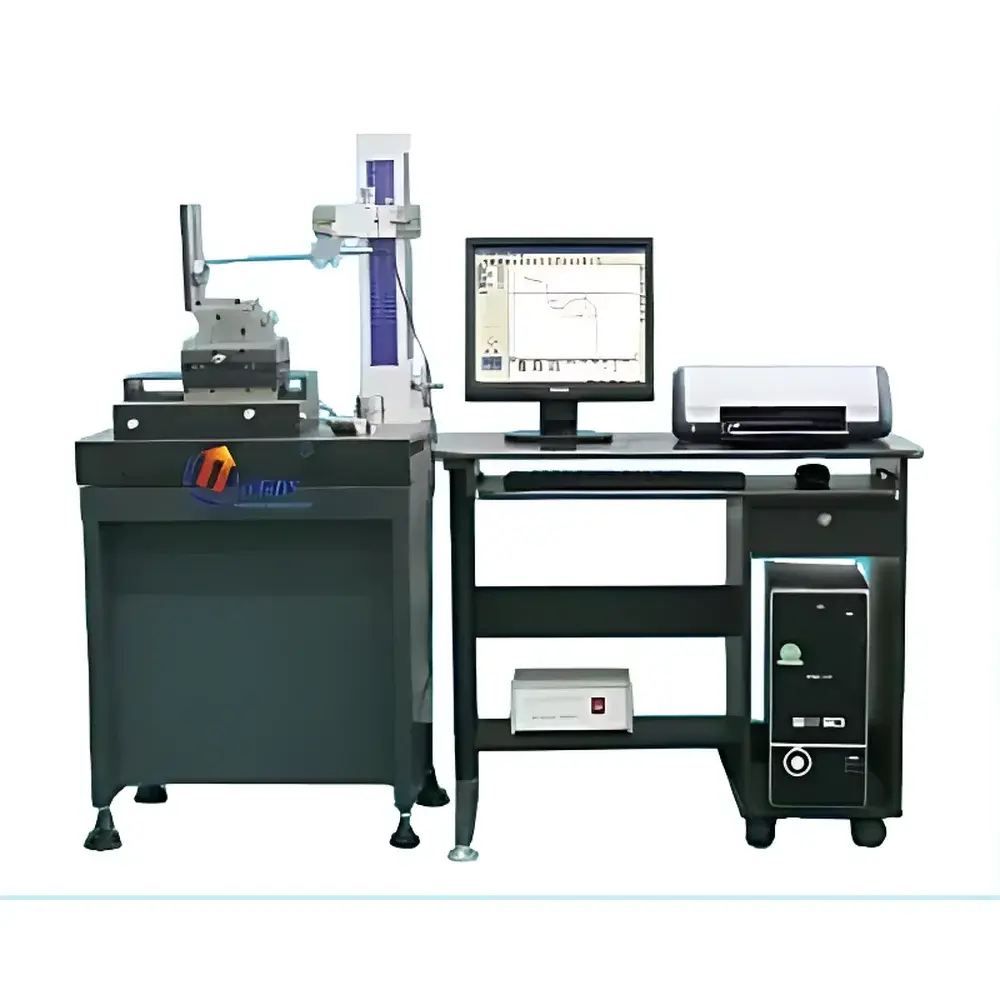
MC012-XZ-150 Precision Contact Profilometer for Geometric Form and Contour Measurement
| Origin | China |
|---|---|
| Manufacturer Type | Authorized Distributor |
| Model | MC012-XZ-150 |
| Motion System | Air-bearing Z-axis & Precision Linear Stage |
| Vertical Resolution | 1/65536 (equivalent to ≤0.03 µm typical interpolation resolution) |
| Vertical Range | 6 mm (extendable) |
| Horizontal Travel (X) | 150 mm |
| Z-axis Linearity Error | ≤0.2 µm over 80 mm |
| X-axis Encoder Accuracy | ≤5 µm over 150 mm |
| Workpiece Capacity | Ø1–100 mm shafts, up to Ø200 mm rings, max length 140 mm |
| Traverse Speed | 0.2–0.4 mm/s (3-step mechanical speed control) |
| Power Supply | 220 V, 50 Hz, 0.5 kW |
| Pneumatic Requirement | Clean, dry air ≥0.5 MPa |
Overview
The MC012-XZ-150 is a high-stability, contact-based precision profilometer engineered for deterministic geometric form measurement of mechanical components. It operates on the principle of stylus tracing—where a diamond-tipped probe physically traverses the surface under controlled vertical (Z) and horizontal (X) motion—to acquire high-fidelity elevation data along linear profiles or cross-sectional contours. Its dual-axis air-bearing Z-stage and precision ground granite base ensure minimal mechanical hysteresis and long-term metrological stability, making it suitable for routine quality control and R&D-grade shape analysis in regulated manufacturing environments. Designed specifically for ISO 1101-compliant geometric dimensioning and tolerancing (GD&T) evaluation, the system delivers traceable measurements of straightness, flatness, parallelism, angularity, circularity, concentricity, profile of a line, and profile of a surface—fully aligned with ASME Y14.5 and ISO GPS standards.
Key Features
- Air-bearing Z-axis stage with open-type configuration ensures ultra-low friction, zero wear, and sustained sub-micron vertical repeatability (≤0.2 µm over 80 mm travel)
- High-resolution linear optical encoder (X-axis) with ≤5 µm accuracy over full 150 mm range, enabling precise positional referencing for multi-point contour stitching
- Dual-mode operation: supports both manual alignment and motorized programmable traverse with three-step mechanical speed control (0.2–0.4 mm/s)
- Integrated Windows-based metrology software featuring real-time waveform display, dynamic scaling, on-screen annotation, and customizable report templates (PDF, CSV, BMP export)
- Full rotational freedom of measured profiles: user-defined axis rotation enables direct comparison against CAD nominal geometry or GD&T reference frames
- Comprehensive error compensation suite—including thermal drift correction, probe tip radius compensation, and Abbe error mapping—enhances measurement fidelity without requiring external calibration artifacts
- Ergonomic fixture interface with modular clamping solutions optimized for shafts (Ø1–100 mm), rings (up to Ø200 mm), and prismatic parts up to 140 mm in length
Sample Compatibility & Compliance
The MC012-XZ-150 accommodates a broad spectrum of machined metallic and non-metallic components common in bearing, automotive, aerospace, and hydraulic component manufacturing. Its 6 mm vertical range and ±3 mm effective sensing envelope support deep groove, raceway, and seal groove profiling—even on hardened steel surfaces (HRC 58–62). All measurement routines comply with ISO 5436-1 (profile measurement standards), ISO 12179 (stylus instrument calibration), and ASTM E1155 (linear profile evaluation). The system’s architecture supports audit-ready documentation: raw data files retain full timestamped metadata, and software logs all operator actions, parameter changes, and calibration events—facilitating GLP/GMP compliance and FDA 21 CFR Part 11 readiness when deployed with validated IT infrastructure.
Software & Data Management
The embedded metrology platform runs natively on Windows 10/11 and features a dual-interface design: mouse-driven graphical workflow for rapid setup and keyboard-shortcut mode (e.g., F2 for zeroing, Ctrl+R for report generation) for high-throughput lab environments. All acquired profiles are stored in a structured binary format (.mpr) with embedded calibration coefficients and environmental metadata (ambient temperature, air pressure, operator ID). Batch processing allows automated evaluation of multiple profiles against tolerance bands defined per ASME Y14.5 datums. Export modules generate ISO-standard GD&T reports—including deviation heatmaps, statistical process control (SPC) charts (X̄-R, Cp/Cpk), and overlay comparisons against STEP or DXF reference geometries.
Applications
- Bearing industry: raceway curvature analysis, chamfer angle verification, groove symmetry assessment, and waviness evaluation per ISO 15243
- Hydraulic pump components: vane profile conformity, cam ring roundness, and piston land flatness validation
- Shaft and pin inspection: taper quantification, shoulder perpendicularity, and journal cylindricity via multi-section stitching
- Tooling and mold verification: EDM electrode profile fidelity, injection nozzle orifice edge geometry, and die cavity depth uniformity
- Academic metrology labs: teaching platform for contact profilometry fundamentals, uncertainty budgeting, and GD&T implementation case studies
FAQ
What standards does the MC012-XZ-150 support for GD&T evaluation?
It fully implements ISO 1101, ISO 5436-1, and ASME Y14.5 requirements for line profile, surface profile, straightness, circularity, and angularity assessments.
Is the system compatible with third-party calibration services?
Yes—the Z-axis and X-axis encoders accept NIST-traceable interferometric calibration; certified calibration certificates are issued per ISO/IEC 17025 by accredited providers.
Can measurement data be integrated into enterprise MES or QMS platforms?
Raw .mpr files and exported CSV reports include machine-readable metadata headers, enabling seamless ingestion into Siemens Opcenter, ETQ Reliance, or custom SQL-based quality databases.
Does the software support multi-language UI and report generation?
The interface defaults to English; localized report templates (German, French, Japanese) are available upon request and configured during installation.
What maintenance is required for the air-bearing stage?
Annual inspection of air filter integrity and pressure regulator calibration is recommended; no lubrication or periodic reconditioning is needed due to the non-contact design.