
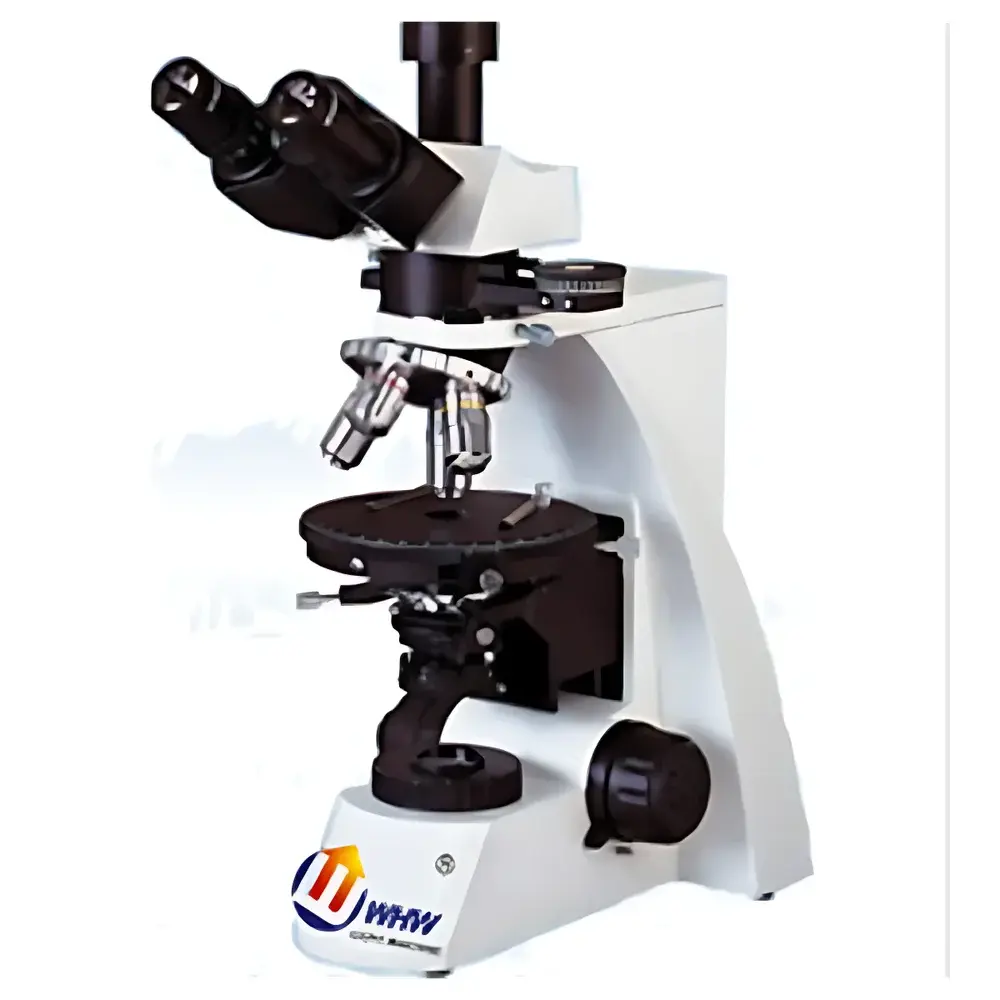
YANRUN PM-12 Transmission Polarizing Microscope
| Brand | YANRUN |
|---|---|
| Origin | Shanghai, China |
| Manufacturer Type | Direct Manufacturer |
| Origin Category | Domestic (China) |
| Model | PM-12 Transmission Polarizing Microscope |
| Price | USD 1 (Reference Only – Contact for Quotation) |
Overview
The YANRUN PM-12 Transmission Polarizing Microscope is a precision-engineered optical instrument designed for quantitative birefringence analysis and anisotropic material characterization in geological, materials science, pharmaceutical, and polymer laboratories. Built on the principles of transmitted-light polarized light microscopy, it enables high-contrast visualization and measurement of optical path differences via interference color interpretation (Michel-Lévy chart), retardation quantification, and crystallographic orientation mapping. The system employs strain-free optical pathways throughout its optical train—including stress-free objectives, compensators, and beam-splitting prisms—to ensure minimal artifact introduction during sensitive polarization measurements. Its modular intermediate tube design supports rapid configuration switching between standard brightfield, orthogonal polarized (crossed Nicols), and compensated observation modes—critical for routine identification of mineral phases, polymer crystallinity, liquid crystal domains, and pharmaceutical polymorphs.
Key Features
- Hinged trinocular head with 30° inclination, adjustable interpupillary distance, and 100% light path allocation to camera port for documentation-grade imaging
- Strain-free plan achromatic polarizing objectives: PM-12A series (designed for 0.17 mm cover glass) and PM-12B series (cover-glass-free), both featuring spring-loaded front lenses for safe high-magnification operation
- Rotatable polarizer with four calibrated positions (0°, 90°, 180°, 270°) and vernier scale (6′ resolution); built-in analyzer with 90° rotation capability and 12′ vernier readout
- Abbe condenser (N.A. 1.25), vertically adjustable and equipped with iris diaphragm and field diaphragm for Köhler illumination optimization
- 360° rotating mechanical stage (Φ150 mm) with concentric locking, fine-positioning vernier (6′ graduation), and centering adjustment
- Integrated compensator suite: full-wave (λ), quarter-wave (λ/4), and quartz wedge retarders—enabling precise retardation measurement across 0–550 nm range
- Coaxial coarse/fine focusing mechanism with 2 µm fine-focus graduation, upper/lower limit stops, and mechanical lock for vibration resistance during extended acquisition
- Four-objective revolving nosepiece with centering adjustment for precise alignment of optical axes across magnifications
Sample Compatibility & Compliance
The PM-12 accommodates standard 26 × 76 mm microscope slides and 18 × 18 mm coverslips (0.17 mm thickness for PM-12A objectives). It supports thin-section petrographic preparations, polymer films, pharmaceutical tablet cross-sections, biological birefringent tissues (e.g., collagen, starch granules), and liquid crystal cells. All optical components comply with ISO 10934-1 (Microscopy — Nomenclature of components for polarizing microscopes) and meet ASTM D4125 (Standard Practice for Microscopical Examination of Asbestos) requirements for polarization fidelity. The instrument’s mechanical stability and thermal management (via low-heat 6 V / 20 W halogen illumination) support GLP-compliant long-duration observation sessions. Optional USB/VIDEO and CCD interfaces enable integration into regulated environments requiring audit-trail-capable image capture per FDA 21 CFR Part 11 guidelines when paired with compliant software.
Software & Data Management
While the PM-12 operates as a standalone optical platform, its trinocular port and standardized C-mount or 23.2 mm photo-tube interface facilitate seamless coupling with third-party digital imaging systems. Compatible software packages—including ImageJ (with Polarization Analyzer plugin), Olympus cellSens, and Media Cybernetics Image-Pro Premier—support quantitative birefringence mapping, retardation calibration using reference standards (e.g., quartz wedge), and automated crystal orientation indexing. All optional digital accessories (USB cameras, video adapters, CCD lenses) are supplied with drivers compatible with Windows 10/11 and Linux-based acquisition platforms. Metadata embedding (magnification, objective ID, retarder type, analyzer angle) is supported via EXIF extension protocols to ensure traceability in quality-controlled workflows.
Applications
- Geological petrography: Identification and extinction angle measurement of silicate minerals in thin sections
- Materials science: Assessment of residual stress distribution in injection-molded thermoplastics and fiber-reinforced composites
- Pharmaceutical development: Discrimination of crystalline vs. amorphous domains in active pharmaceutical ingredients (APIs) and excipients
- Polymer characterization: Quantification of spherulite size, lamellar thickness, and crystallinity index via interference color analysis
- Liquid crystal research: Domain alignment evaluation under electric field stimulation using real-time polarized video capture
- Forensic analysis: Fiber identification based on birefringence magnitude, sign, and dispersion staining behavior
FAQ
What is the maximum usable magnification for oil-immersion observation?
The PM-12A 100× objective (NA 1.25) supports oil-immersion use up to 1000× total magnification when paired with a 10× wide-field eyepiece.
Can the PM-12 be used for quantitative retardation measurements?
Yes—integrated λ, λ/4, and quartz wedge compensators enable direct retardation measurement from 0 to >1000 nm, calibrated against NIST-traceable standards.
Is the halogen illumination stable enough for time-lapse birefringence imaging?
The 6 V / 20 W regulated halogen source features constant-current drive and thermal shielding, delivering <±0.5% intensity drift over 60-minute continuous operation.
Does the microscope support DIC or phase contrast?
No—the PM-12 is optimized exclusively for polarized light transmission; DIC and phase contrast require separate condenser and objective modifications not included in this model.
What certifications apply to the PM-12 for laboratory accreditation?
The instrument conforms to ISO 9001 manufacturing controls; CE marking applies to electrical safety (EN 61010-1); full ISO/IEC 17025 validation requires site-specific performance qualification per user SOPs.






