
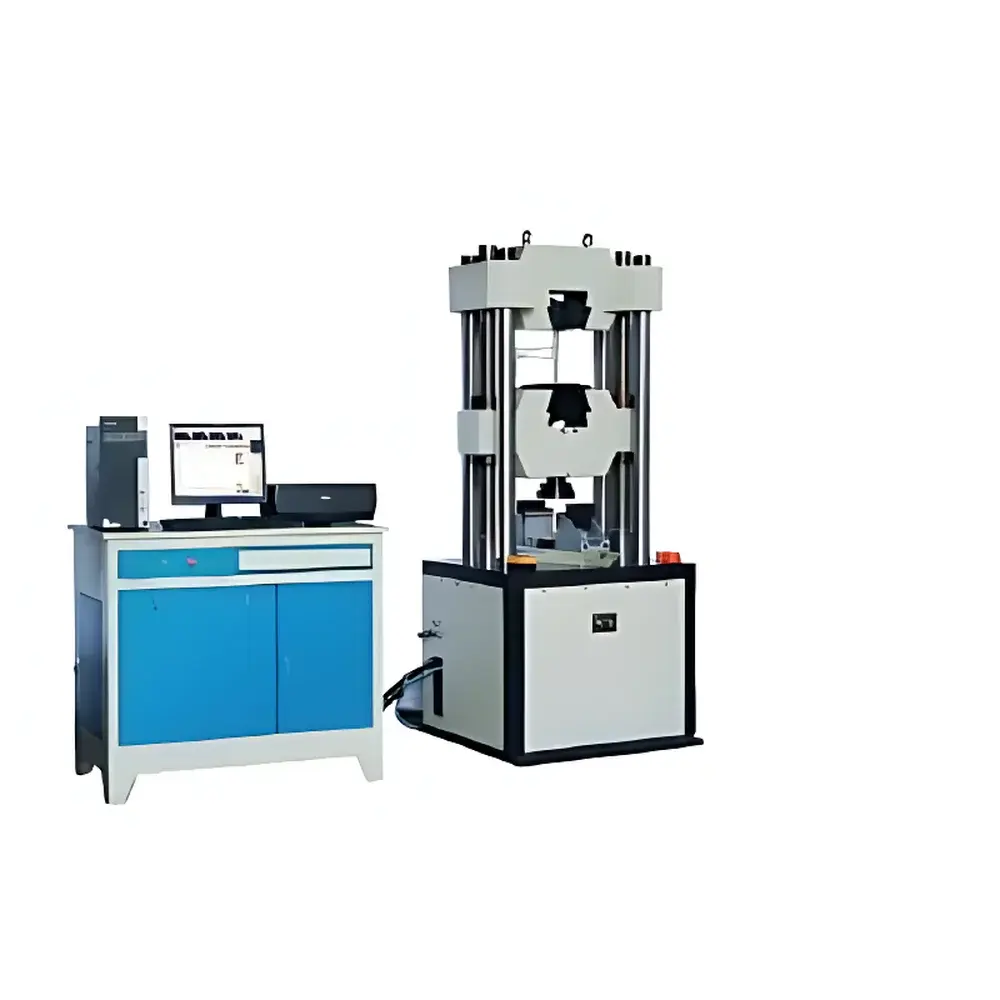
MC009-WAW-600D Microcomputer-Controlled Electro-Hydraulic Servo Universal Testing Machine (Four-Column, 600 kN)
| Origin | Shanghai, China |
|---|---|
| Manufacturer Type | Authorized Distributor |
| Origin Category | Domestic (China) |
| Model | MC009-WAW-600D |
| Pricing | Available Upon Request |
| Max Test Load | 600 kN |
| Force Range | 50–600 kN |
| Force Accuracy | ≤ ±1% of reading |
| Force Resolution | 0.01 kN |
| Displacement Resolution | 0.01 mm |
| Deformation Measurement Accuracy | 0.01 mm |
| Max Tensile Space | 650 mm |
| Max Compression Space | 380 mm |
| Piston Stroke | 150 mm |
| Round Specimen Grip Range | Φ13–Φ40 mm |
| Flat Specimen Thickness Capacity | 0–15 mm |
| Flat Specimen Max Width | 75 mm |
| Compression Platen Diameter | φ160 mm |
| Bend Span Adjustment | Up to 450 mm |
| Bend Roller Diameter | Φ30 mm |
| Bend Roller Width | 120 mm |
| Max Deflection for Bending | 150 mm |
| Max Piston Speed | 50 mm/min |
| Clamping Method | Automatic Hydraulic Clamping |
| Host Dimensions (W×D×H) | 900 × 600 × 2315 mm |
| Host Weight | 1,300 kg |
| Control Cabinet Dimensions (W×D×H) | 800 × 600 × 1130 mm |
| Control Cabinet Weight | 300 kg |
Overview
The MC009-WAW-600D is a high-capacity, microcomputer-controlled electro-hydraulic servo universal testing machine engineered for precision mechanical property evaluation of metallic and non-metallic materials under tension, compression, and bending loads. Designed with a four-column, oil-cylinder-underneath structural architecture, this system delivers stable load application and high reproducibility across extended test cycles. Its hydraulic actuation—driven by a high-pressure gear pump, precision servo valve, and closed-loop pressure control—enables smooth, programmable force and displacement profiles in accordance with ASTM E4, ASTM E8/E8M, ISO 6892-1, and GB/T 228.1–2021 standards. The machine is widely deployed in metallurgical R&D laboratories, aerospace component qualification facilities, civil engineering material certification centers, and university mechanics research departments where traceable, GLP-compliant mechanical testing is required.
Key Features
- Four-column rigid frame with oil-cylinder-underneath configuration ensures minimal frame deflection and high axial alignment accuracy during high-load testing.
- Electro-hydraulic servo control system featuring a proportional servo valve, high-bandwidth pressure transducer, and real-time PID feedback loop for precise force-rate (kN/s), displacement-rate (mm/min), or strain-rate (mm/mm/s) control modes.
- Motor-driven crosshead adjustment via reducer-chain-screw mechanism enables rapid, repeatable setup of tensile (up to 650 mm) and compression (up to 380 mm) test spaces.
- Automatic hydraulic clamping system with dual-stage pressure regulation provides consistent gripping force across round (Φ13–Φ40 mm) and flat (0–15 mm thick, up to 75 mm wide) specimens.
- Integrated safety interlocks: over-load protection (>103% full scale), upper/lower piston travel limits, emergency stop circuitry, and software-enforced parameter boundaries compliant with ISO 12100 and EN 60204-1.
- Modular hardware architecture supports optional extensometry integration (e.g., YYU-25/50 clip-on extensometer) for direct strain measurement per ASTM E83 or ISO 9513 Class 1 requirements.
Sample Compatibility & Compliance
The MC009-WAW-600D accommodates standardized test specimens per ASTM E8, ISO 6892-1, GB/T 228.1, and EN 10002-1. It supports round bar, flat sheet, welded joints, castings, and composite laminates within defined dimensional envelopes. Compression testing utilizes a φ160 mm hardened steel platen; three-point bending employs adjustable supports (max span 450 mm) with Φ30 mm rollers (120 mm width). All force, displacement, and deformation signals are conditioned and digitized at ≥10 kHz sampling rate, meeting data integrity requirements for ISO/IEC 17025 accredited testing labs. System calibration certificates conform to ISO 7500-1 Class 1 verification criteria, and software audit trails comply with FDA 21 CFR Part 11 principles when configured with electronic signature modules.
Software & Data Management
The proprietary Windows-based control software provides a unified interface for test programming, real-time monitoring, post-test analysis, and report generation. Users define multi-step test protocols—including ramp-hold-relax sequences, cyclic loading, and creep hold segments—via intuitive graphical scripting. Raw data (force, displacement, extensometer output) is stored in binary format with metadata embedding (operator ID, sample ID, environmental conditions, calibration timestamps). Export options include CSV, XML, and PDF reports formatted to ISO 5893 and ASTM E1392 templates. Full file management supports version-controlled parameter sets, encrypted backup archives, and role-based access control (administrator, technician, reviewer). Software updates are delivered via signed firmware packages with SHA-256 hash validation.
Applications
This system is routinely employed for tensile strength and yield point determination of structural steels (ASTM A615, A706), aluminum alloys (AMS 4027), titanium forgings (ASTM B348), and high-strength composites. In civil engineering, it validates concrete cylinder compressive strength (ASTM C39), masonry prism behavior (ASTM E447), and rebar bond performance. Aerospace users apply it for qualification of fasteners (NASM 1312), landing gear components (SAE AMS 2300), and thermal barrier coating adhesion (ASTM C633). Academic applications include constitutive modeling of viscoplastic polymers, fracture toughness pre-cracking (ASTM E399), and fatigue crack growth threshold studies (ASTM E647) when integrated with optional dynamic accessories.
FAQ
What international standards does the MC009-WAW-600D support out-of-the-box?
The system complies with force measurement accuracy per ISO 7500-1 Class 1, displacement resolution per ISO 2041, and software functionality aligned with ISO 17025:2017 Annex A2 for automated testing systems.
Can the system be integrated into an existing LIMS or MES environment?
Yes—via OPC UA or TCP/IP API interfaces, raw test data and summary metrics can be streamed to third-party laboratory information management systems using configurable JSON or XML payloads.
Is third-party calibration and traceability documentation provided?
Each unit ships with a NIST-traceable calibration certificate issued by an ILAC-MRA accredited metrology lab, covering load cell, displacement encoder, and pressure transducer channels.
What maintenance intervals are recommended for the hydraulic power unit?
Oil analysis and filter replacement are advised every 1,500 operating hours or annually, whichever occurs first; scheduled inspection of servo valve hysteresis and pump volumetric efficiency is recommended at 5,000-hour intervals.
Does the software support multi-language UI and report generation?
The interface supports English, German, French, Spanish, and Simplified Chinese; report templates are fully customizable and exportable in locale-specific units and terminology.



