
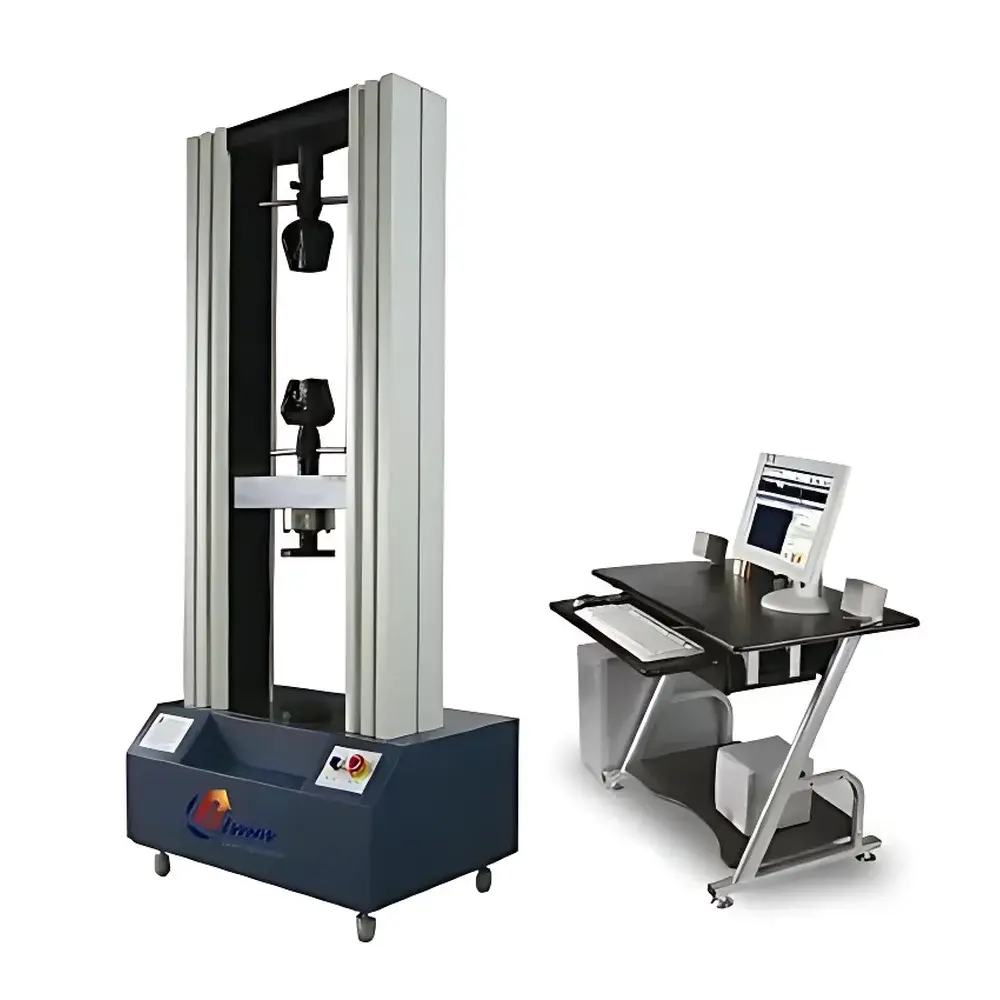
MC009-WDW-100 Microcomputer-Controlled Electromechanical Universal Testing Machine
| Origin | Shanghai, China |
|---|---|
| Manufacturer Type | Authorized Distributor |
| Origin Category | Domestic (China) |
| Model | MC009-WDW-100 |
| Instrument Type | Electromechanical Universal Testing Machine |
| Maximum Test Load | 100 kN |
| Force Range | 2–100% of full scale (optional 0.4–100%) |
| Accuracy Class | Class 1 (optional Class 0.5) |
| Displacement Resolution | ≥0.01 mm |
| Tensile Test Space | 700 mm |
| Compressive Test Space | 800 mm |
| Compression Width | 400 mm |
| Power Supply | 220 V AC |
| Operating Temperature | Room temperature to 35 °C |
| Frame Type | Portal (Dual-Column) |
| Standard Fixtures | Flat jaw (0–7 mm, 7–14 mm), Round jaw (φ4–9 mm, φ9–14 mm), Compression platens |
Overview
The MC009-WDW-100 Microcomputer-Controlled Electromechanical Universal Testing Machine is a high-precision, dual-column electromechanical system engineered for static mechanical property evaluation of metallic and non-metallic materials in accordance with ISO 6892-1, ASTM E8/E21, ASTM D638/D790, GB/T 228.1, GB/T 1040, and other internationally recognized standards. It employs a closed-loop servo motor drive system coupled with high-stability load cells, precision ball-screw transmission, and real-time digital signal processing to deliver repeatable force control, displacement tracking, and strain monitoring. The machine operates on the principle of controlled axial loading—applying tensile, compressive, or flexural loads at programmable rates while continuously acquiring synchronized force-displacement data. Its modular architecture supports integration with environmental chambers, extensometers, and high-temperature furnaces, enabling compliance with GLP/GMP test protocols and regulatory audit requirements such as FDA 21 CFR Part 11 when paired with validated software.
Key Features
- Automatic test termination upon specimen fracture, ensuring operator safety and data integrity.
- Intelligent auto-ranging: seamless switching between four force ranges (1 kN, 2 kN, 5 kN, 100 kN) to maintain optimal signal-to-noise ratio across low- and high-load regimes.
- Real-time data logging: all raw acquisition parameters—including load, crosshead displacement, time stamps, and control mode—are saved automatically without user intervention.
- Programmable speed profiles: supports both stepwise and continuous variable-rate motion control, including ramp-hold-ramp sequences compliant with ISO 6892-1 Annex C.
- Multi-mode closed-loop control: selectable feedback channels include load control, displacement control, strain control (with external extensometer input), and programmed waveform control.
- Comprehensive curve visualization: stress–strain, force–displacement, force–time, and displacement–time plots are generated in real time and exportable in CSV, PDF, or image formats.
- Dual-limit protection: hardware-based mechanical stops complement software-defined travel limits to prevent over-travel damage.
- Overload protection: system halts immediately when applied load exceeds 102–110% of selected range, preventing transducer saturation or frame deformation.
- Batch testing capability: pre-configured test templates enable unattended execution of identical test sequences across multiple specimens, reducing operator dependency and inter-test variability.
- Calibration traceability: built-in calibration routines support NIST-traceable load cell verification using certified reference standards.
Sample Compatibility & Compliance
The MC009-WDW-100 accommodates standardized and custom-shaped specimens per ASTM E8, ISO 6892-1 (tensile bars), ASTM D638 (plastics), ASTM D790 (flexure), ISO 178 (bending), and EN 13115 (composites). Standard fixtures include flat-faced jaws (0–7 mm and 7–14 mm thickness), round jaws (φ4–9 mm and φ9–14 mm diameter), and parallel compression platens (400 mm width). Optional accessories extend applicability to specialized geometries: threaded rod grips, woven strap clamps, wire rope terminations, rubber dumbbell dies, peel adhesion fixtures, shear plates, wood-based panel testers, and high-temperature furnace assemblies (up to 1200 °C). All configurations comply with ISO/IEC 17025 requirements for test method validation, and fixture interchangeability is verified through repeatability studies per ISO 5893.
Software & Data Management
The embedded Windows-based control software provides full IEC 62304-compliant architecture with role-based access control, electronic signatures, and full audit trail functionality—including user login history, parameter modification logs, test start/stop timestamps, and raw data versioning. Data files adhere to ASTM E1447 metadata conventions and embed instrument configuration, calibration status, environmental conditions, and operator ID. Reporting modules generate customizable PDF reports conforming to ISO/IEC 17025 Annex A and FDA 21 CFR Part 11 Subpart B requirements, including digital signatures, tamper-evident hashing, and secure export encryption. Raw data exports support third-party statistical analysis platforms (e.g., JMP, Minitab) via ASCII-delimited formats with SI-unit annotations.
Applications
This system is routinely deployed in QC laboratories, R&D centers, and contract testing facilities for mechanical characterization of structural alloys, aerospace composites, polymer films, elastomers, ceramics, biomedical implants, packaging materials, and construction-grade timber. Typical use cases include yield point determination per ASTM E8, tensile strength mapping across heat-treated batches, creep compliance assessment under sustained loading, modulus gradient profiling in functionally graded materials, and failure mode analysis during post-yield deformation. Its compatibility with environmental enclosures enables low-temperature ductility evaluation (−70 °C) and elevated-temperature relaxation testing (up to 1200 °C), supporting qualification under ASME BPVC Section II and ISO 204.
FAQ
What international standards does the MC009-WDW-100 support out of the box?
It natively implements test procedures aligned with ISO 6892-1, ASTM E8/E21, ASTM D638/D790, GB/T 228.1, and EN ISO 15630, with software templates preconfigured for common test types.
Can the system be validated for regulated environments (e.g., pharmaceutical or aerospace)?
Yes—when equipped with IQ/OQ documentation packages, Part 11-compliant software, and NIST-traceable calibration certificates, it meets FDA, EMA, and AS9100 audit requirements.
Is external extensometry supported for true strain measurement?
Yes—the system provides analog and digital inputs for clip-on, video, or laser extensometers, enabling automatic switching between crosshead and extensometer-derived strain channels.
What is the maximum sampling rate for force and displacement data?
Raw acquisition occurs at 1 kHz; filtered and processed data are logged at user-selectable intervals down to 10 ms resolution.
Does the machine support multi-step cyclic testing?
Yes—programmable waveform control allows definition of complex load/displacement profiles, including tension-compression cycles, dwell periods, and ramp reversal sequences per ASTM D3479.



