
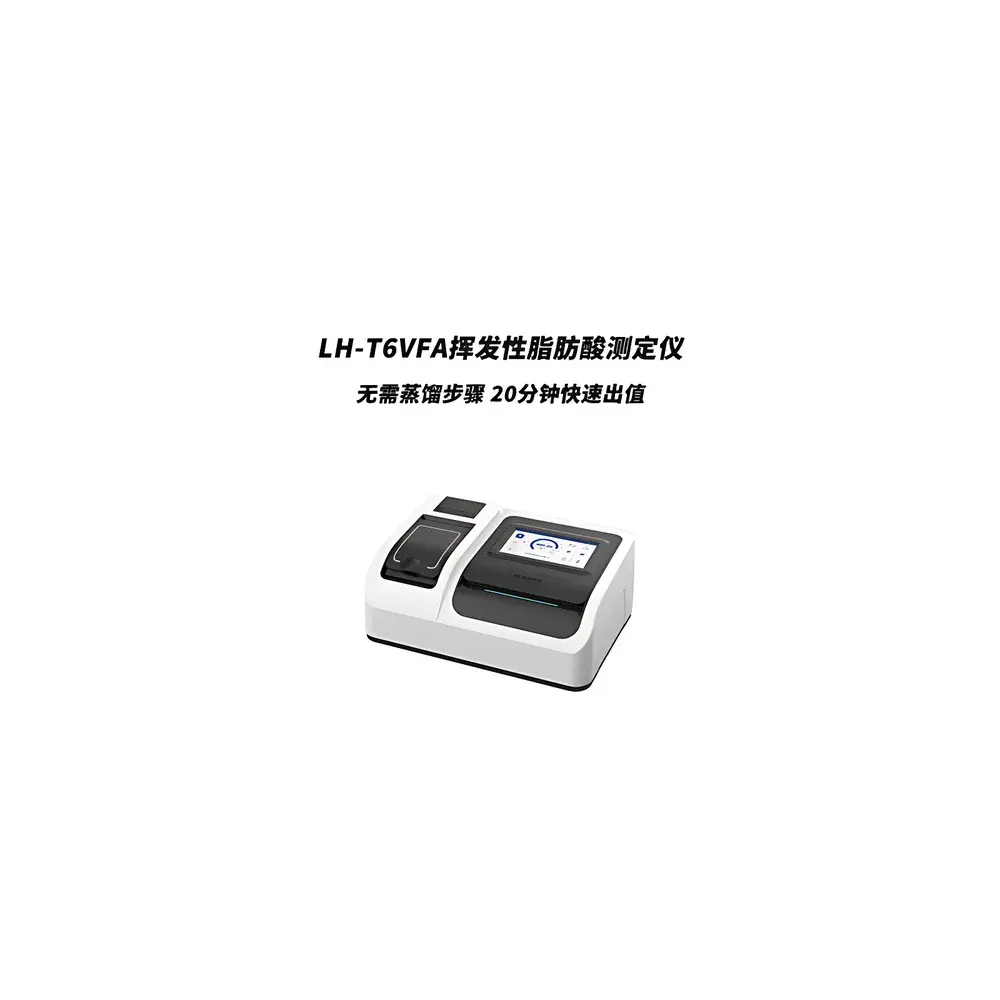
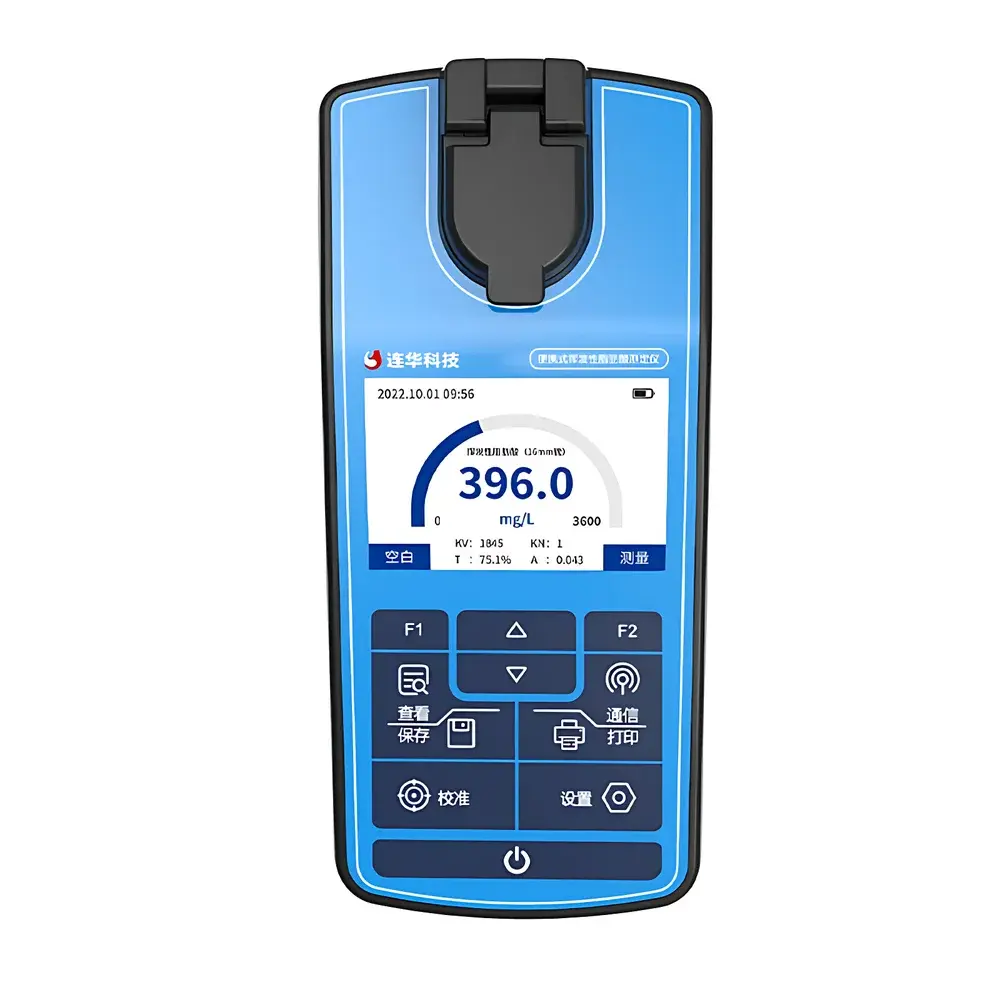
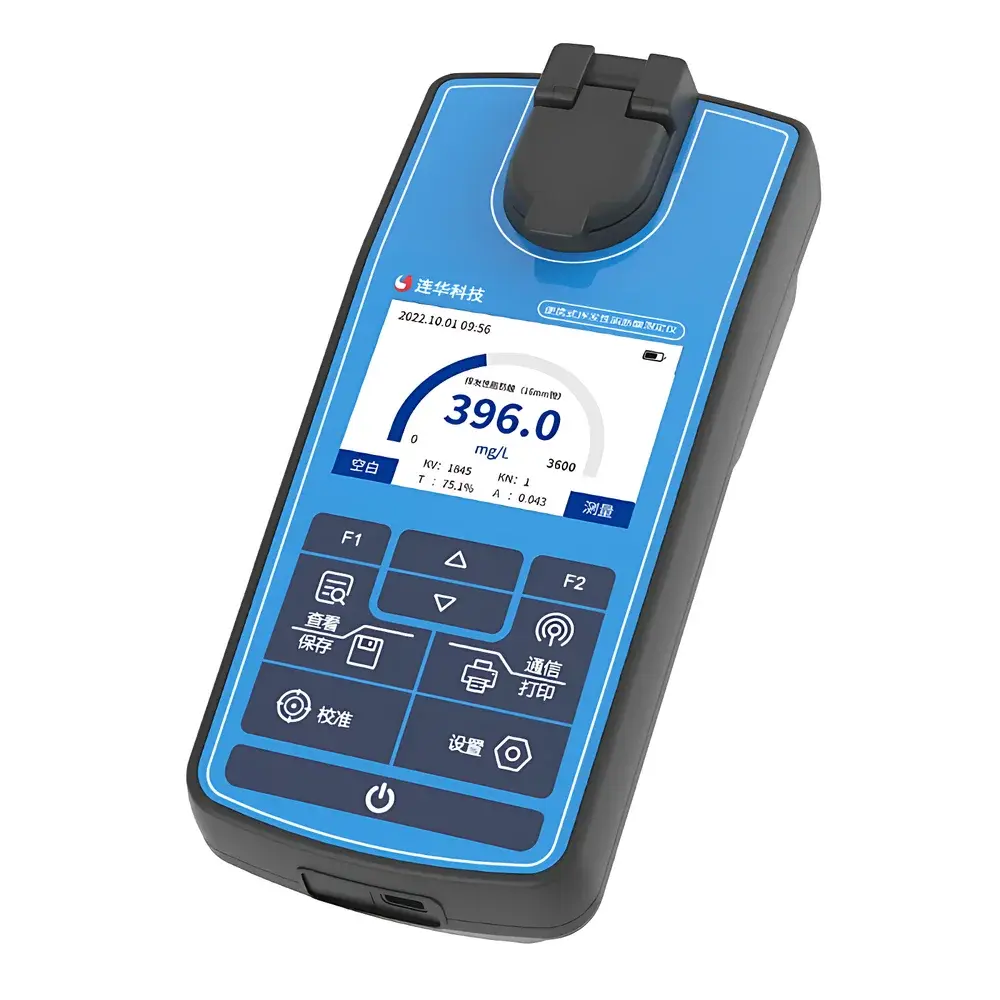
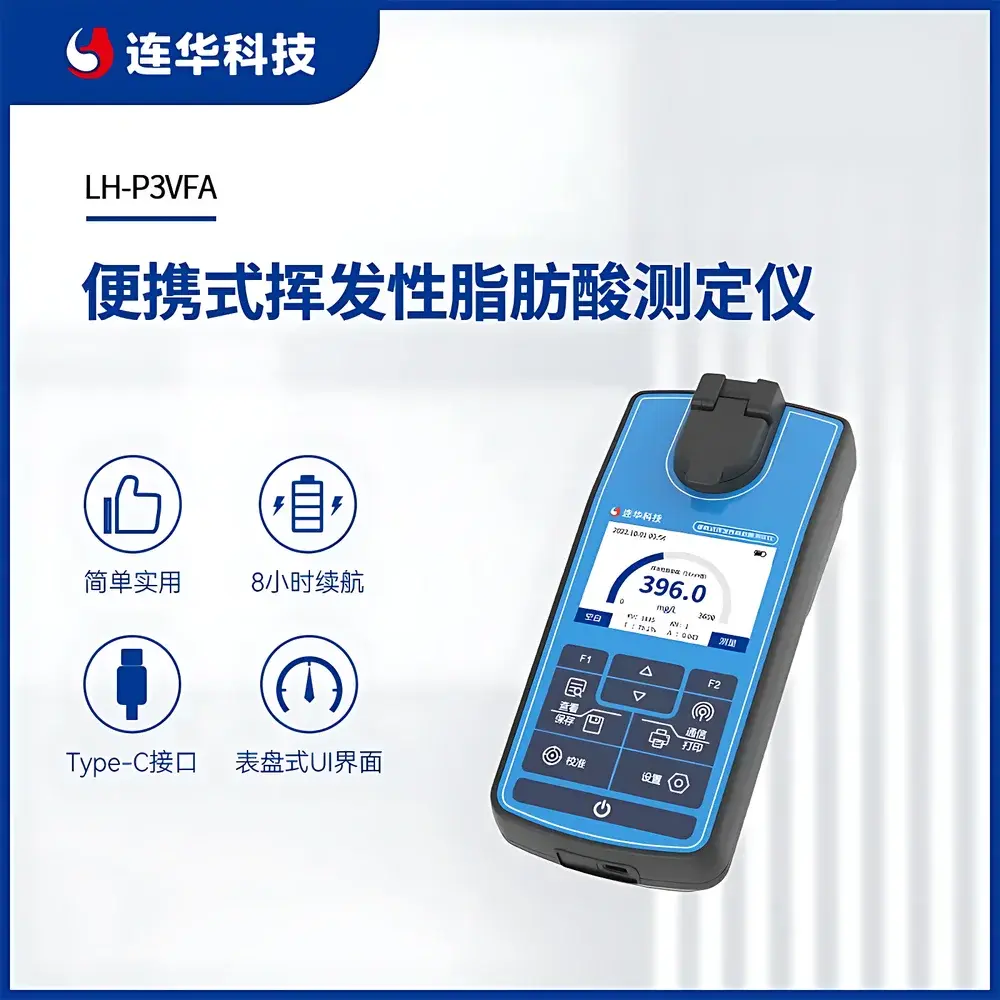
Lianhua Tech Qinglan Series Portable Volatile Fatty Acids (VFA) Analyzer LH-P3VFA
| Brand | Lianhua Tech |
|---|---|
| Origin | Beijing, China |
| Manufacturer Type | Direct Manufacturer |
| Country of Origin | China |
| Model | LH-P3VFA |
| Instrument Type | Portable VFA Analyzer |
| Measurement Principle | Esterification-based Spectrophotometry |
| Analysis Time | ≤20 min per sample |
| Display Units | mg/L or mmol/L (auto-switchable) |
| Power Supply | Built-in rechargeable Li-ion battery (8 h field operation) |
| Interface | USB Type-C (data transfer & charging) |
| Optical System | Calibratable light source with enhanced stability and longevity |
Overview
The Lianhua Tech Qinglan Series Portable Volatile Fatty Acids (VFA) Analyzer LH-P3VFA is a field-deployable analytical instrument engineered for rapid, on-site quantification of volatile fatty acids—including acetic, propionic, butyric, and valeric acids—in aqueous environmental matrices. It operates on a validated esterification-spectrophotometric principle: under controlled heating, VFAs react with acidic ethylene glycol to form alkyl esters; these esters subsequently condense with hydroxylamine to yield hydroxamic acids, which—under ferric ion catalysis—form stable, chromogenic ferric hydroxamate complexes exhibiting characteristic absorbance at 510 nm. This method eliminates time-consuming distillation or extraction steps required by classical titrimetric or GC-based protocols, enabling reliable VFA determination directly in wastewater influent, anaerobic digester samples, leachate, and surface water within 20 minutes. Designed for compliance with routine monitoring workflows under ISO 11923 (water quality — determination of volatile fatty acids — spectrophotometric method) and aligned with EPA Method 375.1 adaptation principles, the LH-P3VFA delivers reproducible results without laboratory infrastructure dependency.
Key Features
- Field-optimized esterification-spectrophotometric assay eliminating distillation, reducing analysis time to ≤20 minutes per sample
- Auto-switching display between mg/L and mmol/L units—calibrated for standard VFA mixtures (acetic acid equivalent)
- Integrated optical calibration capability: user-accessible light source alignment and intensity verification ensures long-term photometric accuracy and minimizes drift
- Dual-mode power architecture: high-capacity lithium-ion battery supports ≥8 hours of continuous operation under mixed ambient temperature and screen-on conditions (20–35°C)
- USB Type-C universal interface for simultaneous data export, firmware updates, and battery charging—compatible with standard lab PCs and mobile diagnostic tablets
- Dynamic analog-style gauge interface with real-time range warning: visual over-range indication prevents misinterpretation of saturated absorbance readings
- Ruggedized housing rated IP65 for dust and water resistance—designed for deployment in municipal pumping stations, landfill monitoring wells, and biogas plant sampling points
Sample Compatibility & Compliance
The LH-P3VFA accepts clarified liquid samples with turbidity <5 NTU and suspended solids <50 mg/L. It is validated for use with raw sewage, anaerobic digester supernatant, activated sludge effluent, landfill leachate, and agricultural runoff. Sample pretreatment requires only centrifugation or membrane filtration (0.45 µm); no acidification or preservative addition is needed prior to analysis. The methodology conforms to the technical scope of ISO 11923 and serves as a field-screening alternative to ISO 14851 (biodegradability testing) and ASTM D5888 (anaerobic biodegradation of organic compounds). While not a GLP-certified system, its audit-ready data logs—including timestamped measurement IDs, operator tags, and calibration history—support traceability requirements under ISO/IEC 17025-accredited environmental laboratories conducting supplementary field validation.
Software & Data Management
Data acquisition and reporting are managed via embedded firmware with non-volatile memory storing ≥1,000 test records. Each entry includes sample ID, date/time stamp, measured absorbance, calculated concentration, unit mode, and calibration status flag. Export is supported in CSV format via USB Type-C connection, compatible with LIMS platforms (e.g., LabWare, Thermo Fisher SampleManager) and spreadsheet-based QA/QC review. Firmware supports over-the-air updates through Lianhua Tech’s secure cloud portal (access granted post-warranty registration), ensuring alignment with evolving regulatory interpretation notes. Audit trail functionality meets minimum documentation expectations for EPA Region 10 field screening programs and EU Water Framework Directive (WFD) Annex V auxiliary monitoring protocols.
Applications
- Real-time monitoring of VFA accumulation in anaerobic digesters to detect early-stage process instability or overload conditions
- Leachate characterization at landfill sites to assess organic loading and biodegradation kinetics
- Benchmarking of pretreatment efficiency in industrial wastewater treatment plants handling food processing or brewery effluents
- Field validation of laboratory VFA measurements during inter-laboratory comparison exercises
- Educational use in environmental engineering curricula for teaching spectrophotometric assay development and kinetic optimization
FAQ
Does the LH-P3VFA require daily calibration?
No—factory-calibrated optical path and reference standards enable weekly calibration verification; full recalibration is recommended every 30 days or after 200 measurements.
Can it measure individual VFAs (e.g., acetic vs. propionic) separately?
No—it reports total VFA concentration expressed as acetic acid equivalents; speciation requires GC-FID or HPLC-UV analysis.
Is the reagent kit compatible with other Lianhua Tech analyzers?
Reagents are formulation-specific; the LH-P3VFA uses proprietary esterification/hydroxamate reagent sets optimized for its thermal reaction profile and wavelength detection window.
What is the shelf life of unopened reagent vials?
18 months when stored at 4–25°C in original sealed packaging; desiccant integrity must be verified prior to first use.
Does the device support Bluetooth or Wi-Fi connectivity?
No—data transfer is exclusively via USB Type-C to ensure electromagnetic compatibility in electrically noisy field environments (e.g., near variable-frequency drives in pump stations).
Related Products







