
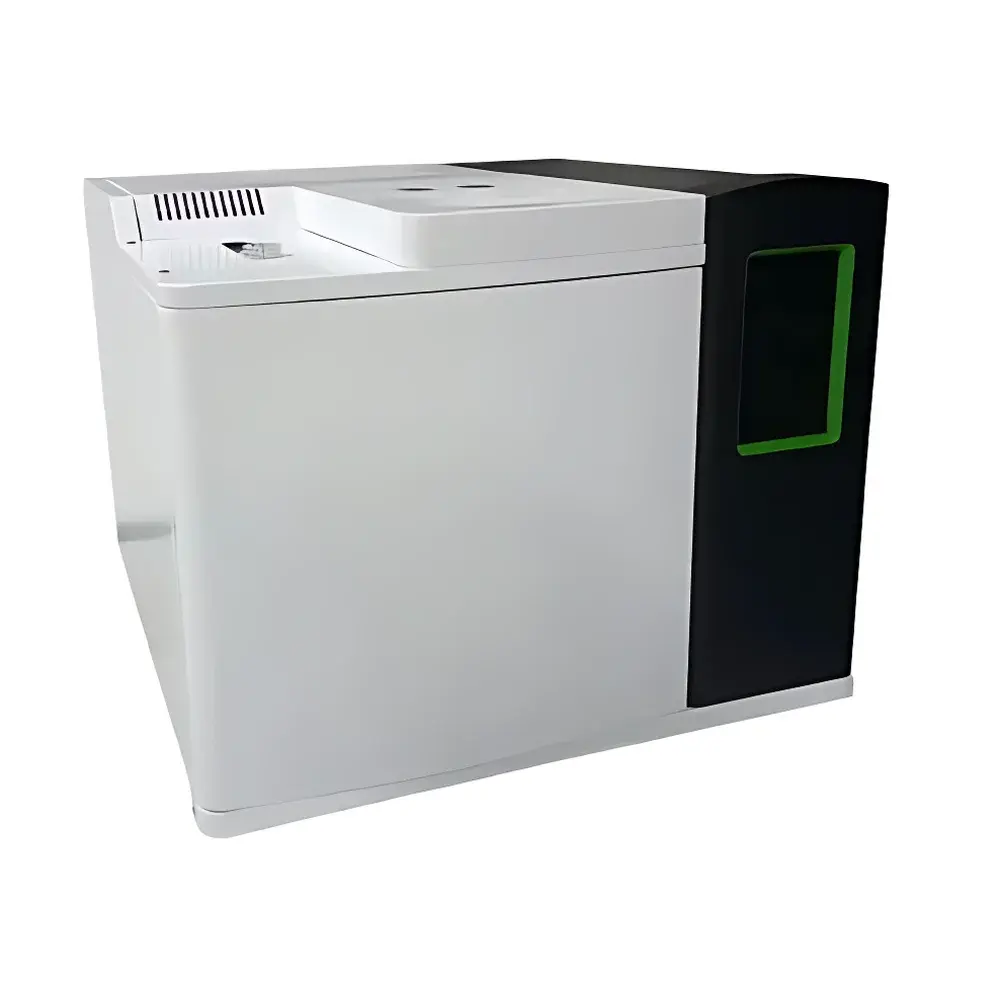
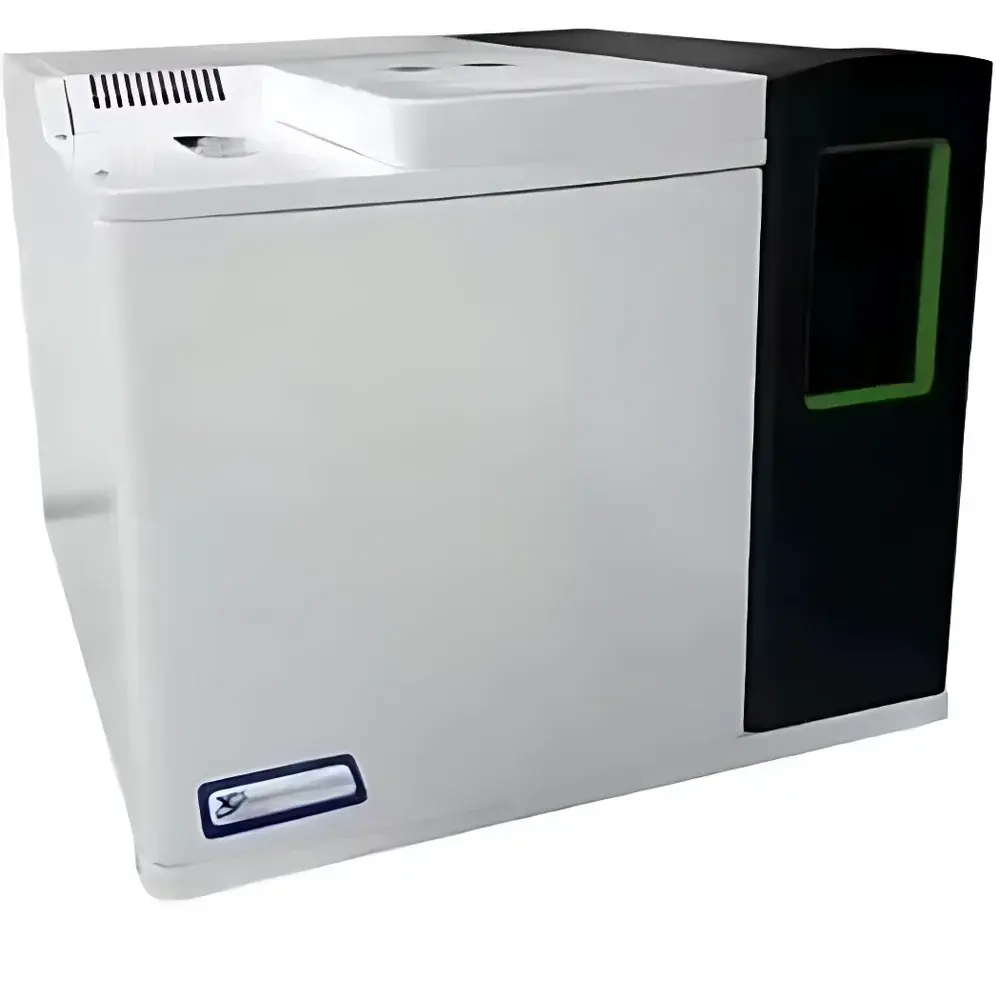
HSPX GC-9100 Laboratory Gas Chromatograph
| Brand | HSPX |
|---|---|
| Origin | Beijing, China |
| Manufacturer Type | Direct Manufacturer |
| Instrument Type | Benchtop Laboratory Gas Chromatograph |
| Model | GC-9100 |
| Temperature Control Range | Ambient +20 °C to 400 °C (oven, inlet, detector) |
| Ramp Rate | 0.1–40 °C/min |
| Cool-down Rate | 450 °C to 50 °C in ~6 min |
| Carrier Gas Flow Range & Control | 0–60 mL/min |
| Carrier Gas Pressure Range & Control | 0–0.6 MPa |
| Injector Max Temp | 400 °C |
| Injector Pressure Setting Range | 0–0.6 MPa |
| Injector Total Flow Setting Range | 0–1200 mL/min |
| Detector Options | FID, TCD, ECD, FPD, NPD |
| Display | Color LCD with bilingual (English/Chinese) UI |
| Control Interface | PC-based software with remote operation capability |
| Automation Interfaces | Built-in driver support for autosamplers, thermal desorbers, purge-and-trap systems |
| Safety Features | Auto flame ignition, flame-out detection & re-ignition, gas leak protection, automatic gas-line initialization |
Overview
The HSPX GC-9100 is a benchtop laboratory gas chromatograph engineered for precision, reproducibility, and operational flexibility in routine and research-grade volatile and semi-volatile compound analysis. Based on proven packed and capillary column separation principles, the instrument utilizes carrier gas–driven partitioning of analytes across a thermally stabilized stationary phase, with detection achieved via interchangeable, high-sensitivity detectors—including Flame Ionization (FID), Thermal Conductivity (TCD), Electron Capture (ECD), Flame Photometric (FPD), and Nitrogen-Phosphorus (NPD) configurations. Designed for compliance with method development workflows under ISO/IEC 17025, ASTM D3612, USP , and EPA Methods 8021B, 8260, and 8270, the GC-9100 supports validated analytical procedures in regulated environments when configured with audit-trail-enabled software and electronic pressure control (EPC) modules.
Key Features
- Modular architecture enabling field-upgradable components—detector modules, oven inserts, and inlet assemblies—ensuring long-term adaptability to evolving analytical requirements.
- Color LCD touchscreen interface with dual-language (English/Chinese) firmware, supporting intuitive local operation and international deployment without software localization delays.
- Advanced temperature control system: programmable ramp rates from 0.1 to 40 °C/min, stable isothermal hold accuracy ±0.1 °C, and rapid cool-down (450 °C → 50 °C in approximately 6 minutes) for high-throughput batch analysis.
- Electronic pressure and flow control (optional EPC integration) delivering precise, repeatable carrier gas delivery (0–0.6 MPa pressure; 0–60 mL/min flow) and total inlet flow management (0–1200 mL/min), critical for retention time stability and method transferability.
- Integrated safety logic: automatic flame ignition sequence, real-time flame monitoring with auto-restart, carrier gas failure detection, and interlocked gas line purging—reducing operator dependency and mitigating risk during unattended runs.
- Built-in hardware interfaces and embedded drivers for third-party automation peripherals, including liquid autosamplers (e.g., CTC PAL, Gerstel MPS), thermal desorption units, and purge-and-trap concentrators—enabling seamless method chaining and extended unattended operation.
Sample Compatibility & Compliance
The GC-9100 accommodates gaseous, liquid, and solid-phase micro-extracted samples via split/splitless, PTV, or cold-on-column injection modes. Its 400 °C maximum injector and detector operating temperature supports robust analysis of high-boiling-point compounds (e.g., PAHs, PCBs, organophosphates) and thermally labile analytes when paired with low-bleed columns. The system meets essential design criteria for GLP and GMP laboratories: hardware-level event logging, user-accessible calibration history, and configurable password-protected access levels. When operated with 21 CFR Part 11–compliant chromatography data systems (CDS), it satisfies FDA-regulated environments requiring electronic signatures, audit trails, and data integrity controls per ALCOA+ principles.
Software & Data Management
The GC-9100 operates with vendor-supplied Windows-based chromatography workstation software supporting method creation, sequence definition, real-time signal monitoring, peak integration (with customizable baselines and retention time windows), and report generation in PDF, CSV, and XML formats. Raw data files are stored in open-format binary structures compatible with third-party processing tools (e.g., OpenChrom, Chromeleon). Software features include scheduled run initiation, conditional event triggers (e.g., temperature-based valve switching), and automated calibration curve fitting using internal standard or external standard protocols. All acquisition and processing parameters are saved with metadata timestamps and user IDs—facilitating full traceability in quality-controlled labs.
Applications
The GC-9100 is routinely deployed in petroleum refining (hydrocarbon group-type analysis per ASTM D5186), environmental testing (pesticide residue screening in soil/water per EPA 8081B), food safety (residual solvent quantification in packaging per USP ), clinical toxicology (blood ethanol and volatile organic compound profiling), and pharmaceutical QC (residual solvents in APIs per ICH Q3C). Its modular detector selection allows method-specific optimization—e.g., FID for hydrocarbon quantitation, ECD for halogenated contaminants, and NPD for nitrogen- or phosphorus-containing alkaloids and pesticides.
FAQ
Does the GC-9100 support 21 CFR Part 11 compliance?
Yes—when used with validated, audit-trail-enabled chromatography data system software and appropriate administrative controls (e.g., role-based access, electronic signatures), the GC-9100 meets technical prerequisites for Part 11 adherence.
Can I upgrade from manual pressure control to electronic pressure control (EPC) after purchase?
Yes—the instrument’s gas module is designed for field retrofitting with EPC valves and digital transducers, preserving original calibration records and method continuity.
What is the minimum detectable concentration for chlorinated pesticides using the ECD configuration?
Under optimized conditions (63Ni source, 30 m × 0.25 mm ID DB-5ms column, 1 µL injection), typical ECD detection limits are ≤0.1 pg on-column for γ-HCH and endosulfan sulfate, consistent with EPA Method 8081B performance criteria.
Is remote diagnostics supported?
Yes—via secure TCP/IP connection, authorized service engineers can perform firmware diagnostics, parameter validation, and log-file analysis without physical site access.
What column dimensions and phases are recommended for residual solvent analysis per USP ?
A 30 m × 0.53 mm ID polyethylene glycol (WAX) column operated at 40 °C isotope-selective for Class 1–3 solvents; method parameters are preloaded in the software library and fully editable.




