
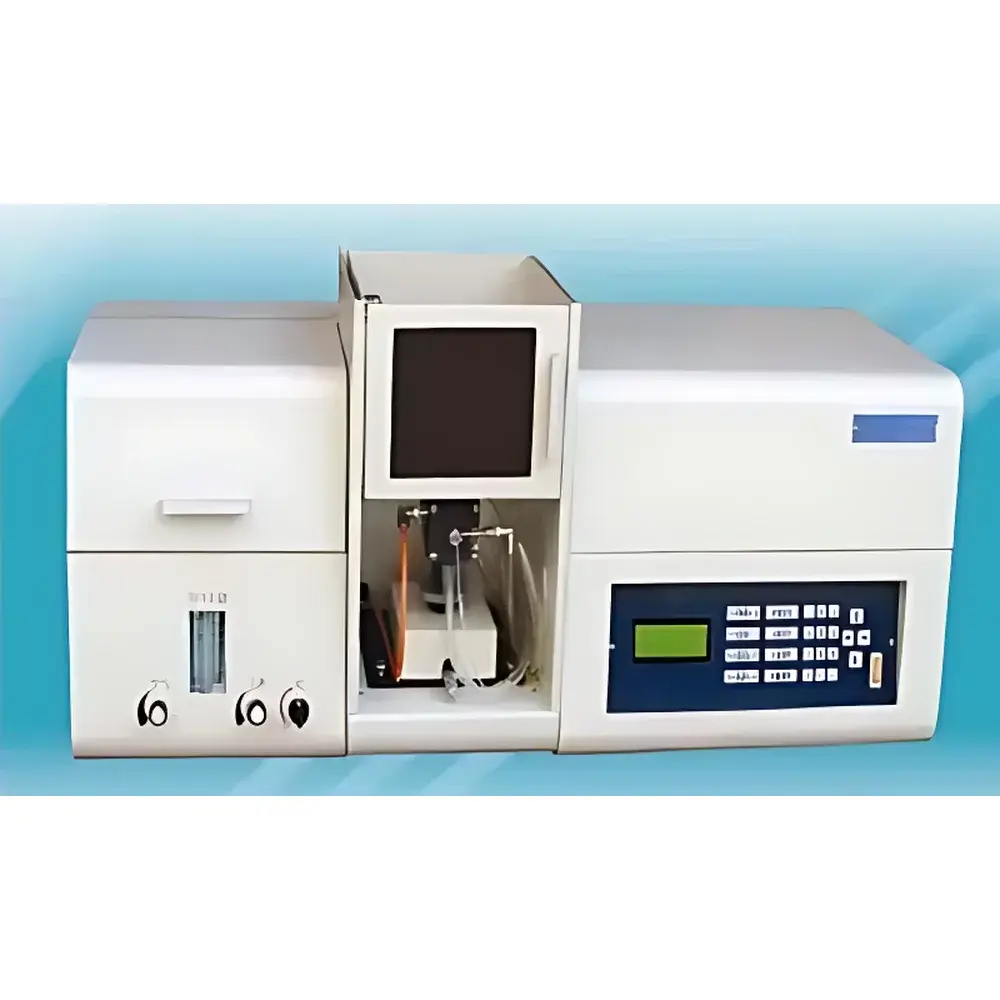
AA2600 Atomic Absorption Spectrometer
| Origin | Beijing, China |
|---|---|
| Manufacturer Type | Authorized Distributor |
| Origin Category | Domestic (China) |
| Model | AA2600 |
| Price Range | USD 7,000–14,000 |
| Instrument Type | Flame AAS |
| Monochromator Type | Czerny-Turner with Aberration Correction |
| Optical System | Single-beam |
| Detector | Photomultiplier Tube (PMT) |
| Background Correction | Deuterium Lamp + Self-Reversal Method |
| Spectral Resolution | 0.3 nm |
| Sensitivity (Cu) | >0.3 A at 5 ppm Cu |
| Precision (RSD) | <0.3% |
| Detection Limit (Cu) | 0.006 µg/mL |
| Wavelength Range | 190–900 nm |
| Wavelength Accuracy | ±0.25 nm |
| Wavelength Repeatability | 0.15 nm |
| Baseline Drift | 0.005 A/30 min |
| Burner | 100 mm Titanium Air-Acetylene Premix Burner |
| Nebulizer | High-efficiency Glass/Plastic/Stainless Steel Options |
| Nebulization Chamber | Corrosion-Resistant Material |
| Flame Height & Position Adjustment | Motorized, One-Minute Switching Between Flame and Hydride Modes |
| Safety Features | Real-time Acetylene Leak Detection, Automatic Gas Shutoff, Overpressure Protection |
| Power Supply | AC 220 V / 50 Hz |
| Power Consumption | 150 W |
| Dimensions (L×W×H) | 1000 × 350 × 390 mm |
| Weight | 70 kg |
| Operating Temperature | 10–35 °C |
| Relative Humidity | ≤80% RH |
Overview
The AA2600 Atomic Absorption Spectrometer is a flame-based analytical instrument engineered for precise quantification of trace metallic elements in liquid samples via atomic absorption spectroscopy (AAS). It operates on the fundamental principle that ground-state free atoms in a flame absorb light at element-specific wavelengths—typically generated by hollow cathode lamps—enabling highly selective and sensitive detection. Designed to meet the performance requirements outlined in GB/T 6780-93 (Chinese national standard for atomic absorption spectrophotometers), the AA2600 delivers robust analytical performance across environmental, pharmaceutical, food safety, geological, and industrial quality control laboratories. Its single-beam optical architecture incorporates a high-stability aberration-corrected Czerny-Turner monochromator, optimized for spectral purity and long-term photometric consistency. The system supports air-acetylene, nitrous oxide-acetylene, and hydride generation atomization modes—enabling analysis of over 65 elements with detection limits as low as 0.006 µg/mL for copper.
Key Features
- Multi-core embedded control system enabling fully automated operation—including wavelength scanning, peak search, spectral bandwidth selection (0.1, 0.2, 1.0, or 2.0 nm), lamp current optimization, and high-voltage adjustment of the PMT detector
- Full-range rapid wavelength scan (190–900 nm) completed within 30 seconds, with automatic peak identification and fine-tuning capability
- Floating optical bench design isolates the monochromator and detector from mechanical vibration and ambient thermal drift, ensuring signal stability over extended measurement cycles
- Dual-mode background correction: deuterium arc lamp for broad-band correction and self-reversal (SR) method for narrow-line interference—enhancing accuracy in complex matrices
- Motorized flame height and burner position adjustment, allowing reproducible optimization of atomization efficiency; flame-to-hydride mode switching accomplished in under one minute
- Integrated safety architecture featuring real-time acetylene leak monitoring, automatic gas cutoff, pressure surge protection, and flame-out detection
- Adjustable fuel/oxidant flow control for precise stoichiometric tuning—critical for optimizing sensitivity and minimizing oxide interferences in refractory elements
- High-intensity optical path design delivering superior photon throughput and signal-to-noise ratio, especially at short UV wavelengths (e.g., As 193.7 nm, Pb 217.0 nm)
Sample Compatibility & Compliance
The AA2600 accommodates aqueous and dilute acid-digested samples compatible with flame atomization protocols. It supports direct analysis of drinking water, soil extracts, biological fluids, and industrial effluents per EPA Method 7000B, ISO 11171, and ASTM D1688. When coupled with optional hydride generation accessories, it extends detection capability to volatile elements including As, Se, Sb, Bi, Te, and Pb—meeting requirements of USP , ICH Q2(R2), and EU Pharmacopoeia 2.2.58. All software operations maintain audit-trail functionality compliant with GLP and GMP documentation standards. Data integrity safeguards include user authentication, electronic signatures, and immutable raw data storage—aligned with FDA 21 CFR Part 11 principles for regulated environments.
Software & Data Management
The embedded acquisition and analysis software provides intuitive workflow navigation through a high-resolution LCD interface. It supports multiple calibration methodologies: linear and polynomial (up to 3rd-order) standard curve fitting, standard addition, and bracketing techniques. Quantitative results include calculated mean, standard deviation, relative standard deviation (RSD), confidence intervals, and detection limit estimation per IUPAC guidelines. All measurements are timestamped and stored with full metadata—including lamp type, slit width, integration time, and background correction mode. Export formats include CSV, TXT, and PDF reports suitable for LIMS integration. Optional PC-based software enables advanced statistical evaluation, method validation templates (linearity, LOD/LOQ, precision, recovery), and compliance-ready electronic lab notebook (ELN) export.
Applications
- Environmental monitoring: Determination of heavy metals (Cd, Cr, Cu, Ni, Pb, Zn) in wastewater, surface water, and leachates per ISO 17294-2
- Food and feed safety: Screening for toxic elements (As, Pb, Cd) in cereals, dairy products, and infant formula in accordance with EU Commission Regulation (EU) No 1881/2006
- Pharmaceutical QC: Elemental impurity testing of active pharmaceutical ingredients (APIs) and excipients per ICH Q3D guidelines
- Geochemical analysis: Multi-element profiling of rock digests and sediment extracts using standardized digestion protocols (EPA 3050B, 3051A)
- Clinical and nutritional labs: Quantification of essential trace elements (Fe, Zn, Mg, Ca) in serum, urine, and whole blood specimens
FAQ
What atomization methods does the AA2600 support?
It supports air-acetylene flame atomization as standard, with optional configurations for nitrous oxide-acetylene flames and hydride generation—enabling analysis of both readily atomized and volatile elements.
Is the AA2600 compliant with international regulatory standards?
Yes—the instrument meets GB/T 6780-93 and its operational software supports data integrity practices aligned with FDA 21 CFR Part 11, ISO/IEC 17025, and GLP/GMP requirements.
Can the AA2600 be integrated into a laboratory information management system (LIMS)?
Yes—raw data and report exports are available in CSV and PDF formats, and optional drivers support ODBC and ASTM E1384-compliant data transfer protocols.
What maintenance is required for long-term stability?
Routine maintenance includes periodic cleaning of the nebulizer and burner head, verification of lamp alignment, and annual wavelength calibration using holmium oxide or didymium filters—procedures documented in the included service manual.
Does the system support multi-element sequential analysis?
No—the AA2600 is a single-element instrument requiring lamp exchange between analyses; however, automated lamp turret options (up to 6 positions) are available as factory-installed upgrades.





