
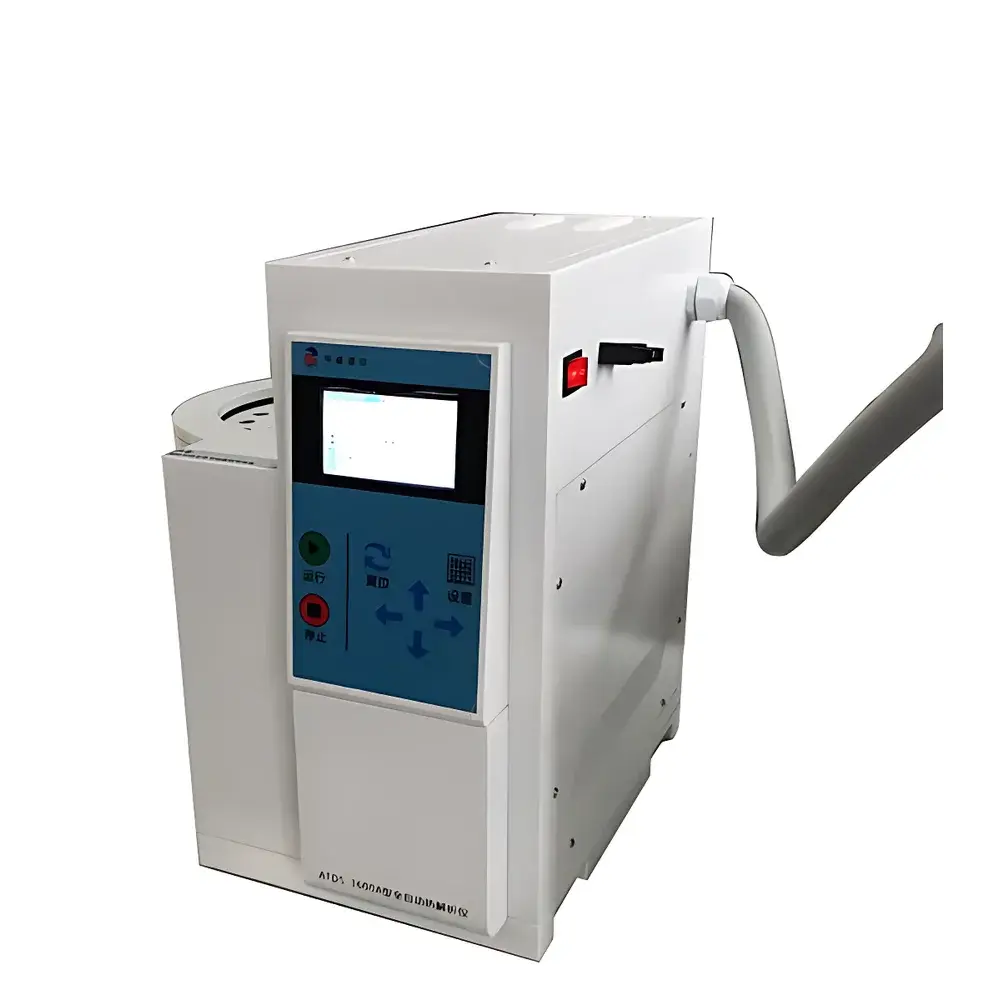
HuaShengPuXin ATDS-3600A Fully Automated Dual-Channel Secondary Thermal Desorber with 20-Position Sampler
| Brand | HuaShengPuXin (HSPX) |
|---|---|
| Origin | Beijing, China |
| Manufacturer Type | Direct Manufacturer |
| Instrument Type | Secondary Thermal Desorber |
| Automation Level | Fully Automated |
| Desorption Zone Temperature Range | Ambient to 400 °C |
| Valve Injection Zone Temperature Range | Ambient to 240 °C |
| Transfer Line Temperature Range | Ambient to 240 °C |
| Cold Trap Temperature Range | −30 °C |
| Temperature Control Accuracy | ±1 °C |
| Analyte Recovery Rate | >95% |
| Sample Capacity | 20 adsorption tubes (dual-channel configuration) |
Overview
The HuaShengPuXin ATDS-3600A is a fully automated, dual-channel secondary thermal desorber engineered for high-fidelity, quantitative analysis of volatile organic compounds (VOCs) and semi-volatile organic compounds (SVOCs) in environmental, occupational health, and indoor air quality applications. It operates on the principle of two-stage thermal desorption: first, analytes are thermally released from sorbent-packed tubes under controlled inert gas flow; second, the evolved vapors are cryogenically focused in a low-temperature cold trap (−30 °C), then rapidly injected—via flash heating—into a coupled gas chromatograph (GC) or GC–MS system. This architecture minimizes breakthrough, maximizes sensitivity, and ensures reproducible transfer of trace-level analytes across complex matrices. Designed to meet the stringent thermal stability and timing precision requirements of modern regulatory methods, the ATDS-3600A supports method-compliant operation per U.S. EPA TO-17, ISO 16017-1, and key Chinese national standards including HJ 644–2013, HJ 734–2014, and GB/T 18883–2002.
Key Features
- Dual-channel parallel processing: Enables simultaneous conditioning, desorption, and cold trapping of two independent samples—reducing cycle time by up to 40% versus single-channel systems without compromising data integrity.
- Precise multi-zone temperature control: Independent PID-regulated heating for desorption oven (ambient to 400 °C), valve manifold (ambient to 240 °C), transfer line (ambient to 240 °C), and cryogenic cold trap (−30 °C), all adjustable in 1 °C increments.
- High-efficiency cold trap: Stainless-steel trap with rapid cooling capability and programmable hold/flash-heating profiles to ensure sharp, narrow band injection into the GC column.
- Robust pneumatic architecture: Electronically actuated high-pressure valves with leak-tight seals and inert-flow path design (electropolished stainless steel and SilcoNert®-treated surfaces) to prevent adsorption or catalytic degradation of reactive VOCs (e.g., aldehydes, terpenes).
- Integrated tube handling: 20-position carousel with motorized indexing, tube identification via barcode reader option (optional), and automatic tube ejection after analysis—supporting unattended overnight operation.
- Thermal performance validation: Temperature uniformity <±0.1 °C across desorption zone; ramp rates exceeding 2000 °C/min during cold trap flash-heating—critical for minimizing band broadening and preserving chromatographic resolution.
Sample Compatibility & Compliance
The ATDS-3600A accommodates standard 6 mm OD × 89 mm length stainless steel or quartz sorbent tubes (e.g., Tenax TA, Carbopack B/C, Carboxen 1000), as well as multi-bed configurations used in EPA TO-17 and HJ 644–2013 workflows. All thermal zones maintain NIST-traceable calibration records. The instrument’s operational parameters—including temperature setpoints, dwell times, carrier gas flow profiles, and valve actuation sequences—are fully configurable to satisfy method-defined requirements in HJ/T 400–2007 (in-vehicle VOCs), GB 50325–2020 (civil construction IAQ), and HJ 583–2010 (solid-phase adsorption–thermal desorption–GC). Its hardware and firmware architecture support audit-ready operation under GLP and ISO/IEC 17025 environments, with optional electronic logbook integration for 21 CFR Part 11–compliant data governance.
Software & Data Management
Controlled via Windows-based HSPX-ThermoDesorb v3.x software, the system provides intuitive method building, real-time thermal profile visualization, and automated sequence scheduling. All method parameters—including desorption time, cold trap hold duration, GC trigger signals, and pressure monitoring thresholds—are stored with timestamped metadata. Raw thermal event logs (valve state, temperature deviation, gas flow status) are saved in CSV and XML formats for third-party LIMS ingestion. Optional software modules enable IQ/OQ documentation templates, calibration certificate generation, and deviation alerting with email/SNMP notification. Data files comply with ASTM E1782 (thermal desorption data format) and are compatible with major GC data systems (Agilent OpenLab, Thermo Chromeleon, Shimadzu LabSolutions).
Applications
- Environmental monitoring: Quantification of C2–C12 VOCs in ambient air, stack emissions, and landfill gas per HJ 734–2014 and EPA Method TO-17.
- Indoor air quality assessment: Compliance testing for formaldehyde, benzene, toluene, xylene (BTX), and other priority pollutants defined in GB/T 18883–2002 and GB 50325–2020.
- Automotive cabin air analysis: Dynamic sampling and desorption of interior materials per HJ/T 400–2007, including aldehydes and odorants at sub-ppbv levels.
- Material emission testing: Screening of VOC off-gassing from carpets, adhesives, paints, and composite panels using standardized micro-chamber protocols.
- Forensic and occupational hygiene: Trace-level detection of workplace contaminants such as styrene, chlorinated solvents, and aromatic hydrocarbons in personal monitoring samples.
FAQ
What sample tube formats does the ATDS-3600A support?
Standard 6 mm OD × 89 mm sorbent tubes (e.g., Tenax TA, Carbopack series); custom-length tubes may be accommodated with optional adapter kits.
Is the cold trap capable of sub-ambient operation below −30 °C?
The standard configuration maintains a minimum cold trap temperature of −30 °C; liquid nitrogen–assisted traps for −100 °C operation are available as a factory-installed option.
Can the instrument be integrated with non-HSPX GC systems?
Yes—universal TTL and 24 VDC trigger I/O ports, along with analog pressure and temperature outputs, enable seamless synchronization with Agilent, Thermo Fisher, Shimadzu, and PerkinElmer GC platforms.
Does the system include validation documentation for laboratory accreditation?
Factory-provided IQ/OQ protocols, temperature mapping reports, and recovery validation data (per HJ 644–2013 Annex C) are included; full GMP-compliant PQ documentation is available upon request.
What maintenance intervals are recommended for routine operation?
Valve manifold inspection every 500 runs; cold trap cleaning and sorbent tube oven calibration annually or per 2000 cycles—whichever occurs first. Full service manuals and spare parts catalogs are supplied with each unit.



