
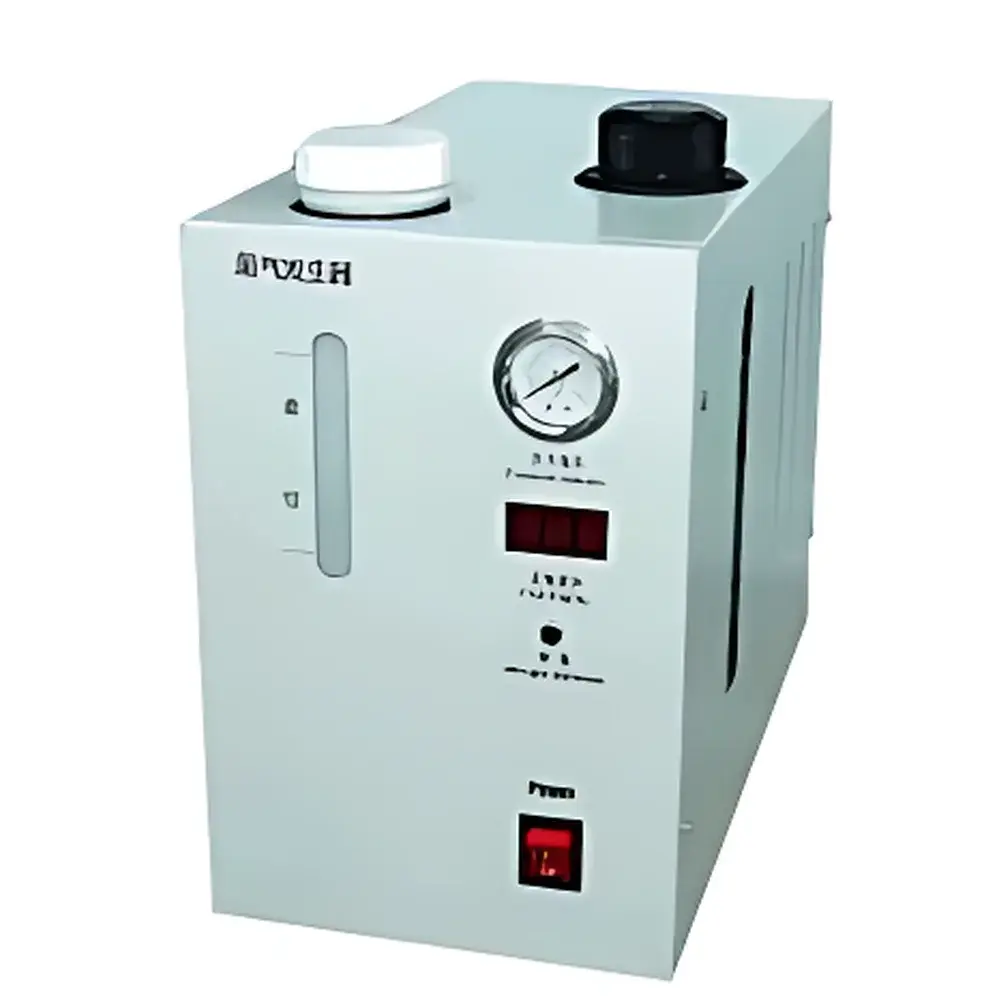
HuaSheng PuXin HS-300 / HS-500 Hydrogen Generator
| Brand | HuaSheng PuXin (HSPX) |
|---|---|
| Origin | Beijing, China |
| Manufacturer Type | Direct Manufacturer |
| Model | HS-300 / HS-500 |
| Hydrogen Generation Principle | Pure Water Electrolysis (KOH Aqueous Solution) |
| Output Flow Rate | 0–310 mL/min (HS-300), 0–510 mL/min (HS-500) |
| Output Pressure | 0.4 MPa |
| Hydrogen Purity | >99.999% |
| Power Consumption | 150 W (HS-300), 250–300 W (HS-500) |
| Water Reservoir Volume | 0.92 L |
| Required Feed Water | Distilled Water |
| Weight | <10 kg (HS-300), <11 kg (HS-500) |
Overview
The HuaSheng PuXin HS-300 and HS-500 Hydrogen Generators are laboratory-grade, on-demand hydrogen supply systems engineered for continuous, safe, and reliable operation in analytical laboratories—primarily as dedicated hydrogen sources for gas chromatography (GC) and GC–MS instrumentation. These units employ a proven, robust alkaline electrolysis process using potassium hydroxide (KOH)-doped distilled water as the electrolyte and aerospace-grade polymeric diaphragms to separate anode and cathode compartments. Under applied DC current, water undergoes electrochemical decomposition: at the cathode, protons are reduced to high-purity hydrogen gas (H₂); at the anode, hydroxide ions oxidize to produce oxygen (O₂), which is safely vented. The system operates without compressed gas cylinders, eliminating associated hazards, logistics overhead, and purity degradation risks common with cylinder-based supply. Designed for integration into regulated environments, the generators maintain stable output pressure (0.4 MPa) and dynamically modulate flow within rated capacity (0–310 or 0–510 mL/min) to match real-time instrument demand—ensuring optimal carrier gas performance across packed, capillary, and microbore GC columns.
Key Features
- Electrolyte-based pure water electrolysis using KOH aqueous solution—no catalysts, no metal hydrides, no consumable cartridges
- Dual-model scalability: HS-300 for low-to-moderate GC throughput; HS-500 for multi-instrument labs or high-flow applications (e.g., FID, TCD, or hydrogenation reactors)
- Integrated digital pressure regulation with automatic overpressure cutoff (0.45 MPa threshold) and real-time flow tracking via calibrated mass flow sensing
- Corrosion-resistant electrode stack featuring titanium-coated nickel mesh grids and aerospace-certified ion-selective diaphragm membranes
- Intelligent control logic enabling seamless pressure/flow synchronization with GC autosamplers and electronic pneumatic controllers (EPCs)
- Distilled water feed requirement ensures minimal ionic contamination and long-term electrolyte stability—no periodic KOH replenishment needed under normal operation
- Compact footprint (<11 kg unit weight) with integrated 0.92 L reservoir and low acoustic emission (<45 dB(A)) for benchtop deployment in shared lab spaces
Sample Compatibility & Compliance
These generators deliver hydrogen meeting ASTM D7218–22 specifications for GC carrier gas purity (≥99.999% H₂, ≤0.1 ppm O₂, ≤0.1 ppm H₂O, ≤0.05 ppm total hydrocarbons). Oxygen and moisture byproducts are physically separated and exhausted through independent vent lines, preventing cross-contamination. The design complies with IEC 61010-1:2010 safety standards for electrical equipment in laboratory use and incorporates dual redundant thermal fuses and ground-fault circuit interruption (GFCI) protection. While not certified to UL/CSA for North American field installation, the units are routinely deployed in ISO/IEC 17025-accredited testing labs and support GLP/GMP traceability when paired with validated logbook protocols. No regulatory filings (e.g., FDA 21 CFR Part 11) are embedded—but raw operational data (pressure, flow, runtime, error codes) can be exported via RS-232 for external audit trail integration.
Software & Data Management
The HS-300/HS-500 operate via embedded firmware with no proprietary software dependency. All operational parameters—including real-time flow rate, system pressure, reservoir level, and fault diagnostics—are displayed on a backlit LCD interface. For laboratories requiring centralized monitoring, optional RS-232 serial output enables connection to Lab Information Management Systems (LIMS) or SCADA platforms. Timestamped event logs (e.g., “Overpressure event at 14:22:07”, “Reservoir refill initiated”) are retained in non-volatile memory for ≥30 days. No cloud connectivity, remote access, or firmware OTA updates are supported—consistent with cybersecurity best practices for analytical infrastructure in regulated QC/QA settings.
Applications
- Primary carrier gas source for capillary GC systems utilizing split/splitless injectors and flame ionization (FID), thermal conductivity (TCD), or electron capture (ECD) detectors
- Fuel gas supply for FID and helium ionization detectors requiring stoichiometric H₂:air ratios
- Reductive atmosphere generation in small-scale catalytic screening reactors (when coupled with mass flow controllers)
- Calibration gas blending support in environmental air monitoring labs (e.g., generating certified H₂-in-N₂ mixtures via dynamic dilution)
- Replacement of high-pressure hydrogen cylinders in university teaching labs—reducing storage compliance burden and enabling 24/7 unattended GC operation
FAQ
What type of water must be used?
Distilled water (conductivity ≤1 µS/cm) is mandatory. Deionized or tap water will cause rapid electrode fouling and membrane degradation.
Is KOH replenishment required during routine operation?
No—the KOH concentration is factory-sealed and stabilized; only distilled water top-up is needed every 7–14 days depending on usage.
Can the generator supply multiple GC instruments simultaneously?
Yes, provided total demand remains within the rated flow range and a properly sized stainless steel distribution manifold with individual pressure regulators is installed.
How often does maintenance require technician intervention?
Annual visual inspection of electrodes and diaphragm integrity is recommended; no scheduled part replacement is specified under normal operating conditions.
Does the unit include oxygen scavenging or purification beyond the membrane separation?
No—oxygen is vented separately via dedicated exhaust tubing; users requiring sub-ppm O₂ levels must install an external palladium-diffusion purifier.



