
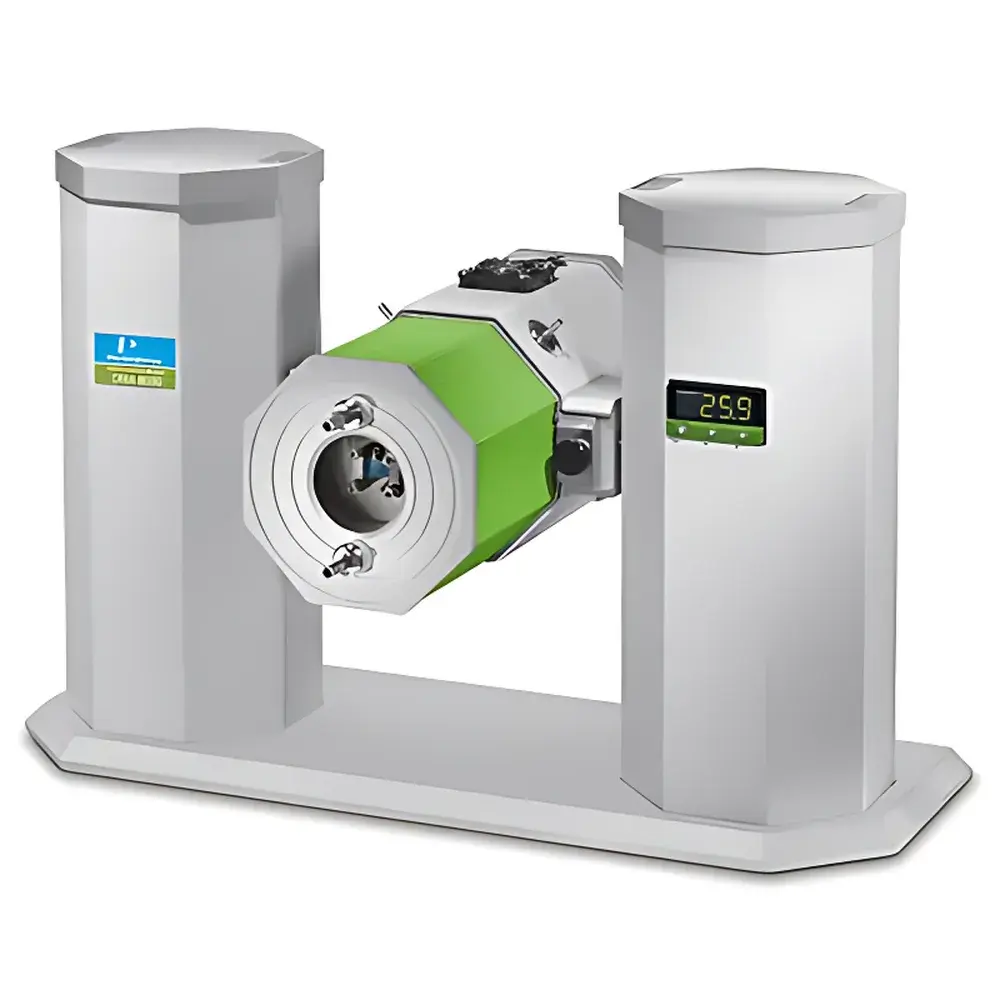
PerkinElmer DMA 8000 Dynamic Mechanical Analyzer
| Brand | PerkinElmer |
|---|---|
| Origin | USA |
| Manufacturer | PerkinElmer, Inc. |
| Model | DMA 8000 |
| Instrument Type | Dynamic Mechanical Analyzer (DMA/DMTA) |
| Temperature Range | –196 °C to 600 °C (with LN₂ cryogenic cooling) |
| Frequency Range | 0.01–300 Hz |
| Cooling Rate | ≤15 min from ambient to –190 °C |
| Liquid Nitrogen Consumption | ~1 L per typical low-temperature DMA run |
| Sample Modes | Dual/Triple Cantilever, 3-Point Bending, Tension, Compression, Shear, and TMA Mode |
| Humidity Control Range | 10–90 % RH (optional humidity generator) |
| Optical Access | Quartz furnace viewport for in-situ visual monitoring and UV-curable sample testing |
Overview
The PerkinElmer DMA 8000 is a high-performance dynamic mechanical analyzer engineered for precision viscoelastic characterization of polymeric, pharmaceutical, food, and composite materials under controlled thermal, mechanical, and environmental conditions. Based on the fundamental principle of forced oscillatory deformation—applying a sinusoidal stress or strain while measuring the resulting out-of-phase response—the DMA 8000 quantifies storage modulus (E′), loss modulus (E″), and tan δ as functions of temperature, frequency, time, or humidity. Its modular architecture integrates a high-stiffness frame, low-noise electromagnetic transducer, and thermally isolated furnace with quartz viewport, enabling simultaneous measurement and real-time observation of structural transitions—including glass transitions (Tg), crystallization events, crosslinking kinetics, and secondary relaxations—across an industry-leading thermal range from –196 °C (using liquid nitrogen cooling) to 600 °C.
Key Features
- Ultra-broad temperature capability: –196 °C to 600 °C, supported by optimized cryogenic delivery and rapid heating/cooling profiles (≤15 min to –190 °C with <1 L LN₂ per test cycle)
- Wide dynamic frequency range: 0.01–300 Hz, programmable in multi-frequency sweeps or isothermal frequency scans (up to 100 discrete frequencies per experiment)
- Multi-configuration mechanical testing: Interchangeable fixtures for dual/triple cantilever, 3-point bending, tension, compression, shear, and full-featured thermomechanical analysis (TMA) mode
- 360° rotational sample stage: Enables precise alignment of anisotropic or asymmetric specimens without mechanical reconfiguration
- Integrated quartz-furnace viewport: Allows optical monitoring of sample morphology, phase separation, or UV-induced polymerization during DMA testing
- Optional humidity control system: Precision RH generator and sensor (10–90 % RH) for hygrothermal DMA studies and moisture-dependent relaxation mapping
- Advanced sample handling: Patented clamp design accommodates challenging geometries—including gels, powders, thin films, and irregularly shaped biomaterials—without adhesive interference
Sample Compatibility & Compliance
The DMA 8000 supports standardized specimen geometries per ASTM D4065, ASTM D7028, ISO 6721-1 through -7, and USP , ensuring data traceability for regulatory submissions. Its modular fixture set complies with GMP-aligned workflows, including audit-trail-enabled method storage and user-access controls. Optional humidity and fluid-bath accessories extend compliance to ISO 22088-3 (polymer aging under humid conditions) and ASTM D5229 (composite moisture absorption effects). All thermal calibrations are referenced to NIST-traceable standards (indium, zinc, and aluminum), and instrument performance verification follows PerkinElmer’s IQ/OQ/PQ protocols aligned with FDA 21 CFR Part 11 requirements for electronic records and signatures.
Software & Data Management
Controlled via Pyris™ DMA software, the system provides a validated, Windows-based platform supporting method development, real-time data visualization, automated baseline correction, and advanced curve-fitting algorithms (e.g., Arrhenius, Williams-Landel-Ferry, and Havriliak-Negami models). Raw time-series and frequency-domain datasets are stored in vendor-neutral ASCII formats (.txt, .csv) and proprietary .pma files with embedded metadata (operator ID, calibration status, environmental logs). Software features include GLP-compliant electronic signatures, role-based permissions, and secure database archiving with configurable retention policies. Export modules support direct integration with LIMS platforms and statistical analysis tools such as JMP and MATLAB.
Applications
The DMA 8000 delivers critical insights across R&D and QC environments: determining Tg breadth and sub-Tg relaxations in amorphous polymers; evaluating crosslink density and network homogeneity in elastomers and thermosets; assessing drug-polymer miscibility and physical stability in amorphous solid dispersions; characterizing starch gelatinization and protein denaturation kinetics in food matrices; quantifying damping behavior and fatigue resistance in fiber-reinforced composites; and performing time-temperature superposition (TTS) for long-term creep prediction. Its TMA mode extends utility to coefficient of thermal expansion (CTE), softening point, and dimensional stability measurements per ASTM E831 and ISO 11359-2.
FAQ
What cooling methods are supported for sub-ambient operation?
The DMA 8000 uses a closed-cycle liquid nitrogen delivery system with optimized flow dynamics to achieve –196 °C; optional mechanical refrigeration units are available for –70 °C operation.
Can the instrument perform simultaneous humidity and temperature sweeps?
Yes—when equipped with the humidity generator, the system executes programmed RH ramps synchronized with temperature profiles, enabling isochronal moisture scans or hygrothermal cycling protocols.
Is TMA functionality fully equivalent to a dedicated TMA instrument?
The integrated TMA mode supports all standard TMA measurements—including expansion, penetration, and probe-type analyses—with identical force resolution, displacement accuracy, and thermal calibration rigor as PerkinElmer’s standalone TMA 4000 system.
How is data integrity ensured for regulated environments?
Pyris software includes 21 CFR Part 11-compliant features: electronic signatures, immutable audit trails, user authentication, and encrypted data storage with version-controlled method templates.
Are third-party fixture interfaces available?
The system adheres to ISO 11359-1 mechanical interface specifications, permitting certified third-party fixtures—subject to mechanical validation and thermal compatibility assessment by PerkinElmer Applications Engineering.
Related Products



