
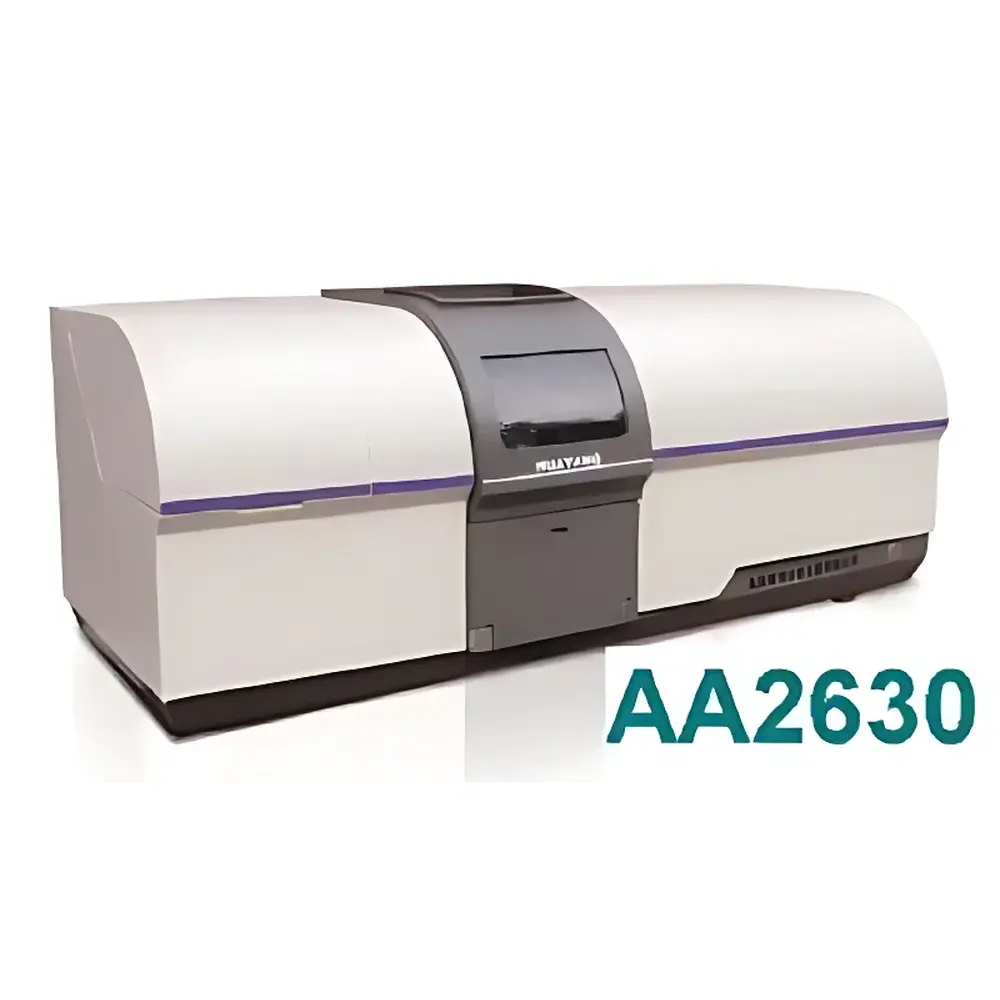
AA2630 Atomic Absorption Spectrometer
| Origin | Beijing, China |
|---|---|
| Manufacturer Type | Authorized Distributor |
| Origin Category | Domestic (PRC) |
| Model | AA2630 |
| Price Range | USD 7,000–14,000 |
| Instrument Type | Flame and Graphite Furnace AAS |
| Monochromator | Plane Diffraction Grating (1800 grooves/mm) |
| Optical System | Double-Beam |
| Detector | High-Sensitivity Photomultiplier Tube (PMT) |
| Background Correction | Deuterium Lamp + Self-Reversal (Auto-Adjusting) |
| Spectral Bandwidth | 0.1 / 0.2 / 0.4 / 1.0 / 2.0 nm (5-step motorized selection) |
| Resolution | ≤0.3 nm (meets Mn 279.5/279.8 nm separation criterion, valley-to-peak energy ratio <20%) |
| Sensitivity (Cu) | >0.3 A at 5 ppm |
| RSD (Precision) | <0.3% (Flame), ≤3% (Graphite Furnace) |
| Detection Limit (Cu, Flame) | 0.005 µg/mL |
| Detection Limit (Cd, GF-AAS) | 1.0 × 10⁻¹² g |
Overview
The AA2630 Atomic Absorption Spectrometer is a dual-mode analytical instrument engineered for high-precision quantitative elemental analysis across environmental, pharmaceutical, clinical, food safety, and metallurgical laboratories. It operates on the fundamental principle of atomic absorption spectroscopy—measuring the attenuation of characteristic hollow cathode lamp radiation as ground-state atoms in a flame or graphite furnace vapor phase absorb specific wavelengths. The system integrates flame atomization (air-acetylene) and electrothermal graphite furnace atomization into a single platform with fully automated switching, enabling seamless transition between high-throughput routine analysis and ultra-trace detection down to sub-picogram levels. Its double-beam optical architecture compensates for source drift and lamp instability in real time, while the suspended monochromator design—featuring a Czerny-Turner configuration with an 1800-line/mm plane diffraction grating—ensures exceptional wavelength stability and photometric reproducibility under variable ambient conditions.
Key Features
- Fully automated dual-atomization platform: integrated flame and graphite furnace systems with motorized positional alignment and automatic switching—no manual reconfiguration required.
- 8-lamp auto-switching turret with pre-stored lamp operating parameters (current, warm-up time, alignment offsets), enabling rapid multi-element sequential analysis.
- Intelligent spectral optimization: motorized slit width control (0.1–2.0 nm, five fixed bandwidths), auto-wavelength scanning, peak search, and zero calibration completed within 30 seconds.
- Advanced flame management: automatic gas flow regulation, ignition sequence, flame height and burner position optimization, and real-time monitoring of combustion gas pressure, coolant flow, and flame status.
- Robust graphite furnace control: up to 11 programmable temperature steps (ramp, hold, maximum-power atomization), precision ±1% temperature control, heating rates exceeding 2000 °C/s, and full power stabilization during atomization.
- Dual background correction: simultaneous deuterium lamp (≥30× correction at 1 A) and self-reversal (auto-absorption) methods, each validated per ASTM E1554 and ISO 11170 protocols.
- Comprehensive safety architecture: interlocked shutdown of gas, power, and cooling upon detection of low water flow, overtemperature, argon underpressure, or flame failure—fully compliant with IEC 61010-1 safety standards.
Sample Compatibility & Compliance
The AA2630 accommodates liquid samples (aqueous, acidic digests, organic extracts) for flame-AAS and direct microvolume injection (5–50 µL) for graphite furnace analysis. Optional hydride generation accessories extend capability to As, Se, Sb, Bi, Te, and Pb in accordance with EPA Method 7060A and ISO 17294-2. The optical path employs UV-grade fused silica components and sealed PMT housing to ensure long-term stability in corrosive laboratory environments. All electronic subsystems meet CE marking requirements (EMC Directive 2014/30/EU, Low Voltage Directive 2014/35/EU). Data acquisition and processing comply with GLP/GMP principles; audit trails, user access control, and electronic signature support are available via optional 21 CFR Part 11-compliant software modules.
Software & Data Management
The instrument is controlled through Windows-native analytical software supporting Windows 10/11 (32- and 64-bit). The interface provides intuitive method setup wizards, real-time spectral visualization, and dynamic parameter adjustment during acquisition. Quantitative analysis includes linear/nonlinear calibration (1st–3rd order polynomial), standard addition, and internal standard correction. Up to 20 replicate measurements are automatically averaged with RSD and SD reporting. Data export supports CSV, Excel (.xlsx), PDF report generation, and direct LIMS integration via ODBC. Raw signal traces, peak integration windows, and furnace temperature profiles are stored with full metadata (operator ID, timestamp, instrument serial number, method version).
Applications
- Environmental testing: quantification of heavy metals (Pb, Cd, Cr, Ni, Cu, Zn) in wastewater, soil leachates, and drinking water per ISO 11885 and EPA 200.7.
- Pharmaceutical quality control: trace metal impurities (e.g., catalyst residues) in APIs and excipients, aligned with ICH Q2(R2) validation guidelines.
- Food and agriculture: determination of essential (Fe, Zn, Ca) and toxic (As, Hg, Cd) elements in cereals, dairy, and infant formula per AOAC 984.27 and EN 15510.
- Clinical and biological matrices: serum Cu/Zn ratios, whole blood Pb screening, and tissue digest analysis under CLIA and CAP requirements.
- Geological and metallurgical assays: base metal content in ores, alloys, and slag using flame-AAS with matrix-matched calibration.
FAQ
What atomization modes does the AA2630 support?
It supports both air-acetylene flame atomization and electrothermal graphite furnace atomization, with fully automated mechanical and optical alignment switching.
Is hydride generation compatible with this instrument?
Yes—optional hydride generation accessories can be integrated for volatile element analysis (As, Se, Sb, etc.), with dedicated software method templates and gas flow synchronization.
How is wavelength accuracy verified and maintained?
Wavelength calibration is performed using holmium oxide and didymium filters; the system achieves ±0.20 nm accuracy across 190–900 nm and repeatability better than 0.10 nm.
Does the software support 21 CFR Part 11 compliance?
The base software includes audit trail logging and user authentication; full Part 11 compliance (electronic signatures, role-based permissions, data integrity controls) requires activation of the validated software module and associated documentation package.
What maintenance intervals are recommended for the graphite furnace?
Graphite tube replacement is typically required after 200–500 firings depending on matrix complexity; furnace cleaning and argon gas line inspection are recommended quarterly, and PMT gain recalibration every six months.





