
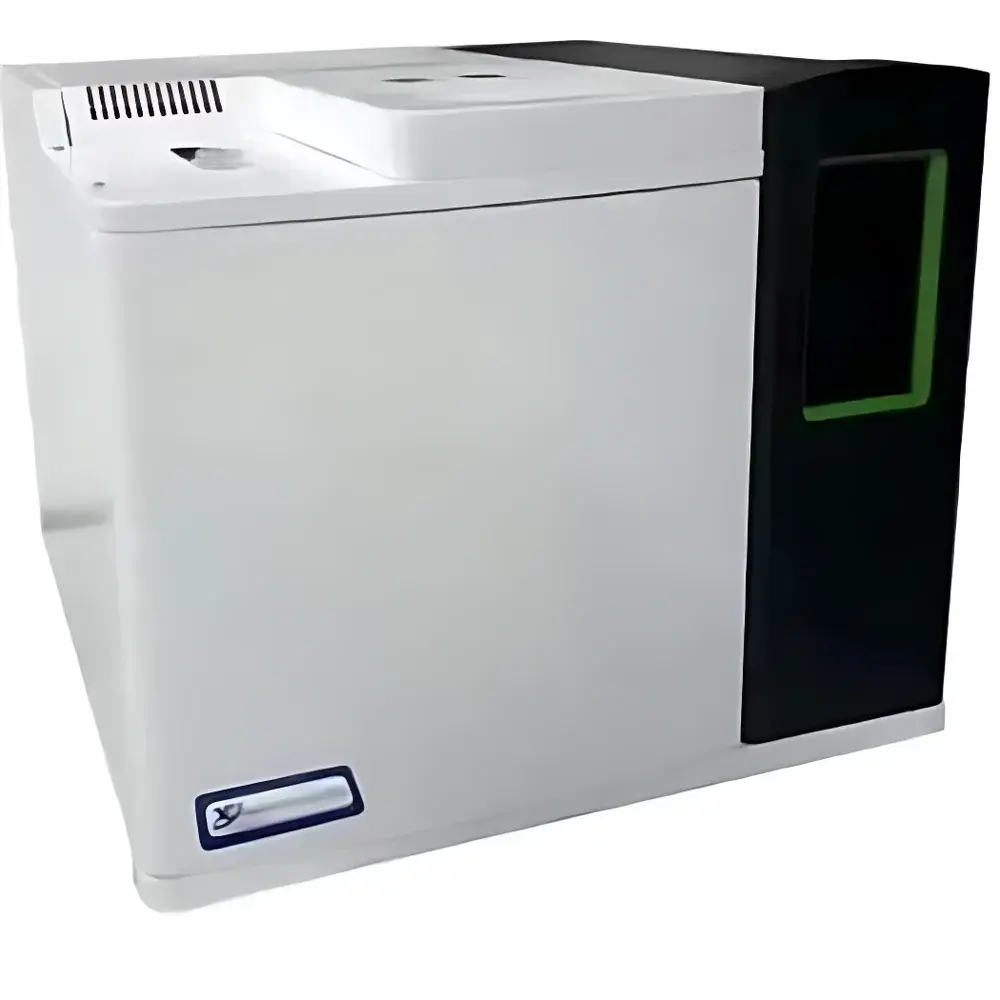
HuaShengPuXin HSPX Mine Methane Gas Analysis Dedicated Gas Chromatograph
| Brand | HuaShengPuXin (HSPX) |
|---|---|
| Origin | Beijing, China |
| Manufacturer Type | Direct Manufacturer |
| Instrument Type | Laboratory Gas Chromatograph |
| Application Scope | Universal (Mine Safety & Gas Monitoring) |
| Oven Temperature Range | Ambient +12 °C to 400 °C |
| Oven Ramp Rate | 0.1–39 °C/min (Standard) |
| Oven Cooling Rate | ~6 min from 450 °C to 50 °C |
| Carrier Gas Flow Control Range | 0–1000 mL/min |
| Carrier Gas Pressure Control Range | 0–970 kPa |
| Injector Maximum Temperature | 400 °C |
| Injector Pressure Setting Range | 0–970 kPa |
| Injector Total Flow Setting Range | 0–1200 mL/min |
| Detectors | TCD (MDL ≤9×10⁻⁶ mg/mL in H₂, n-C₁₆), FID (MDL ≤8×10⁻¹² g/s, n-C₁₆), ECD (MDL ≤0.1 pg, γ-BHC), FPD ([P] ≤1×10⁻¹² g/s, TBP |
| Column Configuration | Packed-column system with methanizer and automated 6-port valve for simultaneous O₂/N₂/CH₄/CO/CO₂ analysis |
| Detection Ranges | O₂ (20.9±5%), N₂ (78±10%), CH₄ (0.5 ppm–10%), CO (0.5 ppm–0.3%), CO₂ (1 ppm–0.5%), C₂H₆/C₂H₄/C₂H₂ (1 ppm–0.3%) |
| Power Supply | AC 220 V ±10%, 50 Hz |
| Max. Power Consumption | 1650 W |
| Net Weight | ~50 kg |
Overview
The HuaShengPuXin HSPX Mine Methane Gas Analysis Dedicated Gas Chromatograph is an engineered solution for quantitative trace- and macro-level gas composition analysis in underground coal mine environments. Designed specifically for continuous monitoring of explosive and asphyxiant gases, it operates on the principle of gas-phase separation via packed-column chromatography followed by selective detection using multiple detector technologies—including Thermal Conductivity Detection (TCD), Flame Ionization Detection (FID), Electron Capture Detection (ECD), Flame Photometric Detection (FPD), and Thermionic Specific Detection (TSD). The instrument integrates a catalytic methanizer to convert CO and CO₂ into CH₄ prior to FID measurement, ensuring accurate hydrocarbon-equivalent reporting for safety-critical threshold evaluation. Its architecture supports dual-stream analysis: primary stream for O₂, N₂, CH₄, CO, and CO₂ via automated 6-port valve switching; secondary stream—configurable with manual 6-port valve—for ethane (C₂H₆), ethylene (C₂H₄), and acetylene (C₂H₂) analysis, enabling early detection of spontaneous combustion precursors per ISO 18503 and national coal mine safety regulations.
Key Features
- Microprocessor-controlled temperature management with independent oven, injector, and detector zones—all programmable from ambient +12 °C to 400 °C, supporting precise isothermal and gradient elution protocols.
- Dual-mode oven ramp capability: standard (0.1–39 °C/min) and high-speed (0.1–80 °C/min), coupled with rapid cooling (~6 minutes from 450 °C to 50 °C) to minimize cycle time between sequential samples.
- Full digital carrier gas pressure and flow regulation (0–970 kPa; 0–1200 mL/min total injector flow), ensuring retention time stability and method reproducibility across variable ambient conditions.
- Integrated self-diagnostic firmware continuously monitors detector status, heater integrity, valve actuation, and gas supply continuity—displaying real-time fault codes and actionable remediation guidance on the 32-digit LED interface.
- Multi-detector compatibility: user-selectable installation of TCD, FID, ECD, FPD, or TSD modules, each meeting published sensitivity thresholds compliant with ASTM D1945 and ISO 6974-1 for natural gas analysis.
- Four stored method profiles accessible via front-panel navigation, enabling rapid reconfiguration for routine mine air screening versus incident-response forensic profiling.
Sample Compatibility & Compliance
The HSPX system accepts direct injection of compressed mine air samples (typically 0.5–2.0 mL) collected in stainless-steel or electropolished aluminum sampling bags meeting ISO 16000-18 requirements. It is validated for use with certified reference gas mixtures traceable to NIST SRMs (e.g., NIST 1620, 1621) and conforms to Chinese national standard GB/T 13610–2014 for gas chromatographic analysis of natural gas components. All detector configurations satisfy GLP-aligned data integrity requirements, including electronic audit trails for method changes, calibration events, and sample injection logs—supporting regulatory readiness for MSHA Part 31 and provincial coal safety bureau inspections.
Software & Data Management
While hardware operation is fully standalone via front-panel controls, optional PC-based chromatography data systems (CDS) provide FDA 21 CFR Part 11-compliant acquisition, peak integration, and report generation. Raw signal files are exportable in .CDF format for third-party statistical analysis (e.g., PCA, cluster analysis of gas ratio trends). Calibration curves support multi-point linear and quadratic regression with weighting options; limit-of-detection (LOD) and limit-of-quantitation (LOQ) calculations follow ICH Q2(R2) guidelines. Audit trail metadata includes operator ID, timestamp, instrument state, and environmental sensor readings (optional external temperature/humidity input).
Applications
- Routine surveillance of ventilation air for CH₄ accumulation exceeding 1.0% v/v—the statutory alarm threshold in most jurisdictions.
- Discrimination of thermal degradation signatures: elevated C₂H₄/C₂H₆ ratios indicate low-temperature oxidation; rising C₂H₂ signals correlate with arc-induced heating (>500 °C), per NFPA 56E fire risk assessment protocols.
- Verification of inertization efficacy during sealed-off area management via O₂ depletion kinetics modeling.
- Post-ignition forensic analysis of explosion residues to reconstruct pre-event gas composition and stoichiometric imbalance.
- Calibration validation of fixed-point electrochemical and infrared sensors deployed in distributed mine monitoring networks.
FAQ
Is this instrument suitable for unattended operation in remote mine sites?
Yes—its solid-state electronics, wide ambient operating range (5–40 °C), and non-volatile memory for method storage support extended deployment without PC dependency. Optional UPS integration ensures uninterrupted power during grid fluctuations.
Can it meet international certification requirements for hazardous area installation?
The base configuration is rated for safe operation in non-classified surface laboratories. For Zone 1/21 installation, ATEX/IECEx-certified explosion-proof enclosures and intrinsically safe sample introduction modules are available as factory-engineered options.
What maintenance intervals are recommended for long-term reliability?
Carrier gas filters require replacement every 6 months; detector jets and septa every 3 months under continuous use. Annual verification of temperature accuracy (per ASTM E77) and detector response linearity (per ISO 10723) is advised for regulatory compliance.
Does the system support automated calibration gas delivery?
Yes—via optional integrated multi-port gas selector valve with programmable sequence control, enabling unattended bracketing calibrations before and after batch analysis.
How is data integrity ensured during regulatory audits?
All instrument events—including method loads, calibration injections, detector parameter changes, and manual overrides—are timestamped and logged in a write-once, read-many (WORM) internal memory partition, satisfying ALCOA+ principles for raw data preservation.





