
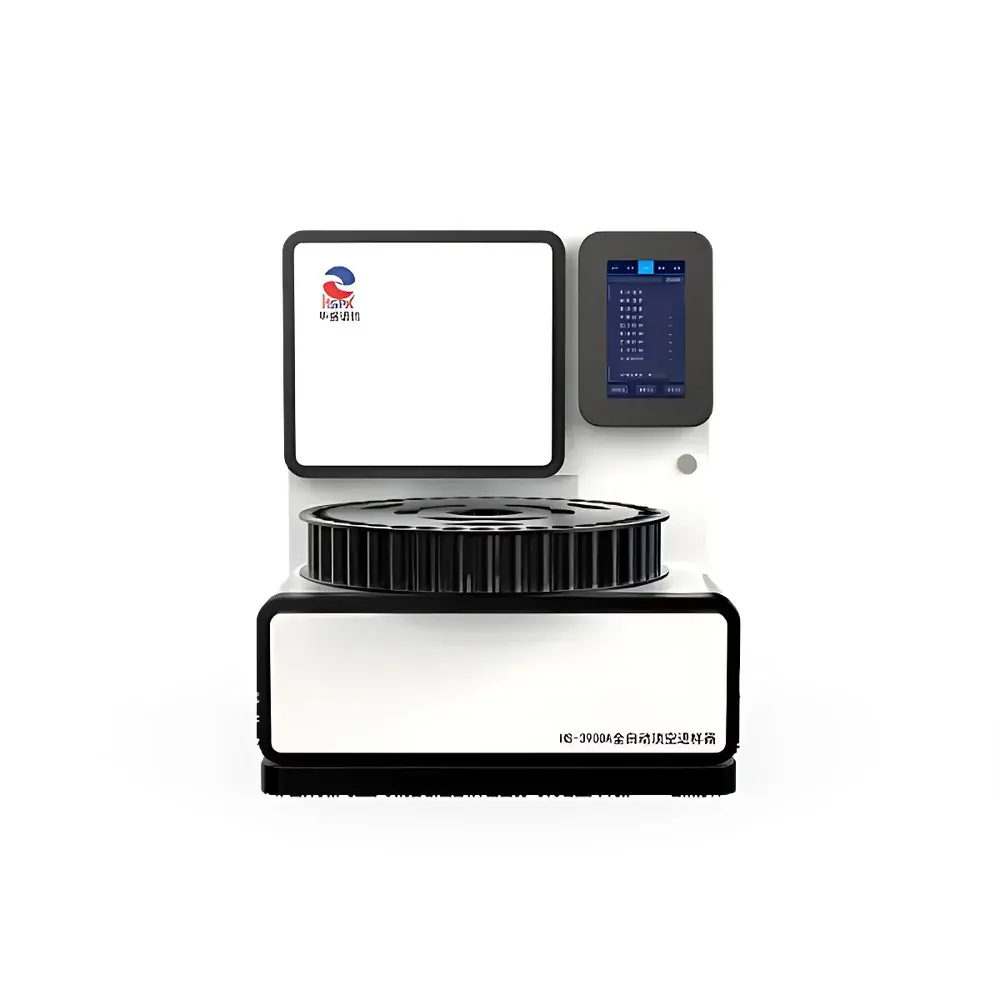
HuaShengPuXin HS-3900A Fully Automated Headspace Sampler
| Brand | HuaShengPuXin (HSPX) |
|---|---|
| Origin | Beijing, China |
| Manufacturer Type | Direct Manufacturer |
| Instrument Type | Dynamic Headspace Sampler |
| Automation Level | Fully Automated |
| Sample Vial Heating Range | 20°C to 200°C |
| Valve & Transfer Line Temperature Control Range | 20°C to 240°C |
| Sample Loop Volume | 1 mL |
| Temperature Control Accuracy | ±0.1°C |
| Vial Capacity | 40 positions |
| Vial Format | 20 mL standard headspace vials |
| Dimensions (W×D×H) | 530 × 680 × 655 mm |
| Weight | ~50 kg |
Overview
The HuaShengPuXin HS-3900A Fully Automated Headspace Sampler is a precision-engineered dynamic headspace sampling system designed for seamless integration with gas chromatographs (GC) and GC-MS platforms. It operates on the principle of equilibrium headspace analysis—where volatile analytes partition from liquid or solid matrices into the vapor phase above the sample—and enables quantitative determination of trace-level volatile organic compounds (VOCs) at sub-ppb concentrations. Unlike static headspace systems, the HS-3900A implements a carrier-gas purged dynamic mode, enhancing sensitivity and reproducibility for low-concentration analytes in complex environmental, forensic, food, and clinical matrices. Its robust thermal architecture supports method transfer across regulatory-compliant workflows, particularly where rigorous temperature stability and minimal carryover are critical.
Key Features
- Fully automated 40-position sample carousel with programmable vial sequencing and priority queueing for unattended operation over extended shifts.
- Independent triple-zone temperature control: sample vial oven (20–200°C), valve assembly (20–240°C), and transfer line (20–240°C), each with ±0.1°C accuracy and <0.1°C thermal gradient uniformity.
- 1 mL fixed-volume pressurized sampling loop with inert, low-dead-volume valve actuation—optimized for high-fidelity transfer of VOCs without adsorption or degradation.
- Low-voltage heating design for the transfer line (≤24 V AC), meeting IEC 61010-1 safety requirements for laboratory instrumentation.
- Integrated leak-tight pneumatic circuit with real-time pressure monitoring and automatic fault detection during pressurization, equilibration, and injection phases.
- Modular hardware architecture supporting firmware-upgradable protocols for method flexibility and future compatibility with new GC vendor triggers (e.g., Agilent, Thermo Fisher, Shimadzu).
Sample Compatibility & Compliance
The HS-3900A accommodates standard 20 mL crimp-top headspace vials with magnetic or manual sealing options, compatible with common septa materials (PTFE/silicone, BTO). It supports aqueous, slurry, soil homogenates, blood, beverages, and polymer extracts—provided samples are thermally stable below 200°C. The system meets technical requirements referenced in multiple Chinese environmental and public health standards, including HJ 679-2013, HJ 741-2015, HJ 1067-2019, and HJ 642-2013. While not certified to ISO/IEC 17025 or FDA 21 CFR Part 11 out-of-the-box, its deterministic timing, audit-ready event logging, and parameter-lock functionality enable validation under GLP/GMP frameworks when deployed with compliant LIMS or chromatography data systems (CDS).
Software & Data Management
Controlled via Windows-based HSPX HeadSpace Manager software, the HS-3900A provides method-driven workflow configuration—including equilibration time, pressurization pressure, purge duration, loop fill volume, and injection speed—with full parameter versioning and user-access-level permissions. All thermal and pneumatic events are timestamped and logged with millisecond resolution. Raw log files export in CSV format; metadata embeds instrument ID, operator ID, and method checksums. Optional OPC UA server integration allows bidirectional communication with enterprise-level CDS platforms for centralized audit trail management and electronic signature support per ALCOA+ principles.
Applications
- Environmental testing: Quantification of benzene, toluene, ethylbenzene, xylenes (BTEX), chlorinated solvents, and aldehydes in groundwater, wastewater, and soil extracts per EPA Method 502.2 and HJ-series protocols.
- Forensic toxicology: Blood alcohol concentration (BAC) analysis per GA/T 842-2019, with validated linearity from 0.02–5.00 g/L and RSD <2.5% (n=6).
- Food & beverage QA/QC: Residual solvent screening in alcoholic beverages, flavor release profiling in dairy products, and packaging migration studies (e.g., limonene, acetaldehyde).
- Pharmaceutical stability: Headspace analysis of residual solvents (ICH Q3C Class 2 & 3) in active pharmaceutical ingredients (APIs) and final dosage forms.
- Materials science: Outgassing characterization of adhesives, coatings, and composites under controlled thermal ramping.
FAQ
What sample matrices are supported?
Aqueous solutions, soil slurries, blood, urine, food homogenates, and polymer extracts—as long as thermal decomposition does not occur below 200°C.
Is the system compatible with third-party GC vendors?
Yes—equipped with TTL, RS-232, and Ethernet interfaces; pre-configured trigger profiles available for Agilent, Thermo Fisher, Shimadzu, and PerkinElmer GC systems.
Can the 1 mL loop be replaced with alternative volumes?
No—the loop is factory-calibrated and sealed; loop volume modification voids calibration certification and is not supported under warranty.
Does the HS-3900A meet FDA 21 CFR Part 11 requirements?
It provides foundational features (audit trail, electronic signatures, parameter locking); full compliance requires configuration within a validated CDS environment and documented SOPs.
What maintenance intervals are recommended?
Valve seal replacement every 10,000 injections; transfer line bake-out weekly; vial carousel alignment check quarterly; full thermal calibration annually by authorized service technician.




