
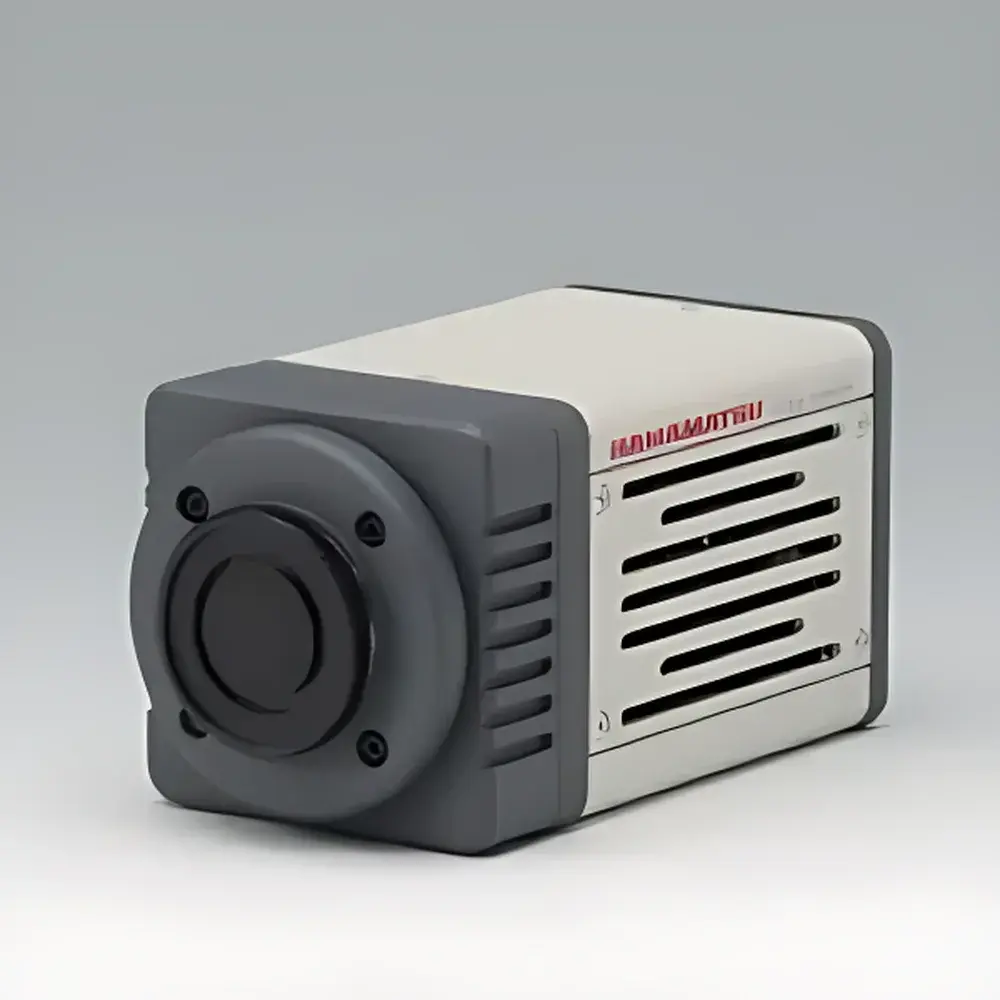
Hamamatsu C12741-03 InGaAs Near-Infrared Camera
| Brand | Hamamatsu |
|---|---|
| Origin | Japan |
| Model | C12741-03 |
| Effective Pixels | 640 × 512 |
| Pixel Size | 20 µm |
| Spectral Range | 950–1700 nm |
| Cooling | Thermoelectric (−10 °C) |
| Bit Depth | 14-bit digital output |
| Frame Rate | 60 fps |
| Interface | USB 3.0 and EIA-170 (analog) simultaneously |
| Bad Pixel Rate | < 0.37% |
| Image Correction | Flat-field, background subtraction, exposure time correction |
Overview
The Hamamatsu C12741-03 is a high-performance, thermoelectrically cooled InGaAs focal plane array (FPA) camera engineered for quantitative near-infrared (NIR) imaging in the 950–1700 nm spectral band. Unlike uncooled or passively stabilized NIR sensors, the C12741-03 integrates a Peltier cooler to maintain the sensor at a stable −10 °C, significantly suppressing dark current and enabling low-noise, high-dynamic-range acquisition under varying ambient conditions. Its 640 × 512 pixel InGaAs detector delivers spatial resolution optimized for industrial inspection, photovoltaic characterization, and optical alignment tasks where silicon-based CCD/CMOS sensors lack spectral sensitivity. The camera operates on the principle of photon-to-electron conversion in lattice-matched In0.53Ga0.47As, with quantum efficiency exceeding 70% across its operational range—critical for weak-signal detection in laser beam profiling, electroluminescence (EL), and photoluminescence (PL) imaging.
Key Features
- Thermoelectric cooling to −10 °C ensures thermal stability and reproducible dark signal performance over extended acquisition periods.
- 14-bit digital output via USB 3.0 interface enables high-fidelity data transfer with minimal latency; simultaneous analog output (EIA-170 compliant) supports legacy frame grabber integration.
- Pixel uniformity optimized through factory calibration: fixed-pattern noise is corrected via on-board flat-field and background subtraction algorithms, yielding pixel response non-uniformity (PRNU) < 1.5% RMS.
- Low defect rate: < 0.37% dead or hot pixels, verified per Hamamatsu’s internal screening protocol; defective pixel map is provided and supported by software interpolation.
- Programmable exposure control with real-time correction for shutter timing drift—essential for quantitative intensity mapping in time-resolved NIR applications.
- 60 fps full-frame readout at native resolution, scalable via region-of-interest (ROI) binning or subsampling for higher-speed applications without hardware modification.
Sample Compatibility & Compliance
The C12741-03 is compatible with standard C-mount lenses and NIR-transmissive optics (e.g., CaF2, ZnSe, or Ge-coated objectives). It meets IEC 61000-6-3 (EMC emission) and IEC 61000-6-2 (immunity) requirements for industrial environments. While not intrinsically rated for hazardous locations, its sealed aluminum housing provides IP40 ingress protection. For regulated quality systems, the camera supports traceable calibration workflows: NIST-traceable radiometric calibration kits are available separately, and metadata embedding (exposure time, temperature, gain) complies with ISO 12232:2019 digital image sensor characterization guidelines. When integrated into GxP-compliant test benches, audit trails for image acquisition parameters can be logged externally via Hamamatsu’s HCImage Live SDK.
Software & Data Management
Hamamatsu provides HCImage Live—a cross-platform (Windows/macOS/Linux) application supporting real-time display, histogram analysis, multi-frame averaging, and TIFF/RAW export with embedded EXIF-like metadata. The SDK (C/C++, Python, MATLAB bindings) enables custom integration into automated inspection platforms, including synchronization with motion controllers or laser pulsers via TTL trigger I/O. All image corrections (flat-field, offset, gain) are applied in real time or deferred for post-processing, preserving raw sensor data integrity. Export formats include 16-bit TIFF (uncompressed), HDF5 (for time-series stacks), and CSV (pixel-intensity matrices), facilitating compatibility with MATLAB, Python (NumPy/SciPy), and commercial metrology suites such as Keysight PathWave or National Instruments TestStand.
Applications
- Silicon wafer inspection: Detection of subsurface cracks, dopant distribution, and edge defects via transmission NIR imaging at 1310 nm—leveraging silicon’s transparency window.
- Photovoltaic evaluation: Quantitative EL/PL imaging of solar cells and modules; measurement of series resistance gradients, shunt leakage paths, and micro-crack propagation under bias.
- Laser beam diagnostics: Real-time M² measurement, centroid tracking, and intensity profile analysis for fiber-coupled 1064 nm, 1550 nm, or supercontinuum sources.
- Fiber optic component testing: Insertion loss mapping, connector end-face inspection, and splice loss quantification in single-mode and multimode telecom fibers.
- Industrial machine vision: Embedded thermal anomaly detection in sealed enclosures (e.g., power electronics, battery modules) using passive NIR emissivity contrast.
FAQ
Does the C12741-03 support external triggering with precise timing synchronization?
Yes—it accepts TTL-compatible trigger signals (rising-edge active) with programmable delay (0–100 ms, 10 µs resolution) and jitter < 1 µs. Trigger modes include single-shot, burst, and continuous with hardware handshake.
Can the camera operate continuously for extended periods without thermal drift?
With active −10 °C cooling and proper heat-sink mounting, baseline dark current drift remains below 0.5% over 8-hour acquisitions at constant ambient temperature (25 ± 2 °C).
Is radiometric calibration included with the system?
Factory flat-field and dark reference frames are supplied. NIST-traceable absolute radiometric calibration is optional and delivered as a certified report with calibrated irradiance responsivity (µV/(W/cm²)) per pixel.
What lens mount options are available?
Standard C-mount is provided; F-mount and M42 adapters are available as accessories. Custom flange distance adjustments are supported for telecentric or macro NIR lens integration.
How is firmware updated, and is backward compatibility maintained?
Firmware updates are performed via USB using Hamamatsu’s dedicated utility. Version history and release notes document API changes; all SDK versions maintain binary backward compatibility for existing integrations.





