
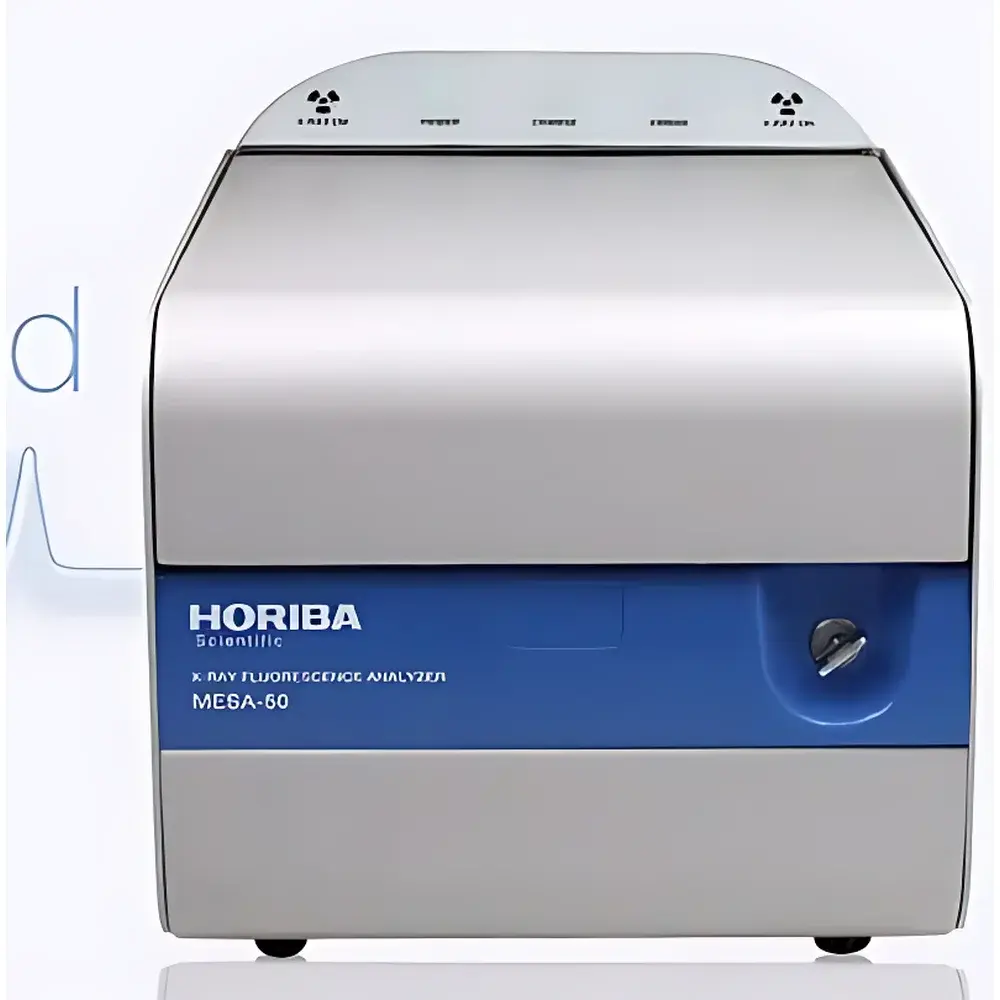
HORIBA MESA-50 Energy Dispersive X-Ray Fluorescence Spectrometer
| Brand | HORIBA |
|---|---|
| Origin | Japan |
| Model | MESA-50 |
| Form Factor | Benchtop/Portable |
| Elemental Range | Al (13) to U (92) |
| Detection Limit | ppm-level |
| Energy Resolution | 131 eV (at Mn Kα) |
| Repeatability | <1% RSD |
| Dimensions | 294 × 208 × 205 mm |
| Weight | 12 kg |
| Battery Life | Up to 6 hours |
| Sample Imaging | Coaxial CCD camera |
| Detector | Silicon Drift Detector (SDD) |
| Signal Processing | HORIBA Digital Pulse Processor (DPP) |
| Vacuum/Nitrogen Requirement | None (ambient air operation, including Cl analysis) |
Overview
The HORIBA MESA-50 is a benchtop energy dispersive X-ray fluorescence (EDXRF) spectrometer engineered for high-precision elemental analysis across regulatory screening, quality control, and field-deployable applications. Utilizing a micro-focus X-ray tube and a high-efficiency silicon drift detector (SDD), the MESA-50 operates on fundamental EDXRF principles: incident X-rays eject inner-shell electrons from sample atoms; subsequent electron transitions emit characteristic fluorescent X-rays, whose energies are uniquely assigned to specific elements (Z = 13–92). Unlike wavelength-dispersive systems, EDXRF enables simultaneous multi-element detection without mechanical scanning—ideal for rapid, non-destructive screening of regulated substances such as Pb, Cd, Hg, Cr(VI), Br, Cl, and P in compliance with RoHS, ELV, POPs, and halogen-free directives. Its compact, self-shielded architecture eliminates external radiation hazards, meeting IEC 62471 and ISO 20816 safety requirements for Class 1 equipment.
Key Features
- Integrated coaxial CCD imaging system: Real-time visual alignment ensures the measurement spot corresponds precisely to the observed region—critical for heterogeneous or micro-feature analysis.
- Three interchangeable collimators (Ø0.5 mm, Ø1.0 mm, Ø3.0 mm): Enables optimized excitation geometry for fine wires, SMD components, coatings, and bulk materials.
- HORIBA Digital Pulse Processor (DPP): Delivers real-time dead-time correction, pile-up rejection, and adaptive baseline restoration—enhancing peak fidelity and quantitative accuracy at low count rates.
- Ambient-air operation: No vacuum pump or liquid nitrogen cooling required; chlorine (Cl) and other light elements (e.g., Mg, Al, Si, P, S) are quantified reliably under atmospheric conditions.
- Onboard rechargeable Li-ion battery: Supports up to 6 hours of continuous operation—validated per UN 38.3 transport safety standards—enabling mobile lab use, factory floor audits, and customs inspection scenarios.
- Eco-design compliance: Meets EU ErP Directive (2009/125/EC) and RoHS 3 (2015/863/EU); fully recyclable chassis and low-power X-ray tube (<10 W typical).
Sample Compatibility & Compliance
The MESA-50 accommodates solid, powder, and thin-film samples ranging from 1 mm² electronics solder joints to 100 mm² industrial PCBs. Its open-sample chamber accepts irregular geometries without fixture tooling. All measurements adhere to ASTM E1621–23 (Standard Guide for XRF Analysis of Waste Materials) and ISO 12885:2022 (XRF — General requirements for calibration and validation). For regulated testing, method validation documentation supports GLP-compliant workflows, and audit trails comply with FDA 21 CFR Part 11 when paired with HORIBA’s optional LabSolutions EDX software (v3.5+). Certified reference materials (CRMs) including NIST SRM 2710a, 2783, and BAM BCR-680 are pre-loaded in calibration libraries.
Software & Data Management
Controlled via HORIBA LabSolutions EDX v3.5, the MESA-50 provides intuitive workflow-driven operation: auto-focus imaging, one-click screening mode (pass/fail against user-defined thresholds), and full-spectrum quantitative analysis using fundamental parameter (FP) and empirical calibration models. Data export supports .csv, .xlsx, and .cdf formats; spectral archives are timestamped and digitally signed. The software includes built-in uncertainty estimation per ISO/IEC 17025:2017 Annex A.3, traceable to NIST-traceable CRMs. Remote diagnostics and firmware updates are delivered over TLS 1.2-secured HTTPS connections—no local server dependency.
Applications
- Regulatory screening: RoHS 2 (EU), China RoHS II, JEITA-MT-001, and Korean RoHS enforcement testing for electronics, cables, and packaging.
- Automotive supply chain: ELV-compliant verification of catalysts, brake pads, and polymer composites.
- Recycling & scrap sorting: Rapid identification of alloy grades (e.g., stainless steels, aluminum series) and hazardous contaminants in shredded e-waste.
- Research & development: Thin-film thickness and composition profiling (e.g., solar cell CIGS layers, battery cathode coatings).
- Forensics & archaeometry: Non-invasive provenance analysis of pigments, coins, and ceramics.
FAQ
Does the MESA-50 require external cooling or vacuum accessories?
No. It operates in ambient air with no liquid nitrogen, Peltier coolers, or vacuum pumps—reducing total cost of ownership and enabling immediate deployment.
Can it quantify chlorine without helium purge?
Yes. The SDD’s low-noise performance and DPP’s optimized light-element processing allow reliable Cl detection (3.17 keV) in air, validated per IEC 62321-5:2013 Annex C.
Is the instrument compliant with EU CE marking requirements?
Yes. It carries CE marking under the EMC Directive 2014/30/EU and Low Voltage Directive 2014/35/EU, with full technical documentation available upon request.
How is measurement reproducibility verified?
Repeatability is assessed per ISO 8258:1991 using 10 consecutive measurements of certified brass CRM (NIST SRM 482); typical RSD is ≤0.8% for Cu, Zn, Pb at 100 s live time.
What maintenance is required beyond routine cleaning?
None. The X-ray tube lifetime exceeds 20,000 hours; the SDD has no consumables. Annual performance verification using check sources (⁵⁵Fe, ¹⁰⁹Cd) is recommended but not mandatory.





