
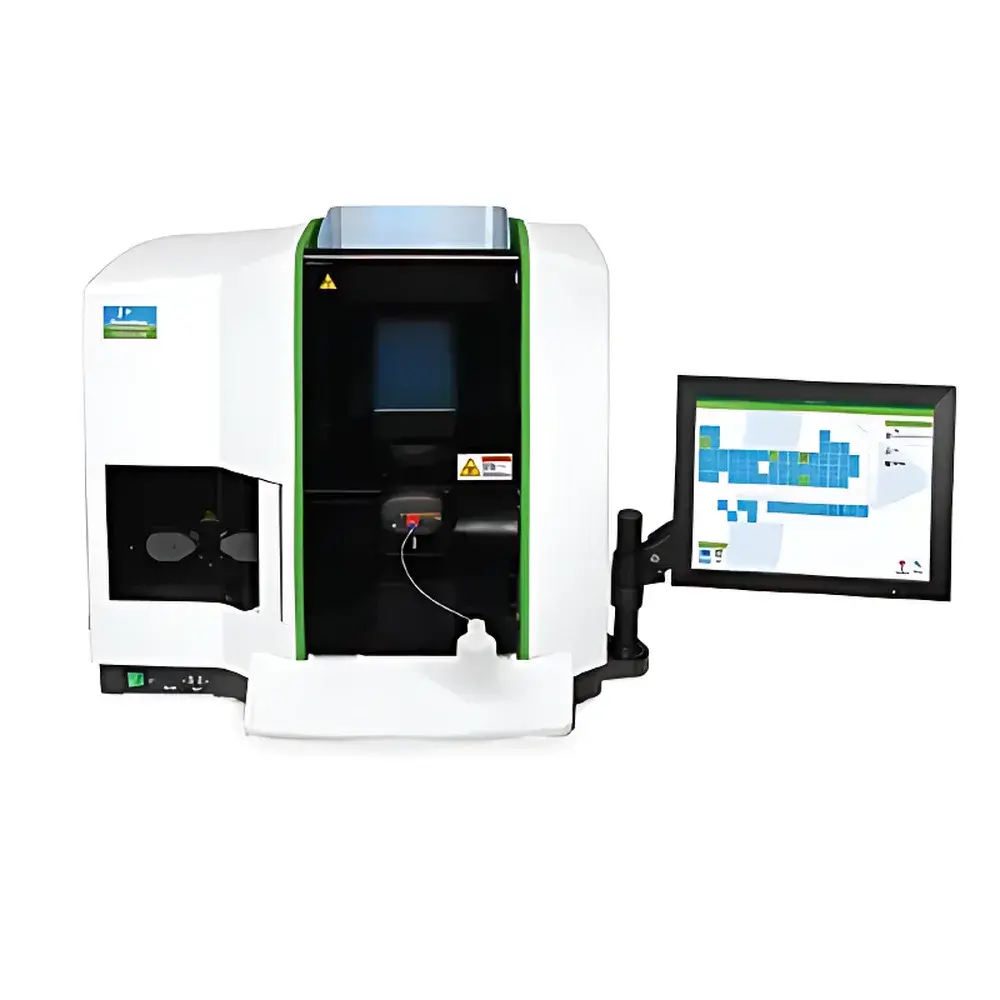
PerkinElmer PinAAcle 500 Flame Atomic Absorption Spectrometer
| Brand | PerkinElmer |
|---|---|
| Origin | Singapore |
| Manufacturer Type | Original Equipment Manufacturer (OEM) |
| Instrument Type | Flame AAS |
| Model | PinAAcle 500 |
| Monochromator | Echelle Grating |
| Optical System | Dual-Beam |
| Detector | Solid-State CCD Array |
| Background Correction | Deuterium Lamp |
| Flame System | FAST Flame Automated Burner Head Positioning and Gas Control |
Overview
The PerkinElmer PinAAcle 500 is a benchtop flame atomic absorption spectrometer engineered for high-throughput, routine elemental analysis in environmental, clinical, food safety, and industrial quality control laboratories. It operates on the fundamental principle of atomic absorption spectroscopy—where ground-state free atoms in a flame absorb light at element-specific wavelengths emitted by hollow cathode lamps. The instrument employs a dual-beam optical architecture to compensate for source intensity drift and lamp fluctuations, ensuring stable baseline performance over extended measurement sequences. Its echelle grating monochromator delivers high spectral resolution with broad wavelength coverage (190–900 nm), enabling precise isolation of analytical lines without mechanical slit adjustment. The fully corrosion-resistant nebulizer chamber, burner head, and gas pathways are constructed from inert, acid-resistant materials—including PTFE, quartz, and ceramic—to withstand aggressive sample matrices (e.g., concentrated HNO₃, HCl, or HF-containing digests) without degradation.
Key Features
- FAST Flame Automation Platform: Fully motorized burner head positioning, automatic gas flow optimization (air/acetylene or nitrous oxide/acetylene), and real-time flame alignment ensure reproducible atomization conditions across thousands of analyses.
- Dual-Beam Optical Design: Compensates for lamp intensity drift and electronic noise, delivering enhanced signal stability and reduced calibration frequency.
- Echelle Grating Monochromator: Provides fixed-resolution spectral separation across the full UV-Vis range; eliminates need for manual grating rotation or slit width tuning.
- Deuterium Arc Background Correction: Simultaneously measures atomic and background absorption using time-shared detection, correcting for structured molecular absorption and scattering effects up to 2.5 A.
- Corrosion-Resistant Fluidic Pathway: Nebulizer, spray chamber, and burner components are fabricated from chemically inert materials to maintain long-term performance in high-acid or saline sample environments.
- Integrated Safety Interlocks: Automatic flame shutdown upon gas pressure deviation, insufficient cooling airflow, or burner misalignment—compliant with EN 61010-1 and UL 61010-1 requirements.
Sample Compatibility & Compliance
The PinAAcle 500 accepts aqueous liquid samples (0.5–5 mL volume) introduced via standard concentric nebulizers. It supports direct analysis of diluted digests from microwave-assisted acid digestion (EPA Methods 3050B, 3051A, 3052), as well as low-solids environmental waters (EPA Method 7000B) and biological fluids following appropriate dilution and matrix-matching protocols. Instrument design conforms to ISO/IEC 17025:2017 requirements for analytical equipment validation. Data acquisition and method storage support audit-trail functionality aligned with FDA 21 CFR Part 11 principles when used with compliant software configurations. Routine operation meets ASTM D1688 (copper in water), ASTM D5600 (trace metals in petroleum), and ISO 11885 (water quality—determination of selected elements by AAS) specifications.
Software & Data Management
Controlled via Syngistix™ for AA Software (v5.5+), the system provides method development wizards, multi-element calibration curve generation (linear, quadratic, or weighted least-squares), QC check standards monitoring, and automated report generation in PDF or CSV formats. All instrument parameters—including lamp current, slit width (virtual), integration time, and background correction mode—are stored with each analysis. Raw absorbance/time data and processed concentration results are timestamped and user-annotated, supporting GLP-compliant record retention. Optional LIMS connectivity enables bidirectional data exchange via ASTM E1384 or HL7-compatible interfaces.
Applications
- Environmental testing: Quantification of Ca, Mg, Fe, Cu, Zn, Pb, Cd, and Ni in drinking water, wastewater, soil extracts, and airborne particulate filters.
- Clinical and nutritional analysis: Measurement of essential trace elements (e.g., Zn, Cu, Mg) in serum, urine, and infant formula.
- Food and beverage quality assurance: Monitoring Na, K, Ca, and heavy metals in dairy products, juices, and fortified cereals per AOAC 984.27 and ISO 6496 protocols.
- Industrial process control: Elemental verification in electroplating baths, catalyst slurries, and semiconductor-grade chemicals.
- Academic research: Teaching labs benefit from intuitive workflow design and robust hardware suitable for undergraduate instrumental analysis courses.
FAQ
What flame gases are supported by the PinAAcle 500?
Air/acetylene for low-to-medium temperature elements (e.g., Na, Ca, Mg); nitrous oxide/acetylene for refractory elements (e.g., Al, Si, V, Ti). Gas selection is automated via the FAST Flame platform.
Is graphite furnace capability available on this model?
No—the PinAAcle 500 is a dedicated flame AAS system. For electrothermal atomization, PerkinElmer offers the PinAAcle 900F or 900T models with integrated graphite furnace modules.
How does deuterium background correction compare to Zeeman correction?
Deuterium correction is optimized for broadband, continuous background (e.g., salt matrixes); Zeeman correction—available on higher-tier models—is superior for narrowband, structured background (e.g., molecular bands in organic solvents).
Can the instrument be validated for GMP environments?
Yes—when deployed with Syngistix™ in 21 CFR Part 11 mode (including electronic signatures, audit trail, and role-based access), it satisfies GMP documentation requirements for pharmaceutical raw material testing.
What maintenance intervals are recommended?
Nebulizer cleaning every 100 samples; burner head inspection after 500 flame hours; annual optical alignment verification and detector dark-current calibration.




