
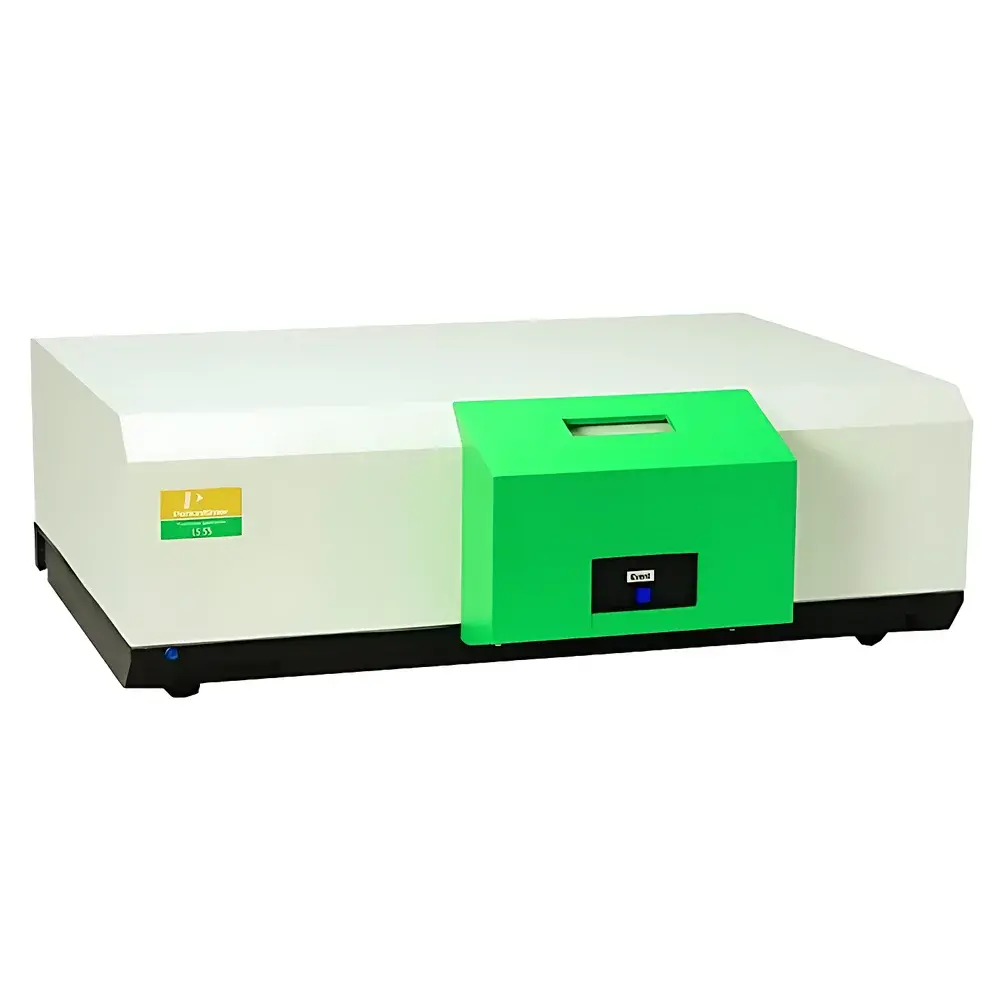
PerkinElmer LS-55 Fluorescence, Phosphorescence and Luminescence Spectrophotometer
| Origin | USA |
|---|---|
| Manufacturer Type | Authorized Distributor |
| Origin Category | Imported Instrument |
| Model | LS-55 |
| Pricing | Upon Request |
Overview
The PerkinElmer LS-55 is a high-performance, modular fluorescence, phosphorescence, and luminescence spectrophotometer engineered for precision molecular photoluminescence measurement in research, quality control, and regulatory-compliant laboratories. Based on the proven optical architecture of the LS-50B platform, the LS-55 employs pulsed xenon lamp excitation—eliminating continuous thermal load, minimizing sample photodegradation, and enabling time-resolved detection without hardware add-ons. Its dual-monochromator design delivers high spectral purity and low stray light, essential for quantitative analysis of weakly emissive species, long-lived phosphorescent states, and low-intensity bioluminescent or chemiluminescent reactions. The instrument operates on the principle of photonic excitation followed by wavelength-resolved emission detection, with real-time dark-current subtraction between pulses to enhance signal fidelity at low-light conditions.
Key Features
- Pulsed xenon lamp source (150 W) with >10⁹ pulse lifetime, minimal ozone generation, and no warm-up delay—enabling immediate start-up and stable intensity over extended operation.
- Independent excitation and emission monochromators with continuously adjustable slit widths: 2.5–15 nm (excitation) and 2.5–20 nm (emission), both adjustable in 0.1 nm increments for optimized resolution/sensitivity trade-offs.
- Wavelength accuracy ±1 nm and repeatability ±0.5 nm across 190–900 nm range, traceable to NIST-certified standards.
- High signal-to-noise ratio: ≥750:1 RMS at the water Raman peak (350 nm excitation), and ≥2500:1 RMS at baseline—critical for detecting trace analytes and low-quantum-yield compounds.
- Large sample compartment accommodating automated accessories including solid-sample holders, temperature-controlled cuvette holders (–10 °C to +100 °C), polarization modules, and microplate readers.
- Fully software-controlled phosphorescence measurement: adjustable delay time (1 µs to 10 s), gate width (1 µs to 10 s), and pulse repetition rate—no external phosphorimeter required.
Sample Compatibility & Compliance
The LS-55 supports liquid, solid, powder, thin-film, and microvolume samples via interchangeable holders and optical interfaces. It complies with key international analytical standards including ASTM E1657 (fluorescence instrumentation validation), ISO 17025 requirements for measurement uncertainty estimation, and USP , , and for luminescence assay validation. When operated with FL WinLab™ software under audit-trail-enabled mode, the system meets FDA 21 CFR Part 11 requirements for electronic records and signatures—supporting GLP and GMP environments. All optical components are calibrated using certified reference materials (e.g., quinine sulfate in 0.1 M H₂SO₄, europium chelate standards), ensuring inter-laboratory comparability.
Software & Data Management
FL WinLab™ software provides a validated, Windows-based platform for instrument control, data acquisition, processing, and reporting. It features advanced multidimensional visualization tools—including contour plots, synchronous scanning, and 3D emission-excitation matrices—that facilitate deconvolution of overlapping fluorophore signals in complex mixtures (e.g., protein folding intermediates, environmental humic substances, pharmaceutical impurity profiling). Data export conforms to ASTM E1947 and ASTM E2524 formats, supporting LIMS integration. Version-controlled method templates, electronic signature workflows, and full audit trail logging (user actions, parameter changes, calibration events) are embedded for regulated use.
Applications
- Quantitative and qualitative analysis of polycyclic aromatic hydrocarbons (PAHs), vitamins (e.g., B2, B12), amino acids, and nucleic acid derivatives.
- Time-resolved phosphorescence assays for oxygen sensing, triplet-state kinetics, and heavy-metal ion detection (e.g., Ru(II)/Ir(III) complexes).
- Bioluminescence monitoring in reporter gene assays (luciferase), ATP quantification, and cell viability studies.
- Chemiluminescence-based immunoassays (CLIA), ELISA enhancement, and reactive oxygen species (ROS) detection.
- Material science applications: quantum dot characterization, OLED emitter screening, and photocatalyst evaluation under controlled excitation conditions.
FAQ
Does the LS-55 require external hardware to perform phosphorescence measurements?
No—the LS-55 performs time-resolved phosphorescence natively via software-controlled pulse timing, eliminating the need for separate phosphorimeters or mechanical choppers.
What is the minimum detectable concentration for quinine sulfate under standard conditions?
At optimal settings (5 nm slits, 1 s integration, 350 nm excitation), the limit of detection is ≤50 pM in 1 cm quartz cuvettes, based on IUPAC signal-to-noise criteria (3σ).
Is FL WinLab™ compatible with modern Windows OS versions and networked lab environments?
Yes—FL WinLab™ v6.2.1 and later support Windows 10/11 (64-bit), domain authentication, and secure remote access via PerkinElmer’s LabLink™ infrastructure.
Can the LS-55 be integrated into automated sample handling systems?
Yes—it supports RS-232, USB, and Ethernet communication protocols and is compatible with third-party autosamplers (e.g., CTI Analytics, Gerstel) via standardized command sets.
How is wavelength calibration verified and maintained?
Calibration is performed using mercury-argon and holmium oxide reference lamps; verification intervals follow ISO/IEC 17025 guidelines and can be scheduled automatically within FL WinLab™.





