
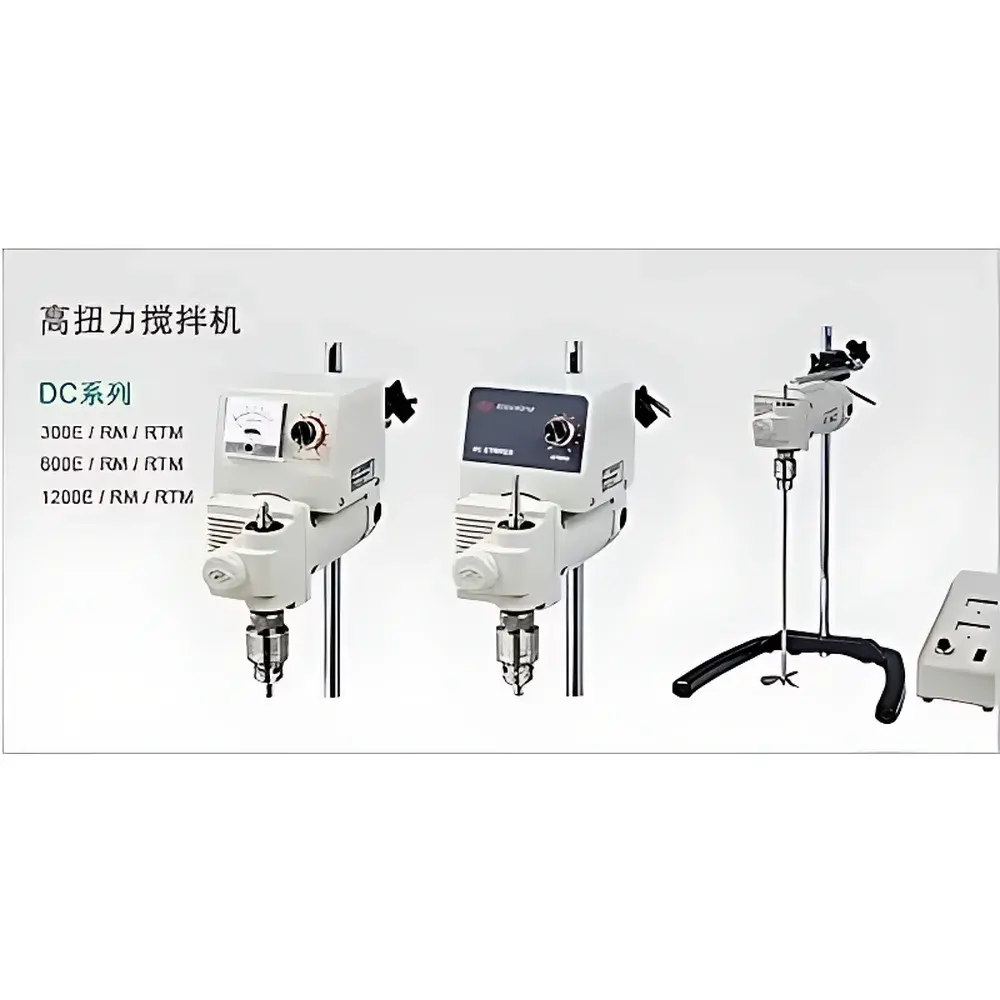
DAMAI DC-Series High-Torque Laboratory Stirrer
| Origin | Taiwan |
|---|---|
| Manufacturer Type | Authorized Distributor |
| Model | 1200E / RM / RTM |
| Pricing | Available Upon Request |
| Motor | DC 200 W |
| Speed Range | 1,200 rpm (1200E), 600 rpm (600E), 300 rpm (300E) |
| Torque Output | 15 kg·cm (1200E), 30 kg·cm (600E), 60 kg·cm (300E) |
| Dimensions (W×D×H) | 125 × 250 × 250 mm |
| Net Weight | 6.5 kg |
| Power Supply | AC 110/220 V, 50/60 Hz |
| Construction | Stainless Steel Shaft & Clamp, Chemically Resistant Coating |
| Drive System | Continuously Variable Speed Control (Analog) |
| Safety Features | Overcurrent Limiting, Thermal Overload Protection, Soft-Start Acceleration Profile |
| Display Options | RM — Analog RPM Gauge |
Overview
The DAMAI DC-Series High-Torque Laboratory Stirrer is an engineered solution for demanding mixing and dispersion tasks in analytical, pharmaceutical, polymer, and materials science laboratories. Built upon a brushless DC motor architecture with integrated thermal and current regulation, the system delivers stable rotational output across variable load conditions—particularly critical when processing high-viscosity fluids (e.g., polymer melts, ceramic slurries, hydrogels, or concentrated emulsions) or large-volume batches (up to 20 L, depending on impeller geometry and vessel configuration). Its core operating principle relies on direct-drive torque transmission via a rigid, stainless steel hollow shaft—enabling precise depth adjustment of stirring elements without mechanical disassembly. Unlike AC induction stirrers, the DC motor provides linear speed-torque characteristics, ensuring consistent angular momentum even under transient viscosity spikes or sudden load changes.
Key Features
- High-torque DC motor (200 W continuous rating) with three calibrated speed-torque configurations: 1200E (1,200 rpm / 15 kg·cm), 600E (600 rpm / 30 kg·cm), and 300E (300 rpm / 60 kg·cm)—optimized for scalability across low-, medium-, and high-viscosity applications.
- Hollow stainless steel shaft (304 grade) with precision-machined chuck interface—supports rapid, tool-free vertical positioning of standard ISO 228–1 or DIN 12761 stirring rods, propellers, or custom agitators.
- Chemically inert, epoxy-polyester powder-coated housing—resistant to common solvents, acids, and bases encountered in QC/QA workflows; compliant with ISO 14644-1 Class 8 cleanroom-compatible surface finish standards.
- Continuously variable analog speed control with tactile feedback potentiometer—eliminates discrete step transitions and maintains ±1.5% speed stability under nominal load (per ASTM E2917-22 calibration methodology).
- Dual-stage electronic protection: (i) real-time current limiting circuitry prevents winding saturation during startup or stall events; (ii) thermally coupled NTC sensor triggers automatic shutdown at ≥85 °C internal coil temperature.
- RM variant includes a front-panel analog tachometer (0–1,500 rpm); RTM adds a second analog gauge calibrated for torque (0–70 kg·cm), enabling empirical correlation between power draw and fluid resistance—valuable for process validation and scale-up modeling.
Sample Compatibility & Compliance
The DC-Series accommodates a broad range of sample types—including Newtonian and non-Newtonian liquids, suspensions, pastes, and semi-solids—with volume capacities up to 20 L in jacketed glass reactors or stainless steel vessels (diameter ≥150 mm). All wetted components meet USP Class VI biocompatibility requirements. The device conforms to IEC 61010-1:2010 (Safety Requirements for Electrical Equipment for Measurement, Control, and Laboratory Use) and carries CE marking under the EU Low Voltage Directive 2014/35/EU. It supports GLP-compliant operation when paired with external data loggers (e.g., certified USB thermocouple interfaces), and its analog signal outputs are compatible with legacy SCADA systems used in regulated environments.
Software & Data Management
While the base unit operates as a stand-alone analog instrument, optional RS-485 Modbus RTU interface modules (sold separately) enable integration into centralized laboratory informatics platforms. When connected, real-time RPM and torque values (RTM model only) can be streamed at 10 Hz resolution for time-series analysis in MATLAB, Python (via PyModbus), or LabVIEW. Audit trails—including operator ID, timestamped setpoint changes, and fault event logs—are retained locally for ≥30 days. The system supports 21 CFR Part 11–compliant electronic signatures when deployed with validated third-party middleware (e.g., Thermo Fisher SampleManager LIMS).
Applications
- Preparation of homogeneous polymer solutions prior to rheological characterization (e.g., viscoelastic testing per ISO 6721-10).
- Mixing of high-solid-content battery electrode slurries (NMC, LFP) under inert atmosphere gloveboxes—leveraging low-speed, high-torque capability to minimize particle fracture.
- Dispersion of nanomaterials (e.g., graphene oxide, TiO₂ nanoparticles) in aqueous or organic media for stability assessment per ASTM D7976.
- Emulsification of pharmaceutical ointments and topical gels where shear history directly impacts active ingredient distribution and release kinetics.
- Accelerated aging studies requiring controlled agitation of corrosive reagents (e.g., HNO₃/HF mixtures for semiconductor wafer cleaning validation).
FAQ
What is the maximum recommended viscosity range for the 1200E model?
The 1200E is optimized for viscosities up to 50,000 mPa·s at 1,200 rpm using a 40 mm diameter anchor impeller in a 5 L vessel. For >100,000 mPa·s, the 300E or 600E variants are advised.
Can the hollow shaft accommodate custom-designed impellers with internal cooling channels?
Yes—the 12 mm inner diameter allows passage of tubing up to Ø8 mm; users must verify mechanical clearance and dynamic balance prior to operation.
Is the analog torque gauge on the RTM model calibrated traceable to NIST standards?
Factory calibration certificates (with uncertainty budgets) are provided; NIST-traceable recalibration services are available through DAMAI’s authorized metrology partners in North America and EU.
Does the unit support continuous operation beyond 8 hours?
Continuous duty cycle is rated for 24/7 operation at ≤70% of maximum torque; ambient temperature must remain below 35 °C with adequate ventilation.
How does the soft-start acceleration profile affect reproducibility in comparative mixing studies?
The ramp time is fixed at 2.5 seconds (0–100% setpoint), minimizing transient shear overshoot—critical for preserving fragile colloidal structures during method transfer between labs.



