
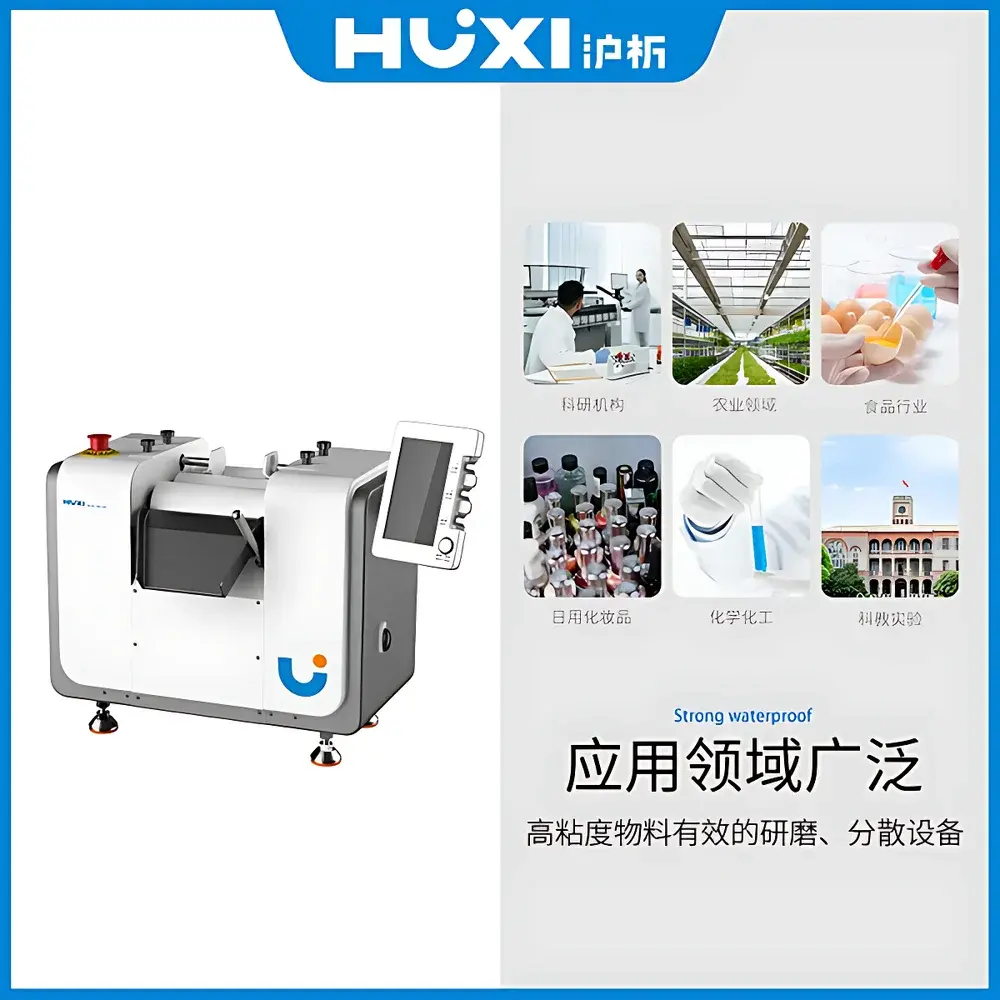
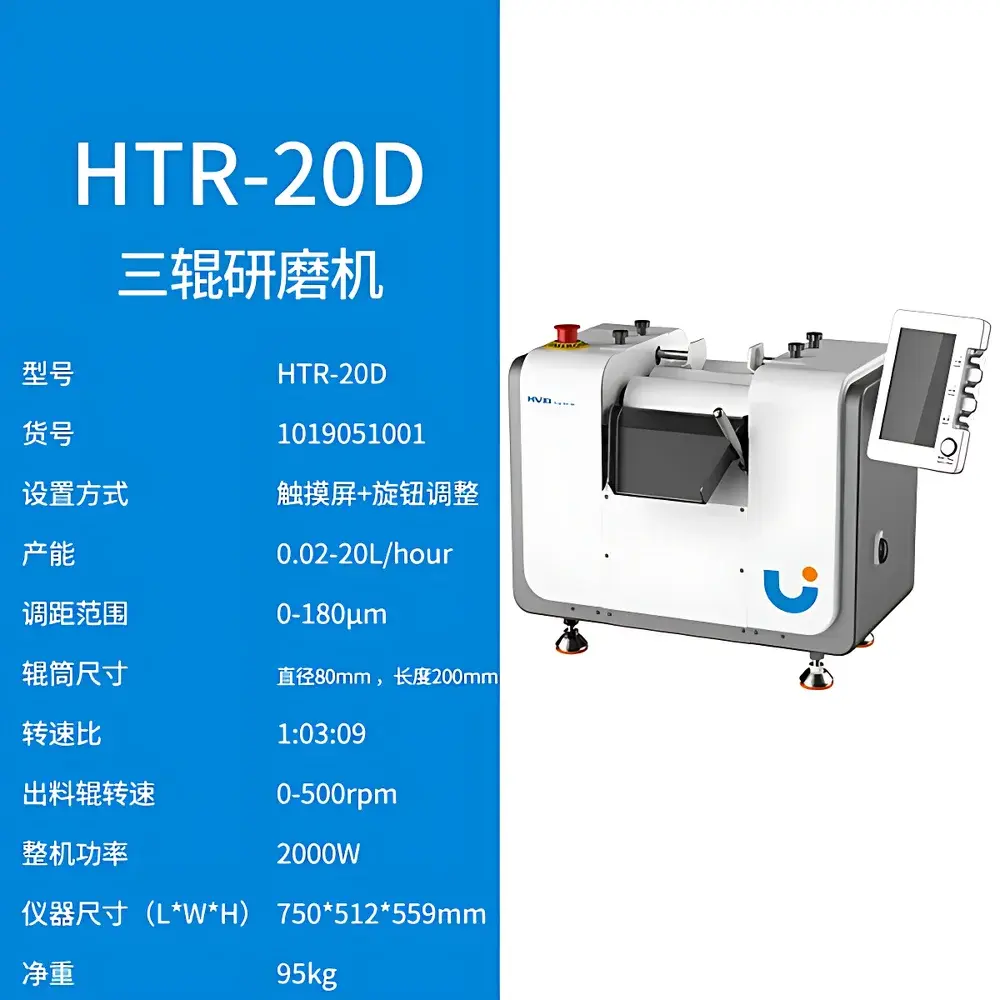
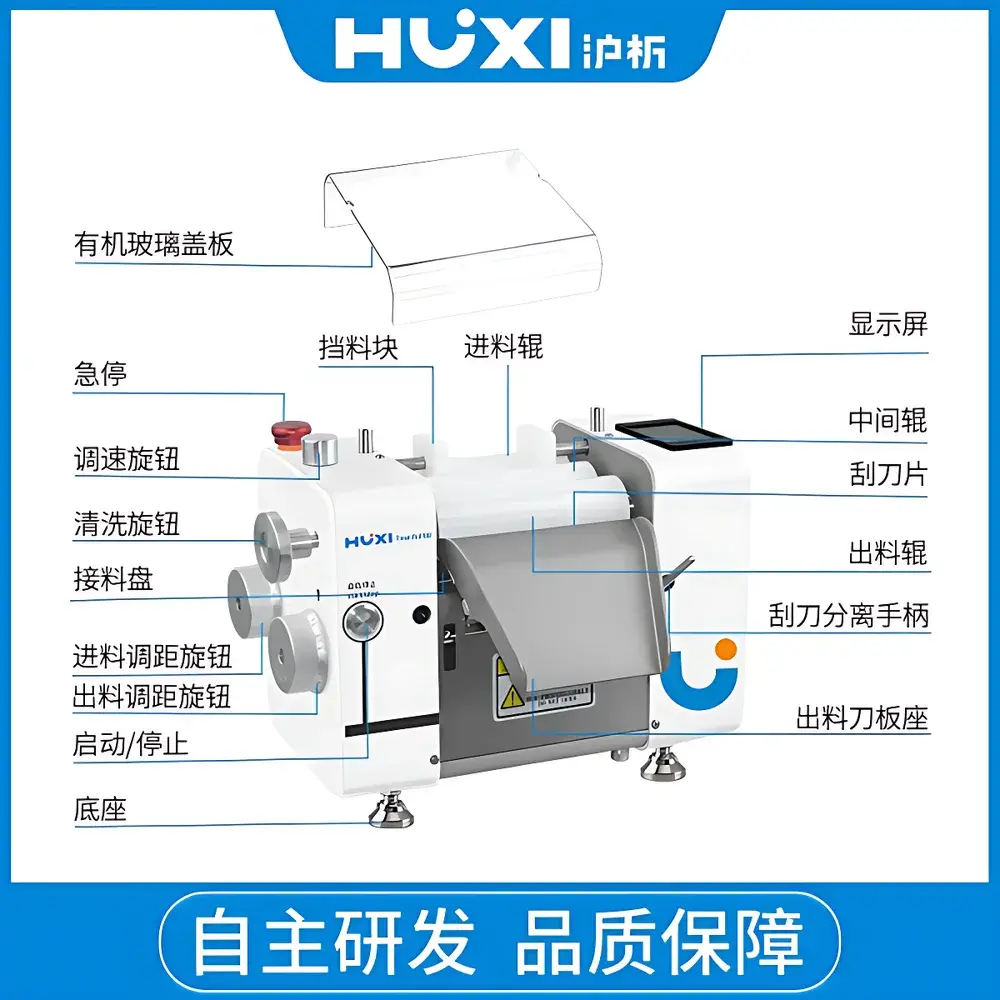
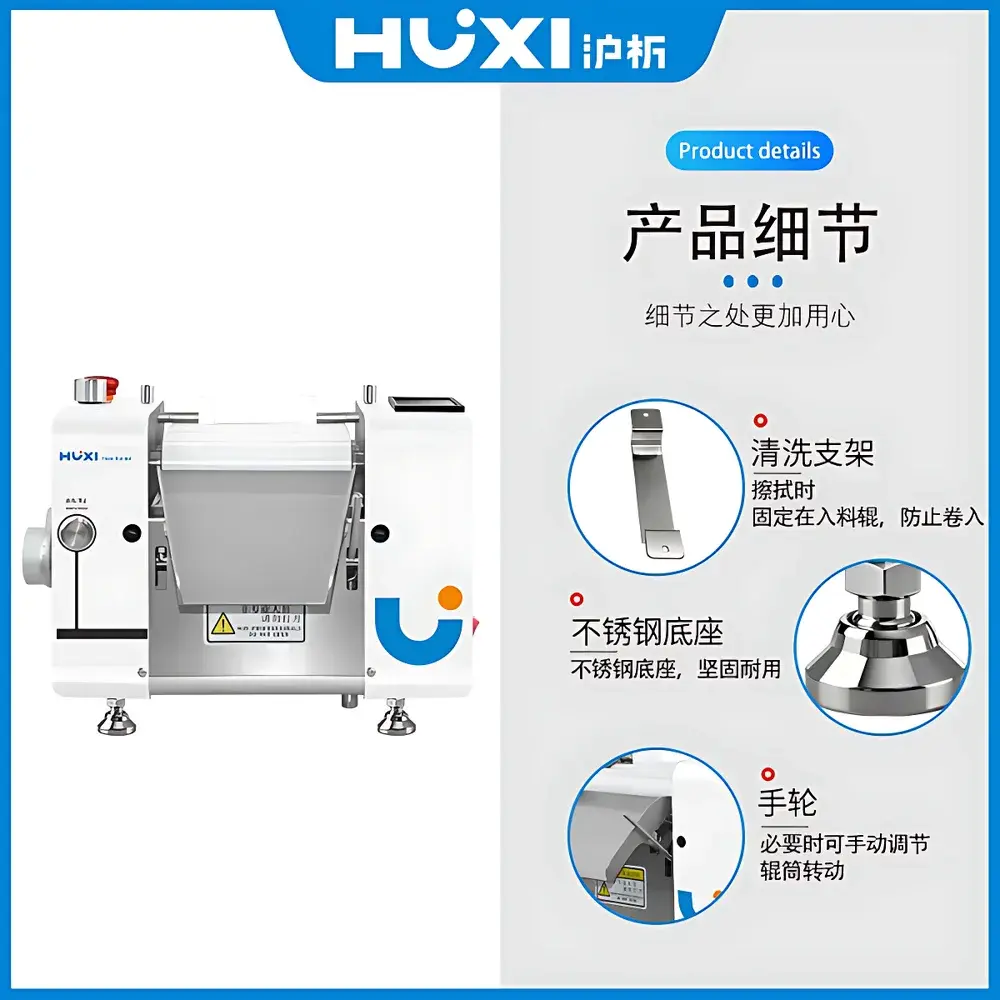
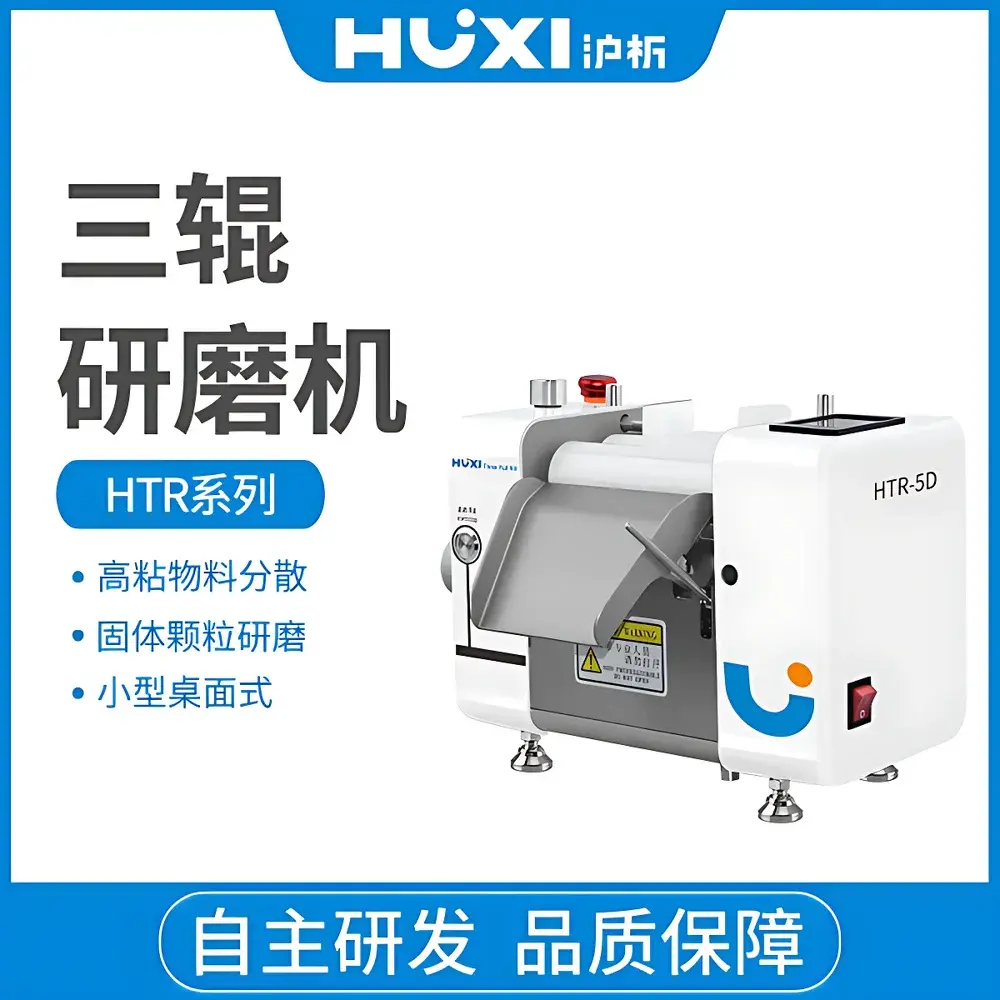
HUXI HTR-20D High-Precision Three-Roll Mill
| Brand | HUXI |
|---|---|
| Origin | Shanghai, China |
| Manufacturer Type | Direct Manufacturer |
| Region of Origin | Domestic (China) |
| Model | HTR-20D |
| Instrument Type | Three-Roll Mill |
| Sample Applicability | Soft and Highly Viscous Materials |
| Final Particle Size | < 0.01 mm |
| Roller Material | Zirconia Ceramic |
| Roller Diameter | 80 mm |
| Roller Length | 200 mm |
| Speed Ratio | 1:3:9 |
| Metering Roller Speed | 0–500 rpm |
| Throughput | 0.02–20 L/h |
| Gap Adjustment Range | 0–180 µm |
| Gap Resolution | 1 µm |
| Roller Concentricity & Straightness | ≤ 2 µm |
| Surface Roughness (Ra) | ≤ 0.3 µm |
| Maximum Line Pressure | ≥ 200 N/cm |
| Power Supply | 220 V AC |
| Total Power Consumption | 2000 W |
| Dimensions (L×W×H) | 750 × 512 × 559 mm |
| Net Weight | 95 kg |
Overview
The HUXI HTR-20D is a high-precision, laboratory-scale three-roll mill engineered for the controlled size reduction, dispersion, and homogenization of soft, highly viscous, and shear-sensitive materials—including pastes, inks, coatings, pharmaceutical ointments, cosmetic emulsions, and nanocomposite slurries. Its operational principle relies on differential rotational speeds across three horizontally aligned, counter-rotating zirconia ceramic rollers. As material passes through the successive nip zones, it undergoes progressive shear deformation, compressive stress, and laminar flow—enabling sub-micron particle deagglomeration and uniform distribution without thermal degradation or mechanical contamination. Designed specifically to bridge the gap between R&D formulation and pilot-scale process validation, the HTR-20D delivers reproducible throughput from 0.02 L/h (micro-batch screening) up to 20 L/h (small-batch production), maintaining metrological traceability throughout scale-up.
Key Features
- Zirconia ceramic rollers (Y-TZP grade) with exceptional hardness (>1200 HV), near-zero thermal expansion, and chemical inertness—ensuring long-term dimensional stability, resistance to staining, and compatibility with aggressive solvents and acidic/basic media.
- Dual-bearing roller support architecture eliminates radial play and dynamic vibration, preserving sub-micron gap repeatability (±1 µm) and minimizing runout-induced dispersion variability.
- Motorized, closed-loop gap actuation system with parametric linear amplification mechanism—enabling precise, stepless adjustment across 0–180 µm range with real-time digital readout of both gap value and instantaneous line pressure (N/cm).
- Integrated pressure curve visualization on the 7-inch vertical color touchscreen interface—providing time-resolved force profiles during milling to empirically assess dispersion kinetics, rheological yield behavior, and endpoint determination.
- Five operational modes: Gap Mode (pre-stored multi-segment recipes, ≥10 programs × 10 segments), Pressure Mode (closed-loop force control), Compensation Mode (in-process gap offset correction), Cleaning Mode (auto-retraction to safe clearance), and Auto-Zero Calibration (thermal drift compensation via reference-based re-homing).
- Multi-level user access control (operator, technician, administrator) with audit-trail-capable event logging—supporting GLP-compliant documentation requirements per ISO/IEC 17025 and FDA 21 CFR Part 11 Annex 11 principles.
- Full-safety mechanical design: polycarbonate roller guard, self-aligning aluminum knife blade holder with hard-anodized surface (6061-T6), emergency stop button, wash-safe stainless steel catch tray, and adjustable leveling feet for stable operation on uneven lab benches.
Sample Compatibility & Compliance
The HTR-20D is validated for processing non-abrasive, low-to-medium Mohs hardness materials—particularly suited for organic pigment dispersions, lithium-ion battery cathode slurries, conductive polymer pastes, dental composites, and topical hydrogels. It excludes hard particulates (e.g., fused silica, tungsten carbide), fibrous matrices, or dry powders requiring impact fracture. All wetted surfaces meet USP Class VI biocompatibility criteria for pharmaceutical contact. The device complies with IEC 61000-6-2 (EMC immunity) and IEC 61000-6-4 (EMC emission) standards. Structural components are stress-relieved via multi-cycle thermal aging and precision CNC machining to retain geometric integrity under continuous thermal cycling (±5 °C ambient fluctuation).
Software & Data Management
The embedded HMI runs on a real-time Linux kernel with deterministic I/O response (<10 ms latency). Process parameters—including gap setpoint, roller speed, pressure feedback, temperature (via optional RTD input), and runtime—are timestamped and exportable as CSV or PDF reports. Configuration files support version-controlled recipe management with SHA-256 checksum verification. Audit logs record all parameter changes, user logins, mode transitions, and alarm events—including timestamps, operator IDs, and contextual metadata. Optional Ethernet/IP or Modbus TCP connectivity enables integration into centralized MES or LIMS platforms for automated batch record generation and electronic signature workflows.
Applications
- Formulation development of high-solids-content electrode slurries for solid-state batteries.
- Dispersion stabilization of quantum dot inks for printed electronics manufacturing.
- Particle size refinement and deagglomeration of titanium dioxide in sunscreen emulsions.
- Homogenization of silicone-based medical adhesives prior to rheological characterization.
- Preparation of uniform ceramic green tapes for LTCC multilayer substrate fabrication.
- Quality control testing of pigment grind fineness per ASTM D1210 and ISO 1524.
FAQ
What types of materials are incompatible with the HTR-20D?
Materials with Mohs hardness >6 (e.g., alumina, silicon carbide), fibrous cellulose derivatives, or dry granular feedstocks lacking minimum 30% vol. liquid phase are not recommended—due to accelerated roller wear and inconsistent feed dynamics.
Is the gap calibration traceable to national standards?
Yes—the auto-zero function references a certified mechanical datum point; gap transducers are factory-calibrated against NIST-traceable laser interferometry, with certificate provided upon delivery.
Can the HTR-20D be integrated into an automated production line?
Via optional industrial communication protocols (Modbus TCP, EtherNet/IP), the unit supports remote start/stop, parameter upload/download, and real-time status monitoring—enabling seamless inclusion in semi-automated pilot lines.
What maintenance intervals are recommended for zirconia rollers?
Under typical lab use (≤4 h/day), roller surface inspection and cleaning are advised weekly; full metrological verification (concentricity, surface finish) is recommended annually or after 500 operating hours.
Does the system support GMP documentation requirements?
Yes—audit trail, electronic signatures, role-based access, and configurable report templates comply with EU Annex 11 and FDA 21 CFR Part 11 for regulated environments.



