
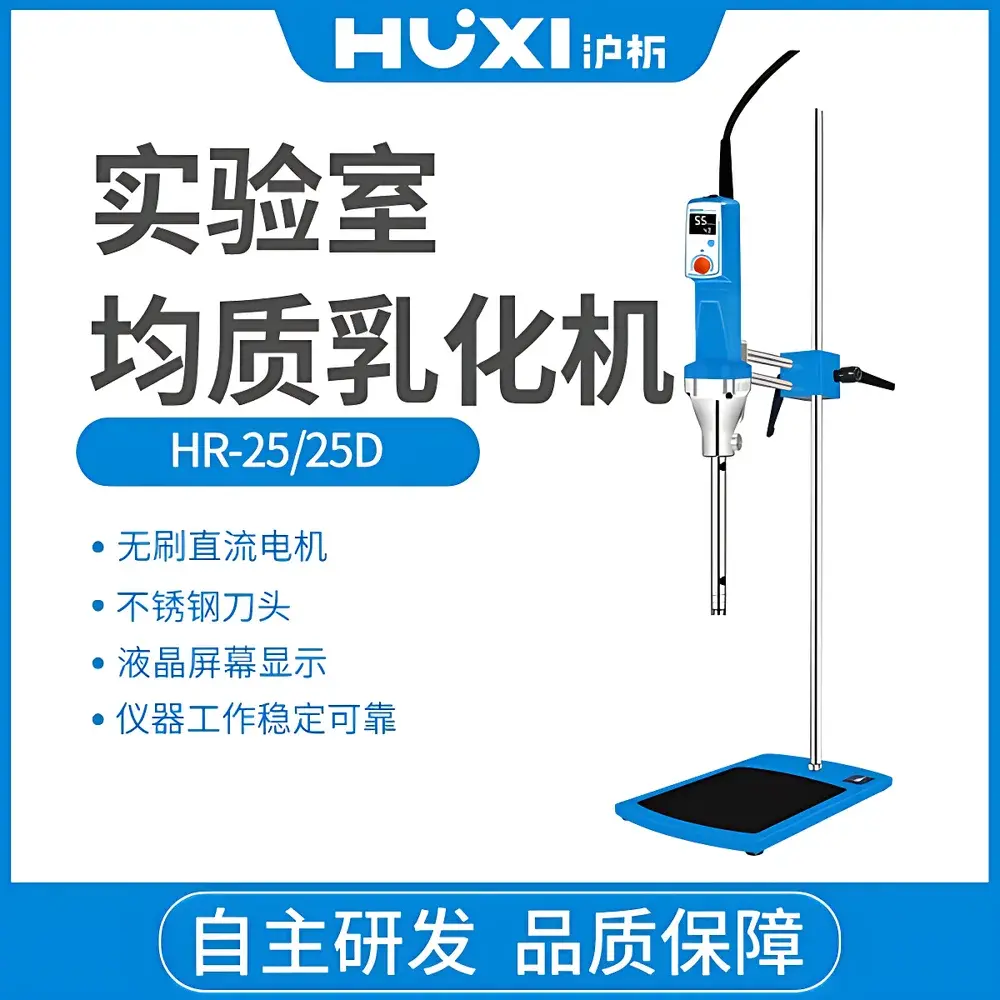
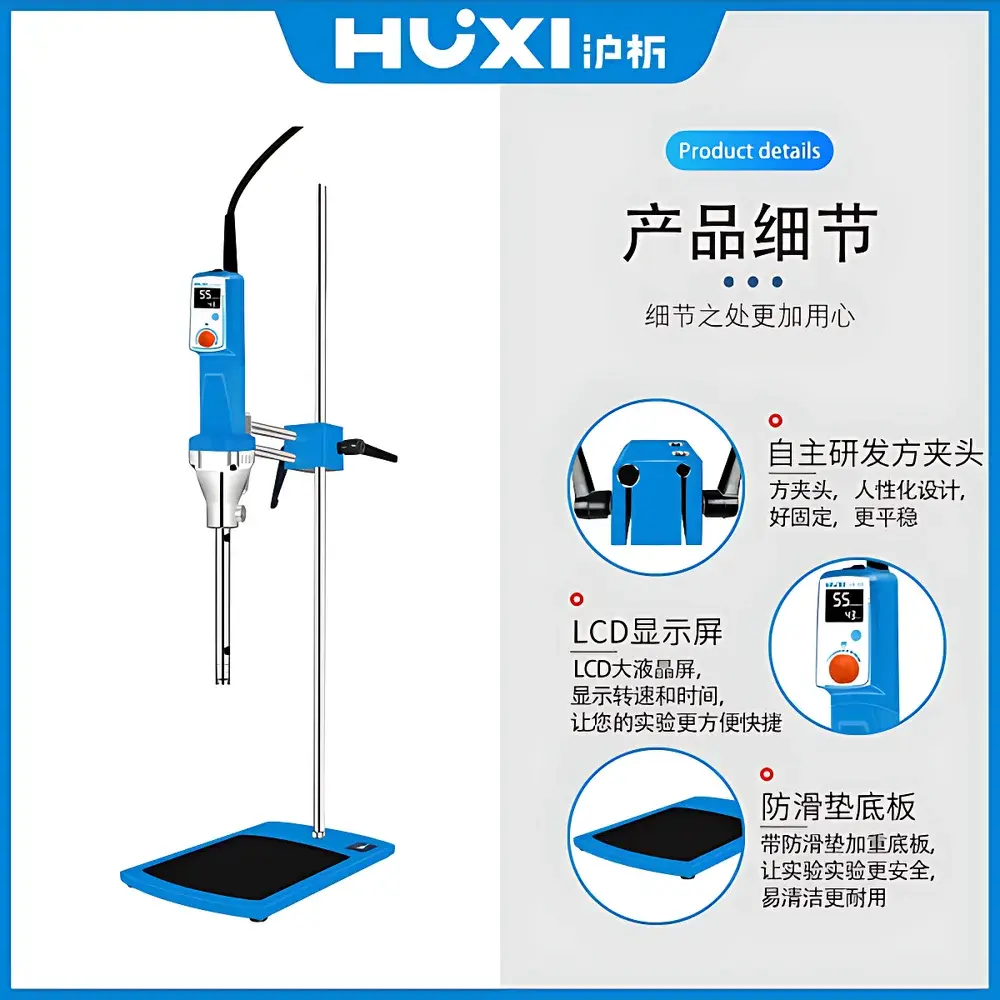
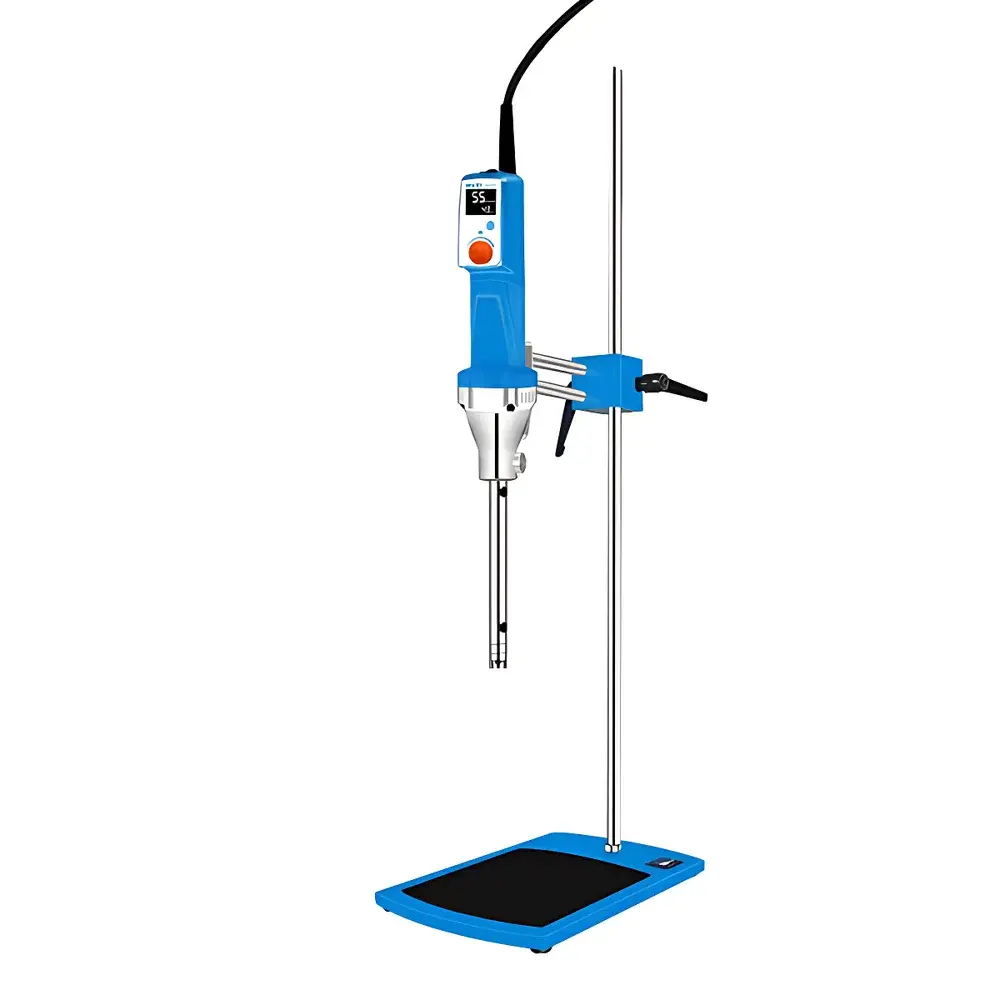
HUXI HR-25D Digital High-Speed Laboratory Homogenizer & Emulsifier
| Brand | HUXI |
|---|---|
| Origin | Shanghai, China |
| Manufacturer | HUXI Scientific Instrument Co., Ltd. |
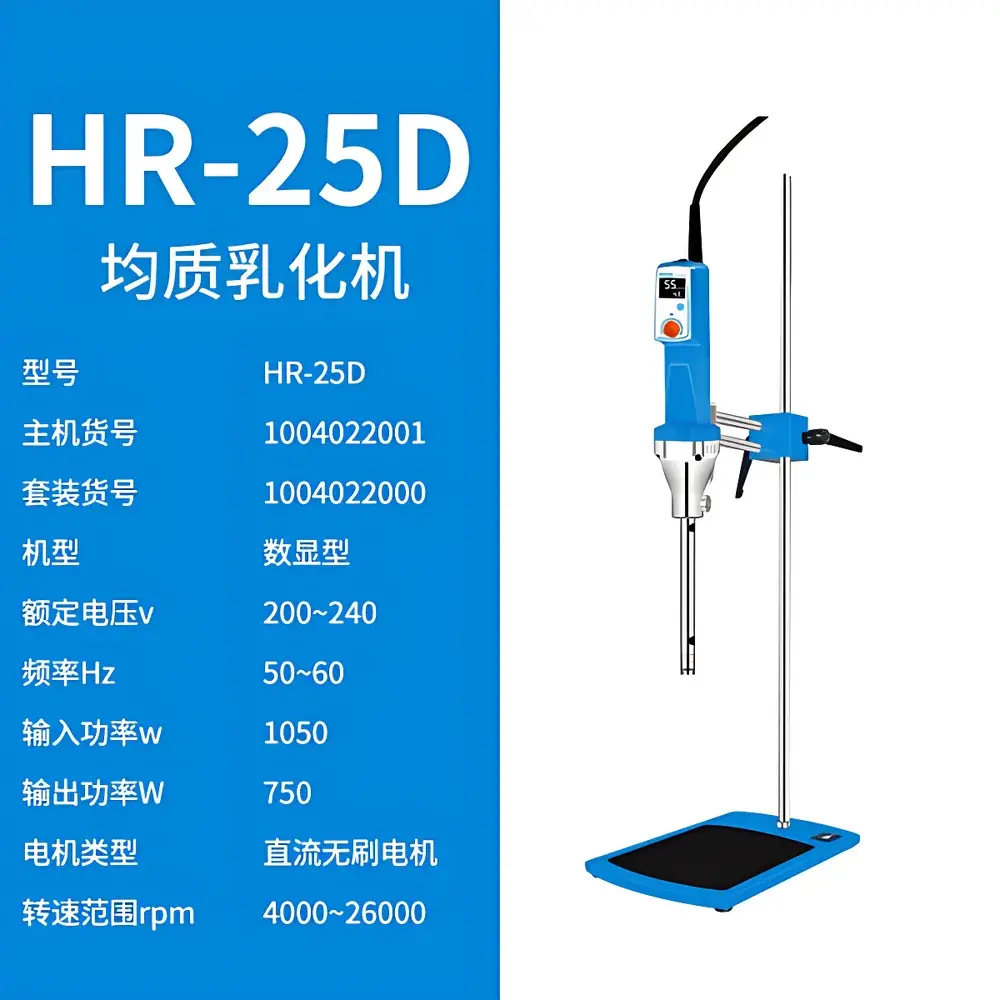
| Model | HR-25D |
| Voltage | 220 V AC |
| Frequency | 50–60 Hz |
| Rated Input Power | 1050 W |
| Rated Output Power | 750 W |
| Max Input Power | 1350 W |
| Max Output Power | 1050 W |
| Motor Type | Brushless DC Motor |
| Speed Range (No-Load) | 4000–26,000 rpm ±100 rpm |
| Speed Range (Water Load) | 4000–26,000 rpm ±100 rpm |
| Speed Display | LCD |
| Speed Control | Precision Knob |
| Processing Volume | 0.2–10,000 mL |
| Timer Range | 0–999 min |
| Time Display | LCD |
| Temperature Measurement Range | −10 to 199 °C (with optional probe) |
| Linear Velocity | 27 m/s |
| Host Dimensions | 365 mm × φ90 mm |
| Net Weight (Host) | 2.5 kg |
| Gross Weight (Full Kit) | 13.045 kg |
| Standard Kit | Main Unit + Rotating Shaft Assembly + Flat Bench Stand |
Overview
The HUXI HR-25D is a digitally controlled high-speed laboratory homogenizer and emulsifier engineered for reproducible mechanical dispersion, cell disruption, emulsification, suspension stabilization, and fine particle size reduction in research and quality control environments. It operates on the principle of high-shear rotor-stator interaction: rotational energy from a brushless DC motor is transferred to interchangeable probe assemblies, generating intense hydrodynamic shear forces within the sample. This mechanism enables efficient breakdown of aggregates, uniform dispersion of immiscible phases, and consistent sub-micron emulsion formation—critical for formulation development in pharmaceuticals, cosmetics, food science, and life sciences. Designed for benchtop use in ISO 17025-accredited labs and GLP-compliant workflows, the HR-25D delivers stable performance across wide volume ranges (0.2–10,000 mL), supporting both low-volume precision homogenization and high-throughput batch processing.
Key Features
- Brushless DC motor architecture ensures thermal stability, extended service life (>10,000 hr MTBF), and precise speed regulation with ±100 rpm accuracy under water load conditions.
- Digital LCD interface provides real-time monitoring of speed (rpm) and timer (min), with intuitive knob-based adjustment and memory retention for frequently used protocols.
- Modular probe system includes multiple rotor-stator geometries (e.g., micro-tip, standard, heavy-duty) enabling optimization for viscosity, particle size target, and sample sensitivity—from soft tissue lysates to viscous polymer solutions.
- Integrated vertical lift system features dual support rods and dual-position clamping, allowing fine-height adjustment (±0.5 mm resolution) and secure fixation of probes across varying vessel diameters and depths.
- Optional PT100 temperature sensor interface supports real-time sample temperature monitoring; programmable thermal cutoff halts operation upon reaching user-defined thresholds (−10 to 199 °C), preventing heat-induced degradation of thermolabile biomolecules or active ingredients.
- Compact footprint (365 mm height × φ90 mm base) and lightweight construction (2.5 kg host) facilitate integration into biosafety cabinets, cold rooms, or multi-instrument workstations without compromising structural rigidity.
Sample Compatibility & Compliance
The HR-25D accommodates aqueous, organic, and semi-viscous matrices—including mammalian cell suspensions, plant tissue homogenates, liposomal formulations, nanoemulsions, polymer dispersions, and food-grade colloids. Probe materials (stainless steel 316L, PTFE-coated options) comply with USP Class VI and FDA 21 CFR 177.2400 for indirect food contact. The device meets IEC 61000-6-3 (EMC emission) and IEC 61010-1 (safety for laboratory equipment) standards. While not certified to ISO 13485 or GMP Annex 1, its design supports audit-ready documentation: digital logs (via optional RS-232/USB export), parameter traceability, and repeatable protocol execution—making it suitable for pre-GMP R&D, analytical method development, and QC release testing under ISO/IEC 17025 clause 7.2.2 (method validation).
Software & Data Management
The HR-25D operates as a standalone instrument with embedded firmware; no proprietary software installation is required. All operational parameters—including set speed, elapsed time, and temperature threshold—are stored in non-volatile memory and recalled at power-on. For laboratories requiring electronic record integrity, optional data logging modules enable timestamped export of run parameters and status flags (start/stop/overheat/interruption) via ASCII-formatted CSV files. These logs satisfy ALCOA+ principles (Attributable, Legible, Contemporaneous, Original, Accurate) when paired with lab-wide LIMS or ELN systems. Audit trail functionality aligns with FDA 21 CFR Part 11 requirements when deployed with validated access controls and electronic signatures.
Applications
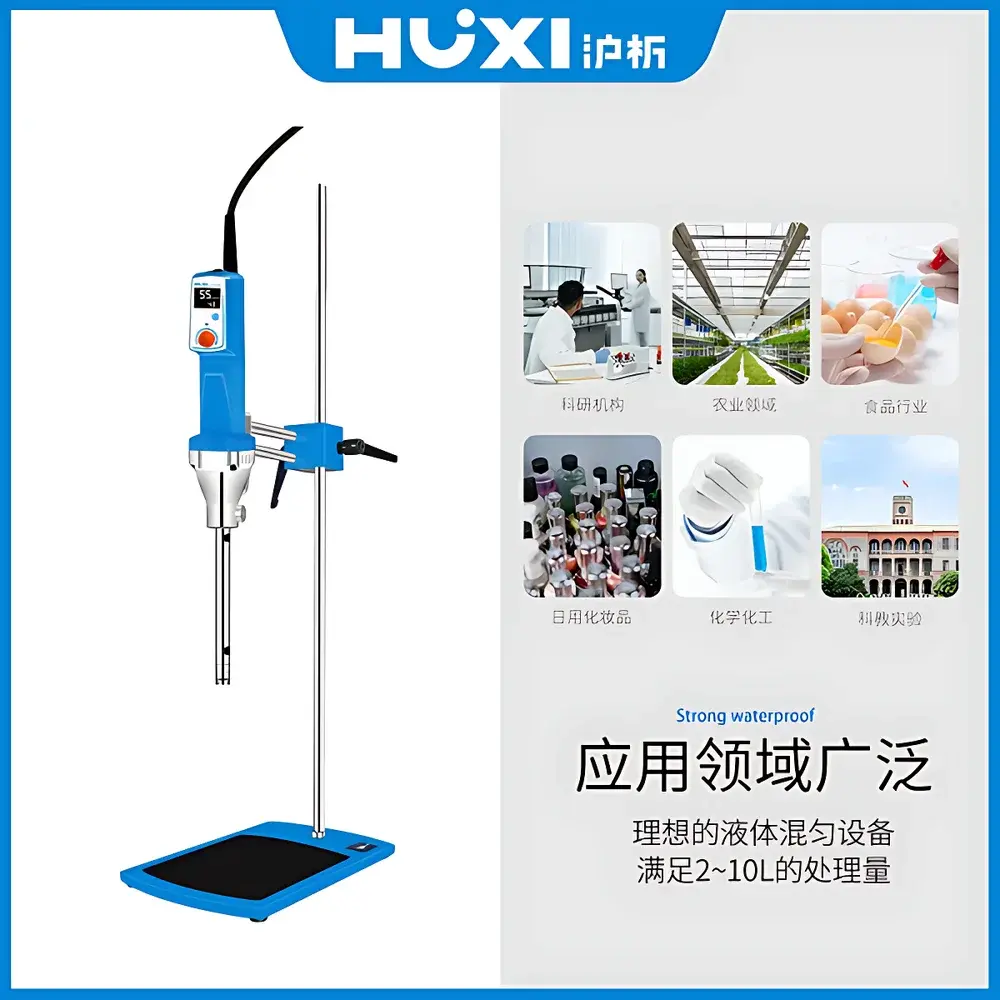
- Biological: Lysis of E. coli, yeast, and mammalian cells; preparation of nuclear extracts; mitochondrial isolation; homogenization of frozen tissues.
- Pharmaceutical: Nanoemulsion and microemulsion development; API suspension stabilization; excipient compatibility screening; dissolution media preparation.
- Cosmetics: Oil-in-water and water-in-oil emulsion formulation; pigment dispersion in creams and serums; viscosity modifier activation.
- Food Science: Homogenization of dairy analogs, nut milks, and functional beverages; particle size reduction in starch or fiber suspensions; texture profiling support.
- Materials: Dispersion of carbon nanotubes, graphene oxide, or metal oxides in solvent systems; catalyst slurry preparation; ceramic precursor mixing.
FAQ
What is the maximum continuous operating time per cycle?
The timer supports up to 999 minutes (16.65 hours); however, for optimal motor longevity and thermal management, continuous operation beyond 30 minutes at >20,000 rpm is not recommended without active cooling or duty-cycle interruption.
Can the HR-25D be used under inert atmosphere or vacuum conditions?
Yes—when fitted with gas-tight probe seals and operated inside gloveboxes or vacuum-rated vessels, provided external pressure differentials remain within ±0.1 bar to prevent seal extrusion.
Is calibration traceable to national standards?
Speed calibration is performed using NIST-traceable optical tachometry during factory acceptance testing; users may verify accuracy annually with handheld laser tachometers compliant with ISO 5348.
Does the unit support external trigger input or footswitch control?
No—external control interfaces are not included, but the timer start/stop function can be initiated manually via front-panel buttons only.
What maintenance intervals are recommended?
Lubrication-free brushless motor requires no routine servicing; annual inspection of probe threads, O-rings, and clamp tension is advised per manufacturer’s maintenance checklist (document ref: HR-25D-MNT-REV3).



