
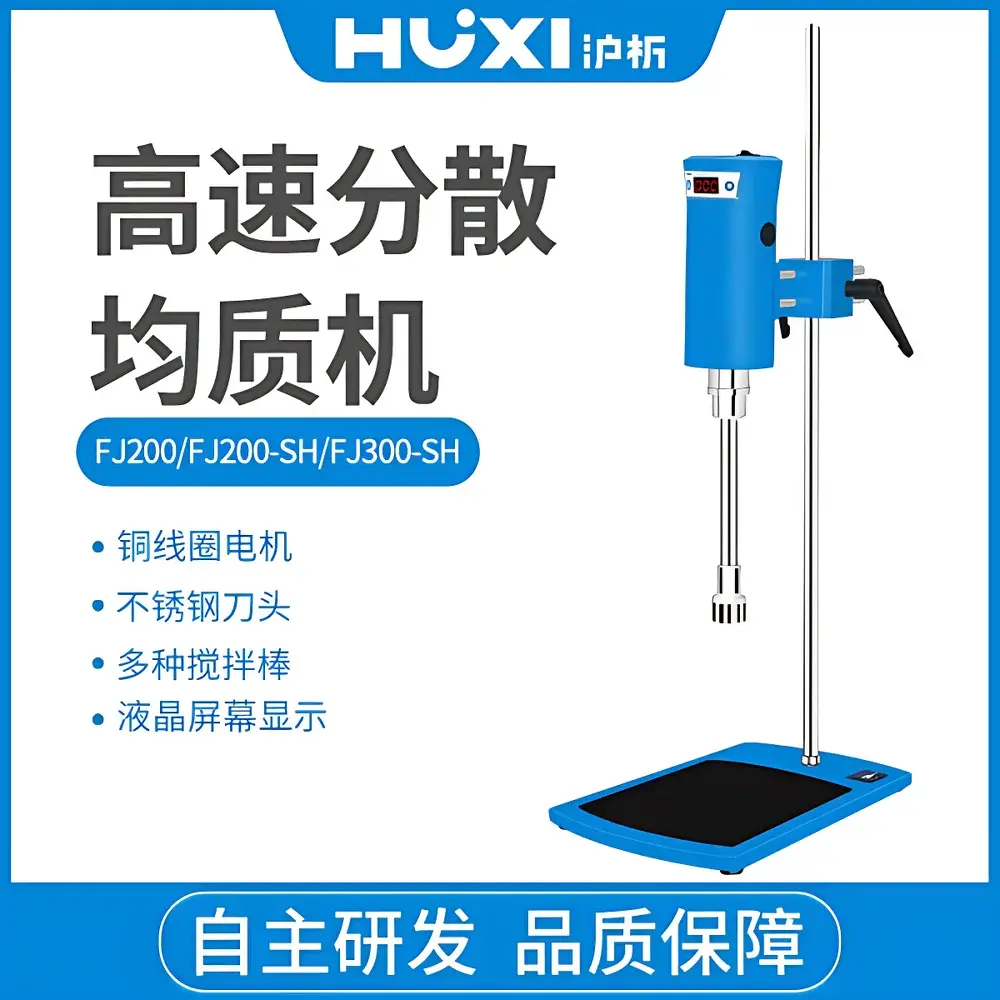
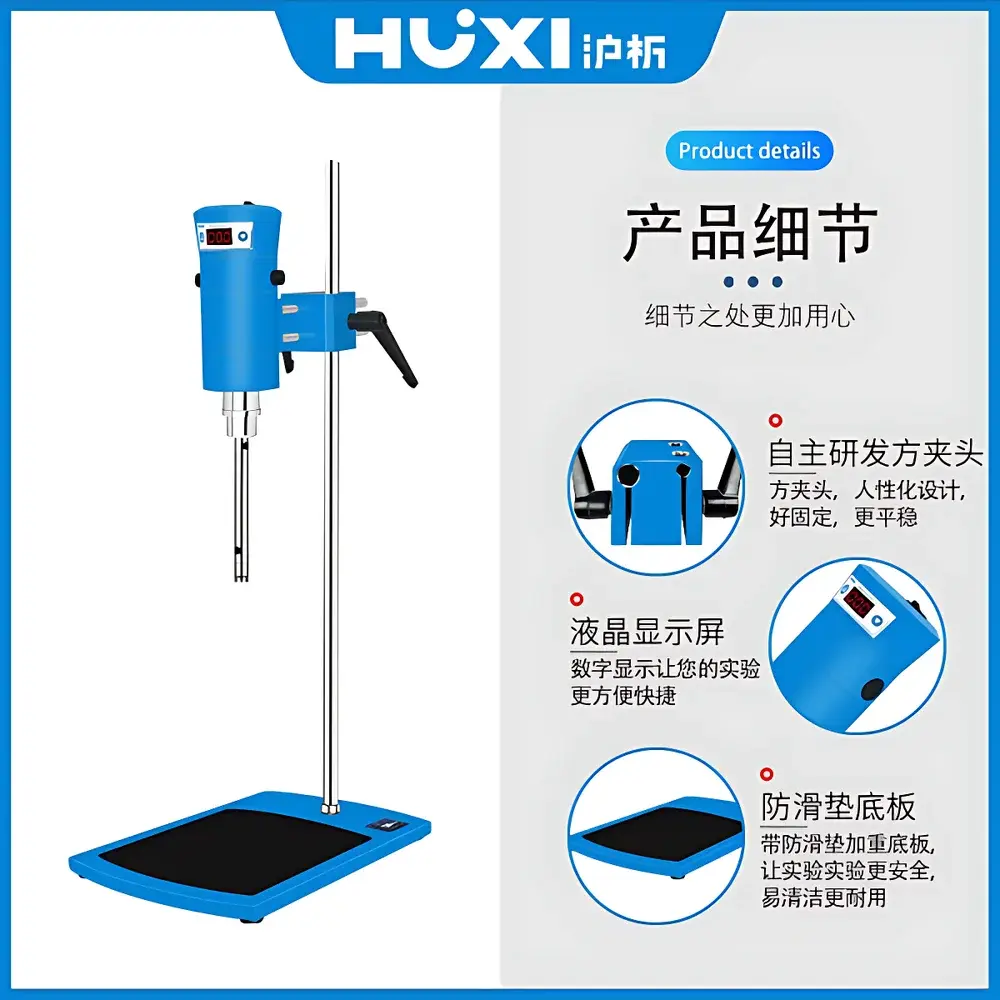
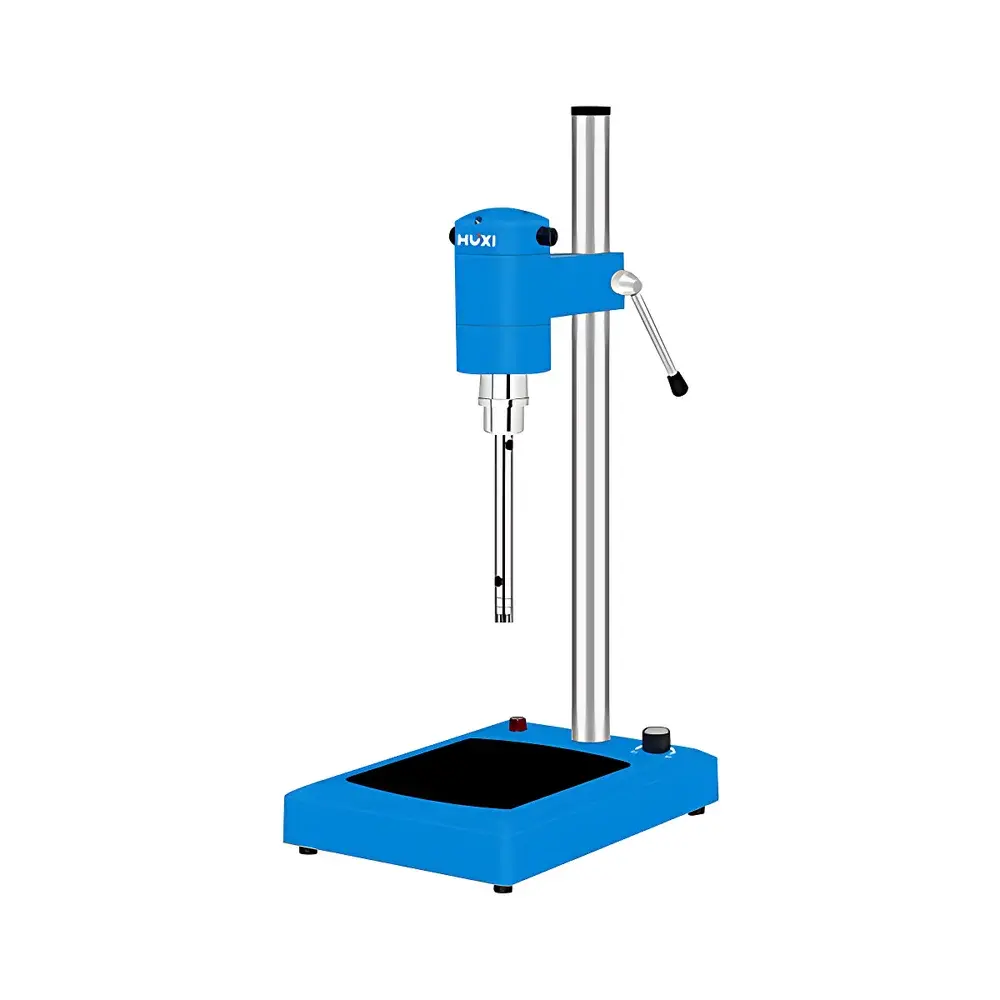
HUXI FJ200 High-Speed Dispersing Homogenizer
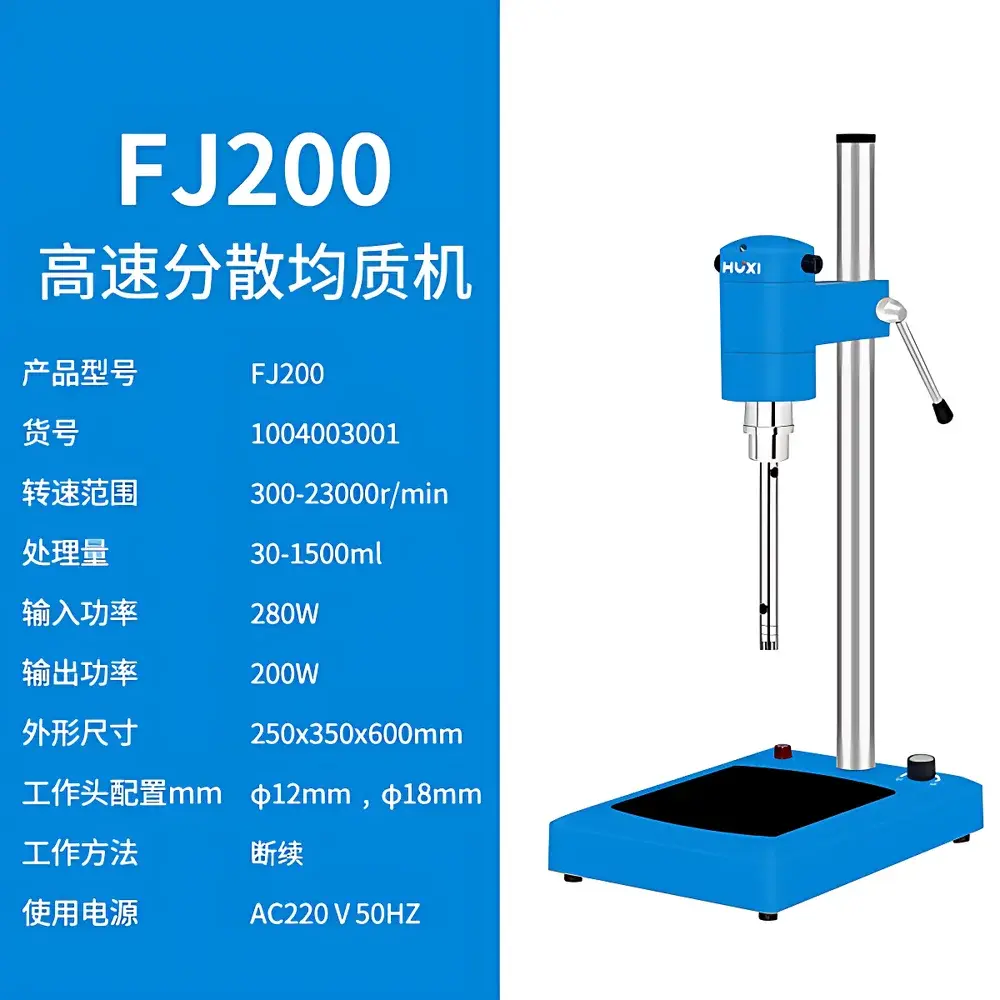
| Brand | HUXI |
|---|---|
| Origin | Shanghai, China |
| Manufacturer Type | Direct Manufacturer |
| Country of Origin | China |
| Model | FJ200 |
| Instrument Type | Probe-Type Rotor-Stator Homogenizer |
| Dimensions (W×D×H) | 250 × 350 × 600 mm |
| Volume Capacity | 30–1500 mL |
| Speed Range | 300–23,000 rpm |
| Input Power | 280 W |
| Output Power | 200 W |
| Rated Torque | 83 N·cm |
| Probe Diameters | φ12 mm and φ18 mm |
| Power Supply | AC 220 V, 50 Hz |
| Operation Mode | Intermittent Duty |
Overview
The HUXI FJ200 High-Speed Dispersing Homogenizer is a precision-engineered laboratory instrument designed for efficient mechanical dispersion, homogenization, emulsification, and cell disruption in liquid-phase systems. It operates on the rotor-stator principle—where high-velocity rotation of a stainless-steel probe generates intense shear forces, cavitation, and turbulent flow within the sample medium. This mechanism enables rapid particle size reduction, uniform suspension of insoluble solids, and stabilization of immiscible phases. The FJ200 is particularly suited for routine QC/QA workflows, formulation development in pharmaceuticals and cosmetics, nanoparticle dispersion in material science, and tissue homogenization in life sciences applications where reproducible, scalable benchtop processing is required.
Key Features
- High-performance universal motor with continuous torque delivery across the full speed range (300–23,000 rpm), engineered for sustained intermittent operation under load.
- Dual interchangeable stainless-steel probes (φ12 mm and φ18 mm) optimized for distinct volume and viscosity regimes—enabling flexibility from micro-scale (30 mL) to mid-volume (1500 mL) processing.
- Robust die-cast aluminum housing provides structural rigidity, thermal dissipation, and electromagnetic shielding, ensuring long-term operational stability and operator safety.
- Stepless electronic speed control with real-time feedback allows precise adjustment and repeatability; no gear-driven mechanisms to introduce backlash or wear-related drift.
- Quick-release probe coupling system facilitates tool-free attachment/detachment, minimizing cross-contamination risk and enabling rapid changeover between samples or protocols.
- Compliance-ready design supports documentation of operating parameters (speed, duration, probe type) as part of GLP-aligned lab records.
Sample Compatibility & Compliance
The FJ200 accommodates aqueous, organic, and mildly corrosive media—including buffers, surfactant solutions, polymer dispersions, and biological lysates—provided compatibility with 304 stainless steel is confirmed. It is not rated for use with strong oxidizers, halogenated solvents, or highly viscous pastes (>5,000 mPa·s). While the instrument itself carries no CE or UL certification, its electrical architecture conforms to IEC 61010-1 safety requirements for laboratory equipment. When integrated into validated workflows, it supports adherence to ISO/IEC 17025 method validation criteria and serves as a compliant unit within FDA 21 CFR Part 11–governed environments when paired with audit-trail-capable data logging systems.
Software & Data Management
The FJ200 operates as a standalone analog-controlled device without embedded firmware or digital connectivity. However, its consistent speed-response profile and mechanical repeatability make it compatible with external timing controllers, programmable logic controllers (PLCs), or PC-based data acquisition systems via analog voltage output (0–10 V) interfaces (optional accessory). Users may log operational metadata—including run time, selected speed setting, probe geometry, and sample ID—in laboratory notebooks or LIMS platforms to satisfy traceability requirements per ISO 15189 or GMP Annex 11 guidelines.
Applications
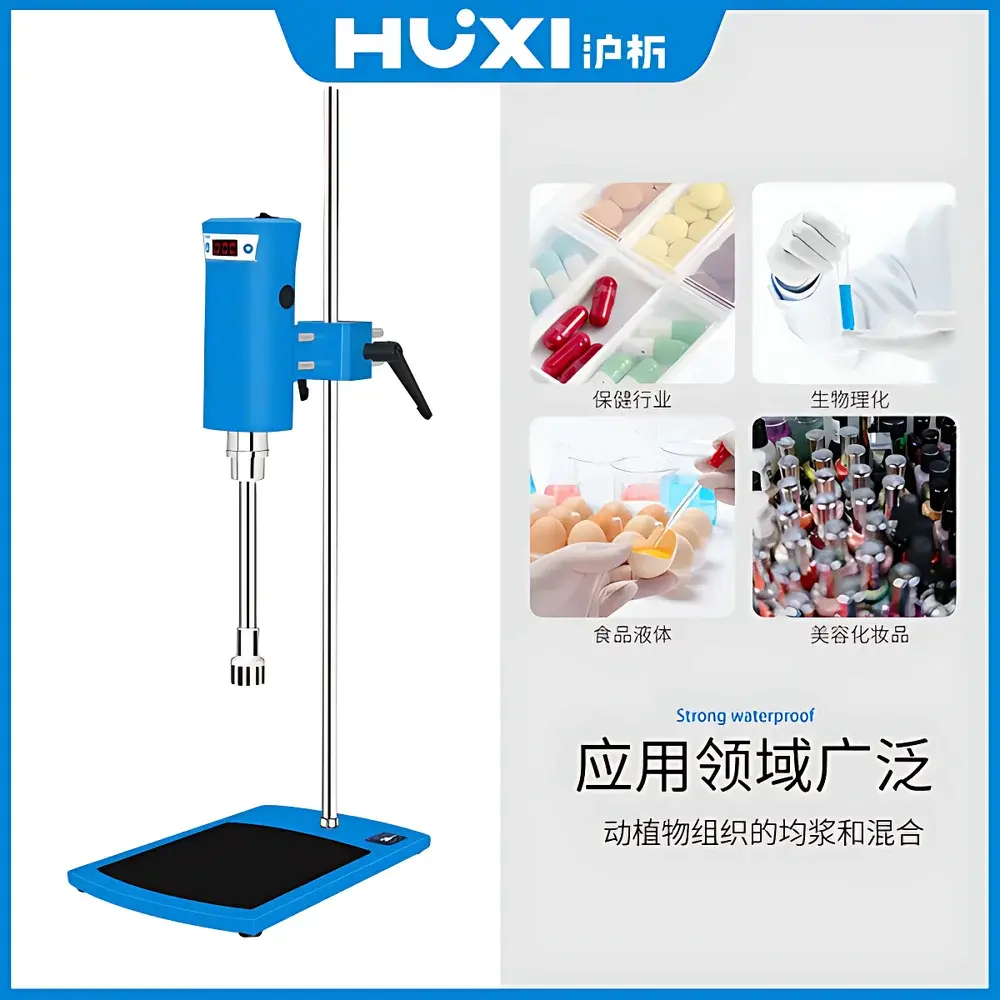
- Preparation of stable colloidal suspensions for DLS or SEM characterization.
- Homogenization of mammalian tissues and bacterial pellets prior to protein extraction or nucleic acid isolation.
- Dispersion of carbon nanotubes, graphene oxide, or metal oxide nanoparticles in solvent matrices.
- Routine emulsification of oil-in-water formulations in cosmetic and food R&D labs.
- Deagglomeration of pigment concentrates and ceramic slurries in materials testing laboratories.
- Standardized sample preparation for ASTM D4290 (particle size analysis of pigments) and ISO 13320 (laser diffraction particle sizing) protocols.
FAQ
What is the recommended maximum viscosity limit for reliable operation?
For optimal performance and probe longevity, the FJ200 is intended for liquids with dynamic viscosity ≤ 5,000 mPa·s at 25 °C. Higher viscosities require reduced speed settings and shorter duty cycles.
Can the FJ200 be used for sterile applications?
Yes—probes and shafts are autoclavable at 121 °C for 20 minutes. Ensure complete drying before reassembly to prevent corrosion.
Is continuous operation supported?
No. The FJ200 is rated for intermittent duty only: maximum 3 minutes ON followed by ≥2 minutes OFF to prevent thermal overload of the motor windings.
How is speed calibration verified?
Users may validate rotational speed using a non-contact optical tachometer referenced against the marked scale on the speed dial; factory calibration certificates are available upon request.
Does the instrument support regulatory-compliant data archiving?
As a manually operated analog device, it does not generate native electronic records—but all operational parameters are fully documentable in paper or electronic lab notebooks aligned with ALCOA+ principles.



