
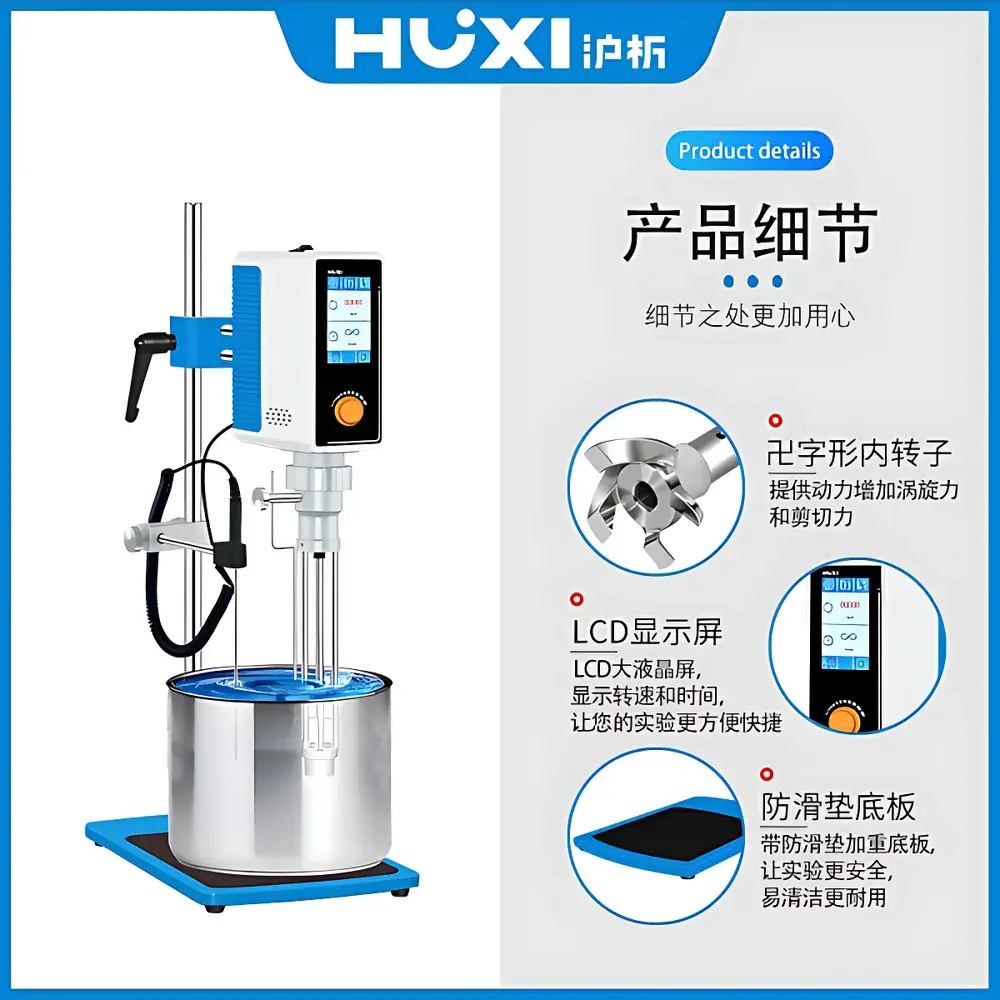
HUXI HRF-35AS High-Shear Dispersing & Emulsifying Homogenizer
| Brand | HUXI |
|---|---|
| Origin | Shanghai, China |
| Manufacturer Type | Direct Manufacturer |
| Country of Origin | China |
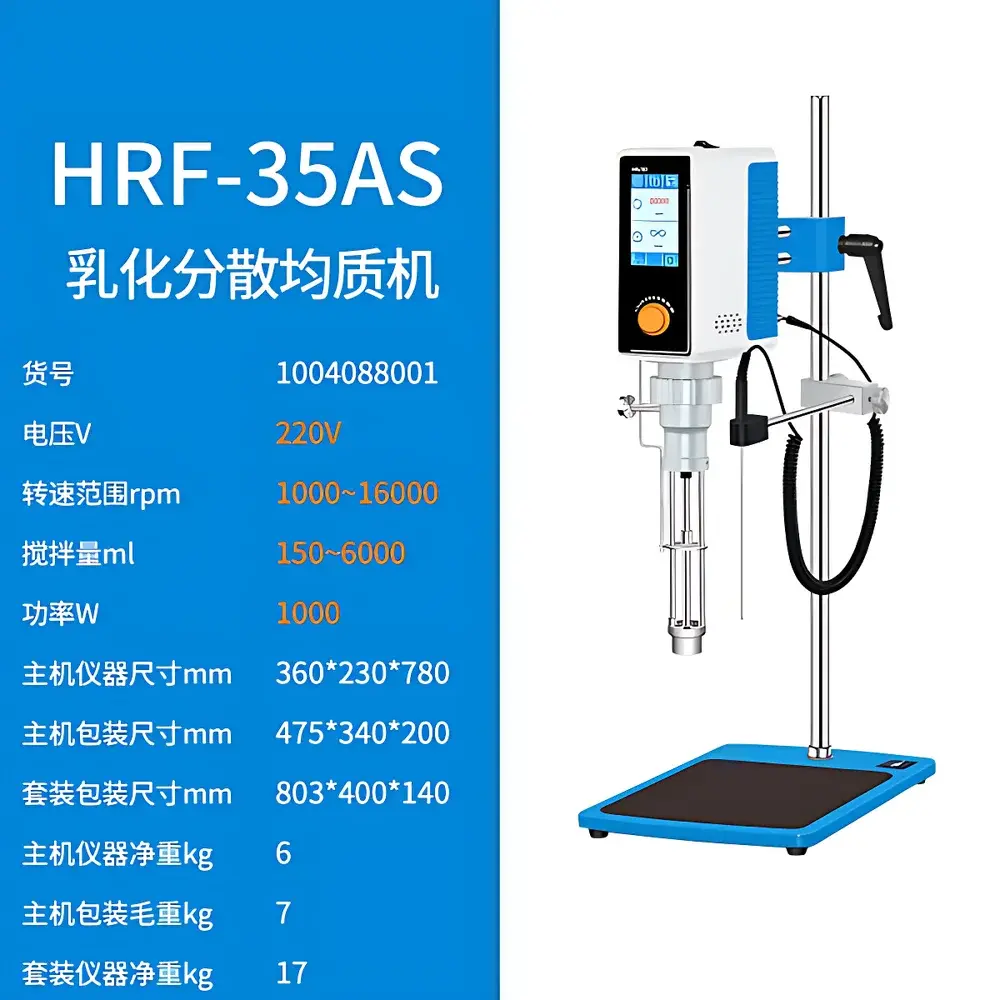
| Model | HRF-35AS |
| Processing Volume | 150–6000 mL |
| Speed Range | 1000–16000 rpm |
| Speed Accuracy | ±10 rpm |
| Programmable Steps | 99 speed/time segments |
| Multi-cycle Control | 80 sets of 4-stage (A→B→C→D) sequences |
| Display | 4.3-inch capacitive touchscreen |
| Power Rating | 1000 W |
| Timer Range | Continuous or 00:00:00–08:00:00 (h:mm:ss) |
| Torque Monitoring | Real-time trend display, max 55 N·cm |
| Max. Viscosity Handling | 20,000 mPa·s |
| Wetted Materials | AISI 316 stainless steel, PTFE |
| Temperature Monitoring | Integrated probe, user-definable safety cutoff from −160 °C to +600 °C |
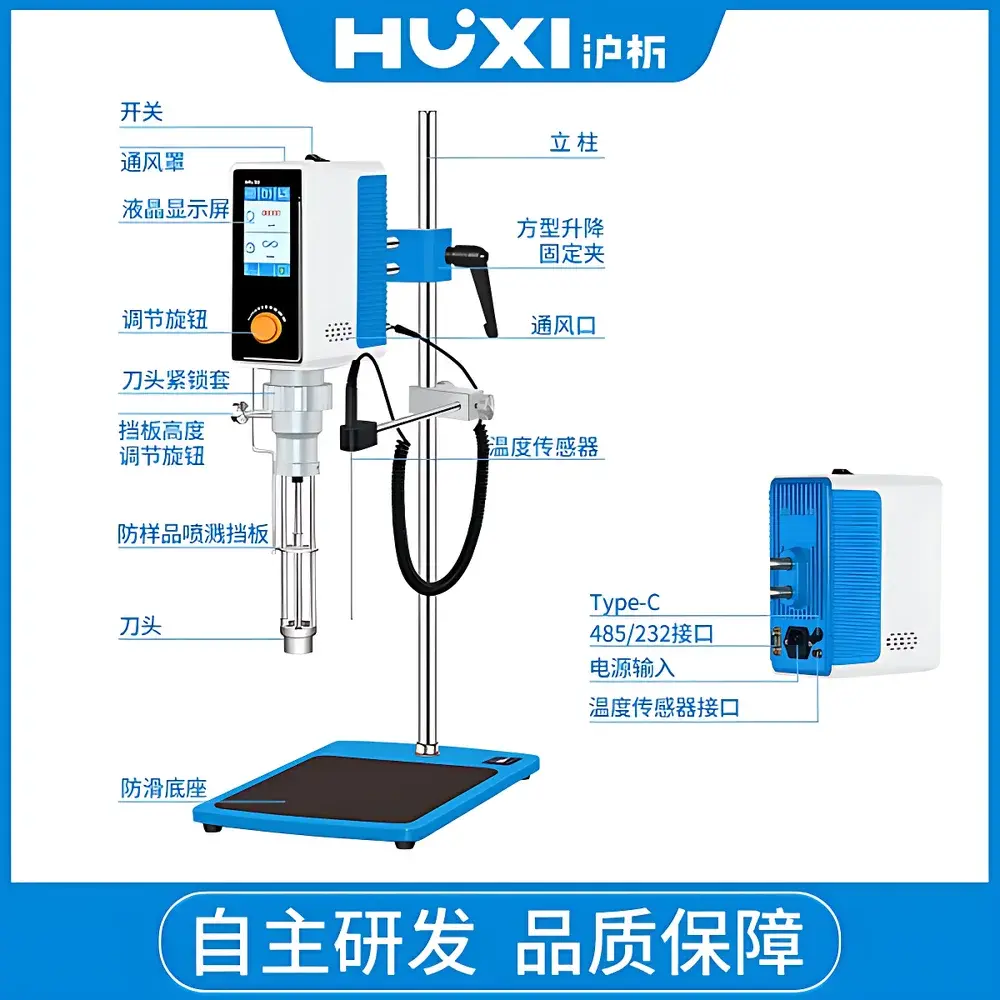
| Data Interface | USB Type-C, RS485 |
| Motor Protection | Overload shutdown, thermal cutoff, fault diagnostics |
| Ambient Operating Conditions | 5–40 °C, ≤80% RH (non-condensing) |
| Dimensions (W×D×H) | 360 × 230 × 780 mm |
| Shipping Carton | 470 × 345 × 205 mm |
| Kit Packaging (with accessories) | 810 × 400 × 140 mm |
Overview
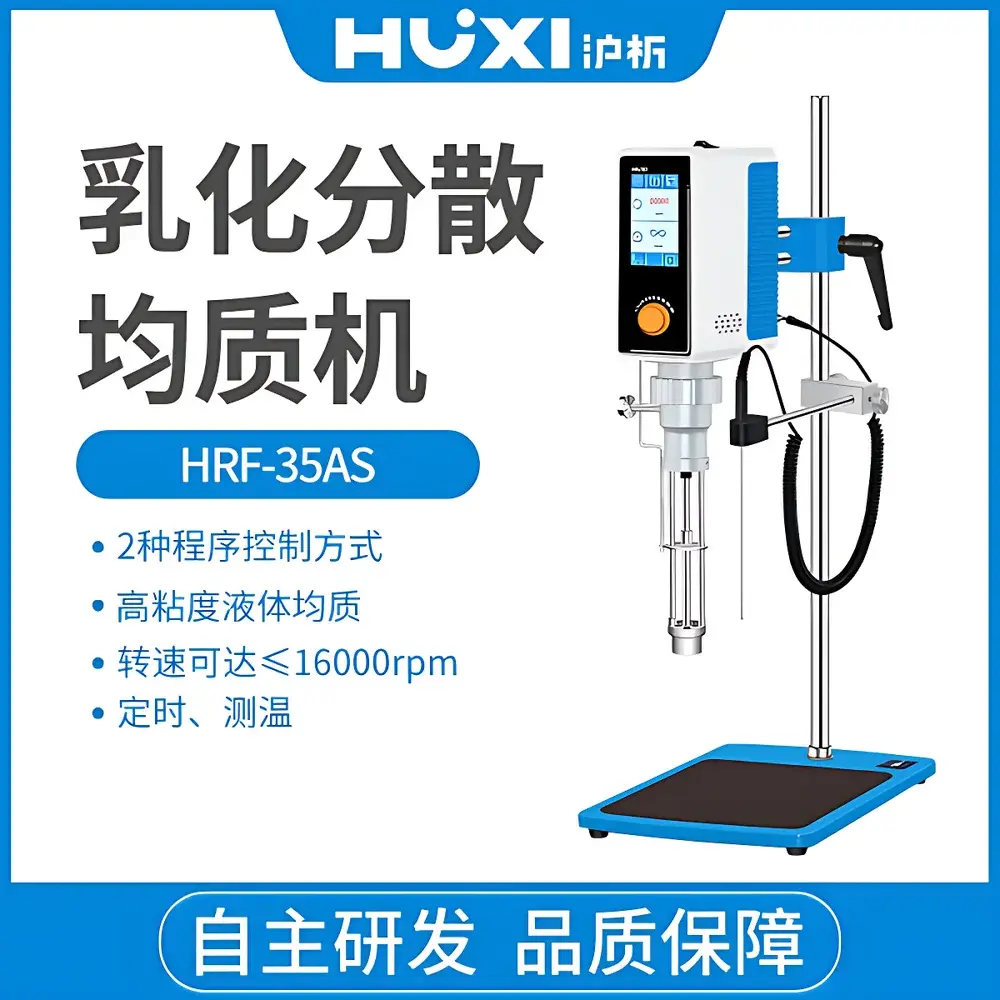
The HUXI HRF-35AS is a high-shear dispersing and emulsifying homogenizer engineered for precision laboratory-scale processing of complex fluid systems. It operates on the principle of rotor-stator mechanical shear, where rapid rotation of a precision-machined rotor within a fixed stator generates intense hydrodynamic forces—including cavitation, turbulent flow, and extensional deformation—to achieve particle size reduction, phase dispersion, and interfacial stabilization. Designed for reproducible batch processing across diverse rheological profiles, the HRF-35AS delivers consistent energy input control essential for formulation development, quality assurance, and process scalability in R&D environments. Its architecture supports both low-volume fine emulsions (<500 mL) and larger-scale dispersion tasks up to 6 L—making it suitable for iterative prototyping and small-batch production validation under GLP-aligned workflows.
Key Features
- Brushless DC motor with integrated thermal management: eliminates carbon brush wear, prevents particulate contamination, and ensures stable torque delivery across extended operation cycles.
- Full programmability via 4.3-inch industrial-grade touchscreen: supports up to 99 independent speed/time segments and 80 customizable 4-phase (A→B→C→D) multi-step protocols for complex kinetic studies.
- Real-time torque monitoring with trend visualization: enables detection of viscosity transitions, gelation onset, or agglomeration events during processing—critical for non-Newtonian system characterization.
- Modular tooling interface compatible with multiple rotor-stator geometries (e.g., fine-gap, high-shear, elongated shear zones), facilitating application-specific optimization for suspensions, o/w emulsions, or nanoparticle dispersions.
- Integrated temperature sensing with configurable upper-limit cutoff (−160 °C to +600 °C range): safeguards thermally sensitive actives (e.g., proteins, probiotics, volatile flavors) and supports cryogenic or elevated-temperature dispersion protocols.
- Dual communication interfaces (USB Type-C and RS485): enable direct connection to LIMS, SCADA, or custom data acquisition platforms for audit-ready electronic records compliant with FDA 21 CFR Part 11 requirements.
Sample Compatibility & Compliance
The HRF-35AS accommodates a broad spectrum of sample types—from low-viscosity aqueous solutions to highly structured pastes (up to 20,000 mPa·s). Its wetted components are constructed from electropolished AISI 316 stainless steel and chemically inert PTFE, ensuring compatibility with aggressive solvents, alkaline cleaners, and acidic formulations. The instrument meets IEC 61000-6-2/6-4 for electromagnetic compatibility and conforms to CE safety directives (2014/30/EU, 2014/35/EU). For regulated environments, its programmable logic, timestamped event logging, and password-protected parameter locking support alignment with ISO/IEC 17025, USP , and GMP Annex 11 documentation expectations.
Software & Data Management
All operational parameters—including setpoints, actual speed/torque/temperature traces, cycle completion status, and fault codes—are stored locally with time/date stamps. Data export is supported via USB mass storage mode (CSV format) or real-time streaming over RS485 using Modbus RTU protocol. Optional PC software (available separately) provides graphical analysis of shear history, comparative batch trending, and automated report generation—including compliance metadata (operator ID, calibration status, environmental log). Audit trails retain all parameter modifications, user logins, and system resets for full traceability.
Applications
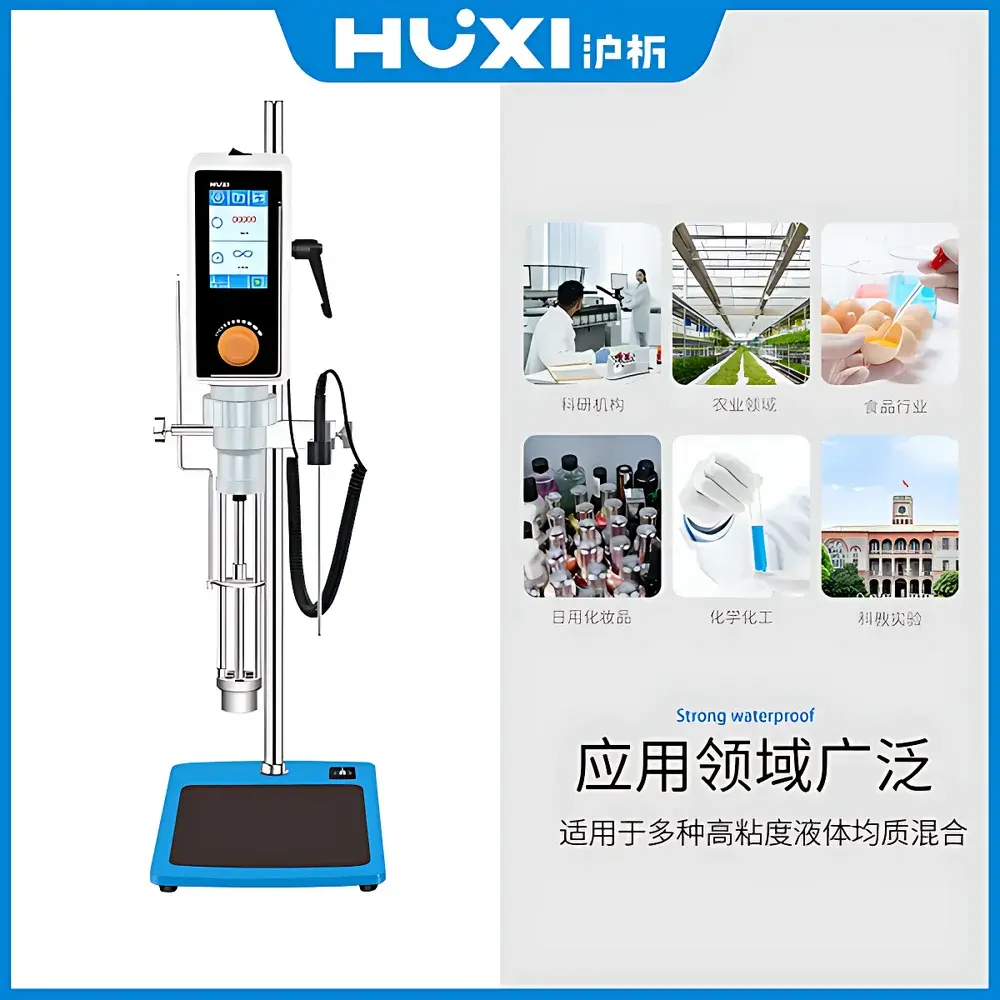
- Pharmaceutical: Preparation of nanoemulsions for parenteral delivery, homogenization of suspension-based oral liquids, and dispersion of insoluble APIs in lipid matrices.
- Personal Care: Development of stable silicone-in-water emulsions, high-viscosity hair conditioning gels, and pigment-loaded cosmetic bases.
- Food Science: Standardized homogenization of dairy analogs (e.g., plant-based yogurts), flavor oil dispersion in beverage concentrates, and ice cream mix deagglomeration.
- Materials Research: Exfoliation of 2D nanomaterials (graphene, MXenes) in solvent systems, carbon black dispersion in elastomer masterbatches, and conductive ink formulation.
- Coatings & Inks: Pigment deagglomeration in UV-curable resins, rheology modifier activation in architectural paints, and wax crystal dispersion in inkjet formulations.
FAQ
What is the maximum recommended continuous operating time per cycle?
The HRF-35AS is rated for uninterrupted operation up to 8 hours per program sequence; however, for viscous or exothermic samples, active cooling and periodic rest intervals are advised to maintain thermal stability and bearing longevity.
Can the instrument be integrated into an automated lab workflow?
Yes—via RS485 Modbus RTU, the unit accepts remote start/stop commands, speed setpoint updates, and status polling, enabling synchronization with robotic liquid handlers or environmental chambers.
Is calibration certification available for regulatory submissions?
Factory calibration reports (traceable to NIST standards) are provided with each unit; optional third-party accredited calibration services (ISO/IEC 17025) can be arranged upon order.
How does the torque trend function assist in method development?
By plotting real-time torque vs. time, users identify inflection points corresponding to structural breakdown (e.g., polymer chain scission), phase inversion, or particle saturation—enabling rational endpoint determination beyond fixed-time protocols.
Are spare parts and service support available outside mainland China?
Global technical support, genuine rotor-stator kits, and firmware updates are accessible through authorized HUXI distribution partners in North America, EMEA, and APAC regions; lead times and regional warranty terms vary by distributor agreement.



