
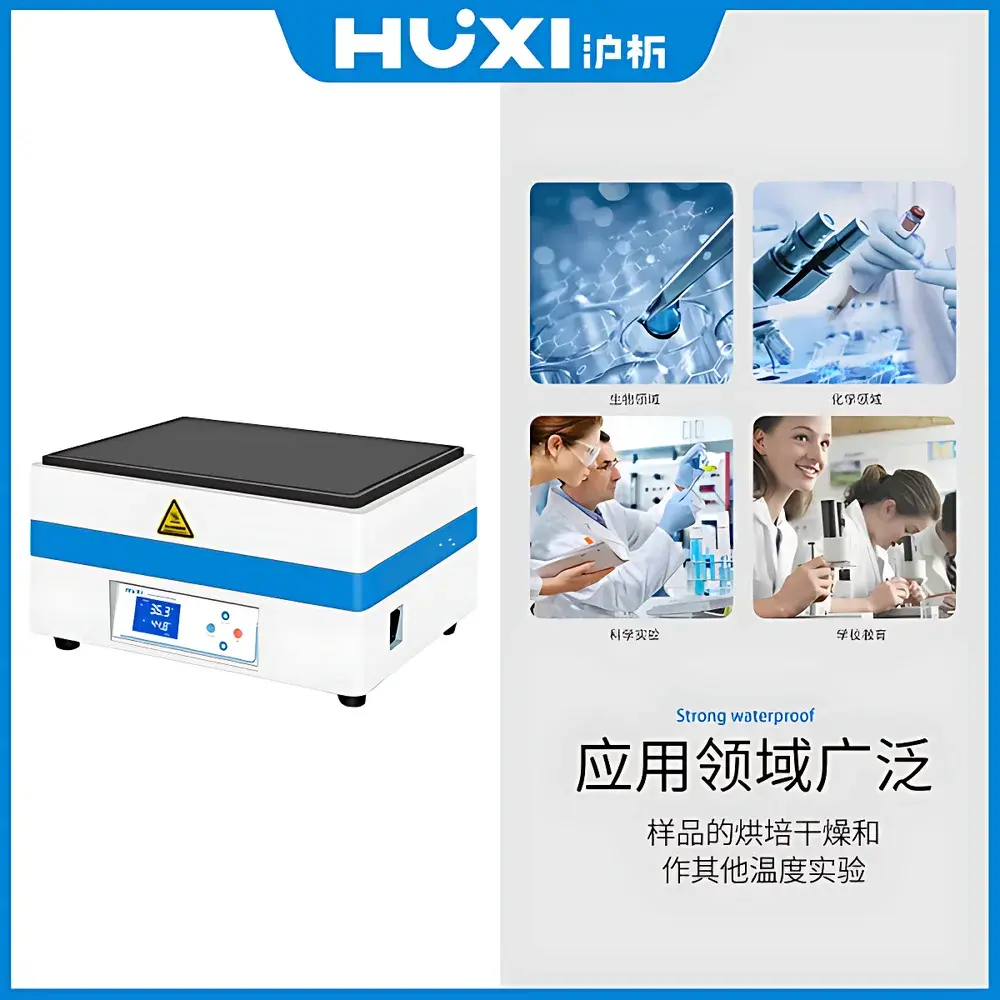
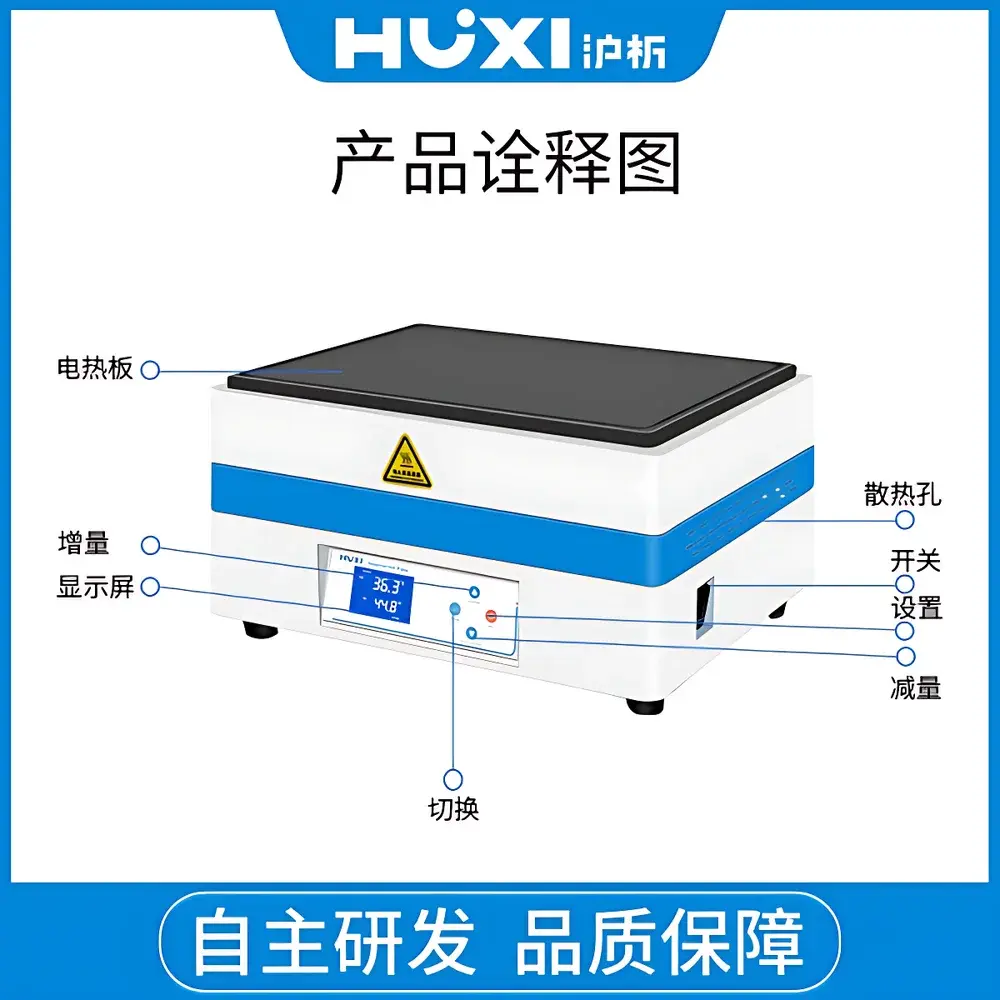
HUXI HX-SP400 Graphite Electric Heating Plate
| Brand | HUXI |
|---|---|
| Origin | Shanghai, China |
| Manufacturer Type | Direct Manufacturer |
| Country of Origin | China |
| Model | HX-SP400 |
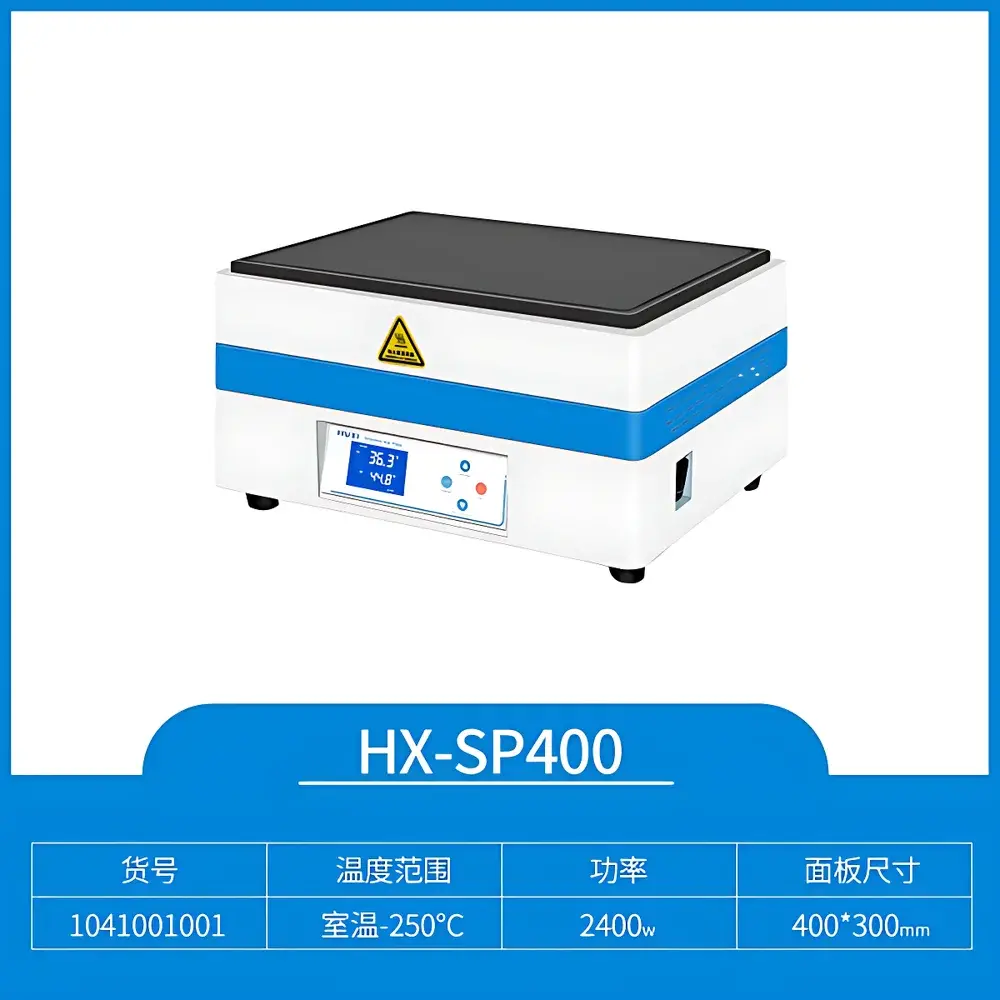
| Heating Power | 2400 W |
| Max. Heating Temperature | 250 °C |
| Temperature Uniformity | ±0.1 °C |
| Plate Dimensions | 400 × 300 mm |
| Heating Zone Dimensions | 400 × 300 mm |
| Display Type | LCD |
Overview
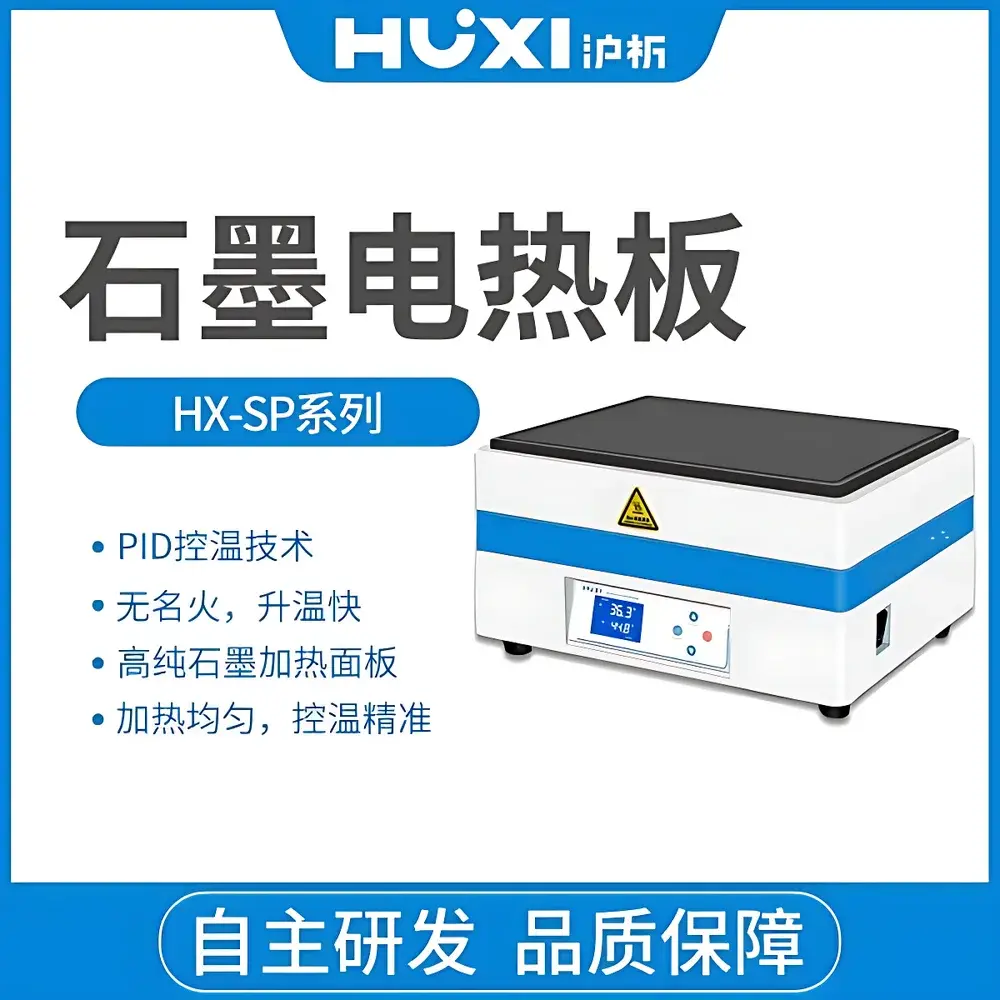
The HUXI HX-SP400 Graphite Electric Heating Plate is a precision-controlled, laboratory-grade heating platform engineered for reproducible thermal treatment during sample preparation, open-vessel digestion, evaporation, concentration, and controlled drying applications. Unlike conventional metal-surface hotplates, the HX-SP400 employs a monolithic high-purity graphite heating plate (12.22 mm thick) coated with chemically resistant high-temperature resin—providing exceptional thermal mass, corrosion resistance to aggressive reagents (e.g., HNO₃, HCl, HF, H₂O₂), and long-term dimensional stability under repeated thermal cycling. Its operating principle relies on resistive Joule heating within the graphite substrate, coupled with closed-loop PID temperature regulation and real-time feedback from embedded high-accuracy Pt100 sensors. Designed for continuous operation in ISO/IEC 17025-accredited laboratories and GLP-compliant environments, the unit maintains stable setpoint control across its full 25–250 °C range (ambient-referenced), with no open flame, minimal radiant heat loss, and negligible electromagnetic interference—ensuring compatibility with adjacent analytical instrumentation.
Key Features
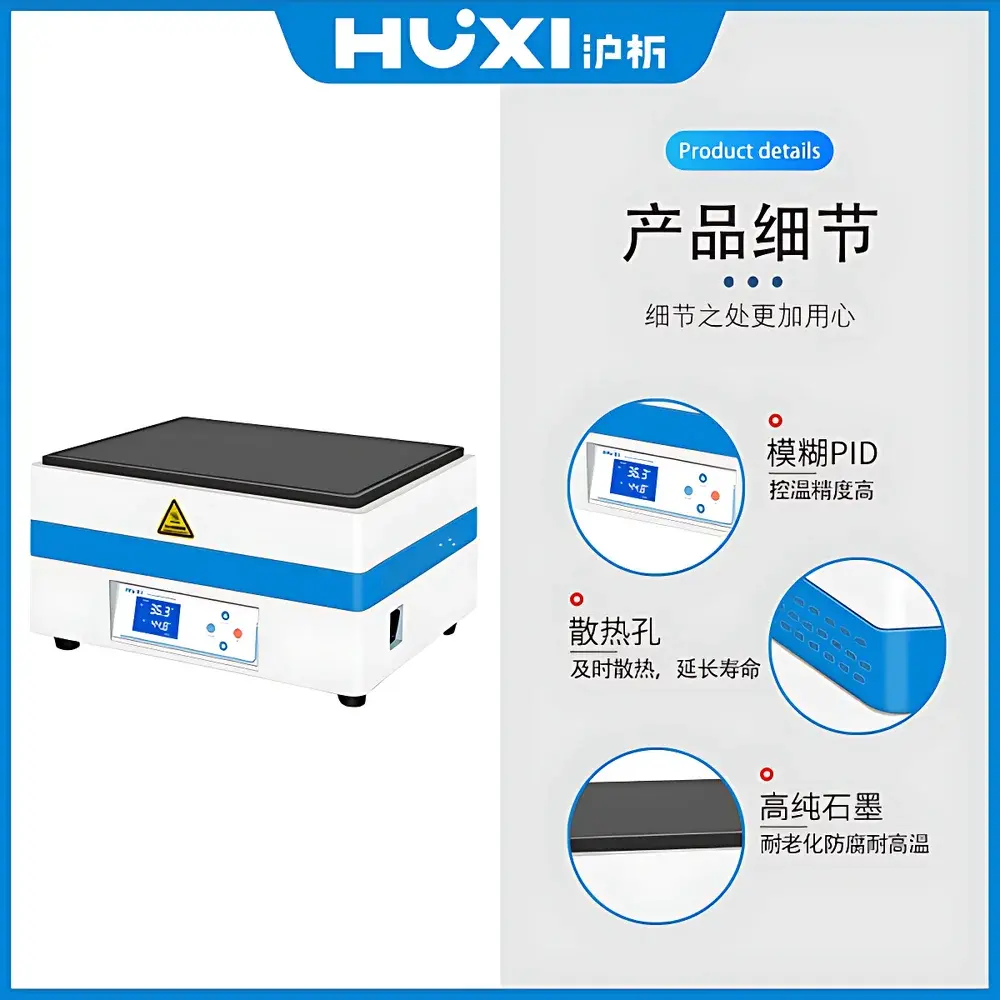
- Monolithic 12.22 mm-thick high-purity graphite heating surface with proprietary high-temp resin coating—resistant to acid fumes, alkali splashes, and thermal shock
- Precision temperature control with ±0.1 °C uniformity across the entire 400 × 300 mm active zone—validated per ASTM E220 and ISO 17025 calibration protocols
- 2400 W high-power resistive heating system enabling rapid ramp rates (≤8 °C/min from ambient to 200 °C) without voltage sag or thermal overshoot
- Full-sealed heating architecture—no exposed coils or air gaps—eliminating contamination pathways and supporting cleanroom-compatible operation
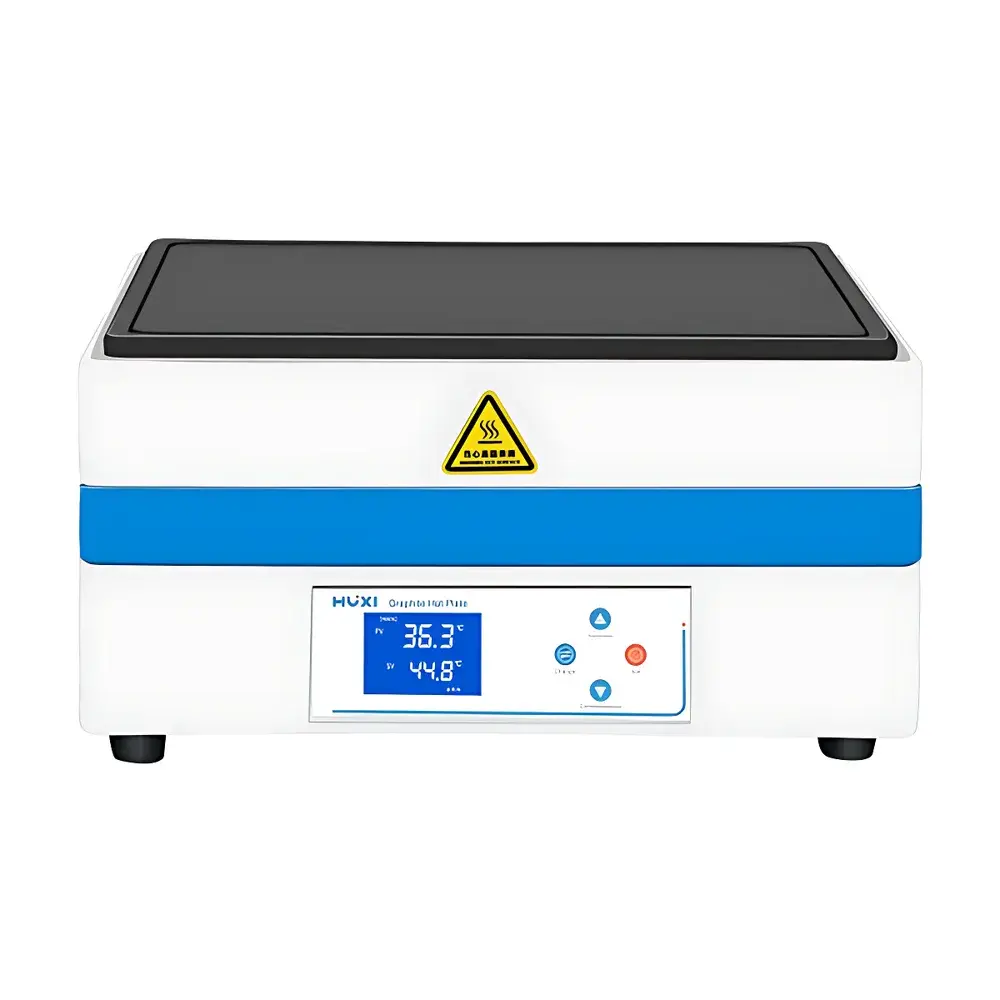
- Intuitive backlit LCD interface with dual-display: setpoint temperature and real-time measured temperature, plus status indicators for heating mode, fault alerts, and timer countdown
- Cold-rolled steel chassis with electrostatic epoxy powder coating—mechanically robust, static-dissipative, and compliant with IEC 61010-1 safety standards for laboratory equipment
Sample Compatibility & Compliance
The HX-SP400 accommodates standard and custom labware including borosilicate glass beakers (50–2000 mL), PTFE and quartz digestion vessels, ceramic crucibles, and stainless-steel trays. Its inert graphite surface ensures non-reactive contact with samples containing heavy metals (As, Cd, Pb, Hg), halogens, sulfates, and organic matrices—critical for EPA Method 3050B, 3051A, and 3052 digestions; ISO 11466 soil analysis; and AOAC 999.10 food digestion workflows. The unit meets CE marking requirements (EMC Directive 2014/30/EU, LVD Directive 2014/35/EU), conforms to RoHS 2011/65/EU material restrictions, and supports audit-ready documentation for FDA 21 CFR Part 11–aligned SOPs when integrated with validated laboratory information management systems (LIMS).
Software & Data Management
While the HX-SP400 operates as a standalone instrument with local LCD control, it features an RS-232 serial port (optional USB-to-serial adapter available) for integration into centralized lab automation networks. When connected to compatible data acquisition software (e.g., LabVIEW™, MATLAB® Instrument Control Toolbox, or custom Python-based SCADA), users can log timestamped temperature profiles, export CSV-formatted datasets with metadata (operator ID, method ID, sample ID), and trigger external events (e.g., relay activation upon reaching target temperature). All parameter changes—including setpoint adjustments, hold durations, and power limits—are recorded with electronic audit trail capability, satisfying GLP traceability requirements for regulated QC/QA labs.
Applications
- Open-vessel acid digestion of environmental matrices: soils, sediments, sludges, and wastewater solids per US EPA SW-846 Methods 3050B and 3051A
- Pre-concentration of trace elements in food and agricultural products—including dairy powders, fish tissue, leafy vegetables, and tobacco—prior to ICP-MS or AAS analysis
- Controlled evaporation of organic extracts in pesticide residue testing (EN 15662, SANTE/11312/2021)
- Drying and conditioning of reference materials, filter papers, and gravimetric precipitates under constant-temperature conditions
- Thermal stabilization of calibration standards and buffer solutions prior to pH, conductivity, or ion-selective electrode measurements
- Supporting ASTM D5191, D5294, and ISO 3405 volatility tests in petrochemical QA/QC workflows
FAQ
Is the HX-SP400 suitable for use with hydrofluoric acid (HF) digestion?
Yes—the graphite plate’s high-purity composition and high-temperature resin coating provide verified resistance to HF vapor up to 220 °C; however, direct liquid HF contact is not recommended. Always use certified HF-resistant labware and operate within a certified fume hood.
Can multiple HX-SP400 units be synchronized for parallel digestion runs?
Not natively—but via external PLC or PC-based control using RS-232 commands, up to 16 units may be daisy-chained and coordinated with master-setpoint logic and interlock sequencing.
What calibration documentation is provided with shipment?
Each unit ships with a factory-issued Certificate of Conformance and a NIST-traceable temperature uniformity report (measured at 100 °C and 200 °C across 9-point grid), valid for 12 months from date of manufacture.
Does the unit support programmable ramp-hold temperature profiles?
No—the HX-SP400 provides manual setpoint control only. For multi-step thermal programs, integration with external programmable controllers or software-defined automation is required.
What maintenance is required to ensure long-term accuracy?
Annual verification of sensor drift and uniformity using a calibrated reference thermometer (e.g., Fluke 1523/1524) is recommended; graphite surface cleaning should be performed with deionized water and lint-free wipes—never abrasive or chlorinated solvents.



