
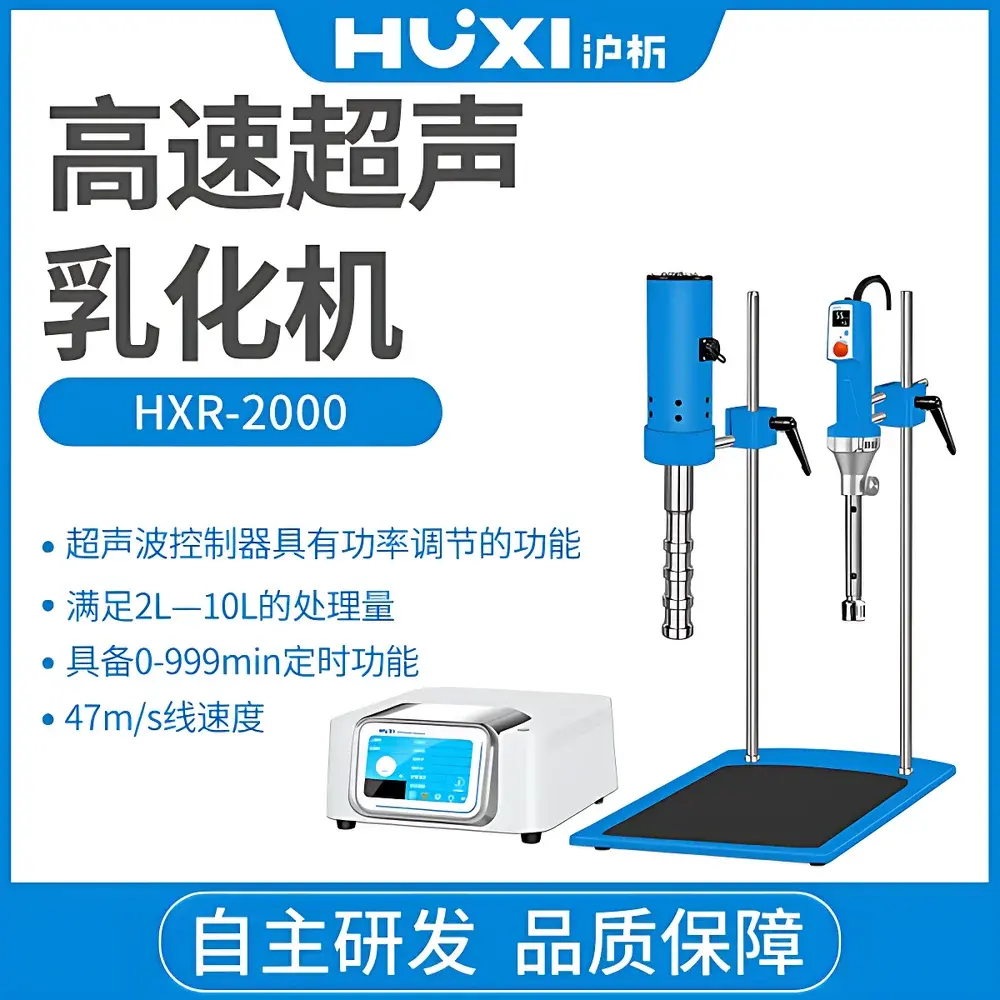
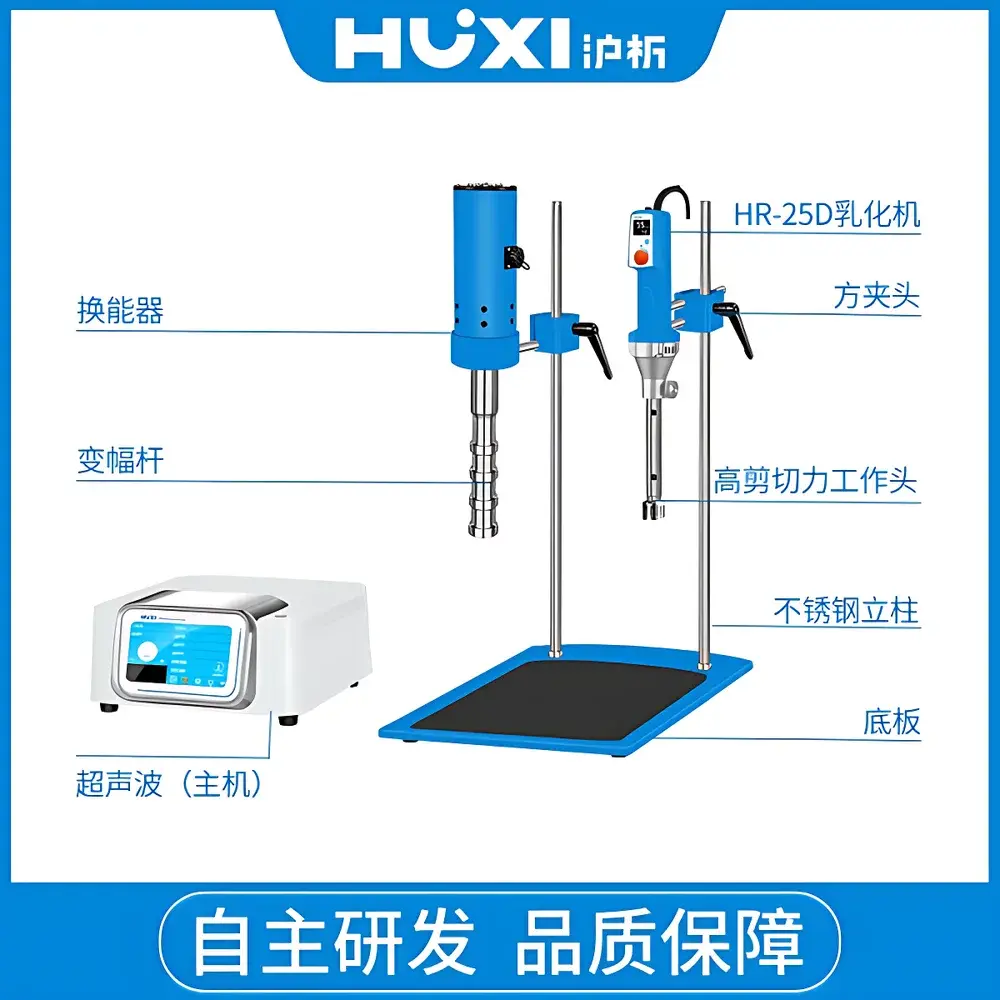
HUXI HXR-2000 High-Power Ultrasonic Homogenizer with Integrated High-Shear Emulsification
| Brand | HUXI |
|---|---|
| Origin | Shanghai, China |
| Manufacturer Type | Direct Manufacturer |
| Country of Origin | China |
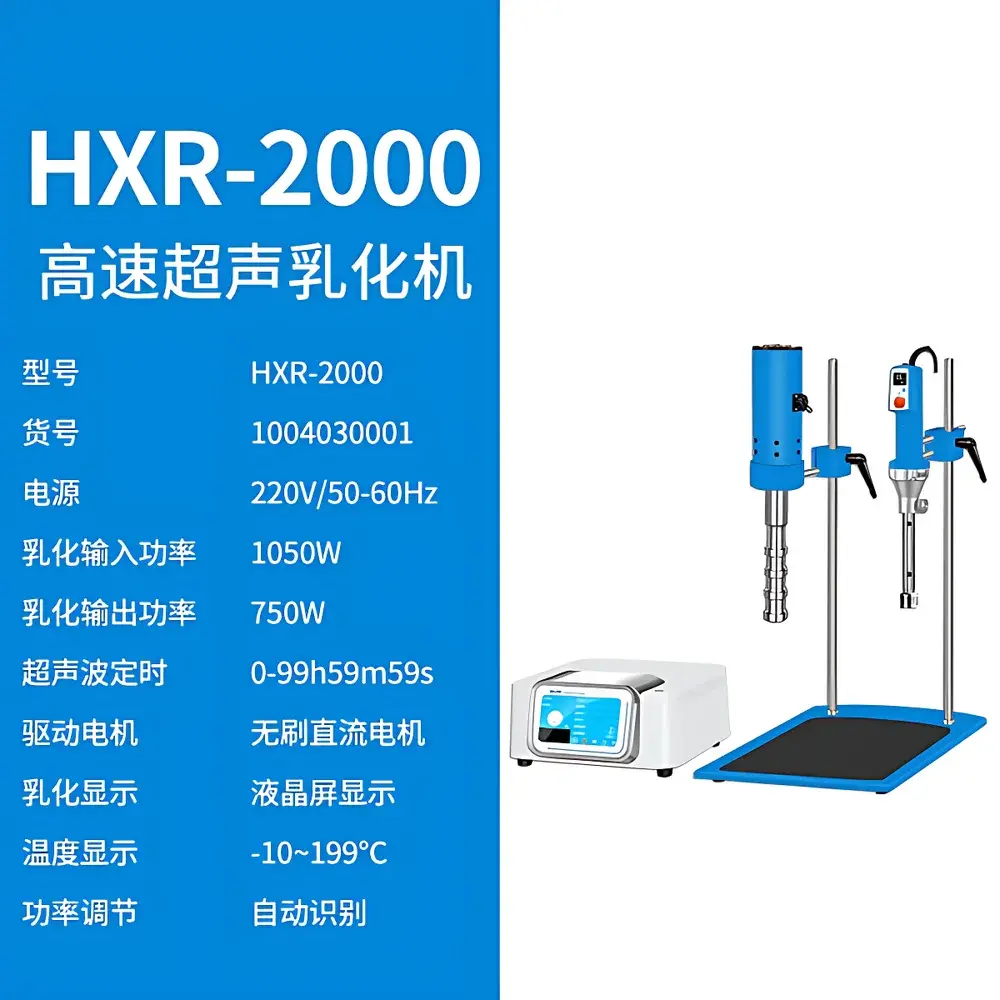
| Model | HXR-2000 |
| Quotation | Upon Request |
| Processing Volume | 2–10 L |
| Power Supply | 220 V AC, 50–60 Hz |
| Total Rated Power | 2000 W |
| Ultrasonic Timing Range | 0–99 h 59 min 59 s |
| Emulsification Timing Range | 0–999 min |
| Display | 7-inch TFT Touchscreen |
| Temperature Monitoring Range | –10 to 199 °C |
| Ultrasonic Probe Material | TC4 Titanium Alloy |
| Ultrasonic Probe Dimensions | Φ40 × 250 mm |
| Probe Type | Stepped (Bamboo-Joint) Design |
| Minimum Immersion Depth | ≥150 mm |
| Emulsification Input Power | 1050 W |
| Emulsification Output Power | 750 W |
| Drive Motor | Brushless DC Motor |
| Emulsification Speed Range | 4000–26,000 rpm |
| Emulsification Rotor-Stator Diameter | 30 mm (Stator Outer Diameter) |
| Emulsification Head Material | ASTM A276 Type 316 Stainless Steel |
| Applicable Sample Types | Pastes, Fibrous Suspensions, Liquids, Gels, Resins |
| Tangential Tip Speed | 47 m/s |
Overview
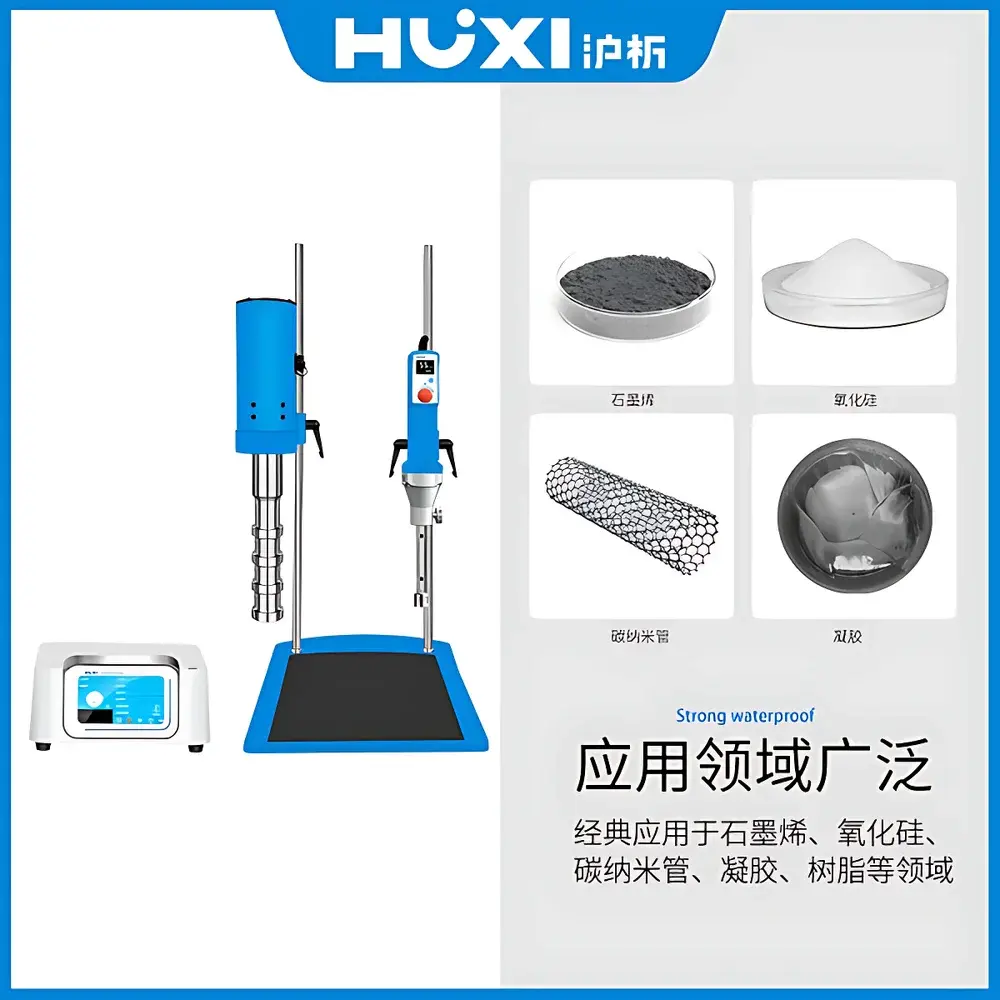
The HUXI HXR-2000 is a dual-mode laboratory homogenization system engineered for high-intensity dispersion and emulsification of challenging samples. It integrates two complementary physical energy delivery mechanisms: high-frequency ultrasonic cavitation (20 kHz nominal) and mechanical high-shear rotor-stator emulsification. This hybrid architecture enables simultaneous or sequential application of acoustic energy and hydrodynamic shear—making it uniquely suited for materials exhibiting high viscosity, low thermal stability, heterogeneous phase composition, or strong interfacial resistance (e.g., graphene dispersions, silica nanoparticle suspensions, carbon nanotube slurries, polymer gels, and thermosetting resins). Unlike standalone ultrasonic processors or rotor-stator homogenizers, the HXR-2000 delivers synergistic energy coupling: ultrasonic waves promote primary particle deagglomeration and micro-cavitation at interfaces, while the high-shear emulsification head ensures uniform distribution and secondary size reduction via controlled laminar-to-turbulent flow transition within the stator-rotor gap. Its robust mechanical design supports reproducible processing across batch volumes from 2 L to 10 L—bridging the gap between benchtop optimization and pilot-scale feasibility studies.
Key Features
- Hybrid energy delivery system combining 2000 W ultrasonic generator (TC4 titanium alloy stepped probe, Φ40 × 250 mm) and 750 W high-shear emulsification module (316 stainless steel rotor-stator, 30 mm stator OD)
- Intelligent frequency tracking circuitry maintains resonance stability under variable load conditions—ensuring consistent cavitation intensity and transduction efficiency regardless of sample viscosity or temperature drift
- Brushless DC motor drive enables precise speed control from 4000 to 26,000 rpm with minimal thermal drift and extended service life
- 7-inch TFT touchscreen interface provides real-time visualization of ultrasonic amplitude, emulsification speed, elapsed time, and temperature feedback (via optional Pt100 sensor)
- Integrated thermal safety protocol: automatic shutdown upon reaching user-defined temperature threshold (–10 to 199 °C range), preventing thermal degradation of heat-sensitive nanomaterials and biopolymers
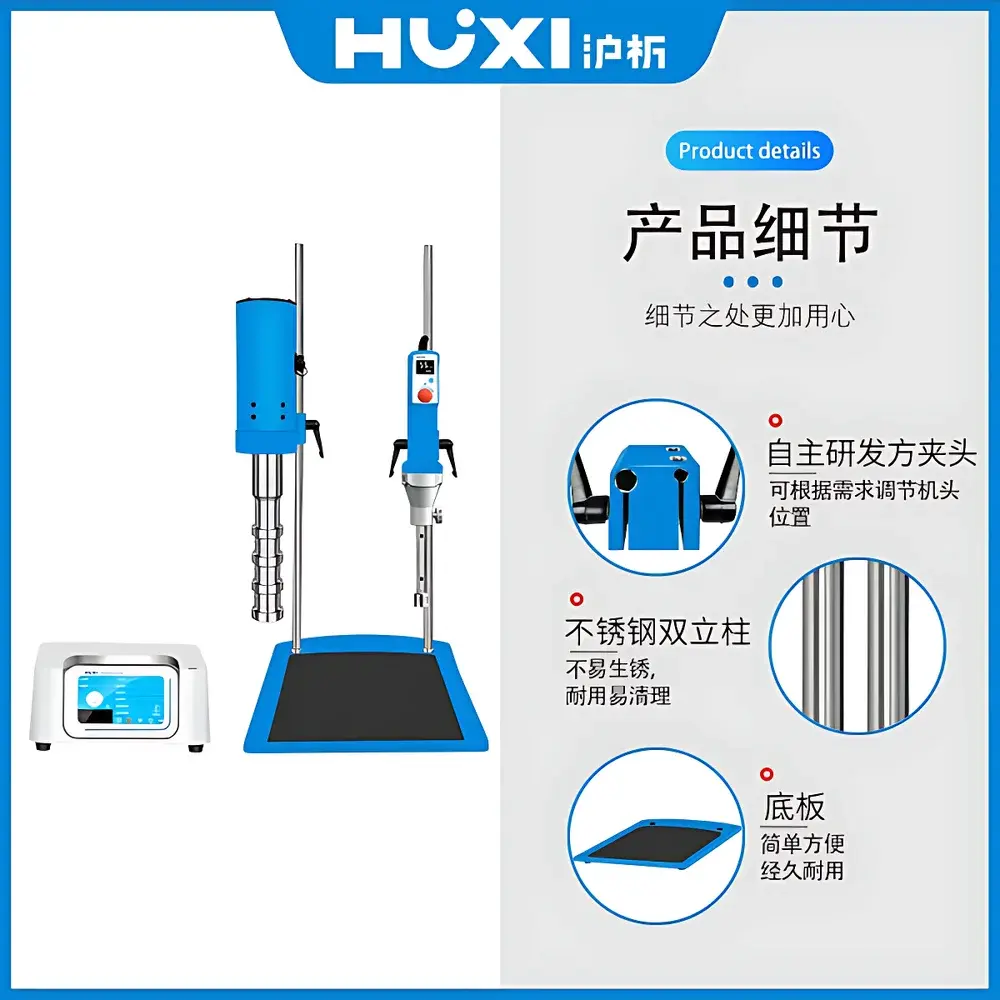
- Ergonomic dual-support lifting column with dual-hole clamping mechanism ensures stable vertical positioning and vibration isolation during prolonged operation
- IP54-rated enclosure and reinforced probe mounting assembly meet IEC 61000-6-2 EMC immunity requirements for shared laboratory environments
Sample Compatibility & Compliance
The HXR-2000 is validated for processing non-hazardous, non-explosive samples within ISO 8573-1 Class 4 air quality environments. Its material contact surfaces—TC4 titanium alloy probe and ASTM A276 Type 316 stainless steel emulsification head—comply with USP and ISO 10993-5 cytotoxicity standards for short-term contact with biological formulations. The system supports GLP-compliant workflows through timestamped event logging (power-on, mode initiation, temperature trigger, shutdown) stored locally on internal flash memory. While not certified for FDA 21 CFR Part 11 compliance out-of-the-box, audit trails can be exported in CSV format for integration into validated LIMS or ELN platforms. Applications include ASTM D7893-14 (nanoparticle dispersion stability testing), ISO 13320:2020 (laser diffraction sample preparation), and USP (liposome size distribution homogenization).
Software & Data Management
The embedded firmware supports fully independent operation without external PC dependency. All operational parameters—including ultrasonic duty cycle, emulsification ramp profiles, temperature setpoints, and runtime limits—are programmable and stored in non-volatile memory. Event logs record timestamps, measured tip temperature, actual rotational speed, and ultrasonic forward/reflected power ratios—enabling post-run correlation of process parameters with final particle size distribution (PSD) or zeta potential data. Data export is supported via USB 2.0 interface in UTF-8 encoded CSV format, compatible with MATLAB, Python pandas, and industry-standard statistical process control (SPC) software. No proprietary drivers or cloud dependencies are required.
Applications
- Preparation of stable aqueous and organic-phase nanocarbon dispersions (graphene oxide, carbon nanotubes, boron nitride nanosheets)
- Homogenization of high-viscosity polymer gels and thermoset resin precursors prior to casting or injection molding
- Cell lysis and subcellular fractionation where combined shear and cavitation improve nucleic acid yield versus single-mode systems
- Emulsification of pharmaceutical nanoemulsions (e.g., lipid-based drug delivery systems per USP )
- Deagglomeration of metal oxide nanoparticles (SiO₂, TiO₂, Fe₃O₄) for catalytic ink formulation
- Dispersion of fibrous biomaterials (cellulose nanocrystals, chitin nanofibrils) in polar solvents
FAQ
What is the maximum recommended continuous operating time per cycle?
The system supports uninterrupted operation up to 99 hours 59 minutes 59 seconds for ultrasonic mode and 999 minutes for emulsification mode. For optimal probe longevity and thermal management, cycles exceeding 30 minutes in high-amplitude ultrasonic mode should incorporate ≥2-minute cooling intervals.
Can the ultrasonic and emulsification modules operate simultaneously?
Yes—the HXR-2000 allows concurrent activation of both modules. However, simultaneous full-power operation (2000 W ultrasonic + 750 W emulsification) requires adequate ambient cooling and is recommended only for short-duration (<5 min), high-intensity dispersion tasks.
Is calibration traceable to national standards?
Ultrasonic amplitude is factory-calibrated using laser vibrometry against NIST-traceable reference transducers. Speed calibration is verified with optical tachometry per ISO 27889:2017. Certificate of Conformance is supplied with each unit.
What maintenance intervals are recommended?
TC4 probe inspection every 200 hours of ultrasonic use; rotor-stator clearance verification every 500 emulsification hours; annual firmware update and electrical safety test (IEC 61010-1) by authorized service personnel.
Does the system support external PLC or SCADA integration?
Digital I/O ports (2× opto-isolated inputs, 2× relay outputs) enable basic start/stop and fault signaling. Modbus RTU over RS-485 is available as an optional firmware upgrade for full parameter read/write capability.



