
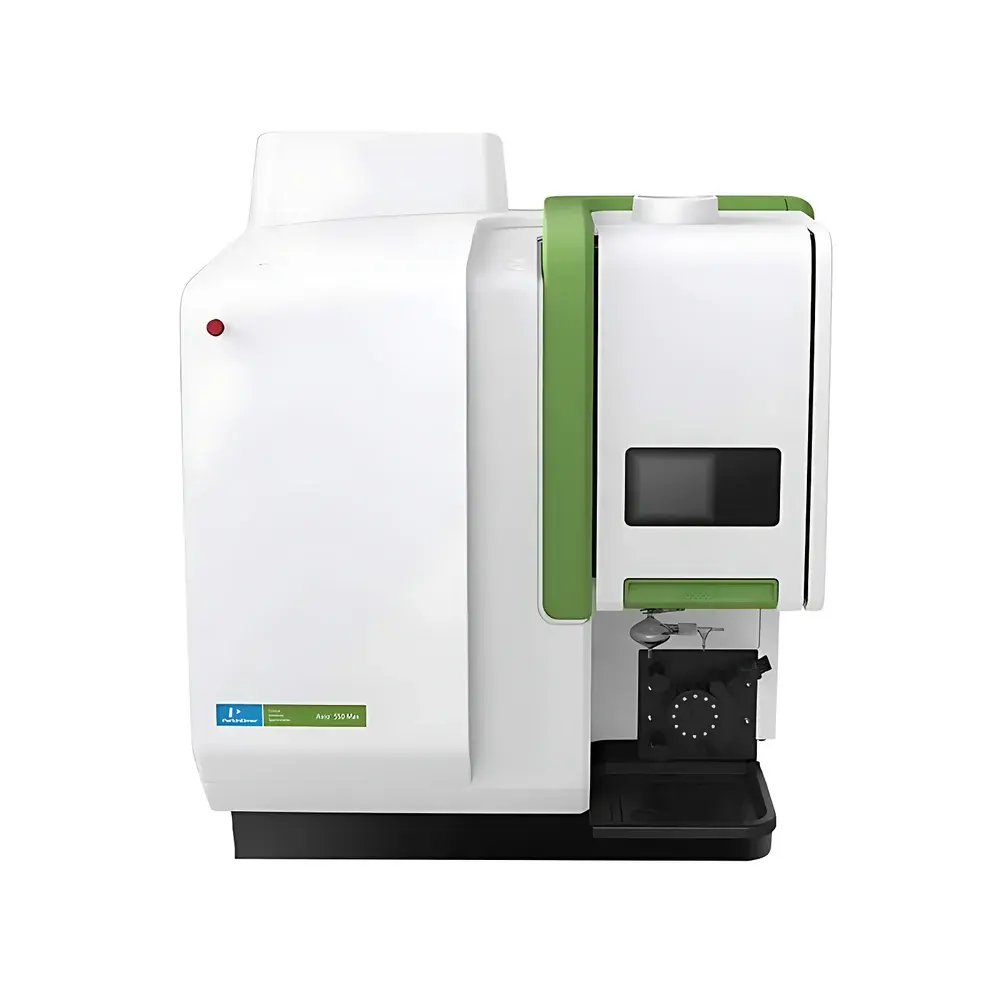
PerkinElmer Avio® 550 Max Inductively Coupled Plasma Optical Emission Spectrometer
| Brand | PerkinElmer |
|---|---|
| Origin | Singapore |
| Manufacturer Type | Original Equipment Manufacturer (OEM) |
| Origin Category | Imported Instrument |
| Model | Avio® 550 |
| Instrument Type | Full-Spectrum Simultaneous ICP-OES |
| Plasma Orientation | Vertical Torch Configuration |
| Software Platform | Syngistix™ for ICP |
| Sample Introduction System | Scott/Cross-Flow Nebulizer with Cyclonic Spray Chamber |
| Optional Capability | HF-Compatible Sample Handling |
Overview
The PerkinElmer Avio® 550 Max is a compact, full-spectrum simultaneous inductively coupled plasma optical emission spectrometer (ICP-OES) engineered for laboratories requiring robust elemental analysis at medium-to-low throughput. It employs a vertically oriented plasma torch—distinct from conventional horizontal configurations—to enhance matrix tolerance and reduce spectral interferences. This design enables direct analysis of high-solids, high-acid, or high-salt samples—including those containing hydrofluoric acid (HF)—without mandatory dilution or extensive offline sample preparation. The instrument operates on the fundamental principle of atomic emission spectroscopy: analyte elements are atomized and excited in a high-temperature argon plasma (~6,000–10,000 K), and their characteristic emission lines across the UV–VIS–NIR range (165–900 nm) are dispersed and quantified using a solid-state echelle optical system with advanced off-axis reflective optics and freeform mirror surfaces. This architecture ensures high wavelength fidelity, low stray light, and stable photometric response over extended operational periods.
Key Features
- FlatPlate™ Plasma Technology: A proprietary solid-state RF generator and planar load coil configuration deliver superior plasma stability, reduced argon consumption (up to 50% less than conventional ICP-OES systems), and elimination of routine torch alignment or cooling gas adjustments.
- Maintenance-Free PlasmaShear™ Interface: Integrates a sheared plasma interface that suppresses oxide-based polyatomic interferences (e.g., ArO⁺, NO⁺) without supplemental argon gas or mechanical moving parts—enabling long-term operational consistency.
- Vertical Torch Design: Provides 100% matrix tolerance for complex samples such as geological digests, environmental leachates, pharmaceutical excipients, and battery electrolytes—minimizing memory effects and carryover.
- Dual-View Plasma Observation: Combines axial and radial viewing paths within a single acquisition cycle, extending linear dynamic range to up to 8 orders of magnitude without manual reconfiguration or method switching.
- Color PlasmaCam™ Real-Time Imaging: A built-in high-resolution color camera enables continuous visual monitoring of plasma shape, position, and stability—supporting remote troubleshooting, method development validation, and operator training.
- Full-Spectrum Acquisition via Universal Data Collection (UDC): Captures all detectable wavelengths simultaneously with no dwell-time penalty or storage overhead—ensuring retrospective spectral interrogation and interference correction post-run.
Sample Compatibility & Compliance
The Avio® 550 Max accommodates liquid samples introduced via a Scott-type or Cross-Flow nebulizer paired with a cyclonic spray chamber—optimized for both aqueous and organic matrices. Its HF-compatible fluidic path permits direct analysis of fluoride-containing samples (e.g., semiconductor etchants, geological silicates) without PTFE degradation or clogging. The system complies with key regulatory frameworks including ASTM D1976 (trace metals in water), ISO 11885 (water quality—determination of selected elements by ICP-OES), and USP / (elemental impurities in pharmaceuticals). Syngistix™ software supports audit trails, electronic signatures, and 21 CFR Part 11 compliance when deployed in GLP/GMP environments.
Software & Data Management
Syngistix™ for ICP is a workflow-driven, icon-based software platform designed for intuitive method setup, real-time diagnostics, and automated quality control. It features live plasma health monitoring, internal standard tracking, drift correction algorithms, and automatic background correction across all wavelengths. Data handling includes native support for LIMS integration via ASTM E1384-compliant export formats (e.g., .csv, .xml), secure user role management, and version-controlled method libraries. All acquisitions are time-stamped and metadata-enriched—facilitating traceability during regulatory audits or technical investigations.
Applications
The Avio® 550 Max serves diverse analytical domains: environmental labs quantify trace metals (As, Cd, Pb, Hg) in wastewater and soil extracts per EPA Method 200.7; clinical and food safety labs screen for toxic elements (Al, Ni, Cr) in dietary supplements and infant formula under FDA guidance; materials science labs perform alloy composition verification and catalyst residue analysis; and academic research groups utilize its dual-view capability for speciation studies involving redox-sensitive elements (e.g., Fe²⁺/Fe³⁺, Cr³⁺/Cr⁶⁺) when coupled with hyphenated separation techniques.
FAQ
Does the Avio® 550 Max support hyphenated techniques such as HPLC-ICP-OES?
Yes—its fast full-spectrum acquisition mode and low dwell-time latency enable seamless coupling with liquid chromatography systems for elemental speciation workflows.
Is the instrument compatible with oxygen or nitrogen auxiliary gases for non-Ar plasma operation?
No—the Avio® 550 Max is optimized exclusively for argon plasma generation and does not support alternative plasma gases.
Can Syngistix™ software be validated for 21 CFR Part 11 compliance?
Yes—when installed with appropriate system controls (e.g., password policies, audit trail activation, electronic signature modules), Syngistix™ meets core requirements for regulated environments.
What is the typical detection limit range for major elements like Ca and Mg?
Sub-ppt to low-ppt detection limits are achievable depending on sample matrix, integration time, and plasma observation mode—typical values fall between 0.005–0.05 µg/L for axial view in clean aqueous standards.
How often does the FlatPlate™ torch require maintenance or replacement?
Under normal operating conditions with certified argon and filtered samples, the torch exhibits >1,000 hours of stable operation without cleaning or realignment—no scheduled maintenance is required.



