
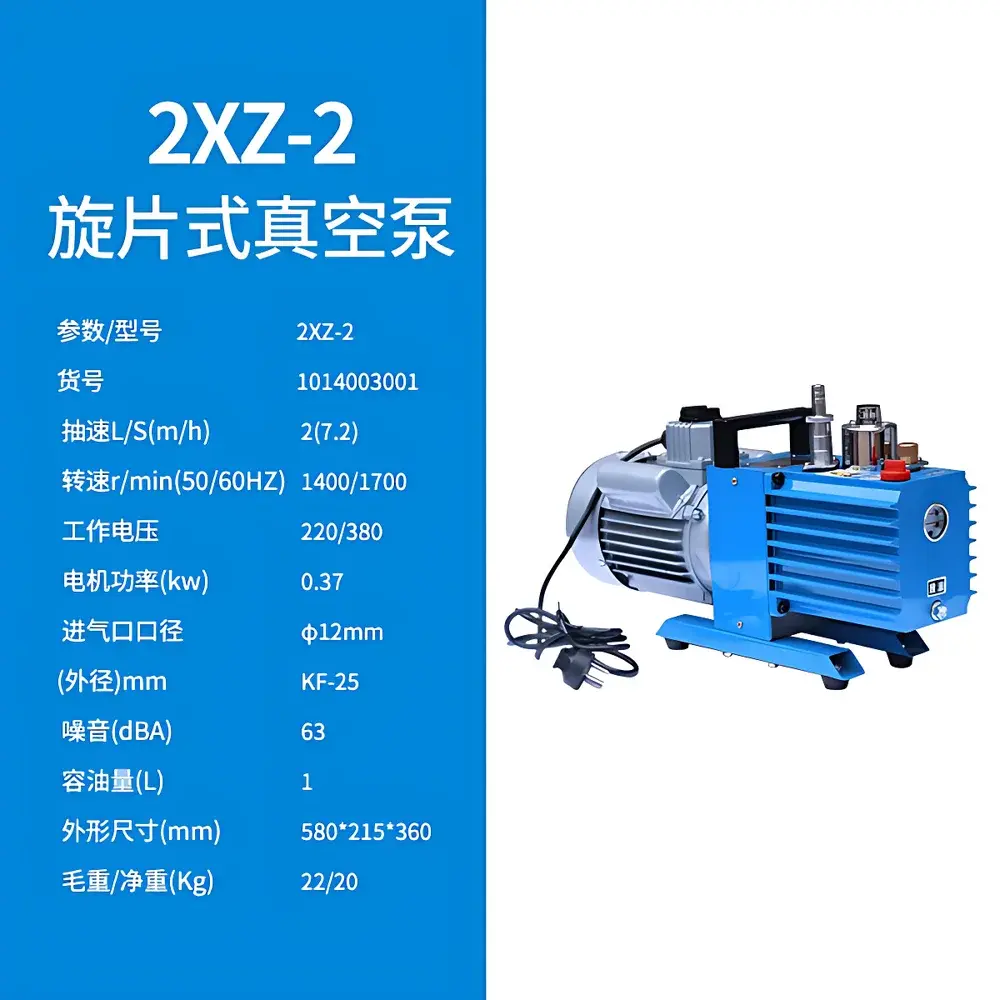
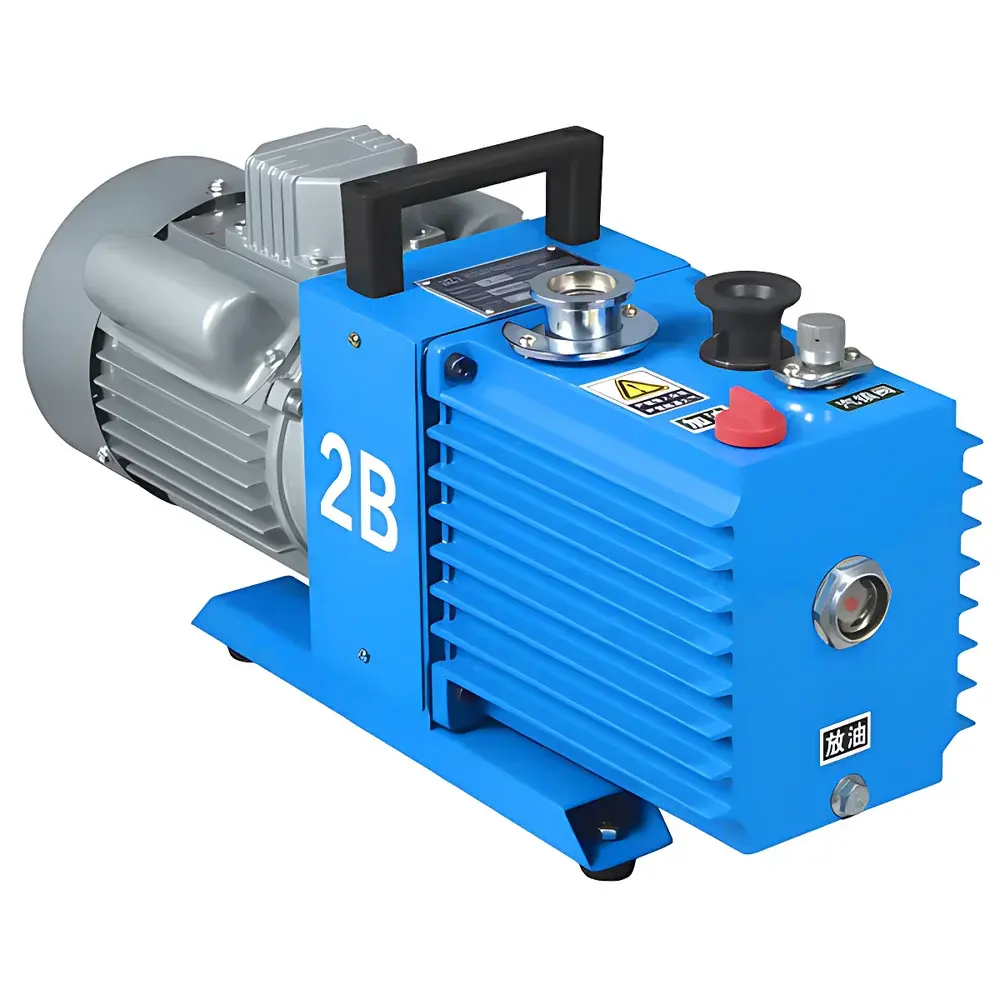
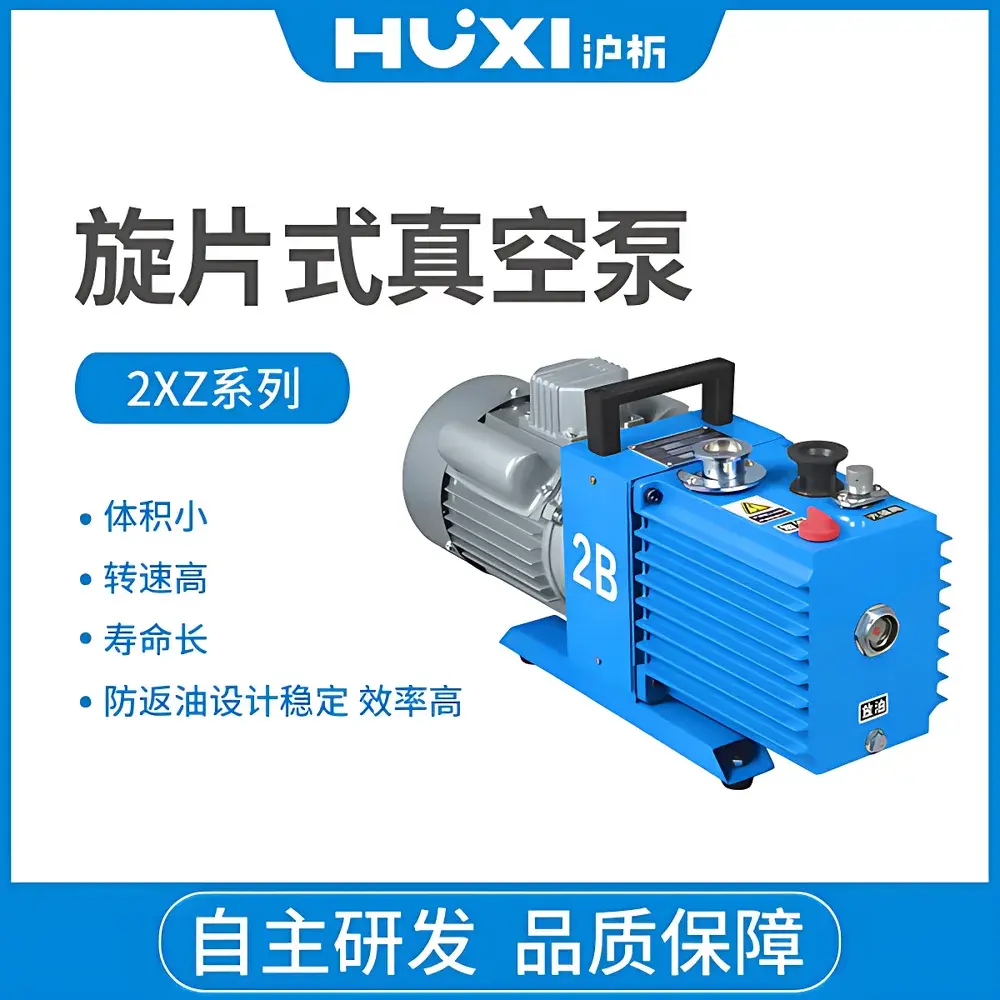
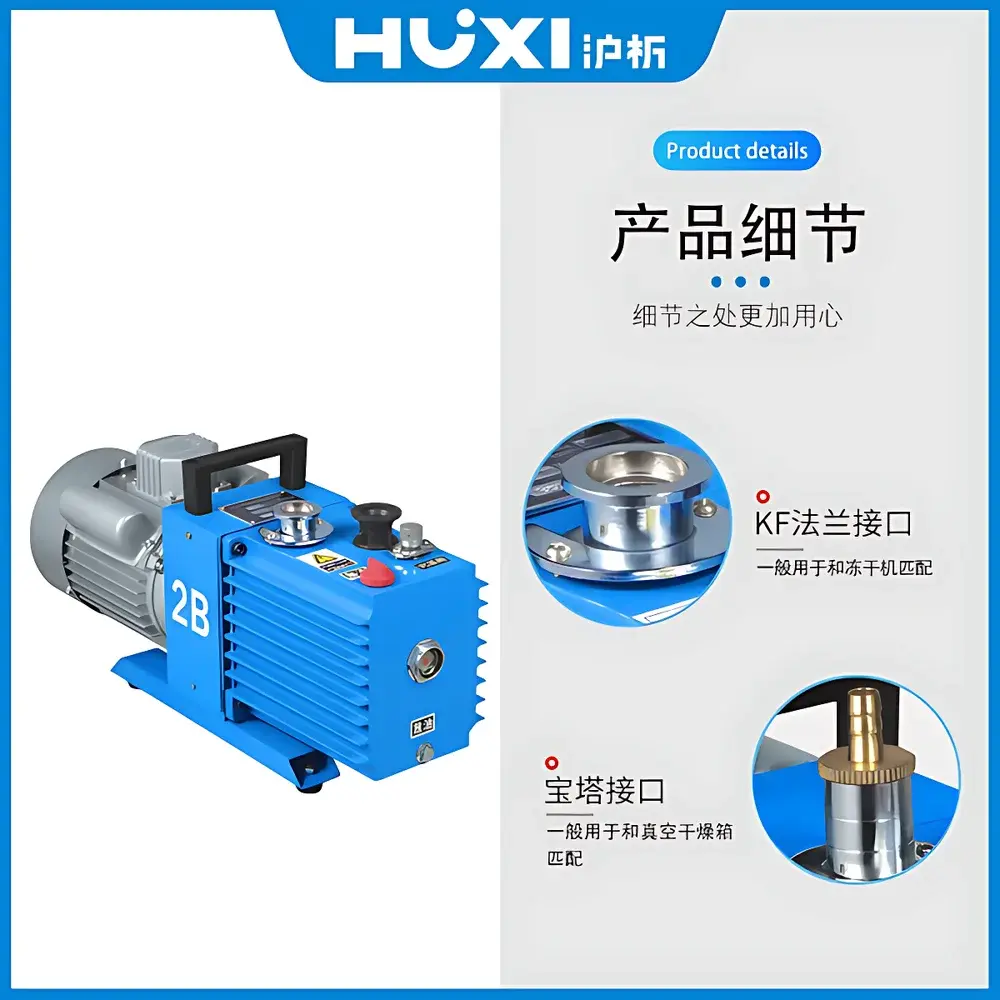
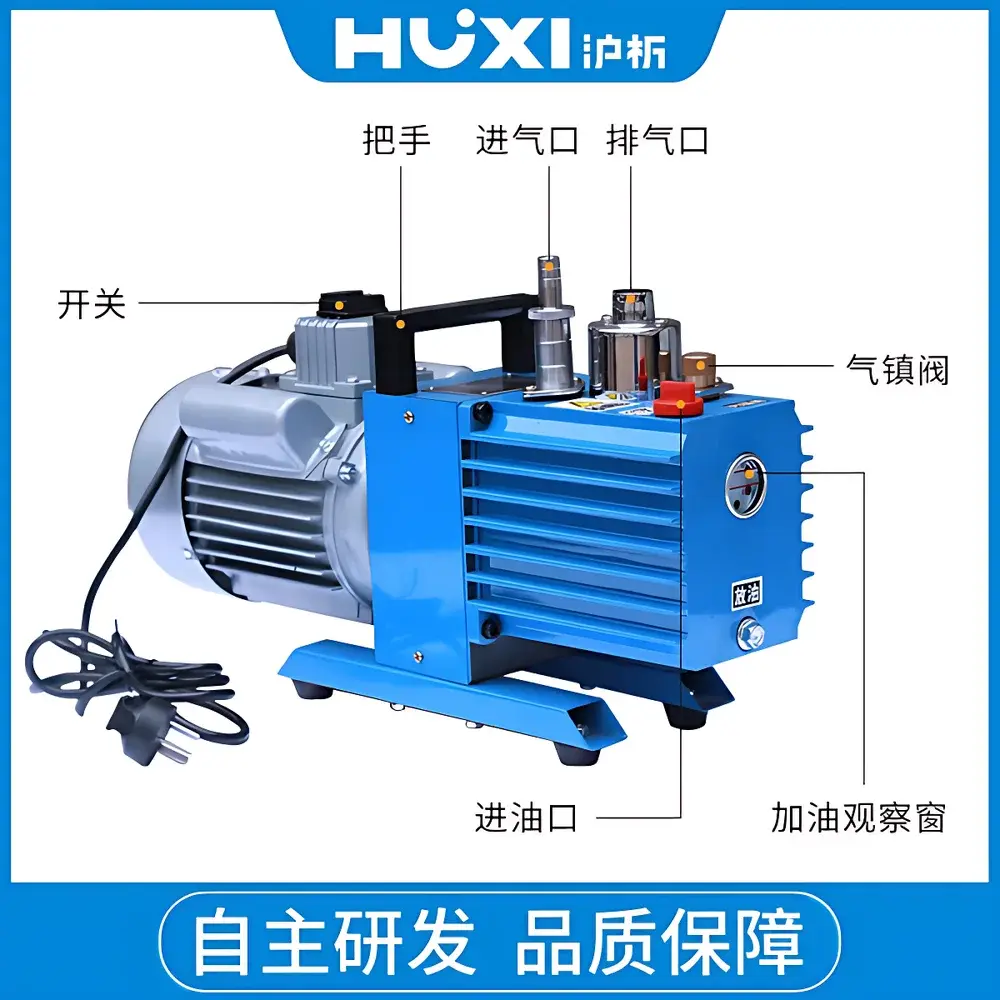
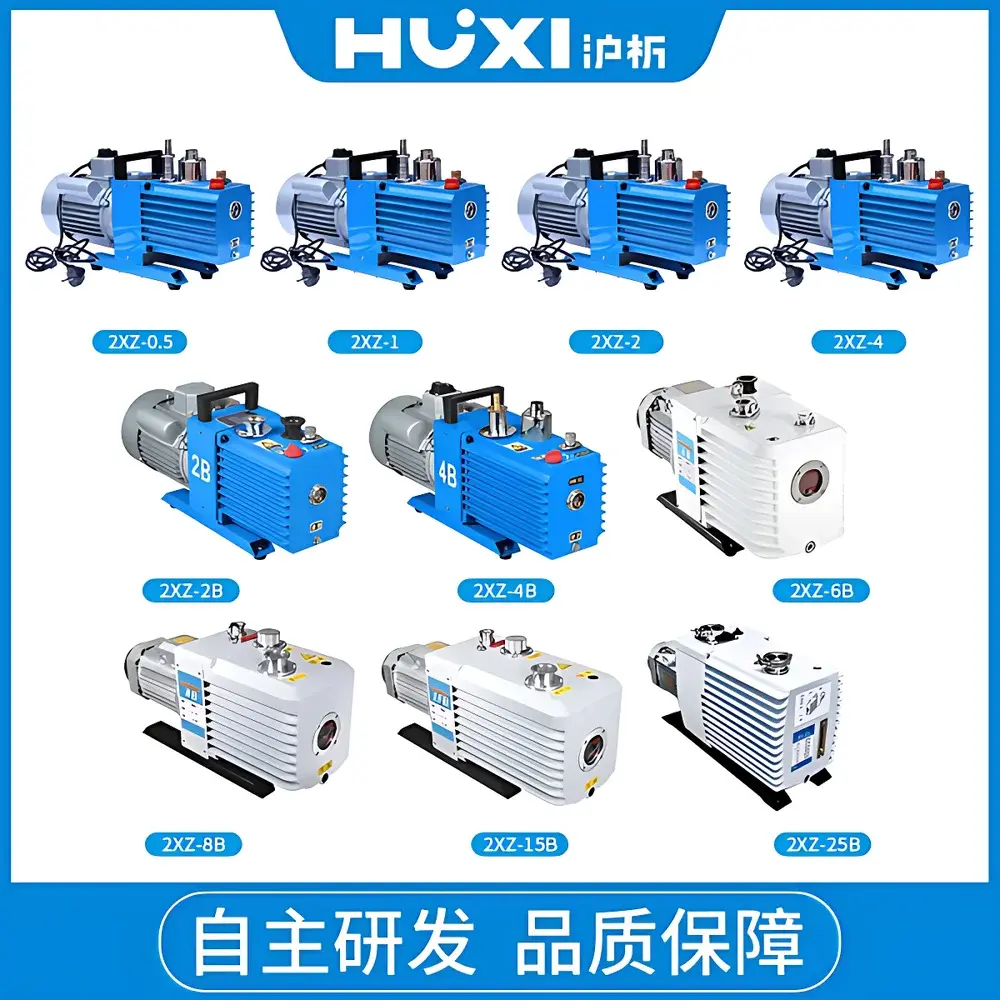
HUXI 2XZ-2 Dual-Stage Rotary Vane Vacuum Pump
| Brand | HUXI |
|---|---|
| Origin | Shanghai, China |
| Manufacturer Type | Direct Manufacturer |
| Country of Origin | China |
| Model | 2XZ-2 |
| Instrument Type | Rotary Vane Pump |
| Pumping Speed | 7.2 m³/h (2 L/s) |
| Ultimate Vacuum Pressure | 1.33 × 10⁻¹ Pa |
| External Dimensions | 480 × 145 × 275 mm |
| Weight | 20 kg |
| Motor Power | 0.37 kW |
Overview
The HUXI 2XZ-2 is a dual-stage, oil-lubricated rotary vane vacuum pump engineered for reliable and stable operation in general laboratory and light industrial vacuum applications. Based on the fundamental principle of positive displacement via rotating vanes within an eccentrically mounted rotor chamber, the 2XZ-2 achieves progressive compression across two sequential stages—enabling both higher ultimate vacuum performance and improved pumping efficiency at low pressures compared to single-stage alternatives. Its design adheres to internationally recognized mechanical vacuum pump architecture, with optimized rotor-stator clearance, precision-machined vanes, and thermally stable cast-iron housing. The pump operates continuously under ambient conditions (15–35 °C) and is rated for use with non-corrosive, dry gases—making it suitable as a primary vacuum source or as a forepump for high-vacuum systems such as diffusion pumps, turbomolecular pumps, and titanium sublimation pumps.
Key Features
- Dual-stage rotary vane configuration delivering an ultimate vacuum pressure of ≤1.33 × 10⁻¹ Pa, enabling effective operation down to medium vacuum range (10⁻¹ to 10⁻² Pa)
- Low-noise mechanical design incorporating vibration-damping mounting feet, balanced rotor assembly, and acoustic shielding—typical operating noise level <62 dB(A) at 1 m distance
- Integrated gas ballast (air bleed) valve allows controlled admission of atmospheric air during pumping of condensable vapors, minimizing oil contamination and extending service life of the mineral-based vacuum oil
- Compact footprint (480 × 145 × 275 mm) and lightweight construction (20 kg) facilitate integration into benchtop vacuum manifolds, glove boxes, and OEM equipment enclosures
- IEC-standard 0.37 kW induction motor with thermal overload protection ensures consistent torque delivery and safe long-term duty cycle operation
- Standard inlet port configured for ISO-KF 25 (QF25) flange; optional adapters available for NW16, ISO-KF 16, and custom-threaded connections
Sample Compatibility & Compliance
The 2XZ-2 is intended for use with non-reactive, non-explosive, and non-corrosive gases—including air, nitrogen, argon, and water vapor below saturation limits. It is not rated for solvent vapors, halogenated compounds, acidic gases (e.g., HCl, Cl₂), or oxygen-enriched atmospheres without prior consultation and modification. The pump complies with CE marking requirements under the EU Machinery Directive 2006/42/EC and Electromagnetic Compatibility Directive 2014/30/EU. All electrical components meet IEC 60034-1 insulation class B standards. While not certified to ISO 22893 (vacuum pumps – safety requirements) or ASTM F2438 (specification for vacuum pumps used in medical devices), its mechanical architecture aligns with baseline expectations for GLP-compliant laboratory infrastructure where vacuum integrity and repeatability are critical.
Software & Data Management
As a standalone mechanical vacuum pump, the 2XZ-2 does not incorporate embedded electronics, digital control interfaces, or data logging capabilities. Operation is manual via standard mains switch and dedicated vacuum line isolation valve. For integration into automated systems, users may pair the pump with external pressure transducers (e.g., capacitance manometers or Pirani gauges) and programmable logic controllers (PLCs) compliant with IEC 61131-3. No proprietary software or driver support is provided; however, analog 0–10 V or 4–20 mA vacuum feedback signals can be accommodated through third-party instrumentation when interfaced via compatible pressure sensors. Audit trails, electronic signatures, or FDA 21 CFR Part 11 compliance are not applicable to this device but may be implemented at the system level by end-users in regulated environments.
Applications
- Primary vacuum source for laboratory vacuum ovens, freeze dryers (lyophilizers), and desiccators requiring base pressures between 10⁻¹ and 10⁻² Pa
- Forepump for high-vacuum systems including diffusion pumps and turbomolecular pumps in thin-film deposition (PVD, sputtering), electron microscopy sample preparation, and surface analysis instrumentation
- Vacuum packaging and degassing of resins, adhesives, and composite pre-pregs in R&D and prototyping workflows
- Support vacuum for vacuum-assisted resin transfer molding (VARTM), vacuum forming of thermoplastics, and vacuum filtration setups
- OEM integration into analytical instruments (e.g., mass spectrometer sample inlets, residual gas analyzers) and production-line equipment (e.g., HVAC component evacuation stations, small-scale food packaging lines)
FAQ
What type of vacuum oil is recommended for the 2XZ-2?
HUXI specifies a mineral-based, low-volatility vacuum pump oil meeting ISO VG 68 viscosity grade and DIN 51506 VDL specifications. Synthetic oils are not recommended unless validated for compatibility with the pump’s elastomer seals and vane material.
Can the 2XZ-2 be operated continuously for 24/7 duty cycles?
Yes—provided ambient temperature remains within 15–35 °C, ventilation is unobstructed, and oil level and condition are verified every 500 operating hours per manufacturer guidelines.
Is the 2XZ-2 suitable for pumping solvents or acid vapors?
No. Exposure to organic solvents, halogenated compounds, or corrosive gases will degrade internal components and void warranty. A cold trap or scrubber must be installed upstream if trace condensables are present.
Does the pump include an exhaust filter or oil mist separator?
The standard configuration includes a basic exhaust baffle; an optional high-efficiency oil mist separator (HUXI part #OMS-2XZ) is available for installations requiring reduced hydrocarbon emissions or clean-room compliance.
What maintenance intervals are recommended?
Oil change every 500 hours or 3 months (whichever occurs first); vane inspection and replacement every 3,000–5,000 hours depending on duty profile and gas load.
Related Products



