
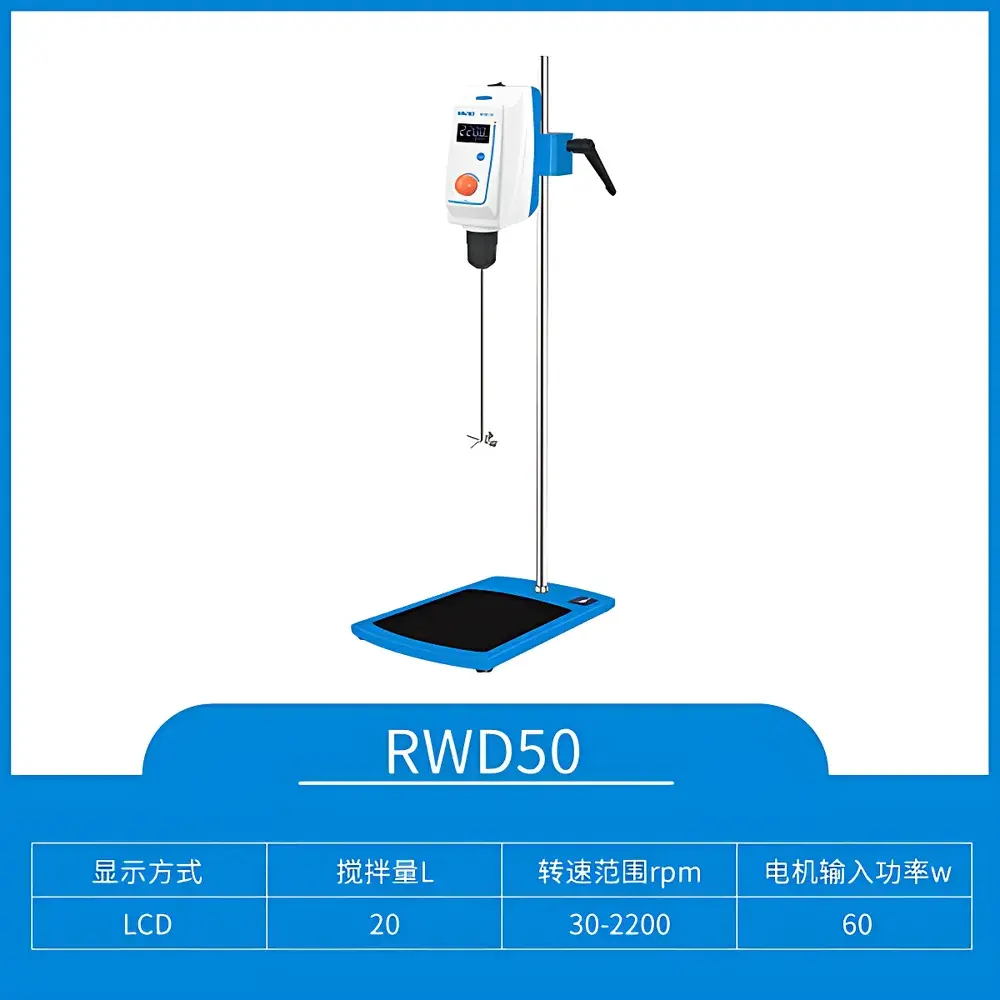
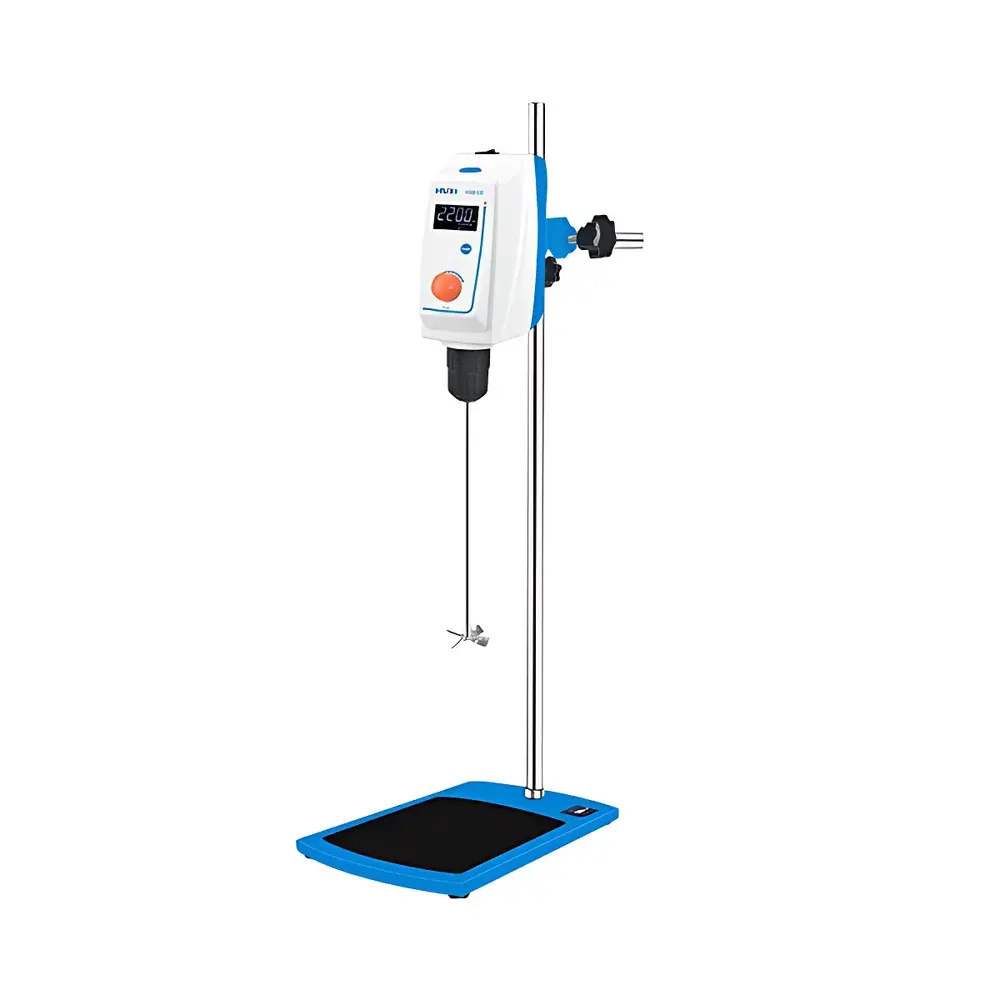
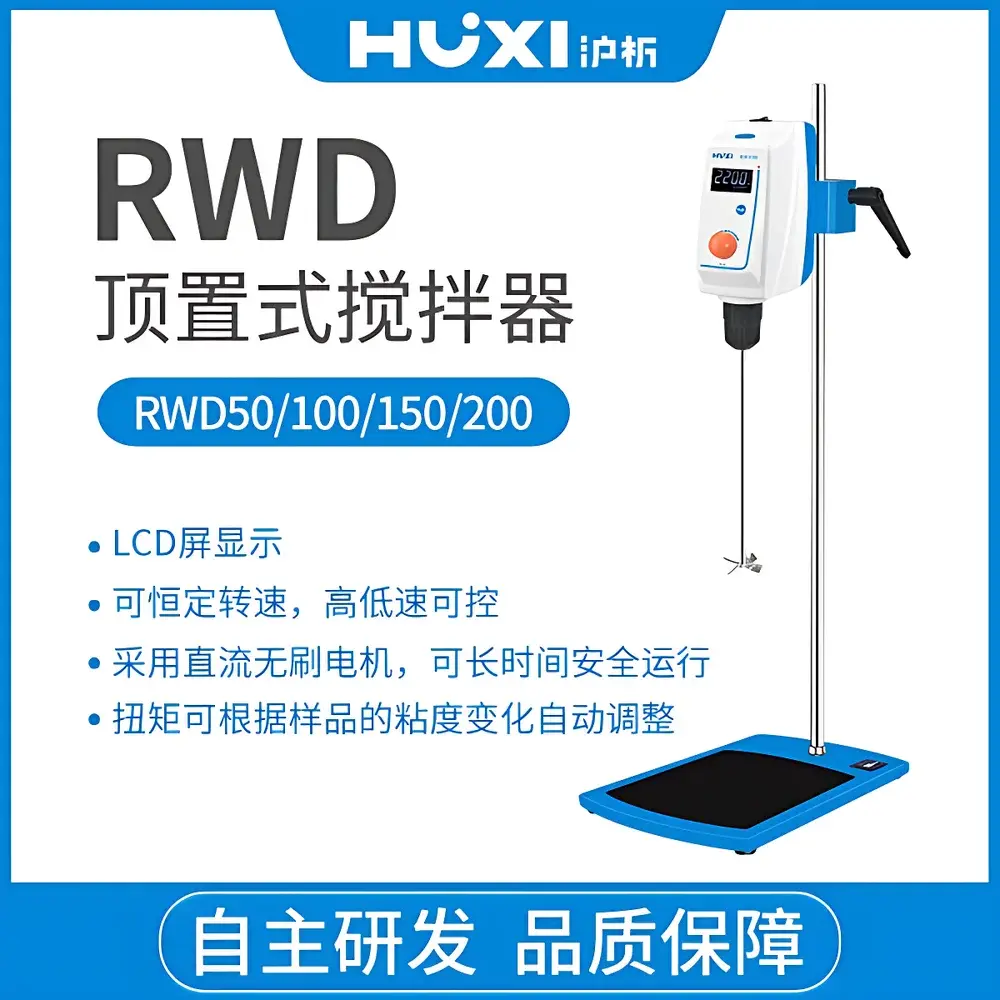
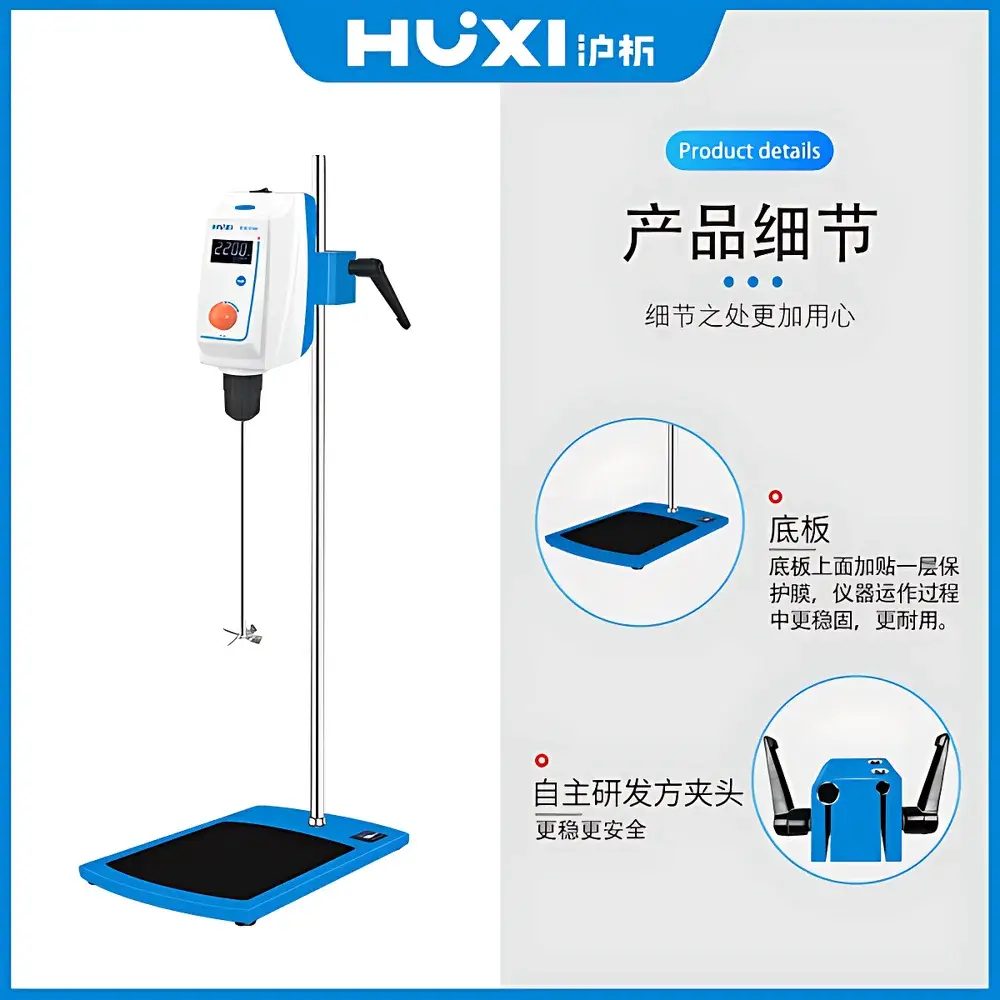
HUXI RWD50 Overhead Digital Stirrer
| Brand | HUXI |
|---|---|
| Origin | Shanghai, China |
| Manufacturer Type | Direct Manufacturer |
| Product Category | Domestic (China-Made) |
| Model | RWD50 |
| Instrument Type | Overhead Electric Stirrer |
| Max. Mixing Volume | 20 L |
| Speed Range | 30–2200 rpm |
| Temperature Control | Ambient Only |
| Display | LCD |
| Speed Accuracy | ±1 rpm |
| Speed Adjustment | Coarse + Fine |
| Timer Range | 1–9999 min |
| Max. Torque | 40 N·cm |
| Max. Viscosity | 10,000 mPa·s |
| Input Power | 60 W |
| Output Power | 50 W |
| Protection Rating | IP42 |
| Operating Environment | 5–40 °C, ≤80% RH |
| Net Weight (Unit) | 4.4 kg |
| Gross Weight (Packaging) | 6.5 kg |
| Dimensions (Unit) | 315 × 200 × 780 mm |
| Packaging Dimensions | 475 × 340 × 200 mm |
Overview
The HUXI RWD50 Overhead Digital Stirrer is an engineered solution for precise, reproducible mixing of low- to high-viscosity samples in research laboratories, quality control environments, and pilot-scale process development. Designed around a robust overhead architecture, it operates on the principle of torque-controlled rotational agitation—transferring mechanical energy from a brushless DC motor through a precision gear train to the stirring shaft. This configuration eliminates magnetic coupling limitations and enables consistent torque delivery across the full speed range (30–2200 rpm), making it suitable for applications where viscosity changes dynamically during operation—such as polymer dissolution, suspension homogenization, or emulsion formation. Unlike magnetic stirrers, the RWD50 avoids heat generation in the sample vessel and supports larger working volumes (up to 20 L) with scalable impeller configurations.
Key Features
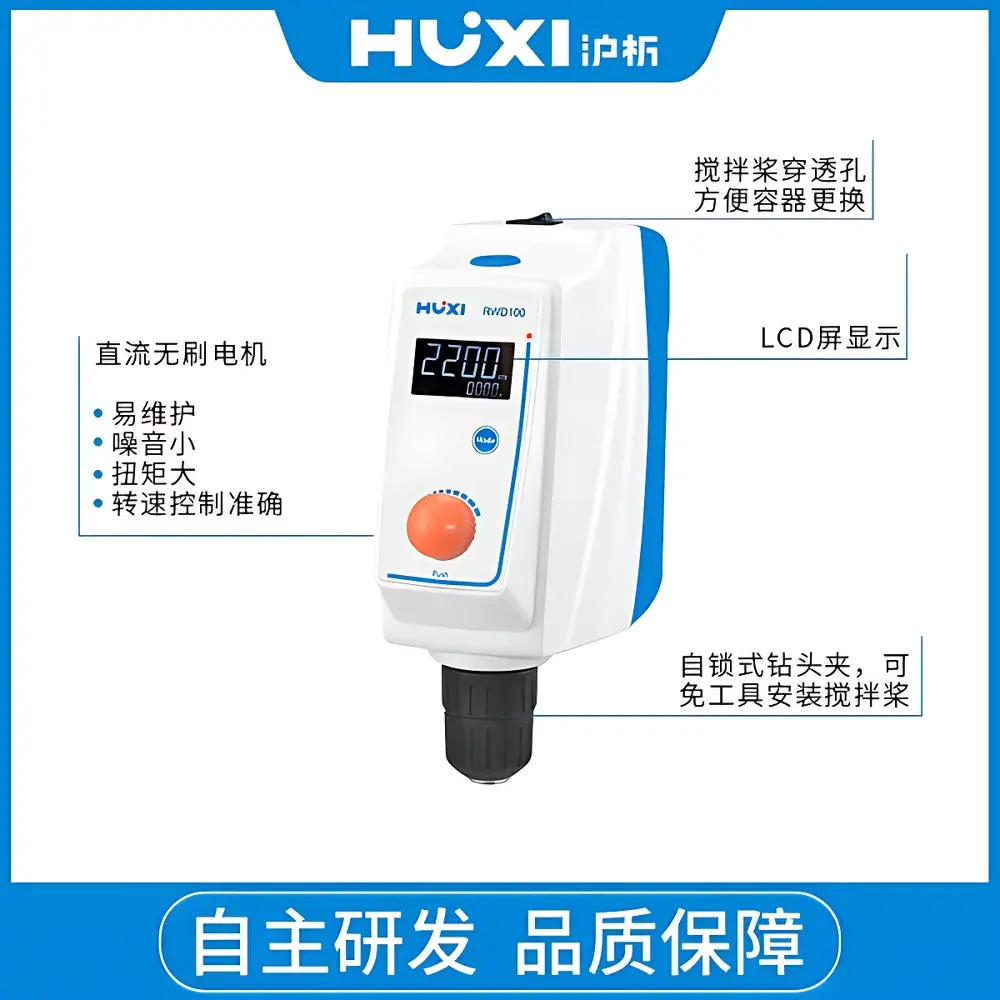
- Brushless DC motor with thermal and current monitoring—ensures continuous operation under load without degradation in speed stability or service life.
- Integrated dual-mode speed control: coarse adjustment for rapid setpoint selection and fine-tuning capability active during operation, enabling real-time adaptation to evolving rheological conditions.
- LCD display showing real-time speed (rpm), elapsed/remaining time, and system status—including fault codes for overcurrent, stall, or thermal overload.
- Auto-shutdown protection triggered by overtorque, short-circuit, or motor stall; visual alarm and audible signal accompany cutoff to support GLP-compliant documentation practices.
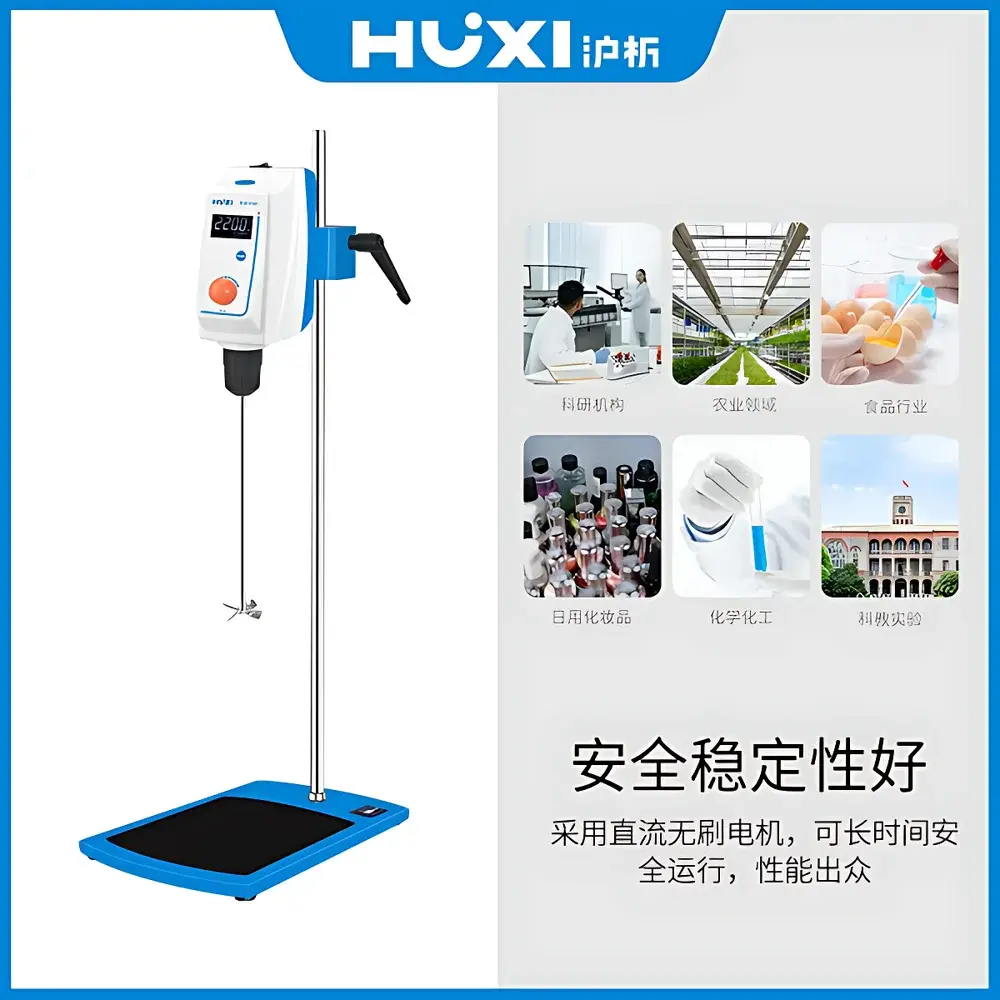
- Self-locking chuck with quick-release mechanism—accepts standard ISO 228/1 or DIN 12879-compatible shafts (6–10 mm diameter); optional square-section vertical stand available for height-stable mounting.
- Intelligent torque compensation: motor controller dynamically adjusts output torque within the 40 N·cm limit to maintain target rpm as sample viscosity increases—reducing manual intervention and improving repeatability.
- IP42-rated enclosure—provides protection against solid objects >1 mm and vertically falling water droplets, suitable for general laboratory use under controlled ambient conditions (5–40 °C, ≤80% RH).
Sample Compatibility & Compliance
The RWD50 accommodates a broad range of sample types including aqueous and organic solutions, suspensions, pastes, and non-Newtonian fluids up to 10,000 mPa·s. Its overhead design supports compatibility with glass, stainless steel, and PTFE-coated vessels (e.g., beakers, jacketed reactors, and crystallizers). The device meets basic electrical safety requirements per GB 4793.1 (equivalent to IEC 61010-1) for laboratory equipment. While not certified for hazardous area use (ATEX/IECEx), its brushless motor and electronic protection architecture align with good engineering practice for non-explosive environments. For regulated industries (pharmaceutical, food, cosmetics), the timer function and fault logging support traceability in SOP-driven workflows; however, native 21 CFR Part 11 compliance requires integration with validated third-party data acquisition software.
Software & Data Management
The RWD50 operates as a standalone instrument with no embedded connectivity (USB/Ethernet/Bluetooth). All operational parameters—including speed setpoint, timer duration, and real-time rpm—are displayed locally on the monochrome LCD interface. No onboard memory or export functionality is provided; therefore, experimental metadata must be recorded manually or via external systems (e.g., lab notebooks, LIMS, or camera-based timestamping). For users requiring digital audit trails, the unit can be integrated into automated platforms using analog 0–10 V or 4–20 mA process outputs (optional module required—contact HUXI technical support for availability and calibration documentation).
Applications
- Chemical synthesis: homogeneous mixing during exothermic reactions or multi-phase catalytic processes.
- Pharmaceutical formulation: preparation of suspensions, granulation binders, and ointment bases under controlled shear.
- Food science: dispersion of thickeners (e.g., xanthan gum), emulsification of dressings, and dough consistency testing.
- Materials science: dispersion of nanoparticles in polymer matrices or ceramic slurries prior to casting or extrusion.
- Environmental analysis: homogenization of sediment/water extracts for heavy metal or organic contaminant assays.
- Educational labs: demonstration of Newtonian vs. non-Newtonian flow behavior using calibrated viscosity standards.
FAQ
What impeller types are compatible with the RWD50?
Standard ISO/DIN shafts (6–10 mm diameter) support propeller, paddle, anchor, and helical ribbons—available separately from HUXI or third-party suppliers meeting dimensional tolerances.
Can the RWD50 be used in temperature-controlled reactors?
Yes—the unit operates at ambient temperature only, but it is mechanically compatible with jacketed vessels and heating/cooling mantles when mounted externally via the optional square stand or custom bracketing.
Is firmware update capability available?
No—the RWD50 uses fixed-function embedded logic; no user-accessible firmware or upgrade path is provided.
Does the timer support repeat cycles or interval modes?
No—the built-in timer functions as a single-cycle countdown (1–9999 minutes); multi-step protocols require external sequencing.
What maintenance is recommended for long-term reliability?
Annual inspection of chuck grip integrity, visual check of motor ventilation grilles for dust accumulation, and verification of torque response using a calibrated viscometer reference fluid (e.g., silicone oil, 5000 mPa·s).



