
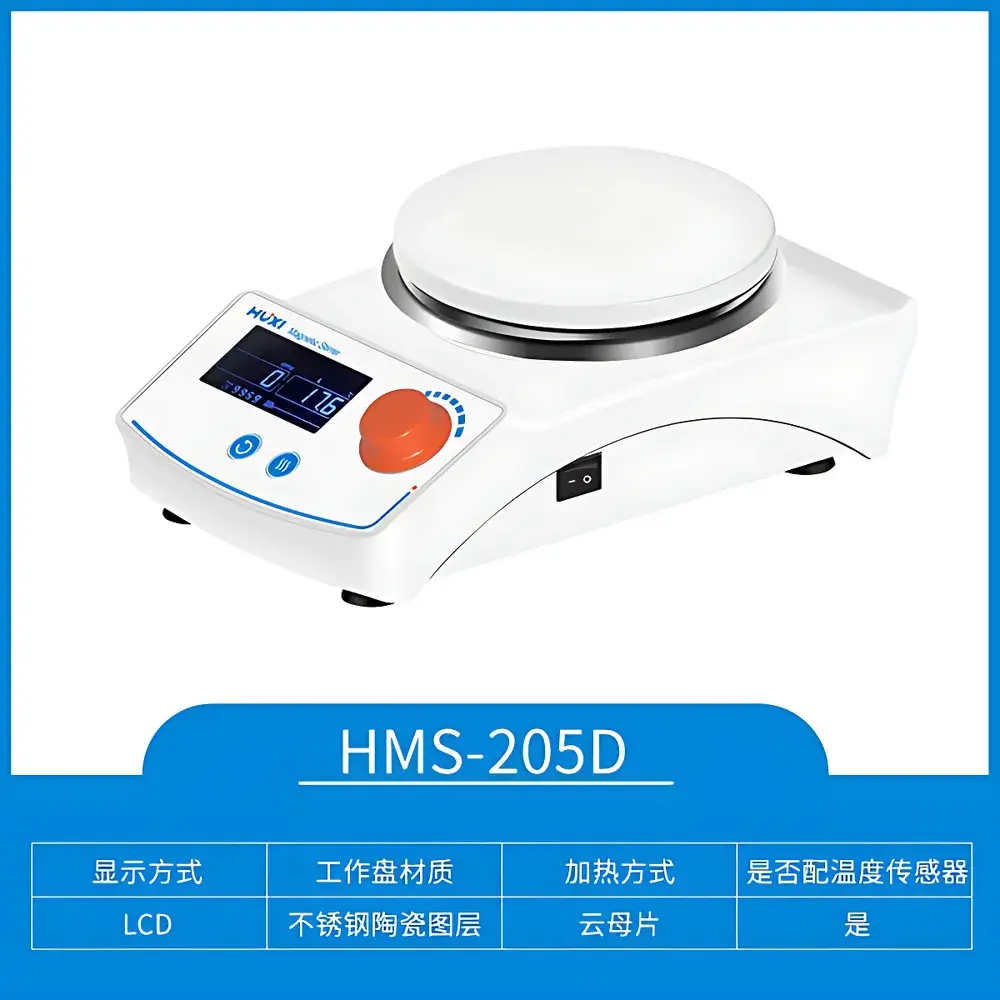
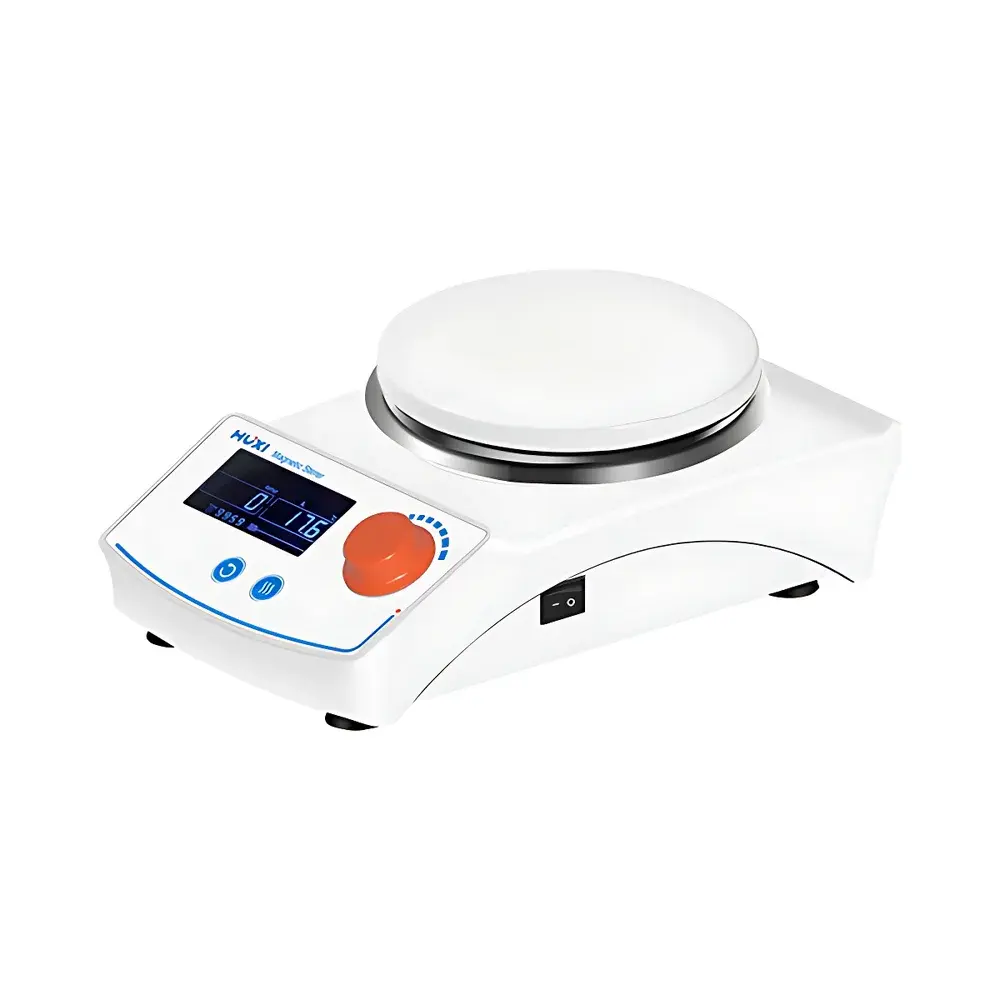
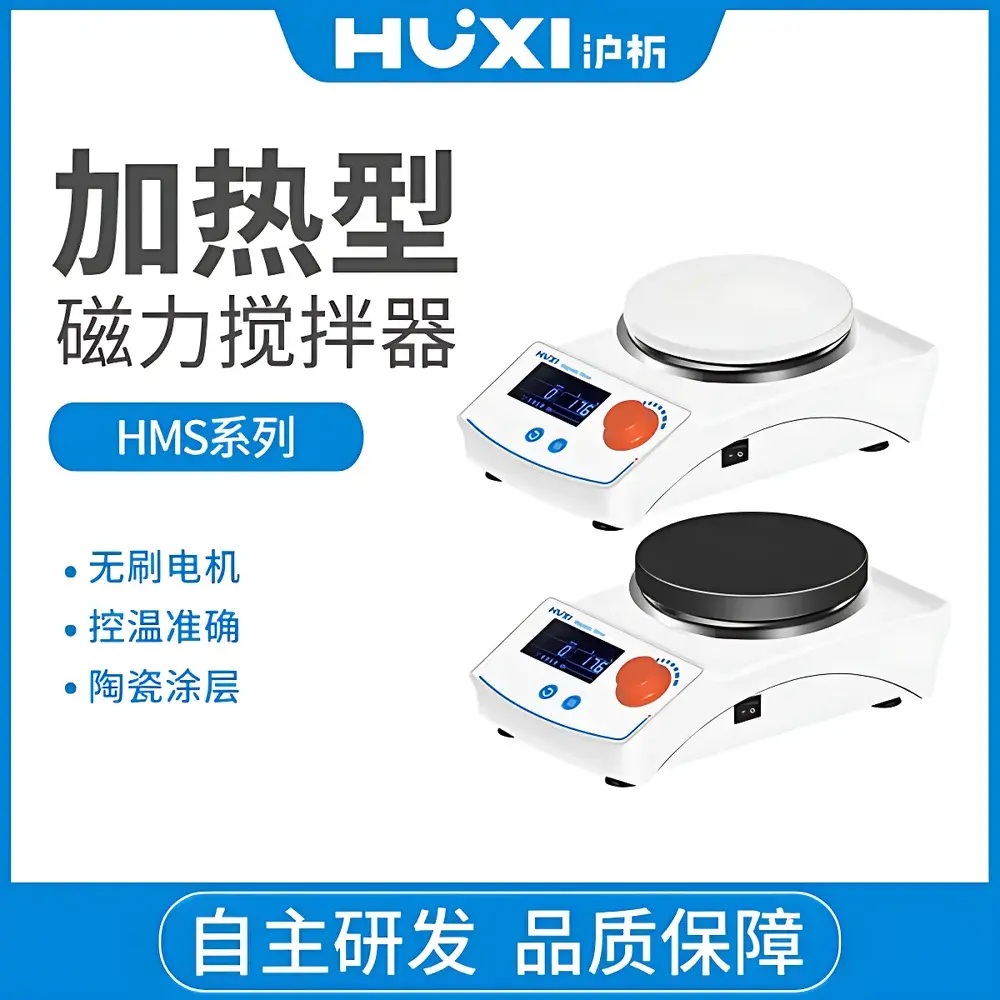
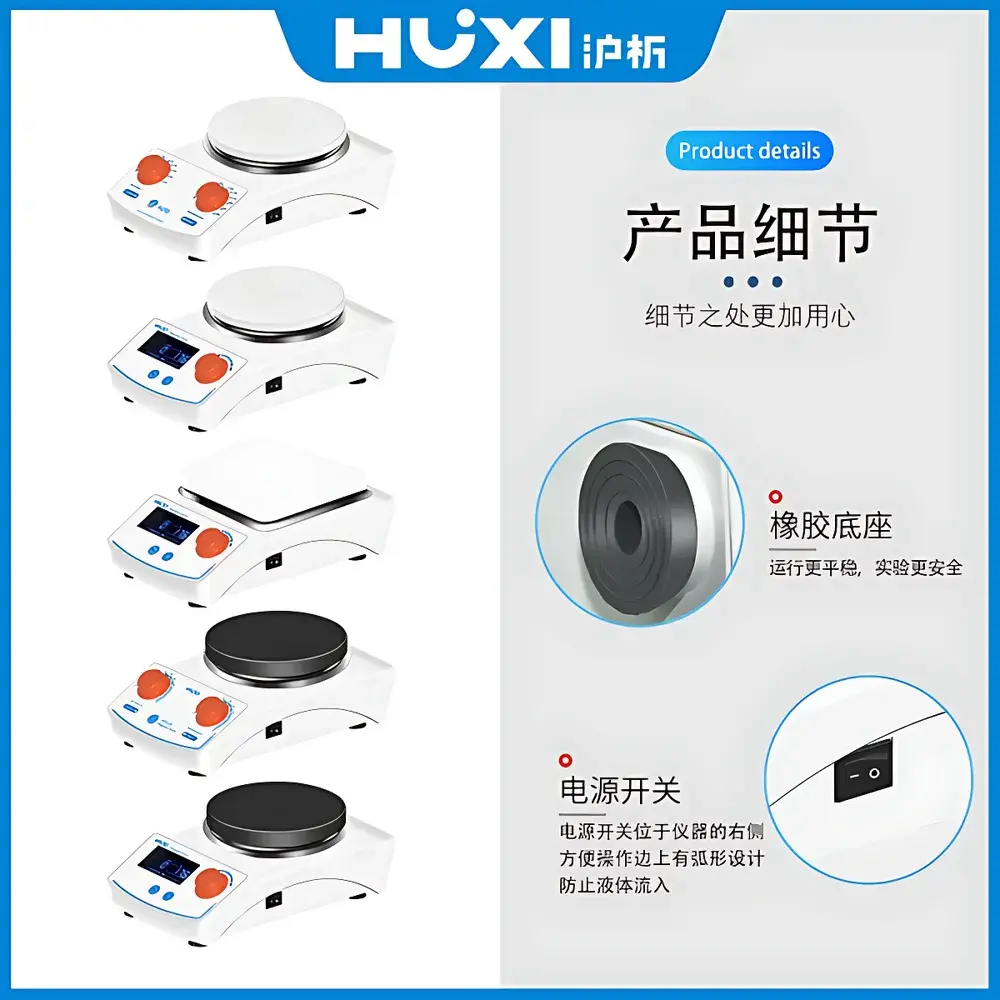
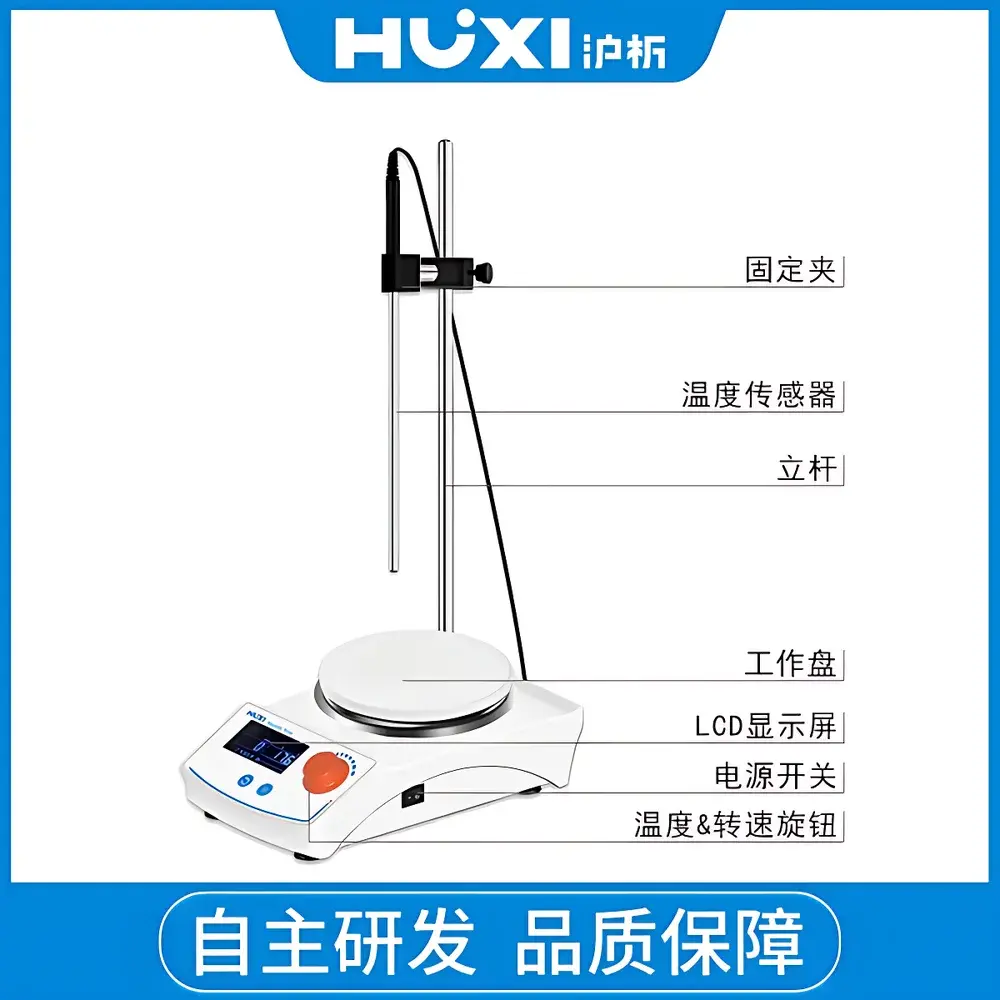
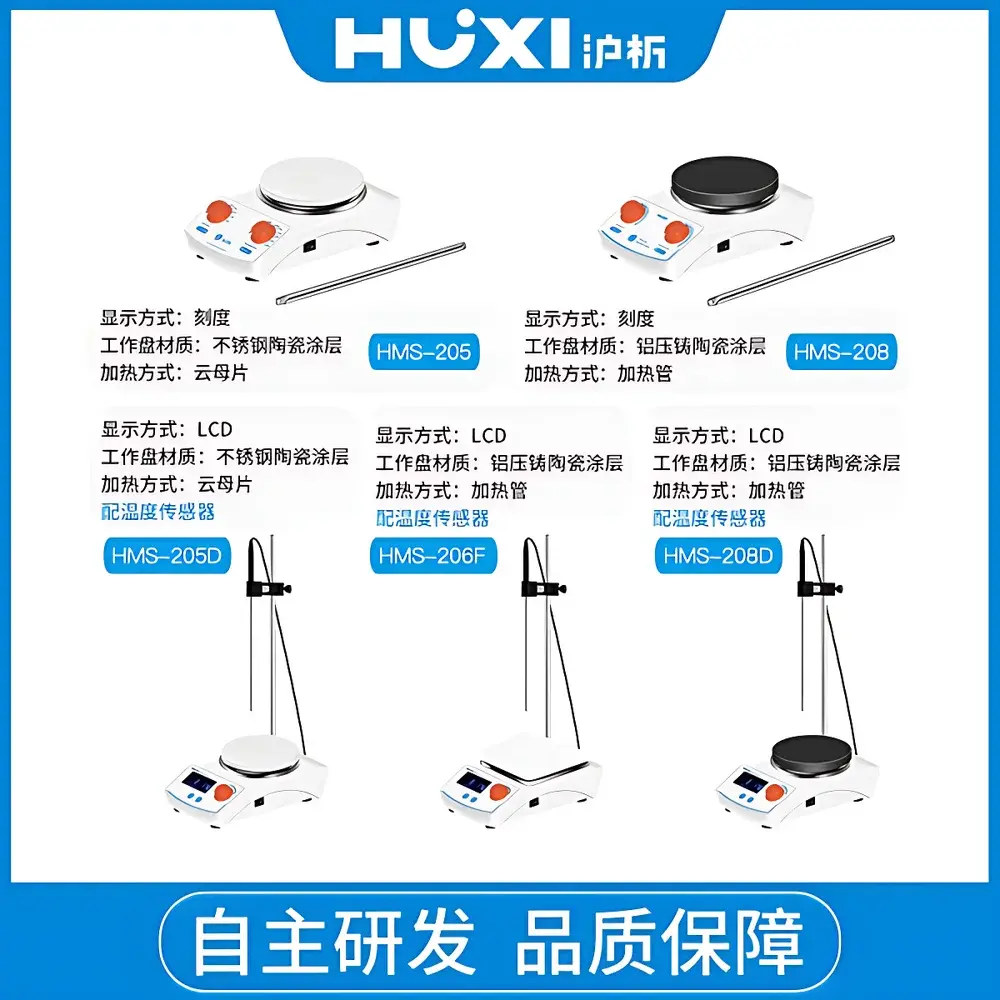
HUXI HMS-205D Heated Magnetic Stirrer
| Brand | HUXI |
|---|---|
| Origin | Shanghai, China |
| Manufacturer Type | Direct Manufacturer |
| Region of Origin | Domestic (China) |
| Model | HMS-205D |
| Instrument Type | Heated Magnetic Stirrer |
| Max. Stirring Volume | 20 L |
| Speed Range | 100–2000 rpm |
| Temperature Control Range | RT+5 to 350 °C |
| Heating Power | 550 W |
| Motor Output Power | 15 W |
| Total Power | 600 W |
| Hotplate Diameter | 145 mm |
| Plate Material | Stainless Steel with Ceramic Coating |
| Heating Element | Mica Sheet |
| Motor Type | Brushless DC Motor |
| Display | Backlit LCD |
| Temp. Resolution | 0.1 °C |
| Temp. Setpoint Accuracy | ±0.1 °C |
| Sensor-Based Temp. Accuracy (PT1000) | ±0.2 °C |
| System Temp. Control Accuracy | ±1 °C |
| Over-Temp Protection Threshold | ≤420 °C |
| Timer Range | 0–99 h 59 min |
| Stir Bar Length Compatibility | 20–80 mm |
| Ambient Operating Conditions | 5–40 °C, ≤80% RH |
| Dimensions (W×D×H) | 165 × 280 × 105 mm |
| Net Weight | 4 kg |
| Gross Weight | 5.4 kg |
Overview
The HUXI HMS-205D Heated Magnetic Stirrer is an engineered laboratory instrument designed for precise, simultaneous heating and magnetic stirring of liquid and low-viscosity heterogeneous mixtures. It operates on the principle of rotating magnetic fields generated by a brushless DC motor-driven internal magnet array, which couples with PTFE- or glass-coated stir bars placed within the vessel. Heat is delivered uniformly via a high-thermal-conductivity mica heating element beneath a chemically inert ceramic-coated stainless-steel hotplate. This dual-function architecture supports applications requiring thermal stability up to 350 °C and reproducible agitation across a wide speed range (100–2000 rpm), making it suitable for synthesis, dissolution testing, buffer preparation, and sample conditioning in analytical and quality control workflows.
Key Features
- Chemically resistant ceramic-coated stainless-steel hotplate — withstands exposure to acids, bases, and organic solvents without degradation or metal ion leaching
- Dual-loop heating control system — ensures uninterrupted thermal regulation even if one circuit fails, supporting unattended operation under GLP-compliant conditions
- Integrated PT1000 external temperature probe input — enables closed-loop feedback control with ±0.2 °C accuracy for critical thermal protocols
- Brushless DC motor — delivers quiet, vibration-minimized rotation with extended service life and minimal maintenance requirements
- Backlit LCD interface — displays real-time values for setpoint and actual temperature, rotational speed, elapsed time, and timer countdown
- Programmable timer (0–99 h 59 min) — supports timed endpoint experiments and automated shutdown for safety and protocol consistency
- Rotary knob with mechanical lock — prevents accidental parameter changes during active operation
- Sealed aluminum housing with IP-rated insulation — protects internal electronics from moisture, vapors, and incidental spills in shared lab environments
- Over-temperature cutoff at ≤420 °C — provides hardware-level thermal fail-safe independent of software control
Sample Compatibility & Compliance
The HMS-205D accommodates standard laboratory glassware (e.g., beakers, flasks, and reaction vessels) up to 20 L capacity when used with appropriately sized stir bars (20–80 mm). Its ceramic-coated surface and non-reactive heating design ensure compatibility with aqueous solutions, polar organics (e.g., ethanol, acetone), and mild corrosives (e.g., diluted HCl, NaOH). While not certified to IEC 61010-1 or UL 61010-1 out-of-box, the unit conforms to essential safety principles aligned with ISO/IEC 17025 laboratory infrastructure requirements. Its stable thermal output and repeatable speed control support method validation per ASTM E2912 (Standard Guide for Validation of Thermal Analysis Instruments) and routine calibration traceable to NIST-traceable reference standards.
Software & Data Management
The HMS-205D operates as a standalone analog-digital hybrid instrument with no embedded firmware-based data logging or network connectivity. All operational parameters are configured and monitored locally via the front-panel LCD. For laboratories implementing electronic recordkeeping under FDA 21 CFR Part 11 or EU Annex 11, users may integrate the device into validated workflows using external data acquisition systems—such as USB-connected thermocouple loggers or programmable PLCs—that capture timestamped temperature and timer outputs. The instrument’s stable analog control loops and mechanical locking interface reduce risk of unintended parameter drift, supporting audit-ready documentation of experimental conditions.
Applications
- Preparation of standardized buffers and reagent solutions in QC labs
- Controlled heating and mixing during polymer dissolution or catalyst activation
- Temperature-dependent solubility studies (e.g., USP dissolution apparatus auxiliary use)
- Pre-analytical sample homogenization prior to HPLC, ICP-MS, or titration
- Small-scale reaction monitoring where constant agitation and thermal ramping are required
- Calibration of temperature probes and viscosity standards in metrology labs
FAQ
What is the maximum recommended vessel size for optimal stirring performance?
For consistent vortex formation and thermal uniformity, use vessels with diameters ≤120 mm when operating at full 20 L capacity; smaller volumes (≤5 L) allow broader geometry flexibility.
Can the HMS-205D be used with conductive or ferromagnetic stir bars?
No — only PTFE-, glass-, or ceramic-coated magnetic stir bars are compatible; ferromagnetic or metallic-core bars may demagnetize or overheat under prolonged 350 °C operation.
Is external temperature feedback mandatory for achieving ±0.2 °C accuracy?
Yes — the stated ±0.2 °C sensor-based accuracy requires connection and proper immersion of the supplied PT1000 probe; plate-surface readings alone achieve ±1 °C system accuracy.
Does the instrument support continuous operation beyond 24 hours?
Yes — the dual heating loop and thermal cutoff enable unattended multi-day runs, provided ambient conditions remain within 5–40 °C and relative humidity stays below 80 % RH.
How often should the ceramic coating be inspected for integrity?
Visually inspect before each use for microcracks or chipping; recoating is not field-serviceable — contact HUXI technical support if corrosion resistance is compromised.
Related Products



