
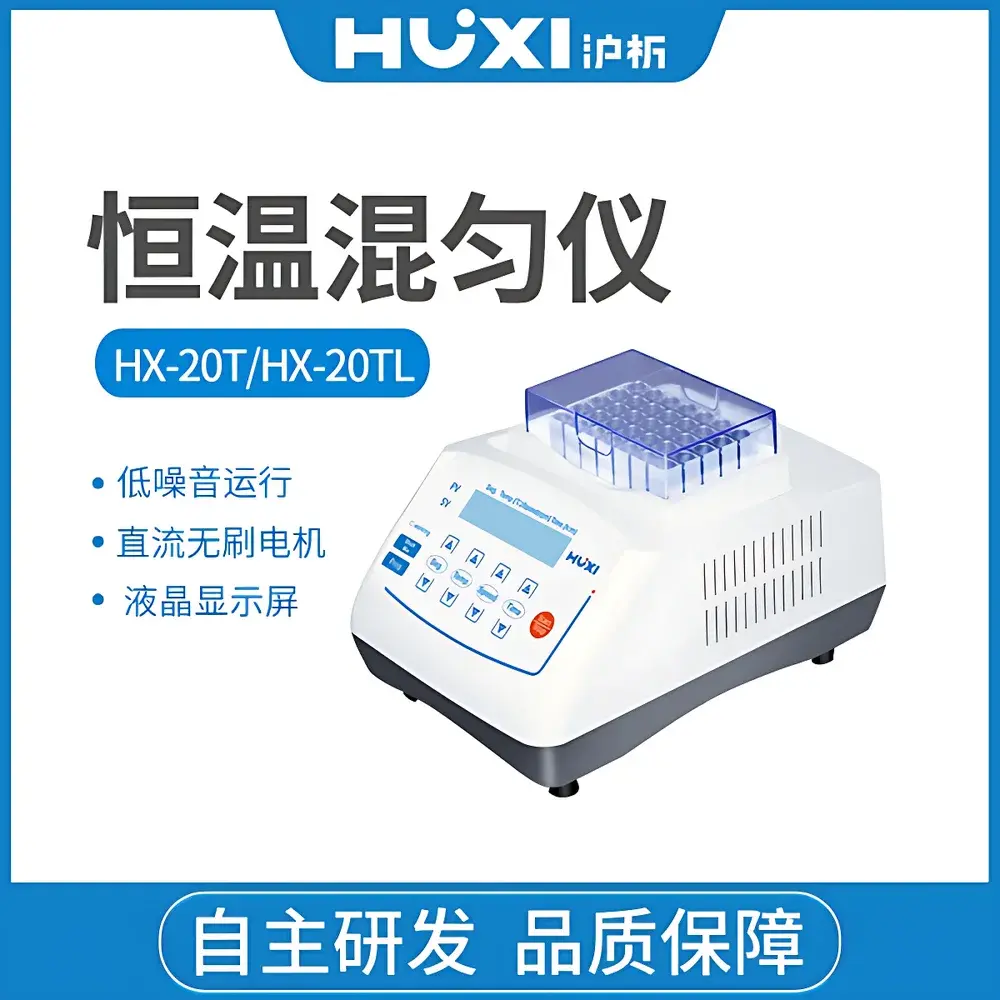
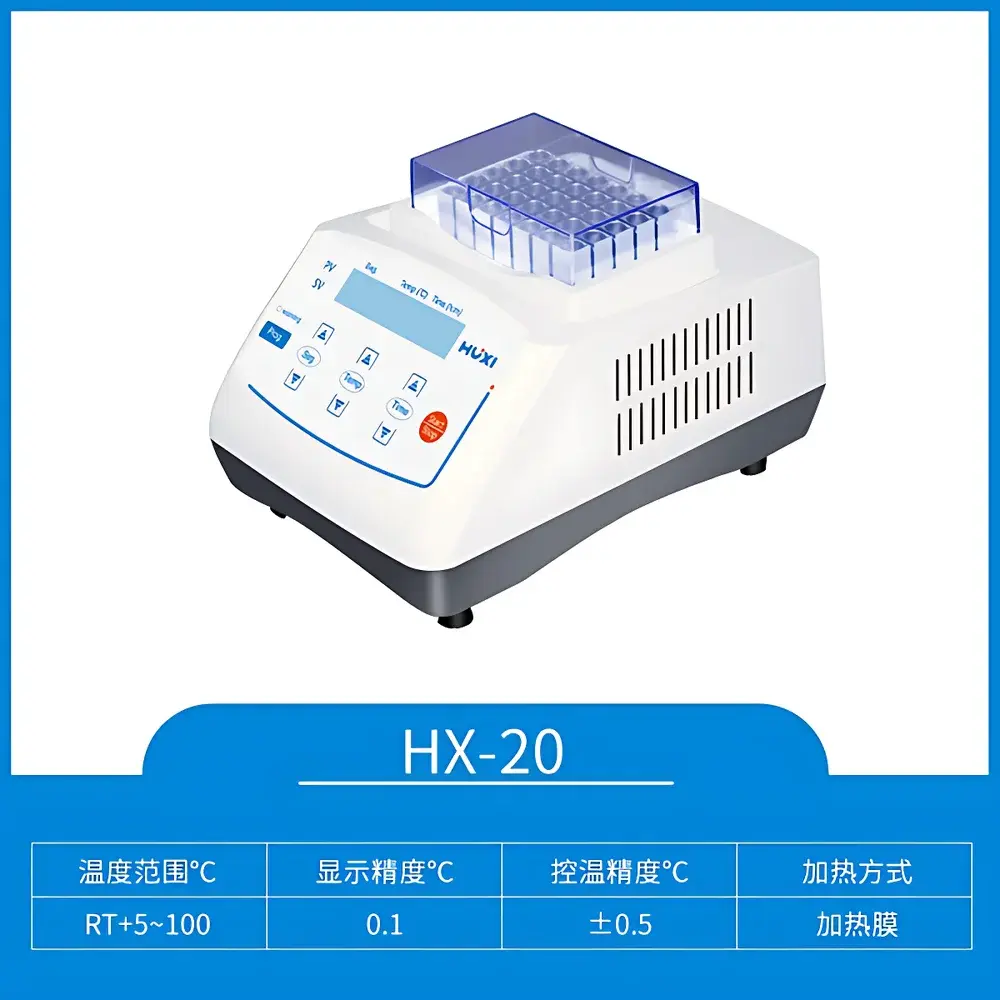
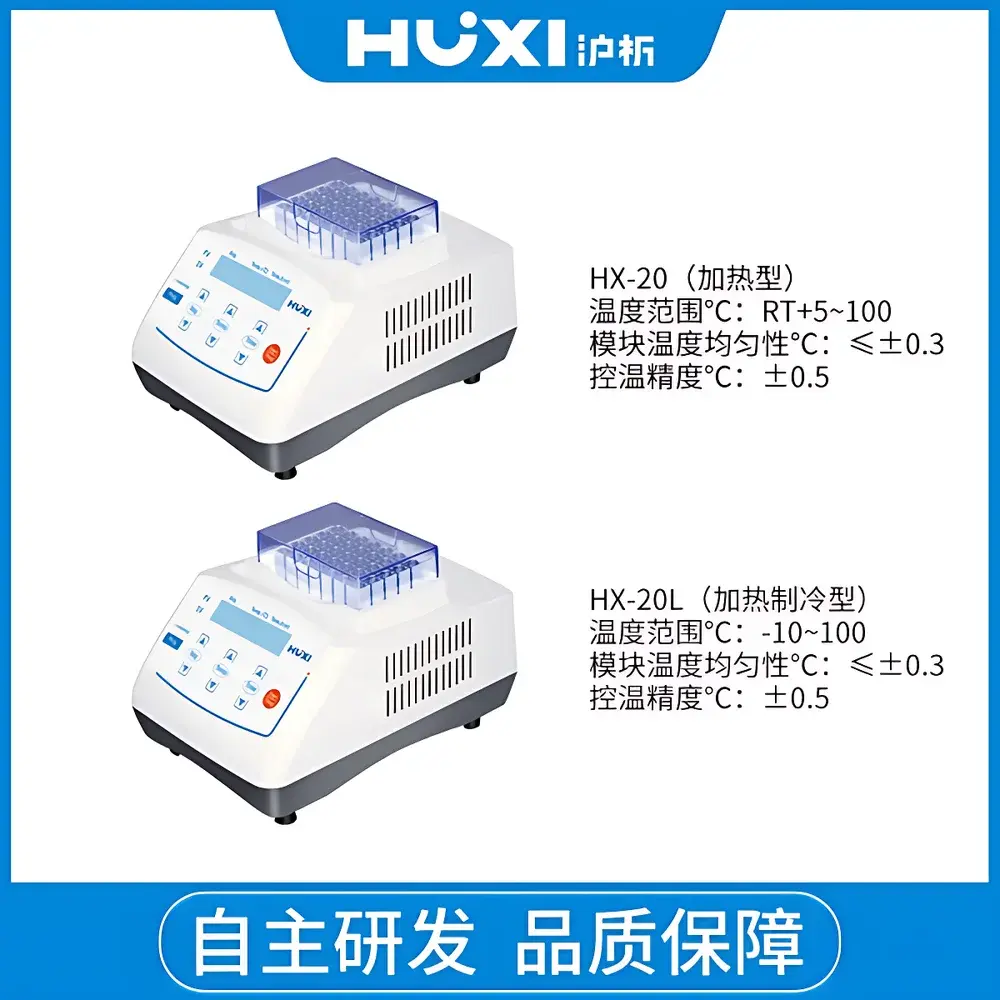
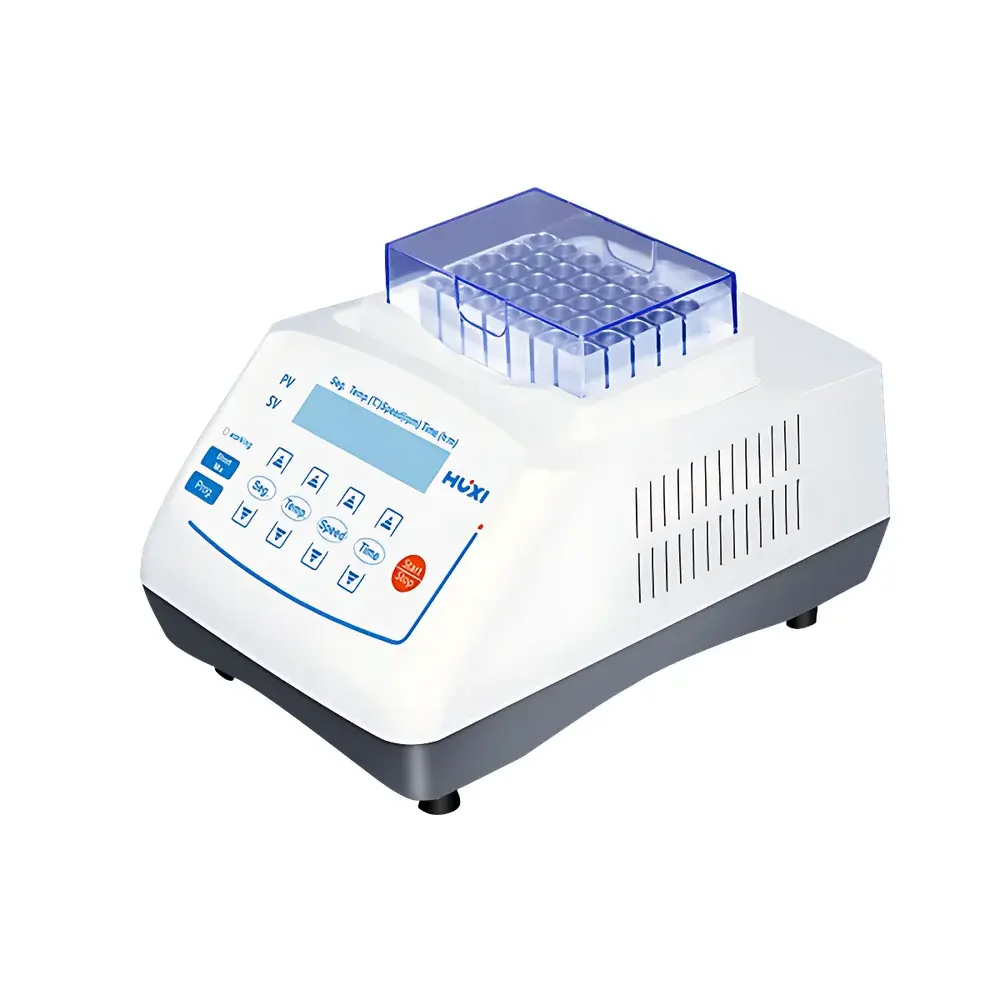
HUXI HX-20 Intelligent Thermomixer Metal Block Heater
| Brand | HUXI |
|---|---|
| Origin | Shanghai, China |
| Manufacturer Type | Direct Manufacturer |
| Model | HX-20 |
| Temperature Range | RT+5°C to 100°C |
| Temperature Accuracy | ±0.5°C |
| Heating Time | ≤15 min (20°C to 100°C) |
| Dimensions | 270 × 190 × 190 mm |
| Net Weight | 7 kg |
| Display Resolution | 0.1°C |
| Block Uniformity | ≤±0.3°C |
| Timer Range | 1 min – 100 h |
| Programmable Steps | Up to 5 temperature/time segments |
| Power Supply | AC 220 V / 120 V, 50 / 60 Hz |
| Rated Power | 150 W |
| Standard Module | 35-position × 2.0 mL |
| Safety | Built-in overtemperature protection, self-diagnostic fault detection with audible alarm, temperature offset calibration function |
Overview
The HUXI HX-20 Intelligent Thermomixer Metal Block Heater is a precision-engineered laboratory instrument designed for simultaneous temperature control and orbital mixing of small-volume samples in standardized tubes. It operates on resistive heating via an integrated aluminum alloy heating block, combined with a brushless DC motor-driven oscillating platform to deliver consistent, low-shear agitation. Unlike water baths or dry baths without mixing capability, the HX-20 integrates Peltier-free thermal regulation with programmable shaking—enabling uniform heat transfer and homogenization critical for enzymatic reactions, nucleic acid denaturation, PCR setup, serum coagulation assays, and protein stability studies. Its compact benchtop architecture and modular block design support rapid method transfer and cross-lab reproducibility under routine QC/QA workflows.
Key Features
- Microprocessor-based PID temperature control with real-time display of current temperature and countdown timer on a high-contrast blue LCD screen
- Touch-sensitive interface supporting intuitive navigation and parameter entry without mechanical buttons
- Multi-step programmability: up to five sequential temperature setpoints with independent dwell times (1 minute to 100 hours per step), enabling complex thermal protocols such as gradient denaturation or stepwise enzyme activation
- Aluminum heating block with surface-anodized finish ensures rapid thermal response, minimal cross-contamination risk, and compatibility with common lab disinfectants (e.g., 70% ethanol, 0.5% sodium hypochlorite)
- Interchangeable module system—including standard 35 × 2.0 mL configuration—with optional configurations (A–N) accommodating 0.2 mL, 0.5 mL, 1.5 mL, 5 mL, and 15 mL tubes, as well as PCR strips and deep-well plates
- Digital temperature offset calibration function allows user-adjusted correction against NIST-traceable reference thermometers
- Comprehensive safety architecture: dual redundant thermal cutoffs, automatic fault detection, audible alarm activation upon sensor failure or overheating, and fuse-protected power input (250 V, 3 A, Φ5 × 20 mm)
Sample Compatibility & Compliance
The HX-20 accommodates a wide range of sample containers including microcentrifuge tubes (0.2–15 mL), PCR strips, and 96-well plates when used with appropriate modules. Its block geometry ensures uniform thermal distribution across all positions (≤±0.3°C variation at 37°C and 95°C), meeting internal validation requirements for assay consistency. While not certified to ISO/IEC 17025 or ASTM E2876 for metrological traceability, the device supports GLP-compliant documentation through external data logging interfaces. Its temperature accuracy (±0.5°C) and repeatability align with common pharmacopeial standards referenced in USP Analytical Instrument Qualification and EP 2.2.45 Thermal Validation Protocols.
Software & Data Management
The HX-20 operates as a standalone instrument with no proprietary software dependency. All operational parameters—including setpoint, ramp rate, hold time, and mixing speed—are configured directly via the front-panel interface. For laboratories requiring electronic record retention, optional RS-232 or USB-to-serial adapters enable integration with third-party LIMS or ELN platforms using ASCII-based command protocols. Audit trail functionality is maintained externally; the unit itself provides timestamped event logs only for critical faults (e.g., overtemperature, sensor open-circuit). No FDA 21 CFR Part 11 compliance features are embedded, but its deterministic behavior and manual calibration log support retrospective verification during GMP audits.
Applications
- Pre-incubation of restriction digests and ligase reactions at precise temperatures (e.g., 37°C, 16°C)
- Thermal denaturation of DNA prior to hybridization or sequencing library prep
- Controlled coagulation of serum or plasma samples for clinical chemistry analysis
- Equilibration of reagents and standards in immunoassay workflows
- Cell lysis enhancement in combination with chemical or enzymatic buffers
- Routine maintenance of enzyme stocks at storage temperatures (e.g., −20°C pre-chill followed by controlled thawing at 4°C or 25°C)
- Accelerated stability testing of biologics under defined thermal stress conditions
FAQ
What tube formats are supported out-of-the-box?
The HX-20 ships with a 35-position × 2.0 mL aluminum module. Additional modules (A–N) are available separately for 0.2 mL PCR tubes, 15 mL conical tubes, 96-well plates, and other configurations.
Can the mixing speed be adjusted independently from temperature?
No—the HX-20 provides fixed-speed orbital shaking optimized for 2.0 mL tube agitation. Speed is not user-variable but is engineered to minimize foaming and splashing while ensuring homogeneous suspension.
Is the unit compatible with 120 V / 60 Hz power supplies?
Yes—dual-voltage auto-switching power input (AC 220 V / 120 V, 50 / 60 Hz) enables global deployment without external transformers.
Does the device support continuous operation beyond 100 hours?
The maximum timer setting is 100 hours per segment; however, multi-step programming allows chained execution across five segments, effectively supporting extended unattended runs.
How is temperature uniformity validated across the block?
Uniformity is specified as ≤±0.3°C at steady state (per ICH Q5C guidance), verified using calibrated PT100 probes placed in corner and center positions of the loaded module under typical operating conditions (e.g., 37°C, 95°C).



