
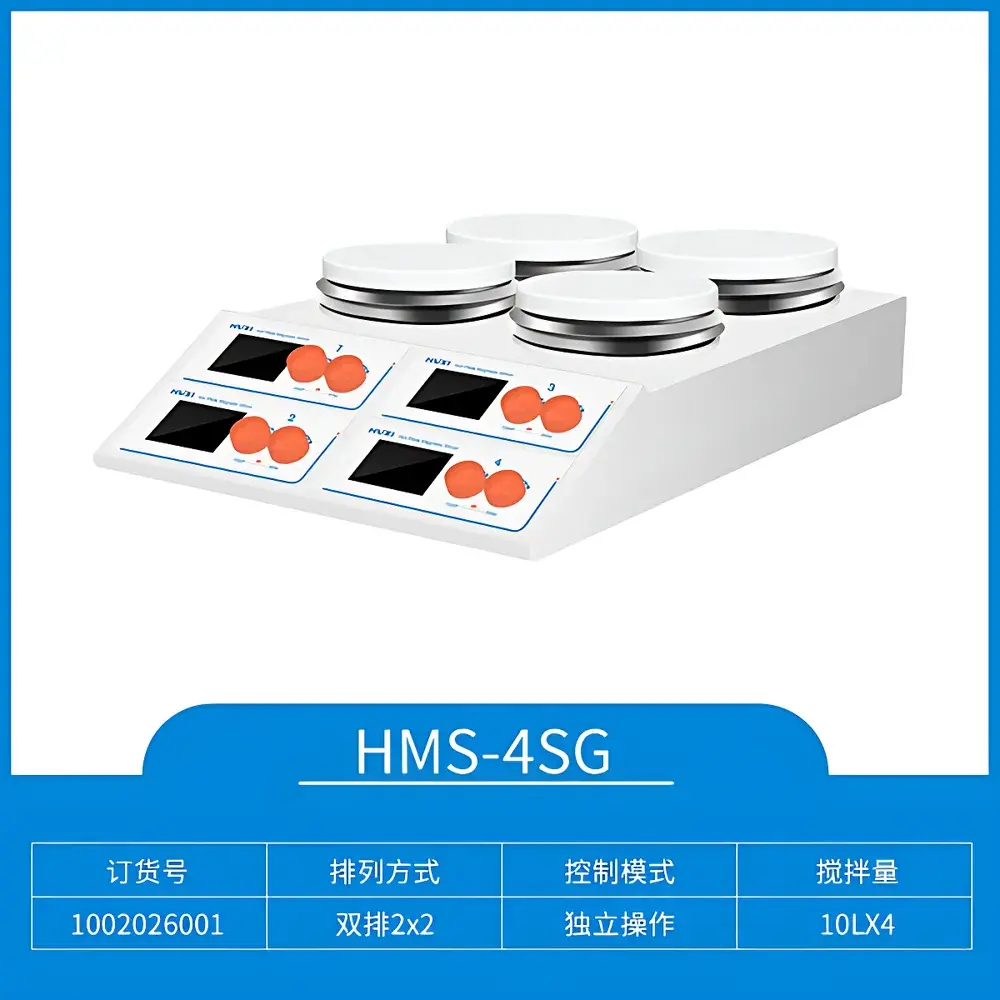
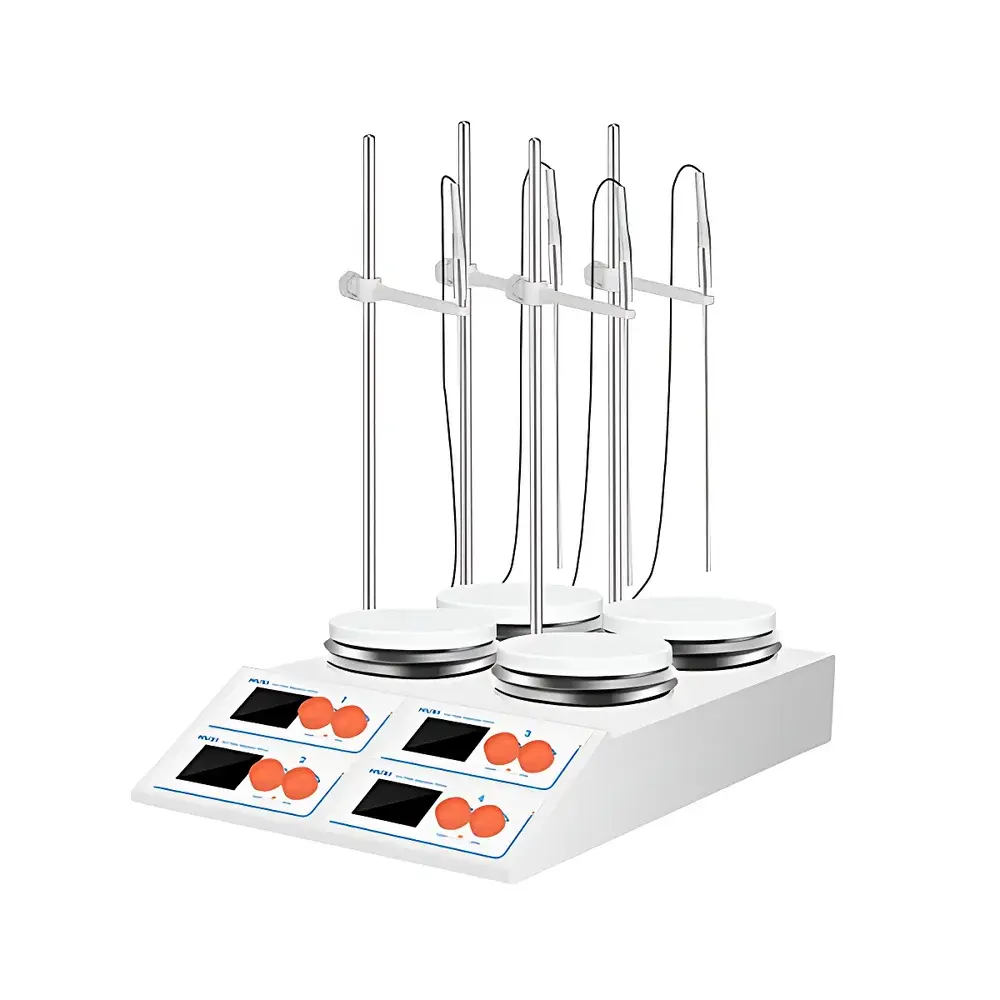
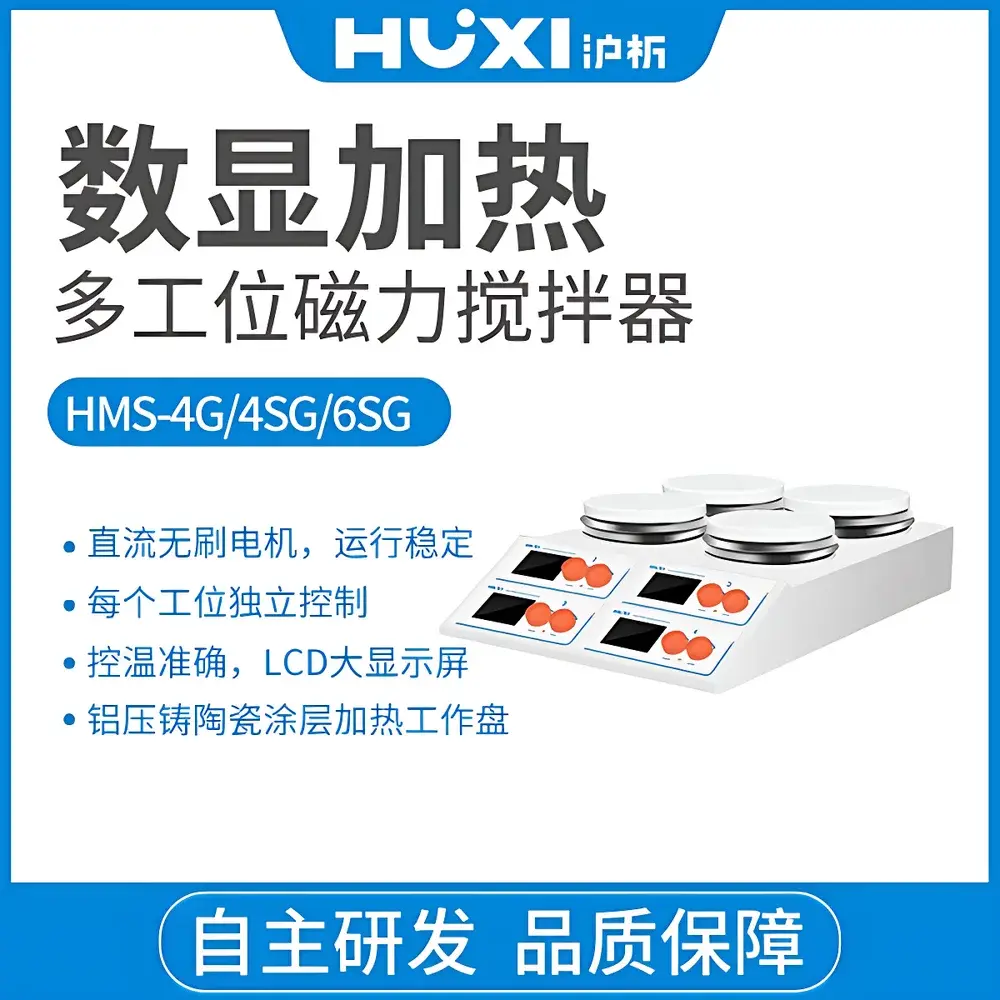
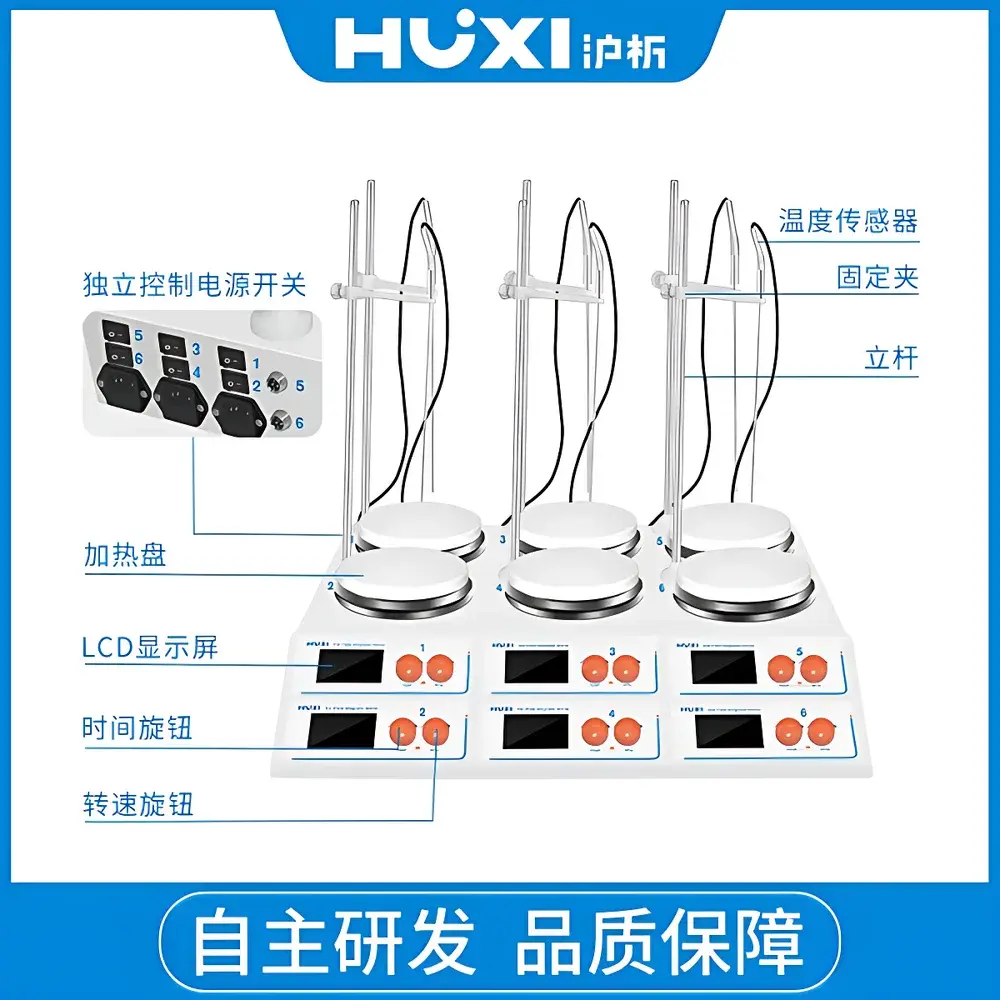
HUXI HMS-4SG Four-Position Heated Magnetic Stirrer
| Brand | HUXI |
|---|---|
| Origin | Shanghai, China |
| Manufacturer Type | Direct Manufacturer |
| Product Category | Domestic (China-Made) |
| Model | HMS-4SG |
| Instrument Type | Magnetic Stirrer |
| Max. Stirring Volume | 10 L × 4 |
| Speed Range | 50–2000 rpm |
| Temperature Control Range | RT + 5 °C to 160 °C |
| Temperature Accuracy | ±1 °C |
| Heating Plate Max. Surface Temp. | ≤320 °C |
| Heating Plate Diameter | 135 mm |
| Center-to-Center Spacing Between Positions | 175 mm |
| Panel Tilt Angle | <30° |
| Power Supply | AC 220 V, 50/60 Hz |
| Noise Level | ≤27 dB(A) |
| Single-Position Motor Power | 10 W |
| Single-Position Heater Power | 350 W |
| Operating Ambient Temp. | 5–40 °C |
| Max. Relative Humidity | 80 % RH |
| Dimensions (W×D×H) | 539 × 363 × 121 mm |
| Net Weight | 10 kg |
| Gross Weight | 14.3 kg |
| Timer Range | 0–9999 min |
| Display | LCD (Temperature & Speed) |
| Control Algorithm | PID with Auto-Tuning |
| Sensor Type | PT100 |
| Enclosure | Metal-stamped + injection-molded thermally resistant polymer |
| Heating Surface | Aluminum die-cast with ceramic coating |
| Included Stir Bars | A-type (9×25×4 mm), C-type (7×25×4 mm), C-type (8×45×4 mm) |
Overview
The HUXI HMS-4SG is a four-position heated magnetic stirrer engineered for precision, reproducibility, and operational flexibility in routine and research-grade laboratory environments. It operates on the principle of magnetic coupling—rotating a magnetic stir bar immersed in a sample via a rotating magnetic field generated beneath a thermally stable ceramic-coated aluminum heating plate. Each of the four independently controllable stations integrates a brushless DC motor and a resistive heating element, enabling simultaneous yet distinct control of stirring speed (50–2000 rpm) and temperature (RT + 5 °C to 160 °C) across multiple vessels. Designed for applications requiring uniform thermal distribution and low mechanical noise, the HMS-4SG features a 135 mm diameter heating surface with optimized heat conduction geometry and a maximum plate surface temperature of 320 °C—supporting rapid ramp-up and stable thermal equilibrium. Its structural architecture prioritizes long-term reliability: the enclosure combines metal stamping with high-temperature-resistant injection-molded polymer, ensuring electrical insulation, corrosion resistance, and mechanical integrity under continuous operation.
Key Features
- Four independent stirring/heating stations with individual speed and temperature controls—enabling parallel processing of up to four dissimilar samples under differentiated experimental conditions.
- Brushless DC motors per station deliver consistent torque output across the full speed range (50–2000 rpm), with low acoustic emission (≤27 dB[A]) and no scheduled maintenance requirements.
- PID temperature control algorithm with auto-tuning capability ensures minimal overshoot and high thermal stability (±1 °C accuracy), validated using integrated PT100 platinum resistance sensors.
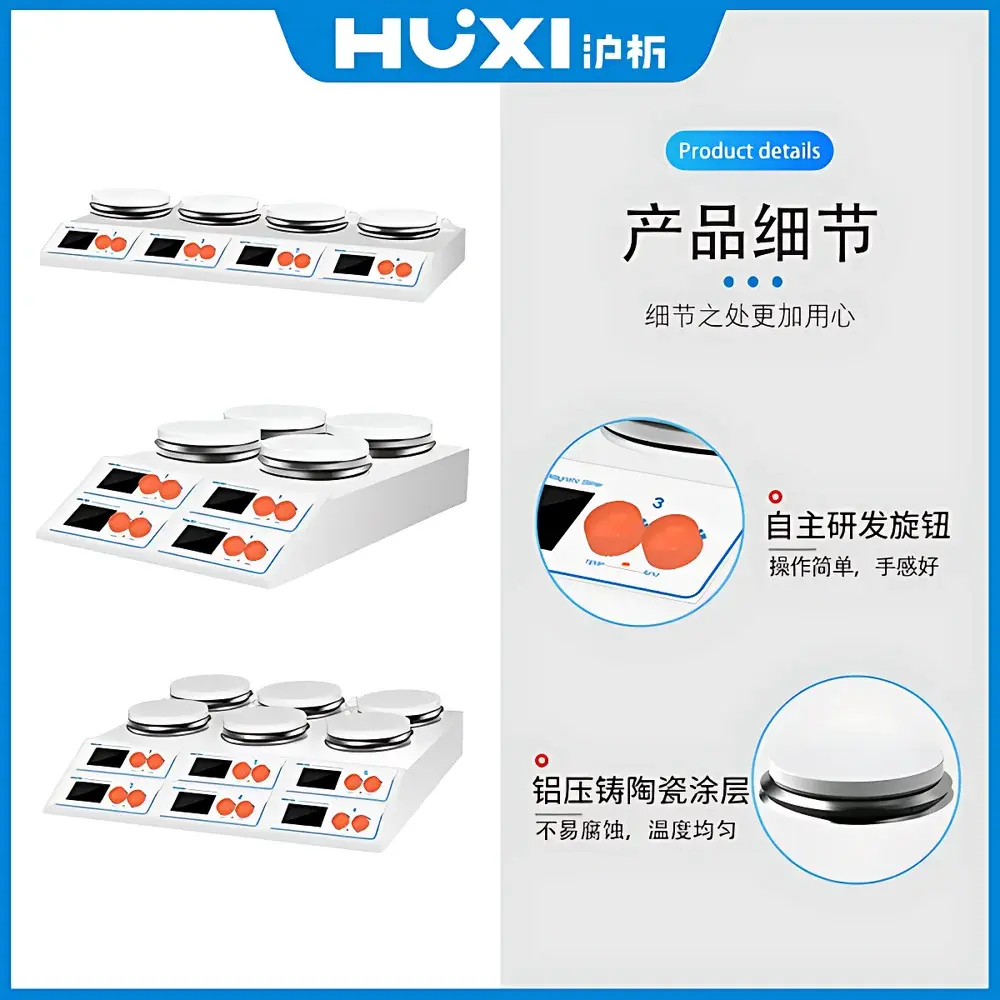
- Aluminum die-cast heating plate with ceramic coating offers exceptional chemical resistance, uniform heat distribution, and extended service life—even during prolonged exposure to acidic, alkaline, or organic solvents.
- Ergonomically tilted control panel (<30° angle) supports both seated and standing operator postures, reducing visual fatigue during extended monitoring sessions.
- Rotary waterproof control knobs provide tactile feedback and enhanced safety in humid or splash-prone lab environments.
- LCD display shows real-time values for speed (rpm) and temperature (°C) at each active station, with intuitive navigation and parameter lockout options to prevent accidental setting changes.
- Programmable timer (0–9999 minutes) supports unattended operation for extended reaction protocols, with automatic shutdown upon completion.
Sample Compatibility & Compliance
The HMS-4SG accommodates standard laboratory glassware including beakers (up to 1000 mL), Erlenmeyer flasks, and round-bottom flasks—compatible with common magnetic stir bars (A-type and C-type configurations supplied). Its design conforms to IEC 61010-1:2010 for electrical safety in laboratory equipment and meets CE marking requirements for electromagnetic compatibility (EMC Directive 2014/30/EU). While not certified for use in explosion-proof or Class I Div 1 hazardous locations, it is suitable for general-purpose chemical synthesis, buffer preparation, dissolution testing, and quality control workflows conducted under ISO/IEC 17025-accredited laboratories. The instrument’s construction materials and thermal management comply with RoHS 2011/65/EU restrictions on hazardous substances.
Software & Data Management
The HMS-4SG operates as a standalone analog-digital hybrid instrument without proprietary software or PC connectivity. All operational parameters—including setpoints, actual readings, timer status, and error codes—are displayed locally via the integrated LCD interface. No data logging, remote access, or electronic record-keeping functionality is included; however, its stable analog control architecture ensures immunity to network latency, firmware corruption, or cybersecurity vulnerabilities. For laboratories operating under GLP or GMP frameworks, manual logbook entries remain the recommended method for documenting run conditions, consistent with FDA 21 CFR Part 11 guidance for non-electronic records. Optional external USB data loggers may be interfaced via analog voltage outputs (if available on custom-configured units), though such integration falls outside standard specifications.
Applications
This system is routinely deployed in pharmaceutical QC labs for dissolution profile development, in environmental testing facilities for heavy metal extraction and digestions, and in academic chemistry departments for multi-variable kinetic studies. Its precise thermal control supports enzyme activity assays requiring strict temperature consistency across replicates, while its quadruple configuration accelerates method optimization in formulation development (e.g., polymer solubilization, nanoparticle dispersion, or emulsion stabilization). In clinical microbiology labs, it facilitates uniform media preparation and antibiotic susceptibility testing protocols. The unit also serves industrial R&D settings—particularly petrochemical and coatings laboratories—where controlled heating and mixing of viscous or temperature-sensitive formulations are critical.
FAQ
Is the HMS-4SG compatible with corrosive reagents such as concentrated HCl or NaOH?
Yes—the ceramic-coated aluminum heating plate and sealed control electronics provide robust resistance to incidental splashes and vapors from common inorganic acids and bases. However, prolonged direct contact with strong oxidizers (e.g., fuming nitric acid) is not recommended.
Can the stirrer maintain temperature stability during overnight runs?
With proper thermal insulation of vessels and appropriate stir bar sizing, the PID-controlled system achieves ±1 °C stability over extended durations; ambient drafts and vessel geometry remain primary variables affecting performance.
What is the maximum recommended viscosity for reliable stirring at 2000 rpm?
For optimal coupling efficiency and motor longevity, the unit is rated for aqueous and low-to-medium viscosity solutions (up to ~500 mPa·s); higher viscosities require lower speeds and larger stir bars.
Are calibration certificates provided with the instrument?
No factory-issued calibration certificate is included; users are advised to perform periodic verification using NIST-traceable thermometers and tachometers per internal SOPs.
Does the HMS-4SG support external temperature probes for sample-in-vessel monitoring?
No—temperature sensing is limited to the heating plate surface via embedded PT100. For solution-phase temperature validation, external digital thermometers must be used separately.
Related Products



