
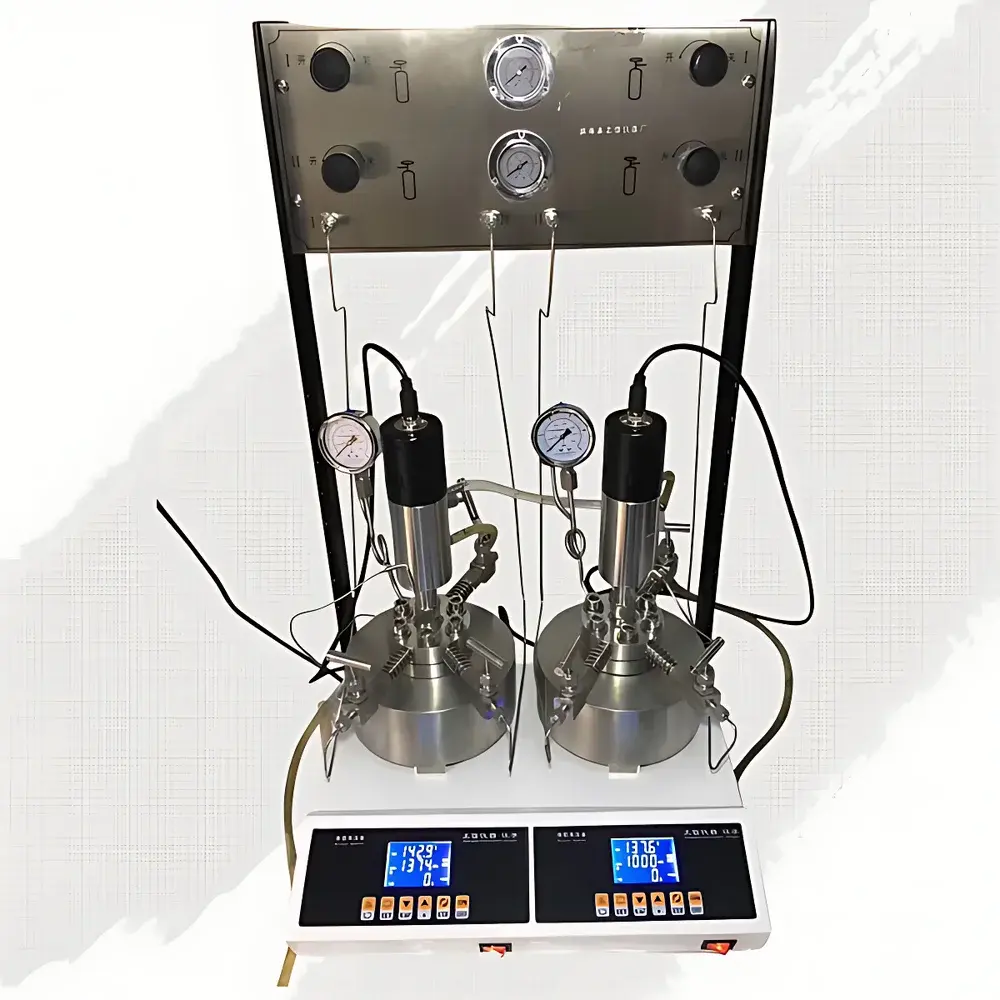
K-PSA-150ML High-Pressure Laboratory Reactor by ZXYIQI
| Brand | ZXYIQI |
|---|---|
| Origin | Jiangsu, China |
| Manufacturer Type | Authorized Distributor |
| Origin Category | Domestic |
| Model | K-PSA-150ML |
| Price | ¥46,000 |
| Usable Volume | 150 mL (Small-scale) |
| Construction Material | Stainless Steel (304/316L standard) |
| Operating Pressure Range | Low-to-Medium Pressure (up to 30 MPa, per series specification) |
| Vacuum Capability | ≤ –0.1 MPa (gauge) |
| Heating Power | 0–2500 W |
| Temperature Range | 0–600 °C |
| Stirring Speed | 0–400 rpm |
| Motor | Brushless DC, 100 W |
| Sealing Options | Soft (PTFE/Gasket) or Hard (Metal-to-Metal) |
| Safety Features | Overpressure rupture disc (Hastelloy), overtemperature/over-time alarm, automatic pressure relief |
| Control System | Dual-loop PID temperature control, programmable ramp-soak profiles (optional), real-time data logging |
Overview
The K-PSA-150ML High-Pressure Laboratory Reactor is a precision-engineered, benchtop-scale reaction system designed for controlled synthesis under elevated temperature and pressure conditions. Built upon the proven K-2-PS parallel reactor platform—co-developed with Chinese research universities over more than a decade—the K-PSA variant integrates robust mechanical design with intelligent process control to support reproducible small-batch experimentation. Its core operating principle relies on sealed, stirred batch reaction kinetics within a rigid, CNC-machined stainless steel vessel, enabling precise regulation of thermal, pressure, and agitation parameters. This architecture supports gas–liquid, solid–liquid, and heterogeneous catalytic reactions where inert atmosphere integrity, thermal uniformity, and mechanical stability are critical—such as hydrogenation, polymerization, supercritical fluid synthesis, and high-temperature catalytic screening.
Key Features
- Monolithic Vessel Construction: The reactor body is fabricated from a single billet of 304 or 316L stainless steel using high-precision CNC machining—eliminating weld seams and ensuring structural homogeneity and leak integrity.
- Quick-Release Clamp Locking System: A six-point torque-balanced clamp mechanism enables rapid, tool-free separation of lid and vessel, minimizing handling time during sample loading/unloading while maintaining repeatable sealing force distribution.
- Dual-Mode Sealing Architecture: Configurable soft-seal (PTFE/gasket-based) or hard-seal (metal-to-metal) interfaces accommodate diverse chemical compatibility requirements—from aggressive halogenated solvents to high-temperature anhydrous environments.
- Integrated Safety Protections: Equipped with a certified Hastelloy C-276 rupture disc, real-time overpressure venting, dual-stage overtemperature cutoff, and programmable time-limited operation to meet GLP-aligned lab safety protocols.
- High-Torque Stirring System: Brushless DC motor (100 W) delivers up to 40 kg·cm torque at 0–400 rpm, enabling homogeneous mixing of highly viscous media—including polymer melts, slurries, and paste-phase catalysts—without stalling or thermal drift.
- Modular Thermal Management: Fully enclosed, embedded heating module with PID-controlled dual-loop thermoregulation ensures ±1 °C stability across 0–600 °C; optional programmable ramp/soak profiles support kinetic studies and multi-step syntheses.
Sample Compatibility & Compliance
The K-PSA-150ML is compatible with a broad range of reactive systems, including but not limited to hydrogenation under H₂ (≤30 MPa), oxidation under O₂ or air, inert-gas–purged coupling reactions (e.g., Suzuki, Heck), hydrothermal crystallization, and solvent-free mechanochemical transformations. Vessel materials extend beyond standard 304/316L to include 310S, 904L, Hastelloy B/C, and titanium alloys—enabling use with corrosive reagents such as HF, molten alkalis, or chlorinated intermediates. All pressure-bearing components conform to GB/T 150 (Chinese equivalent of ASME BPVC Section VIII Div. 1), and the rupture disc assembly complies with ISO 4126-2 for pressure relief devices. While not certified to FDA 21 CFR Part 11 out-of-the-box, audit-ready data logs (timestamped temp/pressure/stir speed) can be exported in CSV format for internal GxP documentation.
Software & Data Management
The reactor operates via an integrated digital controller with backlit LCD interface supporting manual setpoint entry or preloaded multi-step programs. Real-time parameters—including jacket temperature, internal thermocouple reading (K-type, 316L-sheathed, Φ2.0 mm), absolute pressure (digital gauge, 0.1% FS accuracy), and stir speed—are continuously displayed and logged at user-selectable intervals (1 s to 60 min). Data export is supported via USB port to standard spreadsheet formats. Optional RS485/Modbus RTU communication enables integration into centralized lab automation networks (e.g., LabArchives, DeltaV, or custom SCADA). All control firmware implements write-protected parameter storage and session-based audit trails—facilitating compliance with ISO/IEC 17025 clause 7.7 (data integrity) and internal QA review procedures.
Applications
- Catalytic screening for heterogeneous hydrogenation, CO₂ hydrogenation to methanol, and Fischer–Tropsch model reactions
- High-temperature polymerization of polyimides, polyesters, and conductive polymers under nitrogen or argon
- Supercritical fluid processing (e.g., scCO₂ extraction, nanoparticle precipitation)
- Hydrothermal synthesis of MOFs, perovskites, and transition metal oxides
- Pharmaceutical intermediate synthesis under strict stoichiometric and thermal control (e.g., nitration, sulfonation, halogen exchange)
- Corrosion testing of alloy candidates in simulated geothermal or flue-gas desulfurization environments
FAQ
What is the maximum allowable working pressure for the K-PSA-150ML?
The reactor is rated for up to 30 MPa (4350 psi) at 200 °C when equipped with appropriate hard-seal configuration and Hastelloy rupture disc—per ASME-compliant validation testing conducted on the broader K-2-PS platform.
Can the reactor be operated under vacuum prior to pressurization?
Yes. The system achieves ≤ –0.1 MPa (absolute ~0.01 bar) using integrated vacuum-compatible valves and PTFE-sealed fittings, enabling degassing, solvent removal, or inert-purge cycling before introducing reactive gases.
Is third-party calibration documentation available for temperature and pressure sensors?
Factory calibration certificates (traceable to NIM, China) are provided for K-type thermocouples and digital pressure transducers; on-site recalibration services are available through authorized ZXYIQI service partners in Asia-Pacific regions.
How is stirring torque maintained at high-viscosity conditions without motor overheating?
The brushless DC motor features active thermal monitoring and adaptive current limiting; combined with high-efficiency planetary gear reduction, it sustains rated torque up to 400 rpm even with >10,000 cP media—validated using glycerol–silica slurries at 150 °C.
Does the system support automated gas dosing or mass flow control?
Not natively—but standardized 1/4″ VCR ports and 6 mm tube compression fittings allow seamless integration with external mass flow controllers (MFCs), gas manifolds, or liquid dosing pumps via user-supplied instrumentation.



