
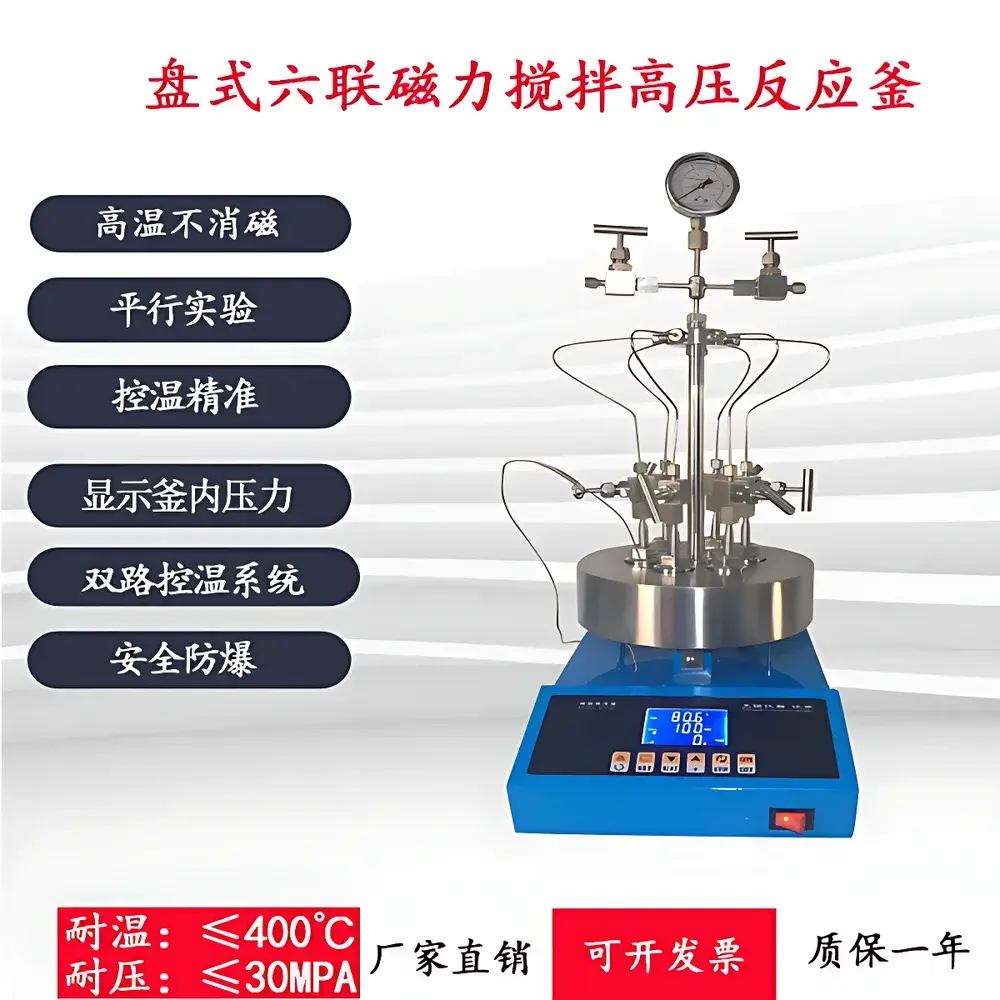
Six-Position Parallel Magnetic Stirring High-Pressure Reactor PSK-6 by ZXYIQI
| Brand | ZXYIQI |
|---|---|
| Origin | Jiangsu, China |
| Manufacturer Type | Authorized Distributor |
| Country of Origin | China |
| Model | PSK-6 |
| Price | USD 5,900 (FOB Jiangsu) |
| Vessel Capacity per Position | 0.05–25 mL |
| Construction Material | 304/316L/310S/904L Stainless Steel, Hastelloy, Titanium |
| Max Operating Pressure | 30 MPa |
| Min Operating Pressure | –0.1 MPa (Vacuum Capable) |
| Temperature Range | 0–500 °C |
| Heating Method | Embedded Modular Heater with PID Dual-Channel Temperature Control |
| Stirring Mechanism | Rare-Earth Permanent Magnet Coupling + Brushless DC Motor |
| Stirring Speed | 0–1000 rpm |
| Sealing System | Dual-Seal (Soft PTFE + Hard Alloy Face Seal) |
| Safety Features | Burst Disc (Hastelloy), Over-Temperature/Over-Pressure Auto-Alarm & Relief, Timed Shutdown |
| Vacuum Level | ≤10⁻¹ Pa (with external vacuum pump) |
| Compliance | Meets ISO 14001 design principles |
| Power Supply | 220 V AC / 50 Hz (110 V option available) |
Overview
The ZXYIQI PSK-6 Six-Position Parallel Magnetic Stirring High-Pressure Reactor is an engineered platform for accelerated reaction screening under rigorously controlled temperature, pressure, and agitation conditions. Based on the Couette flow principle, it employs hermetically sealed magnetic coupling to transmit torque across pressure boundaries—eliminating shaft seals and enabling true leak-tight operation up to 30 MPa. Each of the six independently configurable reactor vessels operates within a shared thermal environment, ensuring uniform heating profiles while maintaining individual pressure and gas-phase management via dedicated inlet/outlet valves. Designed for reproducible kinetic studies and catalyst evaluation, the system supports both static and dynamic reaction modes—including gas consumption monitoring, vapor-phase sampling, and sequential pressurization protocols. Its modular architecture allows integration into automated lab infrastructure via RS485 or optional Ethernet interfaces.
Key Features
- Multi-vessel synchronization: Simultaneous temperature control (±1 °C accuracy), magnetic stirring (0–1000 rpm, programmable direction reversal), and pressure balancing across all six positions.
- Dual-seal integrity: Hybrid sealing combining fluoropolymer (PTFE/PPL) soft gaskets with hardened alloy valve seats (Hastelloy C-276 or Inconel 718) for long-term resistance to H₂S, Cl⁻, and supercritical CO₂ environments.
- Thermal management: Fully enclosed stainless steel heating modules with rapid thermal response (<15 min to 300 °C from ambient); PID dual-loop control prevents overshoot during ramp-hold cycles.
- Safety-critical hardware: Integrated rupture disc (Hastelloy B-2, rated at 30 MPa), redundant pressure transducers, and fail-safe solenoid venting triggered by real-time deviation from setpoints.
- Modular vessel configuration: Interchangeable reactor bodies in 304, 316L, 310S, 904L, titanium Grade 2, or Hastelloy C-22; optional quartz or PTFE liners for corrosive or UV-sensitive chemistries.
- User-configurable operation: Programmable time/temperature/pressure/stirring profiles with up to 10-step sequences; event-triggered data logging (timestamped T, P, rpm) compliant with FDA 21 CFR Part 11 audit trail requirements.
Sample Compatibility & Compliance
The PSK-6 accommodates heterogeneous catalytic systems (solid-supported metals, MOFs, zeolites), multiphase mixtures (gas–liquid, liquid–liquid, slurry), and highly exothermic transformations (e.g., nitration, hydrogenation, oxidation). It complies with mechanical design guidelines outlined in ASME BPVC Section VIII Div. 1 and EN 13445-1 for pressure equipment. Vessel materials meet ASTM A240/A479 standards for corrosion-resistant alloys. All wetted surfaces are electropolished to Ra ≤ 0.4 µm to minimize surface reactivity and facilitate cleaning validation. The system supports IQ/OQ documentation packages aligned with ISO/IEC 17025 and EU GMP Annex 15.
Software & Data Management
ZXYIQI ReactorControl™ v3.2 (Windows-based) provides local or networked supervision of all six reactors. Functions include real-time graphing of T/P/rpm trends, alarm history export (CSV/XML), batch report generation with digital signatures, and role-based user access control. Raw sensor data is stored in encrypted SQLite databases with SHA-256 checksums. Optional OPC UA server enables seamless connectivity to LIMS (e.g., LabVantage, Thermo SampleManager) and MES platforms. All firmware updates undergo regression testing against IEC 62304 Class B medical device software standards.
Applications
- Catalyst screening and lifetime assessment under industrially relevant conditions (e.g., hydrodesulfurization, Fischer–Tropsch synthesis).
- High-pressure hydrogenation of pharmaceutical intermediates with strict impurity profiling.
- Supercritical fluid reactions (scCO₂, scH₂O) requiring precise density tuning via P–T control.
- Corrosion testing of alloy candidates in sour gas (H₂S/CO₂/H₂O) environments per NACE TM0177.
- Thermal stability evaluation of energetic materials per UN Test Series 3.
- Reaction calorimetry via jacket temperature differentials (when paired with calibrated heat flux sensors).
FAQ
What pressure calibration certificates are provided with the PSK-6?
Each unit ships with a factory-verified pressure transducer certificate traceable to NIST standards (valid for 12 months). Optional UKAS-accredited calibration is available upon request.
Can the system be operated under inert atmosphere prior to pressurization?
Yes—integrated purge cycles support automated N₂/Ar evacuation-refill sequences with residual O₂ monitoring down to 10 ppm (requires optional electrochemical O₂ sensor).
Is remote monitoring supported without proprietary software?
Yes—modbus TCP and HTTP REST API endpoints allow third-party SCADA integration without installing ReactorControl™.
How is cross-contamination prevented between parallel runs?
Each reactor has independent gas lines, isolated exhaust paths, and non-recirculating magnetic drive trains; no shared fluidic manifolds exist.
What maintenance intervals are recommended for long-term reliability?
Seal replacement every 200 cycles or 12 months (whichever occurs first); annual verification of pressure relief response time and thermocouple drift (±0.5 °C tolerance).



