
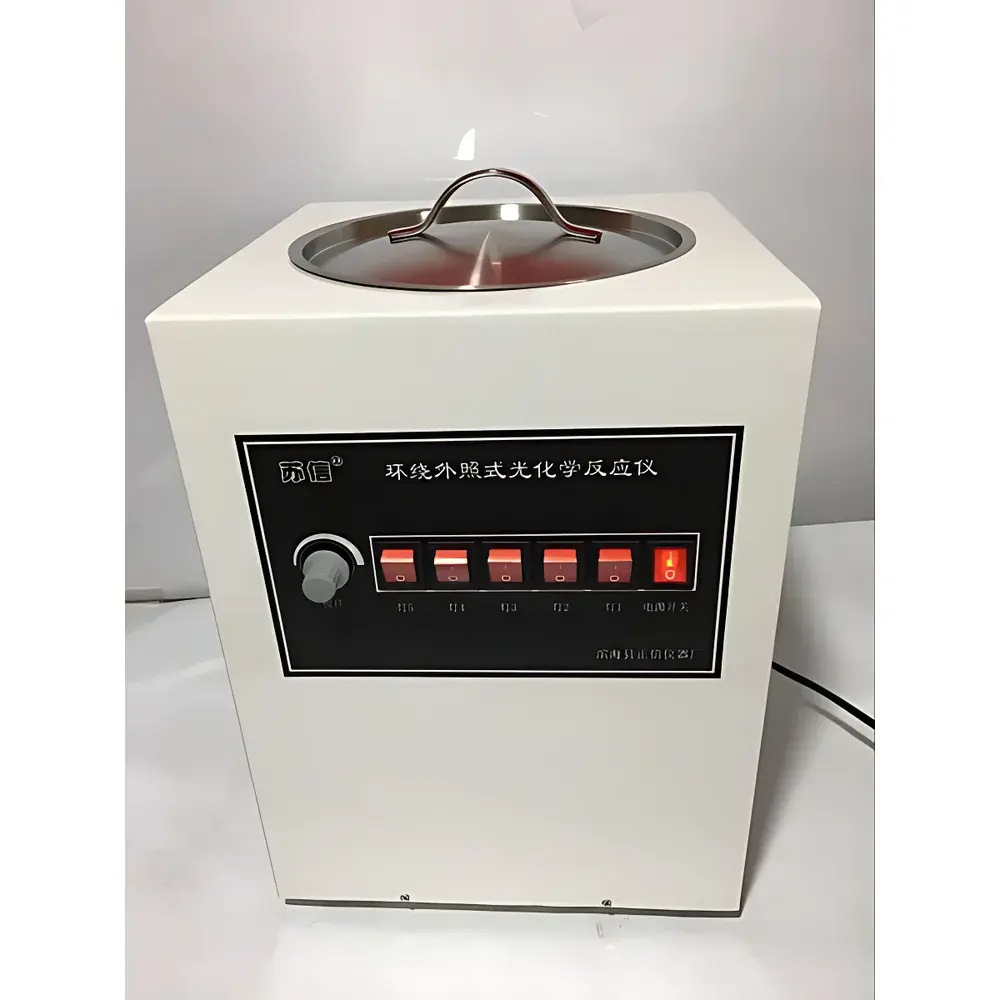
EPR-ZX Zhenxin Circumferential External Irradiation Photochemical Reactor
| Brand | Zhenxin Instrument Factory (ZXYIQI) |
|---|---|
| Origin | Jiangsu, China |
| Manufacturer Type | General Distributor |
| Country of Origin | Domestic (China) |
| Model | EPR-ZX |
| Price | ¥10,000 |
| Vessel Capacity | Small-scale |
| Construction Material | Stainless Steel |
| Operating Pressure | Low-pressure |
| Vacuum Capability | Not Specified |
| Volume Rating | Not Specified |
Overview
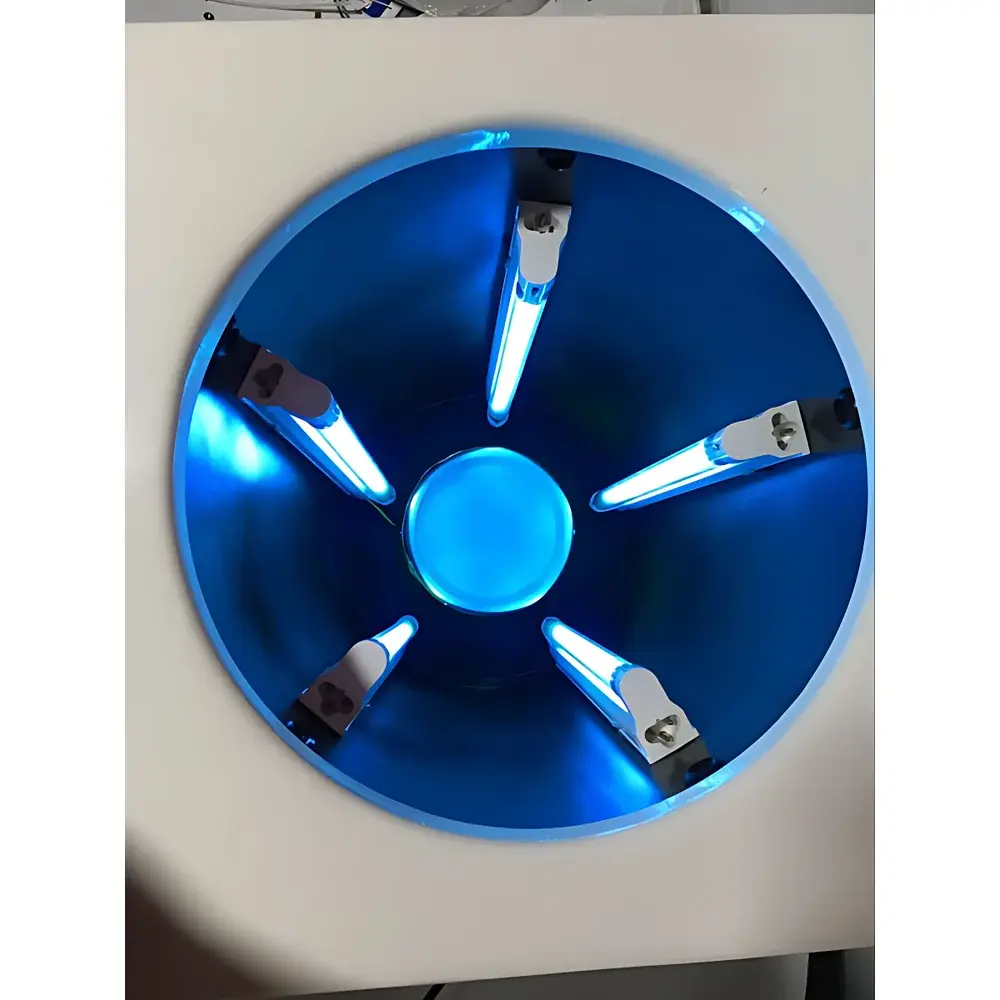
The EPR-ZX Zhenxin Circumferential External Irradiation Photochemical Reactor is an engineered platform designed for controlled photoinduced chemical transformations under ambient or low-pressure conditions. Unlike immersion-type or internal lamp configurations, this reactor employs a circumferential external irradiation geometry—where UV or visible light sources are symmetrically arranged around the cylindrical reaction vessel—ensuring uniform photon flux distribution across the entire lateral surface of the sample. This optical architecture minimizes thermal gradients and photodegradation hotspots while enabling scalable irradiation intensity through modular lamp selection (e.g., 365 nm, 312 nm, or broad-spectrum LED arrays). The reactor operates on the principle of heterogeneous or homogeneous photocatalysis, where incident photons drive electron–hole pair generation in semiconductors (e.g., TiO₂, g-C₃N₄) or directly excite substrates (e.g., aryl diazonium salts, metal carbonyls), facilitating C–C bond formation, oxidative dehydrogenation, or radical-mediated cyclizations. Its stainless-steel construction ensures compatibility with organic solvents, mild acids, and basic media typical in synthetic organic photochemistry.
Key Features
- Circumferential external illumination design for isotropic photon delivery and reduced localized overheating
- Stainless-steel pressure-rated vessel body compliant with ASME BPVC Section VIII Div. 1 for low-pressure operation (≤0.5 MPa gauge)
- Modular lamp housing with standardized M27×2 threading, supporting interchangeable UV-LED, mercury-vapor, or xenon arc modules
- Integrated cooling jacket interface (inlet/outlet NPT 1/4″) for active temperature control during extended irradiation cycles
- Sealed magnetic coupling stirrer drive compatible with PTFE-coated impellers (RPM range: 50–600 rpm, adjustable via external controller)
- Front-access quartz viewport (Ø50 mm, thickness 10 mm, transmission >85% from 200–800 nm) for real-time visual monitoring and inline spectroscopic sampling
Sample Compatibility & Compliance
The EPR-ZX accommodates small-volume reaction mixtures (typically 10–100 mL) in solvent systems including acetonitrile, DMF, THF, methanol, and aqueous buffers. Its stainless-steel wetted parts meet ASTM A240 Type 316L specifications for corrosion resistance. While not rated for high vacuum or autoclave conditions, the reactor’s sealing system—comprising dual O-rings (FKM fluoroelastomer) and torque-limited clamp closure—maintains integrity under inert gas purging (N₂, Ar) and low positive backpressure (≤0.2 MPa). It supports GLP-aligned experimental documentation when paired with time-stamped irradiation logs and temperature traces. Though not certified to ISO/IEC 17025, its mechanical and optical repeatability aligns with internal method validation protocols per ICH Q2(R2) for photochemical step characterization.
Software & Data Management
The EPR-ZX operates as a hardware-controlled platform without embedded firmware or proprietary software. All operational parameters—including irradiation duration, lamp power level, stirring speed, and jacket coolant flow—are manually configured via external analog/digital interfaces. Users integrate the reactor into existing laboratory data ecosystems using standard 4–20 mA or 0–10 V analog outputs (optional add-on) for logging irradiance (via calibrated photodiode sensor), vessel temperature (Pt100 RTD), and stirrer torque. Audit trails comply with FDA 21 CFR Part 11 when recorded through validated third-party SCADA or LIMS platforms (e.g., LabArchives, DeltaV, or custom Python-based acquisition scripts with SHA-256 hashing and electronic signature support).
Applications
- Synthetic methodology development: [2+2] cycloadditions, decarboxylative couplings, and metallaphotoredox catalysis
- Environmental photocatalysis: Degradation kinetics studies of micropollutants (e.g., pharmaceuticals, dyes) under simulated solar irradiation
- Materials science: Controlled synthesis of metal–organic frameworks (MOFs) and covalent organic frameworks (COFs) via light-triggered condensation
- Pharmaceutical process R&D: Photostability testing of APIs per ICH Q1B guidelines using defined irradiance profiles
- Education and training: Hands-on instruction in photochemical kinetics, quantum yield determination (using actinometry), and reactor engineering fundamentals
FAQ
Is the EPR-ZX suitable for vacuum or high-pressure reactions?
No. It is engineered exclusively for low-pressure operation (≤0.5 MPa gauge) and is not rated for vacuum service or pressurized gas-phase reactions.
Can the reactor be used with corrosive reagents such as hydrochloric acid or hydrogen bromide?
Limited compatibility. While 316L stainless steel resists mild corrosion, prolonged exposure to halogenated acids or oxidizing halogens requires optional Hastelloy C-276 lining—available upon special order.
Does the system include radiometric calibration or spectral output documentation for lamps?
Lamp spectral data sheets (irradiance vs. wavelength, full-width half-maximum) are provided per batch; absolute radiometric calibration requires user-deployed NIST-traceable spectroradiometers.
What cooling methods are supported for exothermic photochemical processes?
The jacket accepts chilled water, glycol–water mixtures, or recirculating chillers (−10 °C to +40 °C operating range); dry ice or liquid nitrogen direct contact is prohibited.
Is remote operation or automation integration possible?
Yes—via optional 4–20 mA analog I/O expansion module, enabling PLC or LabVIEW-based sequence control and synchronized data acquisition across multi-reactor setups.



