
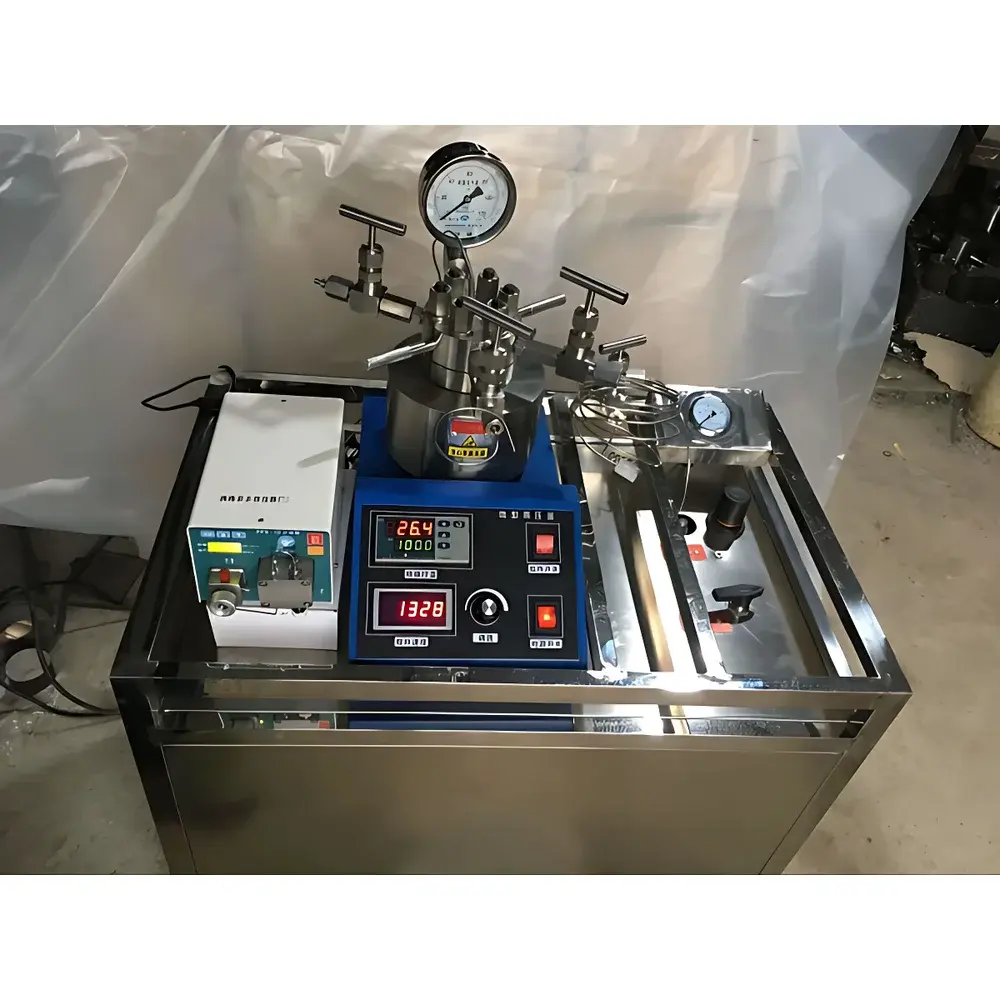
Zhengxin PSK2 Magnetic Coupling Drive Magnetic Stirring Reactor with Integrated Metering Pump
| Brand | Zhengxin Instruments |
|---|---|
| Origin | Jiangsu, China |
| Manufacturer Type | General Distributor |
| Origin Category | Domestic |
| Model | PSK2 |
| Price | USD 1,150 (FOB) |
| Usable Volume | Small-scale (≤500 mL) |
| Construction Material | 316L Stainless Steel |
| Operating Pressure | Low-pressure (≤0.6 MPa gauge) |
| Capacity | 100–500 mL (configurable) |
| Vacuum Capability | ≤−0.098 MPa (absolute) |
Overview
The Zhengxin PSK2 Magnetic Coupling Drive Magnetic Stirring Reactor with Integrated Metering Pump is a compact, sealed benchtop reaction system engineered for controlled liquid-phase synthesis, catalytic screening, and small-batch process development under inert or reduced-pressure conditions. It employs a hermetic magnetic coupling transmission mechanism—eliminating mechanical shaft seals—to ensure leak-tight operation while maintaining high stirring torque at low to medium viscosities. The reactor core operates on the principle of contactless rotational torque transfer via permanent magnets across a pressure-retaining barrier, enabling simultaneous agitation, precise reagent addition, and pressure/vacuum management in a single integrated unit. Designed for laboratory environments where gas evolution, moisture sensitivity, or solvent volatility are critical concerns, the PSK2 supports reproducible kinetic studies, exothermic reaction control, and multi-step sequential dosing protocols without manual intervention.
Key Features
- Hermetically sealed magnetic drive system with dual-ceramic magnet assembly, rated for continuous operation up to 0.6 MPa(g) and vacuum down to −0.098 MPa(abs)
- Integrated peristaltic metering pump (flow range: 0.01–20 mL/min, accuracy ±2% FS) with chemically resistant silicone tubing and programmable dispensing modes (continuous, pulse, volume-triggered)
- 316L stainless steel reactor body and lid with mirror-polished interior (Ra ≤ 0.4 µm), electropolished for enhanced corrosion resistance and cleanability
- Standard instrumentation interface: PT100 temperature sensor port (−20 to 250 °C), pressure transducer port (0–1 MPa), and gas inlet/outlet valves with Swagelok®-compatible 1/4″ NPT fittings
- Modular clamp-type lid design with PTFE-coated graphite gasket, enabling rapid assembly/disassembly and compatibility with optional accessories (reflux condenser, sampling valve, gas dispersion sparger)
- Stirring speed range: 0–1200 rpm, digitally controlled via integrated PID controller with real-time feedback and overload protection
Sample Compatibility & Compliance
The PSK2 reactor accommodates a broad spectrum of organic solvents (e.g., THF, DMF, dichloromethane), aqueous acidic/basic media (pH 1–13), and slurries containing fine catalysts (<50 µm particle size). Its 316L construction meets ASTM A276 and ISO 15510 material specifications for corrosion-resistant austenitic stainless steels. All wetted surfaces comply with USP Class VI biocompatibility requirements for non-implantable devices. The system supports GLP-compliant documentation workflows when paired with external data loggers; pressure and temperature readings can be recorded with timestamped audit trails per FDA 21 CFR Part 11 guidelines when connected to validated SCADA software.
Software & Data Management
While the PSK2 operates as a stand-alone instrument with local digital controls, it features analog (4–20 mA) and digital (RS485 Modbus RTU) output interfaces for integration into centralized lab automation platforms. Optional PC-based control software (sold separately) provides synchronized logging of stirring speed, internal temperature, system pressure, and cumulative pump dispense volume. All logged parameters are exportable in CSV format with ISO 8601 timestamps. The firmware supports user-defined alarm thresholds (e.g., overpressure, motor stall, temperature deviation >±5 °C), triggering audible alerts and automatic pump shutdown to preserve sample integrity.
Applications
- Homogeneous and heterogeneous catalysis studies (e.g., hydrogenation, cross-coupling, enzymatic reactions) under controlled atmosphere
- Development of continuous-flow precursors via sequential metered addition in batch mode
- Thermal stability testing of active pharmaceutical ingredients (APIs) under nitrogen blanket
- Small-scale polymerization trials requiring precise monomer feed control and viscosity monitoring
- Electrochemical synthesis setups where electrode immersion depth and electrolyte homogeneity must be maintained
- Academic teaching labs for demonstrating mass-transfer-limited reactions and Arrhenius kinetics under variable pressure
FAQ
What is the maximum allowable working temperature for the PSK2 reactor?
The standard configuration supports continuous operation up to 250 °C; however, long-term exposure above 200 °C requires optional high-temp gasket material (Kalrez® 6375) and verification of pump tubing thermal stability.
Can the metering pump handle abrasive suspensions or viscous oils?
The integrated peristaltic pump is optimized for Newtonian liquids up to 500 cP; slurries with particles >25 µm or viscosities exceeding 1000 cP require external positive-displacement pumping solutions.
Is the PSK2 compatible with automated reaction platforms like ChemSpeed or H-Evolution?
Yes—via RS485 Modbus RTU protocol, the PSK2 can be addressed as a slave device within third-party orchestration systems for fully unattended multi-step reaction sequences.
Does the system include calibration certificates for pressure and temperature sensors?
Factory calibration certificates (traceable to NIST standards) are provided for both sensors; field recalibration services are available through authorized Zhengxin service centers in APAC and EU regions.



