
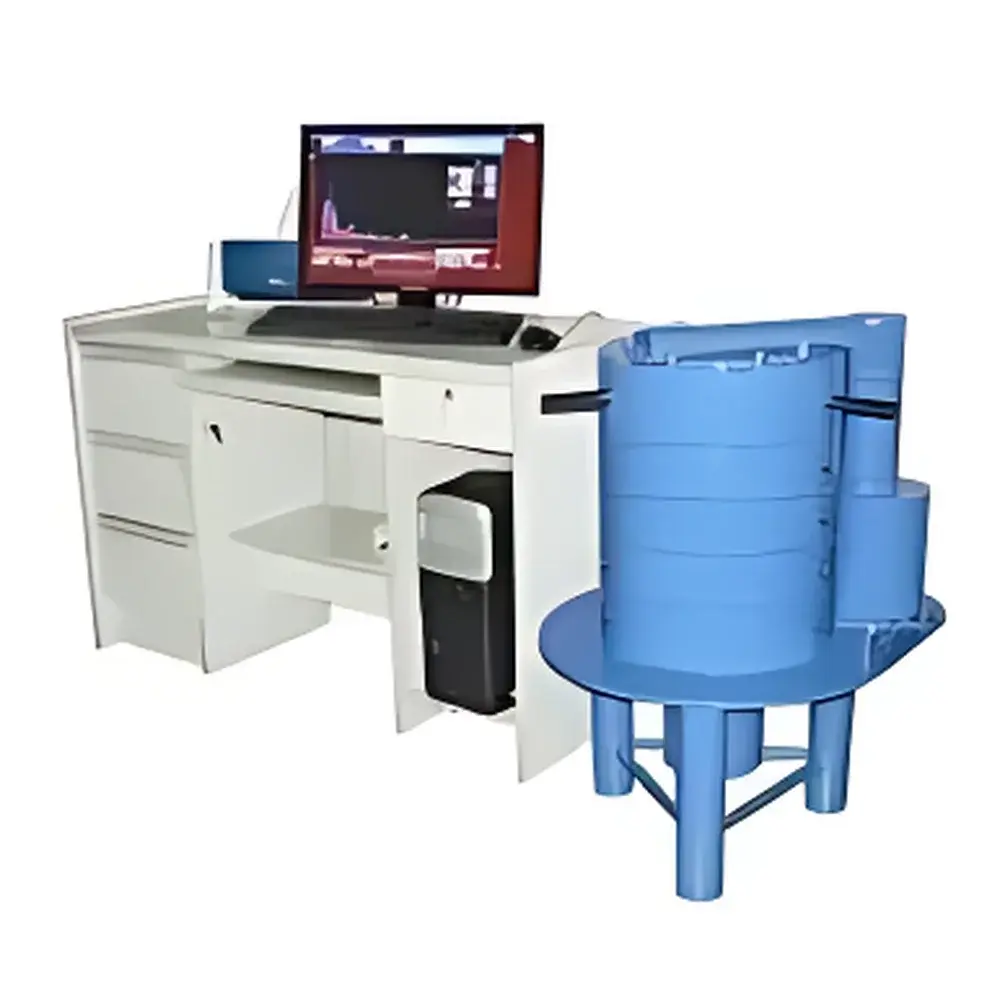
HD-2001 Low-Background Multi-Channel Gamma Spectrometer
| Origin | Beijing, China |
|---|---|
| Manufacturer Type | Authorized Distributor |
| Origin Category | Domestic |
| Model | HD-2001 |
| Instrument Type | Gamma Spectrometer |
| Detector | Ø75 × 75 mm NaI(Tl) Scintillation Crystal |
| Total Channels | Selectable (512 / 1024 / 2048 / 4096), Default Operational Configuration: 2048 channels |
| Energy Resolution | <7.5% at 662 keV (¹³⁷Cs) |
| Differential Nonlinearity | <0.05% |
| Integral Nonlinearity | <0.1% |
| Max. Throughput | >333 kcps |
| Pulse Pile-up Rejection | 500 ns |
| Measurement Uncertainty | <10% (for sample activity >37 Bq/kg) |
| Radionuclide Quantification Ranges | ²³⁸U (37–1×10⁶ Bq/kg), ²²⁶Ra (37–1×10⁶ Bq/kg), ²³²Th (12–4×10⁵ Bq/kg), ⁴⁰K (0.1–100 wt%), Air Radon (4–100,000 Bq/m³), Soil Radon (300–200,000 Bq/m³) |
| Operating Environment | 5–40 °C, ≤90% RH, 220 V ±10%, 50 Hz |
| Lead Shielding Chamber | Ø580 × 850 mm, Wall Thickness: 100 mm, Mass: ~900 kg |
| Compliance | GB 6566–2010, GB 50325–2010, JJG 417–2019 (Calibration Verified by National Institute of Metrology, China) |
Overview
The HD-2001 Low-Background Multi-Channel Gamma Spectrometer is a high-stability, high-throughput scintillation-based gamma-ray spectrometry system engineered for precise radionuclide quantification in environmental, construction, and geological matrices. It operates on the principle of gamma-ray spectroscopy using a thallium-doped sodium iodide [NaI(Tl)] scintillation detector coupled with digital pulse processing and multi-channel pulse-height analysis. The system captures full-spectrum gamma emissions across an energy range of 30 keV to 3 MeV, enabling simultaneous identification and quantification of naturally occurring radioactive materials (NORM)—including ²³⁸U, ²²⁶Ra, ²³²Th, and ⁴⁰K—as well as airborne and soil-borne radon progeny. Its low-background design, realized through a 100-mm-thick lead shield chamber (Ø580 × 850 mm), suppresses ambient cosmic and terrestrial radiation, thereby improving minimum detectable activity (MDA) by up to two orders of magnitude compared to unshielded configurations. The HD-2001 meets metrological requirements defined in Chinese national standards GB 6566–2010 (Radioactivity Limits in Building Materials) and GB 50325–2010 (Indoor Environmental Pollution Control in Civil Engineering), and is routinely calibrated and certified by the National Institute of Metrology (NIM), China.
Key Features
- 2048-channel spectral acquisition as standard operational configuration—currently the highest practical resolution among commercially deployed NaI(Tl)-based gamma spectrometers in China.
- Four integrated measurement modes: powdered sample analysis, non-destructive bulk sample assay, air radon concentration determination (via activated charcoal or scintillation cell coupling), and soil radon exhalation rate assessment.
- Full-waveform digitization with real-time baseline restoration and interference pattern recognition, eliminating pulse pile-up loss and ensuring spectral integrity under high-count-rate conditions.
- Digital oscilloscope mode for live signal waveform visualization—enabling direct verification of pulse shape, noise characteristics, and baseline stability during acquisition.
- Automated peak position monitoring and dynamic gain stabilization to maintain spectral calibration over extended run times (>24 h).
- Comprehensive spectral deconvolution algorithm suite supporting region-of-interest (ROI) integration, full-spectrum least-squares fitting, and multi-isotope interference correction.
- Multi-spectrum overlay and comparative analysis functionality—supporting method validation, inter-laboratory proficiency testing, and pedagogical use in nuclear science curricula.
Sample Compatibility & Compliance
The HD-2001 accommodates heterogeneous sample geometries—including sealed Marinelli beakers (0.5–2 L), cylindrical petri dishes (diameter ≤70 mm), and loose soil/ash powders—without requiring detector reconfiguration. Its geometry-insensitive efficiency calibration supports quantitative analysis of both homogeneous and layered samples, provided density and matrix composition are documented. All measurement protocols align with ISO/IEC 17025:2017 general requirements for competence of testing and calibration laboratories. Data reporting complies with GLP principles, including audit-trail-enabled metadata logging (operator ID, sample ID, acquisition time, HV setting, temperature/humidity logs). While not FDA 21 CFR Part 11–certified out-of-the-box, the system architecture supports traceable electronic signatures and secure data archiving when deployed within validated laboratory information management systems (LIMS).
Software & Data Management
Bundled GammaVision-compatible acquisition and analysis software provides intuitive workflow control—from energy calibration (using ¹³⁷Cs, ⁶⁰Co, and ²²Na reference sources) to nuclide-specific activity calculation with self-absorption and geometry corrections. Raw spectra are stored in standard IEEE 32-bit binary format (.cnf), ensuring interoperability with third-party tools such as Genie 2000, Canberra’s Analyst, or open-source libraries (e.g., PyMCA). All processed results include uncertainty propagation per GUM (Guide to the Expression of Uncertainty in Measurement) principles, with expanded uncertainty (k=2) reported alongside net peak area, background-subtracted count rate, and detection limit estimates. Software updates are delivered via secure HTTPS portal; version history and change logs are maintained for regulatory review.
Applications
- Regulatory compliance testing of building materials (ceramics, granite, concrete aggregates) per GB 6566–2010.
- Indoor radon risk assessment in residential and commercial buildings (GB 50325–2010).
- Environmental baseline surveys of soil, sediment, and groundwater near uranium mining or NORM-handling facilities.
- Quality assurance in phosphate fertilizer production and fly ash utilization in construction.
- Academic research in radioecology, geochronology, and atmospheric radon transport modeling.
- Training platform for nuclear engineering and health physics education programs.
FAQ
What is the effective detection limit for ²²⁶Ra in soil using the HD-2001?
Under 24-hour counting with a 500 g dry soil sample in a standard Marinelli beaker, the typical MDA for ²²⁶Ra is ≤12 Bq/kg (k=2, 95% confidence), assuming optimal shielding and background subtraction.
Can the system be upgraded to support HPGe detectors?
No—the HD-2001 hardware and firmware are specifically optimized for NaI(Tl) scintillation detectors. For high-resolution gamma spectroscopy, users should consider dedicated HPGe systems with cryogenic cooling and digital signal processors.
Is remote operation supported?
Yes—Ethernet-based TCP/IP communication enables full instrument control and real-time spectrum streaming from Windows/Linux clients located up to 100 m from the acquisition unit, provided network latency remains below 10 ms.
How often does the system require recalibration?
Energy calibration should be verified weekly using a long-lived ¹³⁷Cs source; efficiency calibration requires annual revalidation against matrix-matched reference materials traceable to NIM or IAEA standards.
Does the lead chamber meet IAEA RS-G-1.9 shielding recommendations?
Yes—the 100 mm Pb equivalent thickness satisfies IAEA RS-G-1.9 Category II requirements for environmental gamma spectrometry laboratories handling samples up to 10⁴ Bq/kg activity concentrations.







