
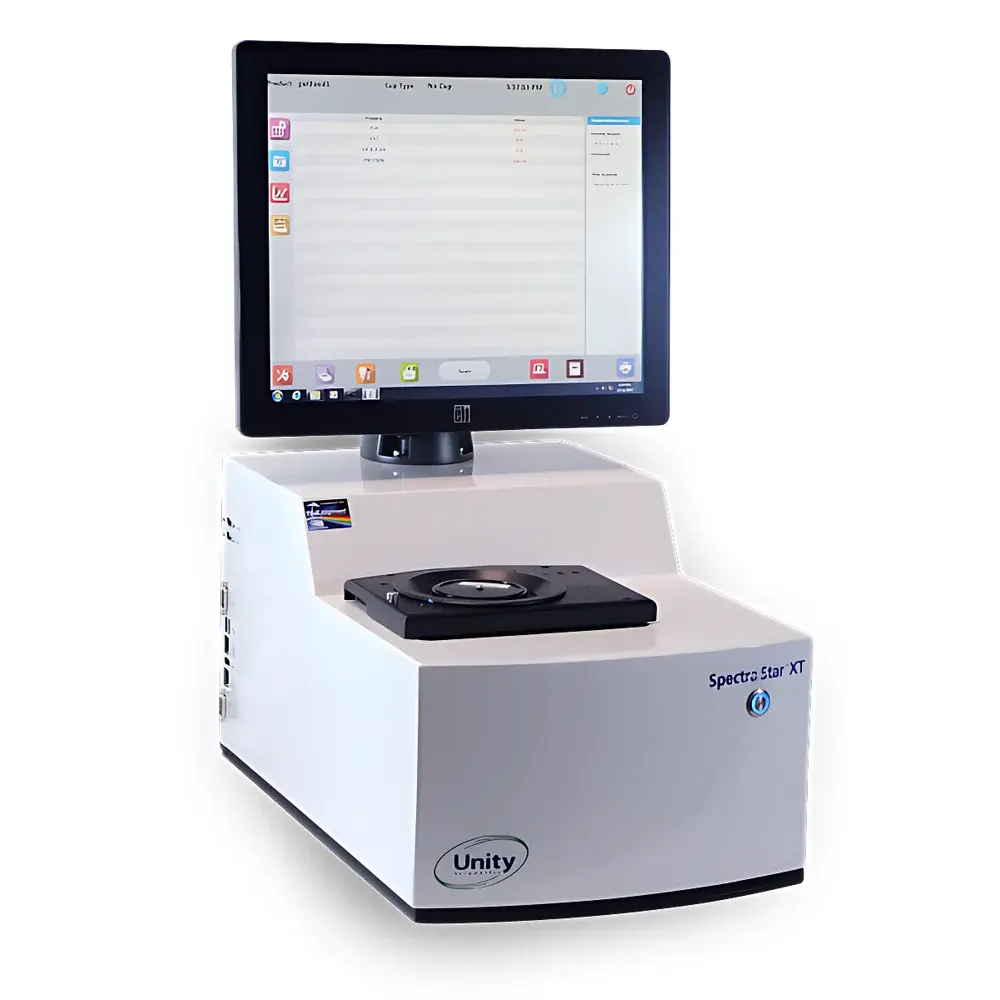
KPM Unity SpectraStar XT Series Near-Infrared Spectrometer (680–2600 nm, Full-Range InGaAs Detector, Lab & At-Line Use)
| Brand | KPM Unity |
|---|---|
| Origin | USA |
| Model | SpectraStar XT Series |
| Wavelength Range | 680–2600 nm |
| Scan Speed | 10–60 s (20 scans) |
| Data Sampling Interval | 1 nm |
| Measurement Mode | Diffuse Reflectance |
| Detector | Cooled Dual InGaAs |
| Calibration Standard | NIST-traceable |
| Software | uScan & UCAL |
| Power Consumption | <5 W |
| Operating Temperature | 1–40 °C |
| Compliance | ISO 12099, LIMS-compatible, IP52-rated enclosure |
| Sample Mass Range | 1–300 g |
| Optical System | Holographic Scanning Grating, Sealed All-Reflective Path with Fused Silica Window |
Overview
The KPM Unity SpectraStar XT Series Near-Infrared Spectrometer is a high-performance, grating-scanning benchtop instrument engineered for quantitative and qualitative analysis of complex organic matrices across agricultural, food, feed, and biochemical laboratories. Operating on the principle of diffuse reflectance near-infrared spectroscopy (NIRS), it captures continuous spectral data from 680 to 2600 nm—spanning the critical first and second overtones of C–H, N–H, and O–H bonds, as well as combination bands associated with aromatic ring structures and aliphatic side chains. This extended spectral coverage enables robust quantification of moisture, crude protein, fat, ash, starch, fiber (including neutral detergent fiber and acid detergent fiber), soluble and true protein, amino acid profiles, and fatty acid composition in intact or minimally prepared samples. Its optical architecture—featuring a laser-etched holographic scanning grating, sealed all-reflective light path with inert-coated mirrors, and fused silica window—ensures long-term wavelength stability, minimal photometric drift, and immunity to ambient humidity or particulate contamination. Designed for both laboratory validation and at-line process support, the SpectraStar XT delivers analytical repeatability compliant with ISO 12099 for forage and feed analysis, while supporting method transfer across instruments via TAS (Traceable Alignment System) calibration technology.
Key Features
- Full-range InGaAs dual-detector system cooled to enhance signal-to-noise ratio and extend dynamic range across 680–2600 nm.
- Holographic scanning monochromator with pre-dispersed optics and high-resolution A/D conversion for sub-nanometer wavelength accuracy and reproducibility.
- Sealed, fanless optical enclosure rated IP52—eliminates need for cooling fans, water chillers, or replaceable filters; suitable for non-climate-controlled production environments.
- Integrated industrial-grade Windows-based computer with 17″ touchscreen, solid-state drive, dual Ethernet ports, four USB 2.0 interfaces, HDMI, VGA, and RS-232 (9-pin) connectivity—fully LIMS-integrated and 21 CFR Part 11 ready with audit trail capability.
- Modular sample interface platform accommodating interchangeable cups: large-diameter (10 cm) bulk cup for heterogeneous feeds, small cup for powders, petri dish adapter, forage cup, liquid cuvette holder, and single-kernel grain cup—enabling representative measurement without grinding or homogenization.
- Low-power (10,000-hour lifetime and internal reference tile—minimizes thermal load and eliminates external calibration drift.
Sample Compatibility & Compliance
The SpectraStar XT accepts solid (whole grains, pellets, flakes, strips, coarse or fine ground materials), liquid (oils, milk, extracts), and semi-solid (paste, slurry, curd) samples without destructive preparation. Its 10 cm open-top rotating measurement window allows non-contact analysis through a durable fused silica viewport—preserving sample integrity and preventing moisture loss during acquisition, in full accordance with ISO 12099 requirements for routine feedstuff analysis. The instrument’s optical path is NIST-traceably calibrated using certified reference standards, and its TAS self-diagnostic engine continuously monitors alignment, lamp intensity, detector response, and grating position—automatically correcting deviations and restoring factory-calibrated performance. All firmware and software comply with GLP/GMP documentation standards, including electronic signatures, version-controlled method storage, and secure user access levels.
Software & Data Management
Two dedicated software modules form the analytical core: uScan and UCAL. uScan serves as the operational interface for daily measurements—supporting automated startup diagnostics, real-time spectral preview, multi-parameter result display, outlier flagging, and customizable reporting templates exportable to CSV, PDF, or LIMS via ODBC or HL7. UCAL provides advanced chemometric modeling capabilities—including MLR and PLS regression, Savitzky-Golay smoothing, SNV, detrending, and multiplicative scatter correction—with native support for model import/export, cross-instrument calibration transfer, and legacy NIR database conversion (e.g., from FOSS, Bruker, or Thermo platforms). Both applications run natively on the embedded Windows OS and support remote maintenance, firmware updates, and secure cloud-enabled diagnostics.
Applications
- Feed & Forage Quality Control: Rapid determination of CP, NDF, ADF, fat, moisture, and lignin in alfalfa, corn silage, soybean meal, and DDGS.
- Dairy &乳制品 Analysis: Quantification of fat, protein, lactose, and solids-not-fat in raw milk, whey, cheese curd, and infant formula powders.
- Oilseed & Biodiesel Feedstock Screening: Prediction of oil content, free fatty acid profile, and oxidative stability indices in rapeseed, sunflower, and jatropha.
- Grain & Seed Testing: Non-destructive assessment of protein, hardness, germination potential, and mycotoxin screening proxies in wheat, barley, rice, and maize.
- Pharmaceutical Excipient Verification: Identity confirmation and assay of starch, cellulose, lactose, and mannitol in tablet blends prior to compression.
FAQ
Does the SpectraStar XT require liquid nitrogen or thermoelectric cooling for the detector?
No—the dual InGaAs detector is passively stabilized using a proprietary thermal management design; no cryogens or active coolers are required.
Can existing NIR calibration models from other vendors be imported into UCAL?
Yes—UCAL supports direct import of PLS models in .csv, .txt, and vendor-neutral .nir formats, with automatic wavelength interpolation and preprocessing alignment.
Is the instrument compatible with enterprise-level LIMS and ERP systems?
Yes—it features dual Ethernet ports, ODBC-compliant database drivers, and configurable API endpoints for bidirectional data exchange with LabWare, STARLIMS, and SAP QM modules.
What is the recommended maintenance schedule?
Annual verification using NIST-traceable standards is advised; the TAS system performs continuous self-checks, and no routine optical alignment or lamp replacement is needed within the first 10,000 operating hours.
How does the sealed optical path affect long-term reliability in dusty or humid environments?
The IP52-rated enclosure prevents ingress of dust and dripping water; combined with the all-reflective, inert-coated optical train, it ensures consistent photometric performance without recalibration—even in feed mill or dairy processing facilities.
Related Products





